Accountıng II (ENG) - Tüm Sorular
Ünite 1
Soru 1
Which of the following characteristics is not true for property, plant and equipment assets?
Seçenekler
A
They are acquired for use in operations
B
They are acquired for resale
C
They are in long-term in nature
D
They are usually depreciated
E
They possess physical substance
Açıklama:
They are not acquired for resale.
Soru 2
Which of the following principle indicates that the revenues of a period must be matched with the expenses of the same period for calculating the profit/loss of the period?
Seçenekler
A
Matching
B
Expense
C
Revenue
D
Cost
E
Objectivity
Açıklama:
The matching principle indicates that the revenues of a period must be matched with the expenses of the same period for calculating the profit/loss of the period.
Soru 3
Assume that the purchase price of the machine is 150,000 TL, transferring costs 5.000 TL and the strengthening operation costed 10,500 TL. What is the total cost of this machine?
Seçenekler
A
150.000
B
155.000
C
155.500
D
160.500
E
165.500
Açıklama:
Total price= 150.000 +10.500 +5000 = 165.500
Soru 4
- purchase price
- brokerage commission
- survey and legal fees
- property taxes in arrears
Seçenekler
A
Only I
B
I and II
C
II, III and IV
D
II and III
E
I, II, III and IV
Açıklama:
The cost of the land includes the following items; - purchase price - brokerage commission - survey and legal fees - property taxes in arrears - taxes assessed to transfer the ownership on the land - cost of clearing the land and removing unwanted buildings.
Soru 5
Which of the following is not included in the cost of the land?
Seçenekler
A
Survey and legal fees
B
Property taxes in arrears
C
Taxes assessed to transfer the ownership on the land
D
Cost of clearing the land and removing unwanted buildings
E
Signs and street light installment
Açıklama:
Installments are not included in the cost of the land. These type of separate long-lived assets are called land improvements.
Soru 6
Assume that ABC Co. purchased a building to use for managerial purposes for 3,450,000 TL and also paid title deed fees for 125,000 TL. Which of the following is true for the amount of building account after the purchase?
Seçenekler
A
3,450,000
B
3,500,000
C
3,575,000
D
3,625,000
E
3,675,000
Açıklama:
3,450,000 +1,125,000 =3,575,000
Soru 7
Which of the following means recording the expenditure as an asset?
Seçenekler
A
Capitalization
B
Building
C
Depreciation
D
Cost
E
Transportation
Açıklama:
Capitalization means recording the expenditure as an asset.
Soru 8
Which of the following asset does not lose their ability to provide services and wear out as they are used?
Seçenekler
A
Building
B
Vehicle
C
Land
D
Machine
E
Bridge
Açıklama:
All assets, except land, lose their ability to provide services and wear out as they are used.
Soru 9
- The cost of the long-lived asset
- The estimated residual value of the long lived asset
- The estimated useful life of the long-lived asset
Seçenekler
A
Only I
B
I and II
C
II and III
D
I and III
E
I, II and III
Açıklama:
In order to measure the depreciation, three elements must be known;
The cost of the long-lived asset - The estimated residual value of the long lived asset - The estimated useful life of the long-lived asset
The cost of the long-lived asset - The estimated residual value of the long lived asset - The estimated useful life of the long-lived asset
Soru 10
ABC Co. purchases a machinery on January 1, 2018 for 280,000 TL. ABC Co. also pays 20,000 TL for transportation and insurance during transportation. ABC Co. estimates to use the machine for 5 years and at the end of it useful life it is estimated to be sold at 45,000 TL. Company will apply double-declining balance depreciation method for the machinery. What will be the depreciation expense recorded for the year ending 31.12.2019?
Seçenekler
A
45.000
B
72.000
C
92.000
D
120.000
E
127.000
Açıklama:
Double− Declining Balance Depreciation = (Cost − Accumulated Depreciation)x 2/ Useful Life
=(280.000 +20.000 - 0) x 2/5= 120.000 for the year 2018
= (300.000 - 120.000) x 2/5 = 72.000 for the year 2019
=(280.000 +20.000 - 0) x 2/5= 120.000 for the year 2018
= (300.000 - 120.000) x 2/5 = 72.000 for the year 2019
Soru 11
Which of the following is recorded as a current asset?
Seçenekler
A
lands that are owned
B
purchased buildings
C
financially leased vehicles
D
accounts receivables
E
long term investments
Açıklama:
Assets are defined as the economic resources acquired by the business in order to benefit from them in the future. In fact, there is an expectation for the businesses to use the assets in their operations. Some of these assets can be converted into cash, sold, collected and consumed within one year or operation cycle which is shorter but some of the assets will be used in operations for more than a year. The first group of assets are called current assets whereas the latter is called non-current assets (long-term assets). Non-current assets are the assets that are acquired to use in the operations of the business for several years. Besides these assets, receivables that have due dates of more than one year will also be reported under non-current assets. In this chapter we will focus on Property, Plant and Equipment which generally holds the largest portion in noncurrent assets. The correct answer is D.
Soru 12
For an economic resource to be recognized as an asset, ________.
Which of the following completes the sentence above?
Which of the following completes the sentence above?
Seçenekler
A
it must be controlled by the creditors
B
it must have a capacity of providing future benefit
C
the transaction must occur in the future
D
it must be rented for less than a year
E
it must be only tangible.
Açıklama:
First of all, for an economic resource to be recognized as an asset, it must have a capacity of providing future benefit. Secondly, it must be controlled by the business and lastly the transaction that caused future benefit and control must occur in the past. The control property here indicates that an economic resource must be fully under control of a business but other parties don’t have a right of providing benefit from it. When the business rents a building to use in the operations, it cannot be recognized as an asset because the business doesn’t have full control on building. The correct answer is B.
Soru 13
Which of the following is not true about property, plant and equipment assets?
Seçenekler
A
They are acquired for use in operations.
B
They are in long-term in nature.
C
They are generally depreciated.
D
They are purchased for resale.
E
They possess physical substance.
Açıklama:
Property, plant and equipment assets have the following major characteristics: They are acquired for use in operations and not for resale: Because those assets are acquired for use in operations for several years, they are recognized under non-current assets.
They are in long-term in nature and usually depreciated: Property, plant and equipment assets provide economic benefit for several years. This means that within the revenue the company earned these assets have contributions.
They possess physical substance: Property, plant and equipment have physical existences. They are also called tangible assets because of this characteristic.
The correct answer is D.
They are in long-term in nature and usually depreciated: Property, plant and equipment assets provide economic benefit for several years. This means that within the revenue the company earned these assets have contributions.
They possess physical substance: Property, plant and equipment have physical existences. They are also called tangible assets because of this characteristic.
The correct answer is D.
Soru 14
A company makes an expenditure for a building it owns, and this extends the useful life of the building. How will this company record this expenditure in the journal?
Seçenekler
A
Debits to Repairs and Maintenance Expense account.
B
Records as an asset.
C
Records as a period expense.
D
Records as an inventory.
E
Records as a depreciation.
Açıklama:
There are also some expenditures made for building and these expenditures yielded as extending the useful life of the asset and/or increasing the capacity of the asset. These kinds of expenditures must be capitalized. Capitalization means recording as an asset. In this context, if an expenditure extends the useful life and/or increases the capacity of an asset, it must be added to the cost of the related asset. The correct answer is B.
Soru 15
A company spends some money on the painting of the interior of its building. In this situation, how will the company record its expenditure in its journal?
Seçenekler
A
Records it as an asset.
B
Adds it to the cost of the building.
C
Records it as a period expense.
D
Records as a depreciation.
E
Records as purchase expense.
Açıklama:
There are also some regular maintenance operations during the life of property, plants and equipment. As for the building, it may be the inside paintwork, some repairs, etc. These expenditures will not be added to the cost of the building, because they do not extend the useful life or increase the capacity of the asset. These kinds of expenditures will be recognized as a period expense and are debited to Repairs and Maintenance Expense account. The correct answer is C.
Soru 16
Which of the following is true about capital expenditures?
Seçenekler
A
They are debited to an asset account.
B
They decrease the asset’s capacity and efficiency.
C
They shorten the useful life of an asset.
D
They are recognized as a period expense.
E
They are debited to Repairs and Maintenance Expense.
Açıklama:
A capital expenditure (balance sheet expenditure) is debited to an asset account because it increases the asset’s capacity or efficiency or extends the asset’s useful life. A capital expenditure is reported on the balance sheet as an asset. The correct answer is A.
Soru 17
After five years of using, a company moves to another location, and so needs to disassemble and reassemble its machinery. In this case, how will the company record these expenditures in its journal?
Seçenekler
A
They will be recorded as period expenses.
B
They will be capitalized.
C
They will be debited to an asset account.
D
They will be included in the cost of the asset.
E
They will be recorded as a depreciation.
Açıklama:
These costs incur only at the initial recognition of machinery and equipment. In other words, for the first recognition of these assets, expenditures made for bringing them to their initial use are capitalized. Assume that the machinery has been installed and the company is using them. After three years of using, the company needs to move and settle to a new location. In this case, the expenditure for disassembling and reassembling the machinery, transportation charges, insurance during transportation, etc. will not be capitalized. They will be recorded as period expenses. The correct answer is A.
Soru 18
A company removes the engines of 5 of its vehicles to extend their useful life. Then, it changes the oil in the engines of another 5 vehicles. In this case, which of the following is true?
Seçenekler
A
Both expenditures will be debited to an asset account.
B
Both expenditures will be recorded as period expenses.
C
Both expenditures will be added to the cost of the asset.
D
The first expenditure is added to the cost of the asset.
E
The second expenditure is debited to an asset account.
Açıklama:
The cost of the vehicles include the purchase price and other necessary expenditures made to bring them to their intended uses. If the expenditure made for vehicles extends the useful life of the vehicle and/ or increases the capacity, like modification or engine renewal, then these expenditures will be capitalized. But the regular maintenance expenditures such as oil change or minor engine repairs will be recorded as period expenses. The correct answer is D.
Soru 19
“A company purchases a car for 30000TL. and pays 5000TL. for legal fees to acquire it. The company expects to use the car for 5 years and at the end of its useful life, the car is estimated to be sold at 10000TL. Company will apply straight-line depreciation method for the machinery. What is the annual depreciation expense of the car?
Seçenekler
A
4000
B
5000
C
8000
D
15000
E
25000
Açıklama:
Straight-line depreciation method allocates the depreciable cost of the asset equally to its useful life and is calculated as follows:
Depreciable Cost = Cost of the asset - Residual value
Straight − linedepreciation = DepreciableCost x 1 / Useful life
Depreciable Cost = Cost of the asset - Residual value
Straight − linedepreciation = DepreciableCost x 1 / Useful life
Soru 20
________ is the amount that the company will receive when an asset is sold at the end of its useful life.
Which of the following terms completes the sentence above?
Which of the following terms completes the sentence above?
Seçenekler
A
cost
B
capitaliztion
C
book value
D
depreciation
E
residual value
Açıklama:
The residual value (also called salvage value) and the useful life of the asset are estimations. The company should estimate the cash value of the asset at the end of its useful life. In other words, residual value is the amount that the company will receive when it is sold at the end of its useful life. By considering together, the company will find out the depreciable cost of the asset. Depreciable cost is the cost when residual value is subtracted from capitalized cost of the asset. The correct answer is E.
Soru 21
Anadolu Co. pays 2500 TL for regular service maintenance expense for official car of the CEO. How will Anadolu Co. record this regular service maintenance expense in the journal?
Seçenekler
A
Records as a period expense
B
Records as purchase expense
C
Records as an expense
D
Records as a depreciation
E
Adds to the cost of the machine
Açıklama:
It was recorded as a period expense. The correct answer is A.
Soru 22
Anadolu Co. signs a contract with a car-design company and renovates the interior of the minivan for the customers. Anadolu Co. pays 100,000 for renovation. How will Anadolu Co. record this expenditure in the journal?
Seçenekler
A
Records as an advances paid
B
Records as a renovation expense
C
Records as a depreciation
D
Records as the repair and maintenance expense
E
Records as Cost of Goods Sold
Açıklama:
The renovation expenditure brought a large transformation in minivan. Thus, the expenditure will be capitalized.
It is recorded as the renovation expense of minivan. The correct answer is B.
It is recorded as the renovation expense of minivan. The correct answer is B.
Soru 23
Which of the following is the allocation of long-term asset’s cost to expense over its useful life?
Seçenekler
A
Revenue expenditure
B
Capital expenditure
C
Depreciation
D
Residual value
E
Long-lived asset
Açıklama:
Depreciation is the allocation of long-term asset’s cost to expense over its useful life. The correct answer is C.
Soru 24
Anadolu Co. purchases a machinery on January 1st 2019 for 200,000 TL. Anadolu Co. also pays 20,000 TL for transportation and insurance during transportation. Upon the receiving of machinery Anadolu Co. pays 5,000 TL for assembling and testing of the machinery. Anadolu Co. estimates to use the machine for 5 years and at the end of it useful life it is estimated to be sold at 25,000 TL. Company will apply straight-line depreciation method for the machinery.
What is the depreciable cost of the machine?
What is the depreciable cost of the machine?
Seçenekler
A
30,000 TL
B
35,000 TL
C
40,000 TL
D
45,000 TL
E
50,000 TL
Açıklama:
The annual depreciation expense is 40,000 TL for the machinery. Over the useful life of the machinery, every year the company will record 40,000 TL depreciation expense.
Purchase Price 200,000 TL
(+) Additional Costs 25,000 TL
Transportation & Ins. 20,000 TL
Assembly & Testing 5,000 TL
Cost of the machine 225,000 TL
(-) Residual Value (25,000) TL
Depreciable Cost 200,000 TL
Straight − linedepreciation = 200,000 x 1/5 years = 40,000 TL
The correct answer is C.
Purchase Price 200,000 TL
(+) Additional Costs 25,000 TL
Transportation & Ins. 20,000 TL
Assembly & Testing 5,000 TL
Cost of the machine 225,000 TL
(-) Residual Value (25,000) TL
Depreciable Cost 200,000 TL
Straight − linedepreciation = 200,000 x 1/5 years = 40,000 TL
The correct answer is C.
Soru 25
Anadolu Co. purchases a machinery on January 1, 2018 for 200,000 TL. Anadolu Co. also pays 20,000 TL for transportation and insurance during transportation. Upon the receiving of machinery, Anadolu Co. pays 5,000 TL for assembling and testing of the machinery. Anadolu Co. estimates to use the machine for 5 years and at the end of it useful life it is estimated to be sold at 25,000 TL. Company will apply double-declining balance depreciation method for the machinery. What is the depreciation expense for the machine in the third year of its useful life?
Seçenekler
A
90,000 TL
B
54,000 TL
C
40,000 TL
D
32,400 TL
E
25,000 TL
Açıklama:
Purchase Price 200,000 TL
(+) Additional Costs 25,000 TL
Transportation & Ins. 20,000 TL
Assembly & Testing 5,000 TL
Cost of the machine 225,000 TL
Residual Value 45,000 TL
Double - Declining Balance Depreciation 1st Year=
(225,000−0)x2/5=90,000 TL
Double - Declining Balance Depreciation 2nd Year=
(225,000−90,000)x 2/5=54,000 TL
Double - Declining Balance Depreciation 3rd Year=
(225,000−144,000)x 2/5=32,400 TL
The correct answer is D.
(+) Additional Costs 25,000 TL
Transportation & Ins. 20,000 TL
Assembly & Testing 5,000 TL
Cost of the machine 225,000 TL
Residual Value 45,000 TL
Double - Declining Balance Depreciation 1st Year=
(225,000−0)x2/5=90,000 TL
Double - Declining Balance Depreciation 2nd Year=
(225,000−90,000)x 2/5=54,000 TL
Double - Declining Balance Depreciation 3rd Year=
(225,000−144,000)x 2/5=32,400 TL
The correct answer is D.
Soru 26
Anadolu Co. purchases a machine for 10,000,000 TL and estimates to use it for 10 years. According to the double-declining balance depreciation method, what will be the depreciation expense for the second year?
Seçenekler
A
2,000,000 TL
B
1,600,000 TL
C
1,280,000 TL
D
1,000,000 TL
E
850,000 TL
Açıklama:
Purchase Price: 10,000,000 TL
Double - Declining Balance Depreciation 1st Year=
(10,000,000 − 0)x 2/10=2,000,000 TL
Double - Declining Balance Depreciation 2nd Year=
(10,000,000 − 2,000,000)x 2/10=1,600,000 TL
The correct answer is B.
Double - Declining Balance Depreciation 1st Year=
(10,000,000 − 0)x 2/10=2,000,000 TL
Double - Declining Balance Depreciation 2nd Year=
(10,000,000 − 2,000,000)x 2/10=1,600,000 TL
The correct answer is B.
Soru 27
Anadolu Co. sells its machine for 150,000 TL. When the machinery was purchased three years ago the capitalized cost of the machinery was 350,000 TL (The machine is estimated to have been used used for 5 years). Anadolu Co. applies straight-line depreciation method and the machinery has an accumulated depreciation of 210,000 TL. How will Anadolu Co. record this sale in the journal?
Seçenekler
A
Records as a Loss on Sale of Machinery&Equipment
B
Records as a Advances Paid
C
Records as a non-profit on Sale of Machinery&Equipment
D
Records as a Depreciation Expense
E
Records as a Gain on Sale of Machinery&Equipment
Açıklama:
Anadolu Co. sells its machine for 150,000 TL. AnadoluCo. receives 150,000 TL cash and it exceeds the book value of 140,000 TL. Thus, a gain of 10,000 TL is recorded.
Soru 28
Which of the following does not increase the capacity or efficiency of an asset or extend its useful life and are reported on the income statement as an expense in the period incurred?
Seçenekler
A
Land Improvements
B
Administrative Expenses
C
Revenue expenditures
D
Removal of Ruins
E
Capital expenditure
Açıklama:
The ordinary repairs are called revenue expenditures (income statement expenditures). Revenue expenditures do not increase the capacity or efficiency of an asset or extend its useful life and are reported on the income statement as an expense in the period incurred. The correct answer is C.
Soru 29
Which of the following is the cash or cash equivalent price of obtaining the asset plus all necessary taxes, purchase commissions and all other amounts paid to ready the asset for its intended use?
Seçenekler
A
Depreciation
B
Long-lved asset
C
Economic Life
D
Property
E
Cost
Açıklama:
Cost is the cash or cash equivalent price of obtaining the asset plus all necessary taxes, purchase commissions and all other amounts paid to ready the asset for its intended use. The correct answer is E.
Soru 30
How is depreciation cost calculated?
Seçenekler
A
Depreciable Cost = Cost of the asset x Residual value
B
Depreciable Cost = Cost of the asset - Residual value
C
Depreciable Cost = Total of the asset - Cost of the asset
D
Depreciable Cost = Cost of the asset + Residual value
E
Depreciable Cost = Cost of the asset / Residual value
Açıklama:
Depreciable Cost = Cost of the asset - Residual value
Capitalized cost minus estimated residual value is called depreciable cost. The correct answer is B.
Capitalized cost minus estimated residual value is called depreciable cost. The correct answer is B.
Soru 31
- The assets that can be converted into cash, sold, collected and consumed within one year or operation cycle which is shorter
- The assets that will be used in operations for more than a year.
- Receivables that have due dates of more than one year
- A factory building rented to use in the operations
Seçenekler
A
I
B
I and III
C
II and III
D
I, II and III
E
I, II, III and IV
Açıklama:
Assets are defined as the economic resources acquired by the business in order to benefit from them in the future. In fact, there is an expectation for the businesses to use the assets in their operations. Some of these assets can be converted into cash, sold, collected and consumed within one year or operation cycle which is shorter but some of the assets will be used in operations for more than a year. The first group of assets are called current assets whereas the latter is called non-current assets (long-term assets). Non-current assets are the assets that are acquired to use in the operations of the business for several years. Besides these assets, receivables that have due dates of more than one year will also be reported under non-current assets. Property, Plant and Equipment generally hold the largest portion in noncurrent assets. As can also be understood from the information given, “The assets that will be used in operations for more than a year.” and “Receivables that have due dates of more than one year” can be recognized as non-current assets, so the correct answer is C.
“The assets that can be converted into cash, sold, collected and consumed within one year or operation cycle which is shorter” are called currents assets. “A factory building rented to use in the operations.” can not be reported under assets. When the business rents a building to use in the operations, it cannot be recognized as an asset because the business doesn’t have full control on building. For example, the business cannot sell the building to anyone.. But there is one exception at this point. Leasing transactions provides companies use the property, plant and equipment assets within a rental agreement. At the end of the agreement the user company called as “lessee” takes over the property of the asset from the owner (lessor) company. During the rental period, lessee makes the rental payments. Though a leasing transaction seems as if it is a rental transaction, because the ownership of the asset is handed over to the user company, according to the substance over legal form concept of accounting. The legal form of this transaction is a rental transaction but as the asset is going to be taken over from the owner at the end of the rental agreement, economic substance of the transaction steps forward and the economic resource acquired by a leasing transaction recognized as an asset.
“The assets that can be converted into cash, sold, collected and consumed within one year or operation cycle which is shorter” are called currents assets. “A factory building rented to use in the operations.” can not be reported under assets. When the business rents a building to use in the operations, it cannot be recognized as an asset because the business doesn’t have full control on building. For example, the business cannot sell the building to anyone.. But there is one exception at this point. Leasing transactions provides companies use the property, plant and equipment assets within a rental agreement. At the end of the agreement the user company called as “lessee” takes over the property of the asset from the owner (lessor) company. During the rental period, lessee makes the rental payments. Though a leasing transaction seems as if it is a rental transaction, because the ownership of the asset is handed over to the user company, according to the substance over legal form concept of accounting. The legal form of this transaction is a rental transaction but as the asset is going to be taken over from the owner at the end of the rental agreement, economic substance of the transaction steps forward and the economic resource acquired by a leasing transaction recognized as an asset.
Soru 32
- They are acquired for use in operations and not for resale.
- They are in short-term in nature and usually depreciated.
- They possess physical substance.
- They are not intended for sale to customers.
- They are economic resources that have physical substance (tangible)
Seçenekler
A
I and II
B
I, III and IV
C
II, III and IV
D
I, III, IV and V
E
I, II, III, IV and V
Açıklama:
Property, plant and equipment assets are economic resources that have physical substance (tangible), are used in the operations of a business, and are not intended for sale to customers.
Property, plant and equipment assets have the following major characteristics:
The statement “They are in short-term in nature and usually depreciated.” is not correct. They are in long-term in nature and usually depreciated.
Property, plant and equipment assets have the following major characteristics:
- They are acquired for use in operations and not for resale: Because those assets are acquired for use in operations for several years, they are recognized under non-current assets. Otherwise, they would either be reported under merchandise inventory or reported as an expense.
- They are in long-term in nature and usually depreciated: Property, plant and equipment assets provide economic benefit for several years. This means that within the revenue the company earned these assets have contributions. In other words, by using these assets their benefits are consumed. As you remember, the matching principle indicates that the revenues of a period must be matched with the expenses of the same period for calculating the profit/loss of the period. So the cost of the long-lived assets should be divided into their useful lives. This allocation of a long-lived asset’s cost over its useful life is called depreciation. Their whole costs must not be recognized as an expense for the year they are acquired. -
- They possess physical substance: Property, plant and equipment have physical existences. They are also called tangible assets because of this characteristic.
The statement “They are in short-term in nature and usually depreciated.” is not correct. They are in long-term in nature and usually depreciated.
Soru 33
- Cost consists of some expenditures necessary to acquire the asset and make it ready for its intended use.
- Cost is the cash or cash equivalent price of obtaining the asset and bringing it to the location and condition necessary for its intended use.
- The cost of the property, plant, and equipment assets does not only consist of the purchase price of the asset.
- Added to the purchase price cash or cash equivalent prices for transferring, installment, assembling, insurance during transfer, permits, etc. must be included.
Seçenekler
A
I and II
B
I and III
C
III and IV
D
II, III and IV
E
I, II, III and IV
Açıklama:
The decision to acquire a long-term asset is a complex process. The historical cost principle requires that companies record property, plant and equipment assets at their actual cost. So, what is cost? Cost consists of all expenditures necessary to acquire the asset and make it ready for its intended use.4 According to the historical cost principle, cost is the cash or cash equivalent price of obtaining the asset and bringing it to the location and condition necessary for its intended use5. So, pay attention to the expression “bringing it to the location and condition necessary for its intended use”. This means that the cost of the property, plant, and equipment assets does not only consist of the purchase price of the asset. Added to the purchase price cash or cash equivalent prices for transferring, installment, assembling, insurance during transfer, permits, etc. must be included. As can also be understood from the information given, the correct answer is D. The statements “Cost is the cash or cash equivalent price of obtaining the asset and bringing it to the location and condition necessary for its intended use.”, “The cost of the property, plant, and equipment assets does not only consist of the purchase price of the asset.” and “Added to the purchase price cash or cash equivalent prices for transferring, installment, assembling, insurance during transfer, permits, etc. must be included.” are correct. The statement “Cost consists of some expenditures necessary to acquire the asset and make it ready for its intended use.” is not correct because cost consists of all expenditures necessary to acquire the asset and make it ready for its intended use.
Soru 34
- Purchase price
- Brokerage commission
- Survey and legal fees
- Property taxes in arrears
- Taxes assessed to transfer the ownership on the land
- Cost of clearing the land and removing unwanted buildings
Seçenekler
A
I, II and III
B
I, IV and V
C
II, IV, V and VI
D
I, III, IV, V and VI
E
I, II, III, IV, V and VI
Açıklama:
All expenditures made to acquire land and ready it for intended use are considered as the part of the land cost. The cost of the land includes the following items:
- purchase price
- brokerage commission
- survey and legal fees
- property taxes in arrears
- taxes assessed to transfer the ownership on the land
- cost of clearing the land and removing unwanted buildings
Soru 35
- Driveways
- Parking lots
- Fences
- Landscaping
- Underground sprinklers
- The cost of clearing the land and removing unwanted buildings
Seçenekler
A
I and II
B
I, III and IV
C
II, III and IV
D
III, IV, V and VI
E
I, II, III, IV and V
Açıklama:
For example, Bar Co. purchases a land for constructing a warehouse. On the land, there is a ruined old mansion. In order to use the land for its intended use, the ruined old mansion must be removed and the land must be cleared for construction. The cost of removing and clearing operations must also be added to the cost of land. After the removal, the debris were sold. The receipt will be a reduction in the cost of the land. Bar Co. installs paving from and to the warehouse. Also, installs signs and street lights. These installments are not included in the cost of the land. These type of separate long-lived assets are called land improvements.
Land improvements are structural additions made to land, such as driveways, parking lots, fences, landscaping, and underground sprinklers.
As can also be understood from the information given, “The cost of clearing the land and removing unwanted buildings” must be added to the cost of land. The installments such as such as driveways, parking lots, fences, landscaping, and underground sprinklers.are not included in the cost of the land, so the correct answer is E.
Land improvements are structural additions made to land, such as driveways, parking lots, fences, landscaping, and underground sprinklers.
As can also be understood from the information given, “The cost of clearing the land and removing unwanted buildings” must be added to the cost of land. The installments such as such as driveways, parking lots, fences, landscaping, and underground sprinklers.are not included in the cost of the land, so the correct answer is E.
Soru 36
- The ordinary repairs are called revenue expenditures (income statement expenditures).
- Revenue expenditures are debited to an asset account because they increase the asset’s capacity or efficiency or extend the asset’s useful life.
- A capital expenditure (balance sheet expenditure) does not increase the capacity or efficiency of an asset or extend its useful life and is reported on the income statement as an expense in the period incurred.
- A capital expenditure is reported on the balance sheet as an asset.
Seçenekler
A
I and II
B
I and IV
C
II and IV
D
I, III and IV
E
I, II, III and IV
Açıklama:
The ordinary repairs are called revenue expenditures (income statement expenditures). Revenue expenditures do not increase the capacity or efficiency of an asset or extend its useful life and are reported on the income statement as an expense in the period incurred.
A capital expenditure (balance sheet expenditure) is debited to an asset account because it increases the asset’s capacity or efficiency or extends the asset’s useful life. A capital expenditure is reported on the balance sheet as an asset.
As can also be understood from the information given the statements “The ordinary repairs are called revenue expenditures (income statement expenditures).” and “A capital expenditure is reported on the balance sheet as an asset.” are correct, so the correct answer is B. The statement “Revenue expenditures are debited to an asset account because they increase the asset’s capacity or efficiency or extend the asset’s useful life.” is not correct, because “Revenue expenditures do not increase the capacity or efficiency of an asset or extend its useful life and are reported on the income statement as an expense in the period incurred.”. The statement “A capital expenditure (balance sheet expenditure) does not increase the capacity or efficiency of an asset or extend its useful life and is reported on the income statement as an expense in the period incurred.” is not correct, either. “A capital expenditure (balance sheet expenditure) is debited to an asset account because it increases the asset’s capacity or efficiency or extends the asset’s useful life.”
A capital expenditure (balance sheet expenditure) is debited to an asset account because it increases the asset’s capacity or efficiency or extends the asset’s useful life. A capital expenditure is reported on the balance sheet as an asset.
As can also be understood from the information given the statements “The ordinary repairs are called revenue expenditures (income statement expenditures).” and “A capital expenditure is reported on the balance sheet as an asset.” are correct, so the correct answer is B. The statement “Revenue expenditures are debited to an asset account because they increase the asset’s capacity or efficiency or extend the asset’s useful life.” is not correct, because “Revenue expenditures do not increase the capacity or efficiency of an asset or extend its useful life and are reported on the income statement as an expense in the period incurred.”. The statement “A capital expenditure (balance sheet expenditure) does not increase the capacity or efficiency of an asset or extend its useful life and is reported on the income statement as an expense in the period incurred.” is not correct, either. “A capital expenditure (balance sheet expenditure) is debited to an asset account because it increases the asset’s capacity or efficiency or extends the asset’s useful life.”
Soru 37
- Company A purchases a basic furnace for 150,000 TL.
- Company B makes an expenditure for 25,000 TL for the machine in order to increase the production capacity of the machine.
- Company C pays 5,000 TL for the annual maintenance of the machine.
- To shorten the distance between suppliers, Company D decides to move the factory to Organized Industrial Zone and pays 150,000 TL for disassembling and reassembling of the machines and 100.000 TL. for the transportation.
Seçenekler
A
I
B
I and II
C
I, II and III
D
I, II and IV
E
I, II, III and IV
Açıklama:
Company A makes some expenditures for the machine. Purchase price is included in the cost of machinery. Company B makes an expenditure for 25,000 TL for the machine in order to increase the production capacity of the machine. As you remember, if the expenditure increases the capacity or productivity of the asset and/or extends the useful life then this expenditure will be added to the cost of the asset. Therefore, Machinery and Equipment account is debited in this transaction. Company C pays 5,000 TL for the annual maintenance of the machine. In this transaction, the expenditure does neither extend the useful life of the machine nor increases the capacity or productivity. So, these kinds of expenditures will not be added to the cost of the machine. They will be recorded as period expense. To shorten the distance between suppliers, Company D decides to move the factory to Organized Industrial Zone and pays 150,000 TL for disassembling and reassembling of the machines and 100.000 TL. for the transportation. Even though the expenditures are made for the assets to bring them to their intended uses, they will be recorded as period expenses; because this criterion is applied just for the initial recognition of the assets. When the assets are ready to use, only the expenditure that will affect their useful lives and capacity will be added to the cost. Otherwise they will be recorded as a period expense.
As can also be understood from the information given the correct answer is B. Company A and Company B can include the expenditures mentioned in the cost of machinery and equipment, but Company C and Company D can record their expenditures as a period expense.
As can also be understood from the information given the correct answer is B. Company A and Company B can include the expenditures mentioned in the cost of machinery and equipment, but Company C and Company D can record their expenditures as a period expense.
Soru 38
- Modification
- Engine Renewal
- Oil Change
- Minor Engine Repairs
Seçenekler
A
I
B
II and III
C
III and IV
D
II, III and IV
E
I, II, III and IV
Açıklama:
The cost of the vehicles include the purchase price and other necessary expenditures made to bring them to their intended uses. If the expenditure made for vehicles extends the useful life of the vehicle and/ or increases the capacity, like modification or engine renewal, then these expenditures will be capitalized. But the regular maintenance expenditures such as oil change or minor engine repairs will be recorded as period expenses. As can also be understood from the information given, the correct answer is C. Expenditures made for oil change and minor engine repairs will be recorded as period expenses. Expenditures made for modification and engine renewal extend the useful life of the vehicle and/ or increase the capacity, then these expenditures will be capitalized.
Soru 39
- Straight-line depreciation method produces a decreasing annual depreciation expense over the asset’s useful life.
- Double-declining balance depreciation method allocates the depreciable cost of the asset equally to its useful life.
- “Cost of the asset - Accumulated Depreciation” is called the “Book Value” of the asset.
- Units-of-production depreciation method depreciates by units rather than by years.
Seçenekler
A
I and II
B
I and IV
C
III and IV
D
I, III and IV
E
I, II, III and IV
Açıklama:
Straight-line depreciation method allocates the depreciable cost of the asset equally to its useful life.
Double-declining balance depreciation method produces a decreasing annual depreciation expense over the asset’s useful life. The statements in the options I and II are not correct. “Cost of the asset - Accumulated Depreciation” is called the “Book Value” of the asset. Units-of-production depreciation method depreciates by units rather than by years. As can also be understood from the information given, the correct answer is C.
Double-declining balance depreciation method produces a decreasing annual depreciation expense over the asset’s useful life. The statements in the options I and II are not correct. “Cost of the asset - Accumulated Depreciation” is called the “Book Value” of the asset. Units-of-production depreciation method depreciates by units rather than by years. As can also be understood from the information given, the correct answer is C.
Soru 40
- Discarding (retiring) of property, plant and equipment assets
- Sell the long-lived asset for cash.
- Exchange the long-lived asset for another long-lived asset.
Seçenekler
A
I
B
II
C
I and II
D
II and III
E
I, II and III
Açıklama:
Property, Plant and Equipment assets remain on the business’s accounting books until they are disposed of. Companies dispose of property, plant and equipment assets which are no longer useful for the company. Eventually, a long-lived asset wears out or becomes obsolete. When plant assets are no longer useful because they have physically deteriorated or become obsolete, a company can dispose them by discarding, selling them for cash, or exchanging them for a new long-lived asset. The disposal of property, plant and equipment assets can take one of three forms:
Accounting for the sale of a long-lived asset is essentially the same as accounting for its discarding except that cash is received in the exchange. In a disposal by sale for cash, the company compares the book value of the asset with the cash received from the sale. If the cash received from the sale exceed the book value of the long-lived asset, a gain on disposal occurs. If the cash received from the sale is less than the book value of the long-lived asset sold, a loss on disposal occurs.
If exchanges have commercial substance (which is when there is a change in cash flow resulting from the transaction), the parties should recognize a gain or loss on the exchange. The old asset will be removed from the accounting books, and the new asset will be recorded at its market value. Most of the exchanges have commercial substance (even when similar assets are exchanged).
As can also be understood from the information given, all the options are the forms of the disposal of property, plant and equipment assets, so the correct answer is E.
- Discard (retire) the long-lived asset.
- Sell the long-lived asset for cash.
- Exchange the long-lived asset for another long-lived asset.
Accounting for the sale of a long-lived asset is essentially the same as accounting for its discarding except that cash is received in the exchange. In a disposal by sale for cash, the company compares the book value of the asset with the cash received from the sale. If the cash received from the sale exceed the book value of the long-lived asset, a gain on disposal occurs. If the cash received from the sale is less than the book value of the long-lived asset sold, a loss on disposal occurs.
If exchanges have commercial substance (which is when there is a change in cash flow resulting from the transaction), the parties should recognize a gain or loss on the exchange. The old asset will be removed from the accounting books, and the new asset will be recorded at its market value. Most of the exchanges have commercial substance (even when similar assets are exchanged).
As can also be understood from the information given, all the options are the forms of the disposal of property, plant and equipment assets, so the correct answer is E.
Soru 41
Which statement is false?
Seçenekler
A
The cost of a plant asset minus accumulated depreciation equals the asset’s book value.
B
Depreciation is a process of allocating the cost of a plant asset over its useful life.
C
Depreciation creates a fund to replace the asset at the end of its useful life.
D
Depreciation is based on the expense recognition principle.
E
Property, plant and equipment assets are economic resources that have physical substance (tangible), are used in the operations of a business, and are not intended for sale to customers.
Açıklama:
Depreciation does not create funds. It provides the cost of the asset to be distributed by distributing it to periods.
Soru 42
Which of the following assets is not subject to a decreasing book value through depreciation, depletion, or amortization?
Seçenekler
A
Natural resources
B
Machine
C
Land
D
Intangibles
E
Vehicle
Açıklama:
All assets, except land, lose their ability to provide services and wear out as they are used. The correct answer is C.
Soru 43
Which of the following is not a capital expenditure
Seçenekler
A
A complete overhaul of an air-conditioning system.
B
Replacement of an old motor with a new one in a piece of equipment.
C
A tune-up of a company vehicle
D
Th e addition of a building wing
E
Th e cost of installing a piece of equipment
Açıklama:
Capitalization means recording the expenditure as an asset. In this respect, except for C, those given in other options are a capital expenditure.
Soru 44
Which item among the following is not an tangible asset?
Seçenekler
A
Goodwill
B
Land
C
Machinery
D
Buildings
E
Equipment
Açıklama:
Goodwill is an intangible asset. Other elements given in the case are tangible assets.
Soru 45
Why would a business select an accelerated method of depreciation for tax purposes?
Seçenekler
A
Accelerated depreciation is easier to calculate because salvage value is ignored.
B
Accelerated depreciation generates higher depreciation expense immediately.
C
Accelerated depreciation generates a greater amount of depreciation over the life of the asset than does straight-line depreciation.
D
MACRS depreciation follows a specifi c pattern of depreciation.
E
The depreciation expense gradually decreases through the following years of the asset.
Açıklama:
Accelerated depreciation generates higher depreciation expense immediately, and therefore lowers tax payments in the early years of the asset’s life.
Soru 46
On October 1, 2012, Freedom Communications purchased a new piece of equipment that cost 35.000. The estimated useful life is five years and estimated residual value is 8.000. What is the depreciation expense for 2012 if freedom uses the straight-line method?
Seçenekler
A
5.400
B
1.350
C
1.750
D
7.000
E
8.000
Açıklama:
(35.000-8.000)/5X12=1.350
Soru 47
On January 1, 2012, Freedom Communications purchased a new piece of equipment that cost 35.000. The estimated useful life is five years and estimated residual value is 8.000. If Freedom uses the straight-line method for depreciation, what is the asset’s book value at the end of 2013?
Seçenekler
A
24.200
B
16.200
C
21.000
D
38.000
E
32.000
Açıklama:
(35.000-8.000)/5=5,400 annual depreciation expense
5,400 TL depreciation expense for 2012
5,400 TL depreciation expense foe 2013
Accumulated depreciation at the end of 2013 10,800 TL
Book Value at the end of the 3013 (35.000-10.800=) 24.200 TL
5,400 TL depreciation expense for 2012
5,400 TL depreciation expense foe 2013
Accumulated depreciation at the end of 2013 10,800 TL
Book Value at the end of the 3013 (35.000-10.800=) 24.200 TL
Soru 48
On October 1, 2012, Freedom Communications purchased a new piece of equipment that cost 35.000. The estimated useful life is five years and estimated residual value is 8.000. Assume Freedom Communications purchased the equipment on January 1, 2012. If Freedom uses the double-declining-balance method, what is depreciation for 2013?
Seçenekler
A
8.400
B
22.400
C
6.480
D
14.000
E
18.000
Açıklama:
35.000X0.4=14.000
35.000-14.000=8.400 depreciation for 2013
35.000-14.000=8.400 depreciation for 2013
Soru 49
A company bought a new machine for 23.000 on January 1. The machine is expected to last four years and to have a residual value of 3.000. If the company uses the double-decliningbalance method, accumulated depreciation at the end of year 2 will be
Seçenekler
A
23.000
B
20.000
C
17.250
D
25.000
E
18.000
Açıklama:
[23.000X (2/4)]=11.500
(23.000-11.500)x(2/4)=5.750
11.500+5.750=17.250
(23.000-11.500)x(2/4)=5.750
11.500+5.750=17.250
Soru 50
....................... is the deduction of the estimated residual value from tangible fixed cost.
Which of the following should be brought to the space left above?
Which of the following should be brought to the space left above?
Seçenekler
A
Amortization
B
Capital expenditure
C
Depletion
D
Depreciable cost
E
Estimated residual value
Açıklama:
The depreciated cost is the deduction of the estimated residual value from the cost of a tangible asset.
Soru 51
Which of the following is NOT considered a Non-current assets?
Seçenekler
A
Cash
B
Building
C
lands,
D
equipment,
E
machineries,
Açıklama:
INTRODUCTION
Non-current assets are the assets that are acquired to use in the operations of the business for several years.
Non-current assets are the assets that are acquired to use in the operations of the business for several years.
Soru 52
Which one is NOTmajor characteristics of Property, plant and equipment assets?
Seçenekler
A
They are usually depreciated
B
They are not use in the operations of a business.
C
They possess physical substance
D
They are in long-term in nature and usually depreciated
E
They are acquired for use in operations and not for resale
Açıklama:
Property, plant and equipment assets have the following major characteristics:
- They are acquired for use in operations and not for resale
- They are in long-term in nature and usually depreciated
- They possess physical substance
Soru 53
Which of the following are included in the cost of land?
Seçenekler
A
The cost of fencing
B
The cost of paving
C
The cost of clearing the land
D
The cost of outdoor lighting
E
The cost of planting tree
Açıklama:
Cost of Land and Land Improvements
The cost of the land includes the following items;
- purchase price
- brokerage commission
- survey and legal fees
- property taxes in arrears
- taxes assessed to transfer the ownership on the land
- cost of clearing the land and removing unwanted buildings.
The cost of the land includes the following items;
- purchase price
- brokerage commission
- survey and legal fees
- property taxes in arrears
- taxes assessed to transfer the ownership on the land
- cost of clearing the land and removing unwanted buildings.
Soru 54
Which of the following assets groups includes fencing?
Seçenekler
A
Machinery
B
equipment
C
Buildings
D
Land improvements
E
Land
Açıklama:
Cost of Land and Land Improvements
Land improvements are structural additions made to land, such as driveways, parking lots, fences, landscaping, and underground sprinklers.
Land improvements are structural additions made to land, such as driveways, parking lots, fences, landscaping, and underground sprinklers.
Soru 55
"Debited to an asset account because it increases the asset’s capacity or efficiency or extends the asset’s useful life" which definition is the following?
Seçenekler
A
Sales Expenditure
B
Revenue expenditures
C
Administrative Expenses
D
Building Expenses
E
A capital expenditure (balance sheet expenditure)
Açıklama:
Cost of Buildings
A capital expenditure (balance sheet expenditure) is debited to an asset account because it increases the asset’s capacity or efficiency or extends the asset’s useful life. A capital expenditure is reported on the balance sheet as an asset.
A capital expenditure (balance sheet expenditure) is debited to an asset account because it increases the asset’s capacity or efficiency or extends the asset’s useful life. A capital expenditure is reported on the balance sheet as an asset.
Soru 56
Which of the following would be expensed rather than capitalized?
Seçenekler
A
Oil change and lubrication
B
Addition to storage capacity
C
Modification for new use
D
Major engine overhaul
E
insurance while in transit
Açıklama:
Like the other long-lived assets, the cost of machinery and equipment includes all the necessary expenditures for the machines and equipment to become available for their intended use. In addition to purchase price, transportation charges, insurance while in transit, installation costs and the cost of testing before using are included in the cost of machinery and equipment9. Assume that the test results are perfect. When the test product sold, the earned revenue will decrease the cost of the machine.
Soru 57
Which of the following items should be depreciated?
Seçenekler
A
Natural resources
B
Land
C
Property, Plant and Equipment other than land
D
Intangible property
E
Copyright
Açıklama:
As mentioned previously in this chapter, depreciation is the allocation of long-term asset’s cost to expense over its useful life. All assets, except land, lose their ability to provide services and wear out as they are used. Thus, the costs of long-lived assets should be recorded as an expense over their useful lives. This periodic recording of the cost of long-lived assets as an expense is called depreciation.Property, Plant and Equipment assets include the assets that the company will use for more than a year.
Soru 58
Which of the following depreciation methods allocates an equal amount of depreciation to each year?
Seçenekler
A
Units-of-balance Depreciation Method
B
Double Declining Units Depreciation Method
C
Units-of-production Depreciation Method
D
Straight-line Depreciation Method
E
Double Declining Balance Depreciation Method
Açıklama:
To overcome these kinds of problems, there are various depreciation methods for the companies to apply but three are used most commonly:
- Straight-line Depreciation Method
- Double Declining Balance Depreciation Method
- Units-of-production Depreciation Method
- Straight-line Depreciation Method
- Double Declining Balance Depreciation Method
- Units-of-production Depreciation Method
Soru 59
"(Cost−Accumulated Depreciation)x2Useful Life" which depreciation method belongs to this formula?
Seçenekler
A
Straight-line Depreciation Method
B
Double−DecliningBalance Depreciation
C
Units-of-production Depreciation Method
D
Basic Depreciation Method
E
Balance Sheet Depreciation Method
Açıklama:
Measuring Depreciation
Double-declining-balance depreciation expense amounts can be computed using the following formula:
Double−DecliningBalance Depreciation=(Cost−Accumulated Depreciation)x2Useful Life
Double-declining-balance depreciation expense amounts can be computed using the following formula:
Double−DecliningBalance Depreciation=(Cost−Accumulated Depreciation)x2Useful Life
Soru 60
Which one of the type of disposal are NOT one of the four steps?
Seçenekler
A
Bring the depreciation up to date.
B
Remove the old, disposed-of asset and associated accumulated depreciation from the accounts.
C
To exchange with merchandise inventories
D
Determine the amount of any gain or loss.
E
Record the value of any cash received (or paid) in the disposal of the asset
Açıklama:
DISPOSING OF PROPERTY, PLANT AND EQUIPMENT ASSETS
If the long-lived asset is no longer useful, it is disposed. In such a case, the company will remove the asset and associated accumulated depreciation from the accounts. Regardless of the type of disposal, there are four steps:
1. Bring the depreciation up to date.
2. Remove the old, disposed-of asset and associated accumulated depreciation from the accounts.
3. Record the value of any cash received (or paid) in the disposal of the asset.
4. Finally, determine the amount of any gain or loss. Gain or loss is determined by comparing the cash received and the market value of any other assets received with the book value of the asset disposed of.
If the long-lived asset is no longer useful, it is disposed. In such a case, the company will remove the asset and associated accumulated depreciation from the accounts. Regardless of the type of disposal, there are four steps:
1. Bring the depreciation up to date.
2. Remove the old, disposed-of asset and associated accumulated depreciation from the accounts.
3. Record the value of any cash received (or paid) in the disposal of the asset.
4. Finally, determine the amount of any gain or loss. Gain or loss is determined by comparing the cash received and the market value of any other assets received with the book value of the asset disposed of.
Soru 61
- They are acquired for use in operations and not for resale.
- They are in long-term in nature and usually depreciated.
- They possess physical substance.
Seçenekler
A
Only III
B
I and II
C
II and III
D
I and III
E
I, II and III
Açıklama:
- They are acquired for use in operations and not for resale.
- They are in long-term in nature and usually depreciated.
- They possess physical substance.
Soru 62
Which of the following is defined as the cash or cash equivalent price of obtaining the asset plus all necessary taxes, purchase commissions and all other amounts paid to ready the asset for its intended use?
Seçenekler
A
Cost
B
Debt
C
Equity
D
Price
E
Fee
Açıklama:
Cost is the cash or cash equivalent price of obtaining the asset plus all necessary taxes, purchase commissions and all other amounts paid to ready the asset for its intended use.
Soru 63
- Purchase price
- Survey and legal fees
- Property taxes in arrears
Seçenekler
A
Only I
B
I and II
C
II and III
D
I and III
E
I, II and III
Açıklama:
The cost of the land includes the following items;
purchase price - brokerage commission - survey and legal fees - property taxes in arrears - taxes assessed to transfer the ownership on the land - cost of clearing the land and removing unwanted buildings.
purchase price - brokerage commission - survey and legal fees - property taxes in arrears - taxes assessed to transfer the ownership on the land - cost of clearing the land and removing unwanted buildings.
Soru 64
ABC Co. purchased a building to use for managerial purposes for 2,500,000 TL and also paid title deed fees for 100,000 TL. They also have the exterior and interior of the building painted to a construction company for 30,000 TL and paid the amount in cash.Which of the following is the cost of the building?
Seçenekler
A
2,400,000
B
2,500,000
C
2,600,000
D
2,630,000
E
2,650,000
Açıklama:
Here in this example, the cost of the building consists of the sum of purchase price and the title deed fee. It is a necessary payment for the company in order to acquire the building. Thus, title deed fee should be added to the cost of the building.
There are also some regular maintenance operations during the life of property, plants and equipment. As for the building, it may be the inside paintwork, some repairs, etc. These expenditures will not be added to the cost of the building, because they do not extend the useful life or increase the capacity of the asset.
The Cost is 2,500,000 +100,000 = 2,600,000 TL
There are also some regular maintenance operations during the life of property, plants and equipment. As for the building, it may be the inside paintwork, some repairs, etc. These expenditures will not be added to the cost of the building, because they do not extend the useful life or increase the capacity of the asset.
The Cost is 2,500,000 +100,000 = 2,600,000 TL
Soru 65
Trade Co. purchases a ceramic furnace for 100,000 TL. As for the transportation charge it pays 5,000 TL, for the insurance 1,000 TL and 8,500 TL for the customs fee. It also pays 7,500 TL for assembling the machinery. Which of the following is the cost of the machinery?
Seçenekler
A
100,000
B
106,000
C
113,500
D
114,500
E
122,000
Açıklama:
=100,000 + 5,000 + 1,000 + 8,500 + 7,500
=122,000
=122,000
Soru 66
XYZ Co. purchases a minivan to use in marketing department for 300,000 TL. They also pays 50,000 TL for renovation. Which of the following is the cost of this minivan?
Seçenekler
A
250,000
B
300,000
C
350,000
D
400,000
E
450,000
Açıklama:
The renovation expenditure brought a large transformation in minivan. Thus, the expenditure will be capitalized.
So the cost is= 300,000 +50,000=350,000TL
So the cost is= 300,000 +50,000=350,000TL
Soru 67
- The cost of the long-lived asset
- The estimated residual value of the longlived asset
- The estimated useful life of the long-lived asset
Seçenekler
A
Only I
B
I and II
C
II and III
D
I and III
E
I, II and III
Açıklama:
In order to measure the depreciation, three elements must be known; - The cost of the long-lived asset - The estimated residual value of the longlived asset - The estimated useful life of the long-lived asset
Soru 68
Which of the following is equal to the capitalized cost minus estimated residual value?
Seçenekler
A
Depreciable cost
B
Annual depreciation expense
C
Depreciation
D
Salvage value
E
Period expense
Açıklama:
Capitalized cost minus estimated residual value is called depreciable cost.
Soru 69
BB Co. purchases a machinery on January 1st 2019 for 200,000 TL. They also pays 20,000 TL for transportation and insurance during transportation. BB Co. estimates to use the machine for 5 years and at the end of it useful life it is estimated to be sold at 40,000 TL. Company will apply straight-line depreciation method for the machinery. Which of the following is the annual depreciation expense?
Seçenekler
A
25,000
B
30,000
C
36,000
D
40,000
E
48,000
Açıklama:
Depreciable Cost = Cost of the asset - Residual value
=(200,000+20,000) - 40,000 =180,000
Straight − line depreciation = DepreciableCost x 1/Useful life
=180,000 x (1/5)= 36,000 TL
=(200,000+20,000) - 40,000 =180,000
Straight − line depreciation = DepreciableCost x 1/Useful life
=180,000 x (1/5)= 36,000 TL
Soru 70
- Discard (retire) the long-lived asset
- Sell the long-lived asset for cash
- Exchange the long-lived asset for another long-lived asset
Seçenekler
A
Only I
B
I and II
C
II and III
D
I and III
E
I, II and III
Açıklama:
The disposal of property, plant and equipment assets can take one of three forms:
• Discard (retire) the long-lived asset.
• Sell the long-lived asset for cash.
• Exchange the long-lived asset for another long-lived asset.
• Discard (retire) the long-lived asset.
• Sell the long-lived asset for cash.
• Exchange the long-lived asset for another long-lived asset.
Ünite 2
Soru 1
- They have a value for a specific company
- Some of them have unlimited life
- Their values fluctuate highly because their benefits are based on competition.
Seçenekler
A
Only II
B
I and II
C
II and III
D
I and III
E
I, II and III
Açıklama:
Intangible assets have distinctive qualifications from other assets that require them to be recorded as intangible asset. These are;
- They have a value for a specific company
- Some of them have unlimited life
- Their values fluctuate highly because their benefits are based on competition.
Soru 2
Which of the following is not included in intangible assets?
Seçenekler
A
Plant
B
Copyrights
C
Licences
D
Patents
E
Trademarks
Açıklama:
Intangible assets don’t have a physical substance or form unlike property, plant and equipment assets. Instead, intangible assets convey special rights from patents, copyrights, licenses, trademarks, etc. and other inventive works. Besides these, intangible assets also include pre-operating costs, research and development costs and leasehold improvements.
Soru 3
- Rights consist of patents, licenses, trademarks, franchises and copyrights
- Intangible assets have a definite life.
- The initial cost of a purchased intangible asset includes only the purchase price.
Seçenekler
A
Only I
B
I and II
C
I and III
D
II and III
E
I, II and III
Açıklama:
- Rights consist of patents, licenses, trademarks, franchises and copyrights
- Intangibles are categorized as having either a limited life (definite life) or an indefinite life.
- The initial cost of a purchased intangible asset includes only the purchase price.
Soru 4
Which of the following is defined as government grants given to the holder for invention in all fields of technology providing that the invention is new, involves an inventive step and is applicable to industry?
Seçenekler
A
Franchises
B
Patents
C
Copyrights
D
Licenses
E
Trademarks
Açıklama:
Patents are government grants given to the holder for invention in all fields of technology providing that the invention is new, involves an inventive step and is applicable to industry
Soru 5
Which of the following is not true for rights?
Seçenekler
A
Rights consist of patents, licenses, trademarks, franchises and copyrights
B
They are expenditures made for using and benefiting the powers that the governmental authorities provided to the company .
C
When the right is acquired, the related account is debited.
D
They are amortized according to contract durations
E
If there are no contracts, then the amortization duration will be ten years by default
Açıklama:
I there are no contracts for the right, then the amortization duration will be five years by default.
Soru 6
BBB Co. paid 1,500,000 TL to acquire a patent on January 1, 2019. The useful life of the patent is 5 years. Which of the following is the amortization rate for this patent?
Seçenekler
A
%10
B
%20
C
%25
D
%30
E
%35
Açıklama:
Amortization rate = 1/Patent's useful life = 1/5 =% 20
Soru 7
ORB Co. paid 2,500,000 TL to acquire a patent on January 1, 2018. The useful life of the patent is 10 years. Which of the following shows the amount of amortization expense as of 31. 12.2019?
Seçenekler
A
25.000
B
50.000
C
250.000
D
400.000
E
500.000
Açıklama:
= 2.500.000 /10= 250.000
Soru 8
Which of the following is granted by a governmental body permits a company to use public property in performing its services?
Seçenekler
A
Patents
B
Trademarks
C
Copyrights
D
Licenses
E
Franchise
Açıklama:
A license is granted by a governmental body permits a company to use public property in performing its services.
Soru 9
- Good reputation
- Skilled employees
- High-quality products
- Relations with labor unions.
Seçenekler
A
I and II
B
II and IV
C
I, II and III
D
II, III and IV
E
I, II, III and IV
Açıklama:
Goodwill means different things to different people. Generally, it refers to a company’s good reputation and intangible assets of a business that is created from favorable attributes that relate to a company and are not attributable to any other specific asset. These include managerial skills, desirable location, good customer relations, skilled employees, high-quality products, and good relations with labor unions. A good reputation may create goodwill, but that company cannot record goodwill for its own business.
Soru 10
Which of the following account is used when the expenditure made for the rented estate to bring it to its intended use and also it increases the value of the estate?
Seçenekler
A
Leasehold improvements
B
Research and Development Costs
C
Pre-operating Costs
D
Natural resources
E
Plants
Açıklama:
The leasehold improvements account is capitalized because the expenditure made is for the rented estate to bring it to its intended use and also it increases the value of the estate.
Soru 11
Which of the following is not true about intangible assets?
Seçenekler
A
They have a value for a specific company.
B
Some of them have unlimited life.
C
• Their values fluctuate highly.
D
Intangible assets have a physical substance.
E
They convey special rights from patents, copyrights, etc.
Açıklama:
Intangible assets are a unique kind of non-current assets that provide certain legal rights, privileges, and competitive advantages to the business1. Intangible assets don’t have a physical substance or form unlike property, plant and equipment assets. Instead, intangible assets convey special rights from patents, copyrights, licenses, trademarks, etc. and other inventive works. Besides these, intangible assets also include pre-operating costs, research and development costs and leasehold improvements. Intangible assets have distinctive qualifications from other assets that require them to be recorded as intangible asset. These are;
• They have a value for a specific company
• Some of them have unlimited life
• Their values fluctuate highly because their benefits are based on competition.
The correct answer is D.
• They have a value for a specific company
• Some of them have unlimited life
• Their values fluctuate highly because their benefits are based on competition.
The correct answer is D.
Soru 12
Which of the following transactions is an example for intangible assets?
Seçenekler
A
Pre-operating costs
B
Land improvements
C
Purchased building
D
Acquired land
E
Short term investments
Açıklama:
Intangible assets are a unique kind of non-current assets that provide certain legal rights, privileges, and competitive advantages to the business1. Intangible assets don’t have a physical substance or form unlike property, plant and equipment assets. Instead, intangible assets convey special rights from patents, copyrights, licenses, trademarks, etc. and other inventive works. Besides these, intangible assets also include pre-operating costs, research and development costs and leasehold improvements. The correct answer is A.
Soru 13
Which of the following is not amortized?
Seçenekler
A
patents
B
copyrights
C
goodwill
D
franchise
E
trademarks
Açıklama:
Unlike patents and copyrights, goodwill is not amortized because it is considered to have an indefinite life. Instead, the acquiring company measures the fair value of its acquired goodwill each year. If the goodwill has increased in fair value, there is nothing to record such as a gain on goodwill. However, if goodwill’s fair value has decreased, then the company records an impairment loss and goodwill must be written down. The correct answer is C.
Soru 14
When a company develops its own intangible assets, how will it record it in the journal?
Seçenekler
A
It is debited under Copyrights account.
B
It is debited under Patents account.
C
It is recorded as period cost.
D
It is debited under Franchises & Licenses account.
E
It is capitalized under Pre-Operating Costs account.
Açıklama:
When a company develops its own intangible assets, it should record those types of costs as period expenses. The correct answer is C.
Soru 15
A company pays 3000 TL to acquire a patent. The useful life of the patent is 5 years. What is the annual amortization expense of it?
Seçenekler
A
600 TL
B
1500 TL
C
3000 TL
D
3500 TL
E
15000 TL
Açıklama:
The cost of the purchased patent is capitalized in Patents account as an intangible asset. This cost is amortized over the years of the patent’s expected useful life. Intangible assets are generally amortized by straight-line method. The cost of the intangible asset is distributed to its useful life equally. In the first example, the useful life of the patent is 10 years.
So the amortization rate will be; Amortization Rate=1/ Patent’ s Useful Life= 1/ 5
Amortization Expense = Capitalized Cost x Amortization Rate
The correct answer is A.
So the amortization rate will be; Amortization Rate=1/ Patent’ s Useful Life= 1/ 5
Amortization Expense = Capitalized Cost x Amortization Rate
The correct answer is A.
Soru 16
In the first year of the coal mine, a company digs out 20000 tons of coal.
Cost of mine: 40000 TL
Estimated total units of resource: 80000
Tons mined during the year: 20000
Residual Value: 0 TL
What is the depletion expense of the first year?
Cost of mine: 40000 TL
Estimated total units of resource: 80000
Tons mined during the year: 20000
Residual Value: 0 TL
What is the depletion expense of the first year?
Seçenekler
A
5000 TL
B
8000 TL
C
10000 TL
D
12000 TL
E
15000 TL
Açıklama:
Depletion per Unit= Cost-Residual Value / Total Estimated Units Available
Depletion Expense=Depletion per Unit x Yearly Extracted Quantity
Depletion per Unit : 40000-0 / 80000 : 0,5
Depletion Expense: 0,5 x 20000 : 10000 The correct answer is C.
Depletion Expense=Depletion per Unit x Yearly Extracted Quantity
Depletion per Unit : 40000-0 / 80000 : 0,5
Depletion Expense: 0,5 x 20000 : 10000 The correct answer is C.
Soru 17
In the first year of the coal mine, a company digs out 2,500,000 tons of gold. Cost of mine : 6,000,000 TL Estimated total units of resource : 30,000,000 tons Tons mined during year : 2,500,000 tons Residual value : 0 TL What is the depletion per unit for this company?
Seçenekler
A
0,1
B
0,2
C
0,3
D
0,4
E
0,5
Açıklama:
Depletion per Unit= Cost- Residual Value / Total Estimated Units Available
Depletion per Unit= 6000000 - 0 /30000000 = 0,2
Depletion per Unit= 6000000 - 0 /30000000 = 0,2
Soru 18
What is the term that refers to a company’s good reputation and intangible assets of a business that is created from favorable attributes that relate to a company and are not attributable to any other specific asset?
Seçenekler
A
patent
B
licence
C
trademark
D
copyright
E
goodwill
Açıklama:
Goodwill means different things to different people. Generally, it refers to a company’s good reputation and intangible assets of a business that is created from favorable attributes that relate to a company and are not attributable to any other specific asset. These include managerial skills, desirable location, good customer relations, skilled employees, high-quality products, and good relations with labor unions. A good reputation may create goodwill, but that company cannot record goodwill for its own business. The correct answer is E.
Soru 19
What are the privileges granted by a government to use public property in performing services?
Seçenekler
A
goodwill
B
patents
C
copyrights
D
franchise
E
licences
Açıklama:
Licenses are privileges granted by a government to use public property in performing services. A license granted by a governmental body permits a company to use public property in performing its services. The correct answer is E.
Soru 20
What is the term used to define an exclusive right granted by the government to publish, reproduce and sell a book, musical composition, film, other art works, computer programs, or intellectual property?
Seçenekler
A
copyright
B
licence
C
goodwill
D
franchise
E
patent
Açıklama:
A copyright is an exclusive right granted by the government to publish, reproduce and sell a book, musical composition, film, other art works, computer programs, or intellectual property. Government grants copyrights to authors, composers, sculptors and other artists for their creations and works. Copyright belongs to the person who creates it. The correct answer is A.
Soru 21
Anadolu Co. paid 300,000 TL to acquire a patent on January 1, 2019. The useful life of the patent is 5 years. What will be the amortization expense in 2019?
Seçenekler
A
75,000 TL
B
60,000 TL
C
50,000 TL
D
40,000 TL
E
30,000 TL
Açıklama:
Amortization Rate= 1/Patent’ s Useful Life = 1/5
Amortization Expense = 300,000 x 1/5 = 60,000 TL
The correct answer is B.
Amortization Expense = 300,000 x 1/5 = 60,000 TL
The correct answer is B.
Soru 22
Anadolu Co. applied for a patent for its newly developed product. For the development process, the company spent 300,000 TL. How will Anadolu Co. record this in the journal?
Seçenekler
A
Records as the Research and Development Cost
B
Records as a Copyright
C
Records as a Amortization Expense
D
Records as a Trademark
E
Records as a Pre-operating Cost
Açıklama:
It is an example of the internally developed patent. It is recorded as the patent development cost. The correct answer is A.
Soru 23
Which of the following is only used for rented assets?
Seçenekler
A
Copyright
B
Trademark
C
Franchises and Licenses
D
Leasehold Improvements
E
Amortization Expense
Açıklama:
The leasehold improvements account is capitalized because the expenditure made is for the rented estate to bring it to its intended use and also it increases the value of the estate. Leasehold Improvements account is only used for rented assets. The correct answer is D.
Soru 24
... is to natural resources as ... is to plant assets and ... to intangible assets.
Which of the following is accurate to fill in the blanks above?
Which of the following is accurate to fill in the blanks above?
Seçenekler
A
Amortization-Depreciation-Depletion
B
Amortization-Depletion-Depreciation
C
Depreciation-Amortization-Depletion
D
Depreciation-Depletion-Amortization
E
Depletion-Depreciation-Amortization
Açıklama:
Depletion is to natural resources as depreciation is to plant assets and amortization to intangible assets. The correct answer is E.
Soru 25
Anadolu Co. made an expense for 20,375 TL for the regular maintenance of the office store used in marketing department. How will Anadolu Co. record this expense in the journal?
Seçenekler
A
Records as amortization
B
Records as a term expense
C
Records as inventory
D
Records as an asset
E
Adds to the cost of the office store
Açıklama:
Regular repair and maintenance expenditures will not be capitalized. They are recorded as term expenses. The correct answer is B.
Soru 26
Which of the following is the value paid above the net worth of the company’s assets and liabilities.
Seçenekler
A
Depletion
B
Natural resources
C
Goodwill
D
Leasehold
E
Amortization
Açıklama:
If acquiring company purchases another company and pays more for that company than the market value of the net assets acquired, the difference is goodwill. Goodwill is recorded only by an acquiring company.
Goodwill is the value paid above the net worth of the company’s assets and liabilities. The correct answer is C.
Goodwill is the value paid above the net worth of the company’s assets and liabilities. The correct answer is C.
Soru 27
Which of the following is privilege granted by a business or a government to sell product or service under specified conditions.
Seçenekler
A
Goodwill
B
Patent
C
Copyright
D
Trademark
E
License
Açıklama:
License is privilege granted by a government to use public property in performing services. A license granted by a governmental body permits a company to use public property in performing its services. The correct answer is E.
Soru 28
Anadolu Co. paid 2,000,000 TL for a 10-year franchise that will expire on December 31, 2029. Make the journal entries for the purchasing of the franchise and the adjusting entry for the first year.
Seçenekler
A
Jan. 1, 2019
- Debit: Franchises & Licenses - 2,000,000
- Credit: Cash - 2,000,000
- Debit: Amortization Expense - 200,000
- Credit: Franchises & Licenses - 200,000
B
Jan. 1, 2019
- Debit: Franchises & Licenses - 2,000,000
- Credit: Cash - 2,000,000
- Debit: Franchises & Licenses - 200,000
- Credit: Amortization Expense - 200,000
C
Jan. 1, 2019
- Debit: Cash - 2,000,000
- Credir: Franchises & Licenses - 2,000,000
- Debit: Amortization Expense - 200,000
- Credit: Franchises & Licenses - 200,000
D
Jan. 1, 2019
- Debit: Cash - 2,000,000
- Credir: Franchises & Licenses - 2,000,000
- Debit: Franchises & Licenses - 200,000
- Credit: Amortization Expense - 200,000
E
Jan. 1, 2019
- Debit: Cash - 2,000,000
- Credir: Goodwill - 2,000,000
- Debit: Amortization Expense - 200,000
- Credit: Goodwill - 200,000
Açıklama:
Jan. 1, 2019
- Debit: Franchises & Licenses - 2,000,000
- Credit: Cash - 2,000,000
- Debit: Amortization Expense - 200,000
- Credit: Franchises & Licenses - 200,000
Soru 29
All intangible assets are subject to a(n) ... impairment test to determine if the assets justify their value on the balance sheet.
Seçenekler
A
mensal
B
semiannual
C
annual
D
biennial
E
ten-year
Açıklama:
All intangible assets are subject to an annual impairment test to determine if the assets justify their value on the balance sheet. The correct answer is C.
Soru 30
Which of the following is the process of allocating the cost of an intangible asset to expense over its useful life?
Seçenekler
A
Definite life
B
Indefinite life
C
Patent
D
Limited life
E
Amortization
Açıklama:
The process of allocating the cost of an intangible asset to expense over its useful life is referred to amortization. The correct answer is E.
Soru 31
Which of the following is not an intangible asset?
Seçenekler
A
Patents
B
Copyrights
C
Licenses
D
Leasehold improvements
E
Buildings
Açıklama:
Buildings are tangible assets.
Soru 32
Which of the following is defined as a unique kind of non-current assets that provide certain legal rights, privileges, and competitive advantages to the business?
Seçenekler
A
Intangible assets
B
Tangible assets
C
Share certificates
D
Trade receivables
E
Inventories
Açıklama:
Intangible assets are a unique kind of non-current assets that provide certain legal rights, privileges, and competitive advantages to the business.
Soru 33
They are long-lived assets They are reported under current assets section of balance sheet. Their values fluctuate highly because their benefits are based on competition. Which of the statements above is true for intangible assets?
Seçenekler
A
Only I
B
I and II
C
I and III
D
II and III
E
I, II and III
Açıklama:
They are reported under non-current assets section of balance sheet. Other statements are true for intangible assets.In addition, intangible assets have distinctive qualifications from other assets that require them to be recorded as intangible asset. These are; • They have a value for a specific company • Some of them have unlimited life • Their values fluctuate highly because their benefits are based on competition.
Soru 34
- Purchase price
- Designing cost
- Constructing cost
Seçenekler
A
Only I
B
I and II
C
II and III
D
I and III
E
I, II and III
Açıklama:
The initial cost for an intangible asset includes only the purchase price.
Soru 35
Which of the following is referred as the process of allocating the cost of an intangible asset to expense over its useful life?
Seçenekler
A
Amortization
B
Initial cost
C
Purchase price
D
Aging
E
Transfer
Açıklama:
The process of allocating the cost of an intangible asset to expense over its useful life is referred to amortization.
Soru 36
Which of the following is not a right?
Seçenekler
A
Patents
B
Licenses
C
Trademarks
D
Copyrights
E
Goodwill
Açıklama:
Rights consist of patents, licenses, trademarks, franchises and copyrights. Goodwill means different things to different people. Generally, it refers to a company’s good reputation and intangible assets of a business that is created from favorable attributes that relate to a company and are not attributable to any other specific asset. These include managerial skills, desirable location, good customer relations, skilled employees, high-quality products, and good relations with labor unions. A good reputation may create goodwill, but that company cannot record goodwill for its own business.
Soru 37
Which of the following is defined as assets that represent distinctive identifications of products or services?
Seçenekler
A
Copyrights
B
Licenses
C
Trademarks
D
Franchises
E
Patents
Açıklama:
Trademarks are assets that represent distinctive identifications of products or services.
Soru 38
Which of the following is defined as the value paid above the net worth of the company’s assets and liabilities?
Seçenekler
A
Goodwill
B
Pre-operating costs
C
Franchises
D
Patents
E
Licenses
Açıklama:
Goodwill is the value paid above the net worth of the company’s assets and liabilities.
Soru 39
- The balance of each class of intangible assets should be disclosed on the balance sheet at their book value.
- Intangibles do not usually use a contra asset account.
- Companies record amortization of intangibles as a direct decrease (credit) to the asset account.
Seçenekler
A
Only I
B
Only III
C
I and II
D
II and III
E
I, II and III
Açıklama:
Intangible assets are usually reported in the balance sheet in a separate section following Property, Plant and Equipment assets. The balance of each class of intangible assets should be disclosed on the balance sheet at their book value (cost less accumulated depreciation) either in the face of the statement or the notes. Intangibles do not usually use a contra asset account like the contra asset account Accumulated Depreciation used for plant assets. Instead, companies record amortization of intangibles as a direct decrease (credit) to the asset account.
Soru 40
In the first year of the coal mine, XX Co. dug out 1,200,000 tons of coal.
Cost of mine : 1,000,000 TL
Estimated total units of resource : 25,000,000 tons
Residual value : 0 TL
Which of the following is the depletion expense of the first year?
Cost of mine : 1,000,000 TL
Estimated total units of resource : 25,000,000 tons
Residual value : 0 TL
Which of the following is the depletion expense of the first year?
Seçenekler
A
40,000
B
45,000
C
48,000
D
50,000
E
53,000
Açıklama:
Depletion per Unit=(Cost- Residual Value) / Total Estimated Units Available
Depletion Expense=Depletion per Unit x Yearly Extracted Quantity
1,000,000 / 25,000,000 = 0.04 per unit
0.04 x 1,200,000 =48,000 TL
Depletion Expense=Depletion per Unit x Yearly Extracted Quantity
1,000,000 / 25,000,000 = 0.04 per unit
0.04 x 1,200,000 =48,000 TL
Soru 41
Which item among the following is not an intangible asset?
Seçenekler
A
Goodwill
B
A trademark
C
A copyright
D
A patent
E
All of the above are intangible assets
Açıklama:
The correct answer is question E. All assets given in the options are intangible assets.
Soru 42
Which of the following assets is not subject to a decreasing book value through depreciation, depletion, or amortization?
Seçenekler
A
Land improvements
B
Goodwill
C
Natural resource
D
Intangibles
E
Machine
Açıklama:
Goodwill is not subject to a decreasing book value through depreciation, depletion, or amortization.
Soru 43
Which of the following is not one of the characteristics of intangible assets?
Seçenekler
A
They have a value for a specific company.
B
Some of them have unlimited life.
C
Their values fluctuate highly.
D
An intangible asset is nonphysical.
E
An intangible asset is both short term.
Açıklama:
The correct answer is question E. An intangible asset is both long term and nonphysical.
Soru 44
What method does an entity generally use for the depreciation of intangible assets?
Seçenekler
A
Double declining balance depreciation method
B
Straight-line method
C
Units-of-production depreciation method
D
First in first out method
E
Last in first out method
Açıklama:
Companies normally use the straight-line method for amortizing intangible assets.
Soru 45
Star Inc. paid 10.000 TL to acquire a patent on May 1, 2018. Which of the following is true about the accounting record to be made according to this information?
Seçenekler
A
Patents 10.000 credit
B
Amortization Expense 10.000 debit
C
Patents 10.000 debit
D
Cash 10.000 debit
E
Amortization Expense 10.000 credit
Açıklama:
According to the information given in the question patents account is 10.000 debit and cash is 10.000 credit.
Soru 46
Victor paid 3.500.000 TL to Smart in order to purchase the right of usage of Smart trademark for 5 years. According to this information, what is the first year amortization expense of the intangible asset?
Seçenekler
A
500.000
B
600.000
C
700.000
D
800.000
E
900.000
Açıklama:
Amortization Expense=3.500.000X(1/5)=700.000
Soru 47
Leasehold Improvements account is only used for ..................
Seçenekler
A
Fixed assets
B
İntangible assets
C
Tangible assets
D
Rented assets
E
Natural Resources
Açıklama:
Leasehold Improvements account is only used for rented assets.
Soru 48
....................is to natural resources as ............ is to plant assets and ............ to intangible assets.
Which of the following should be brought to the places left blank above?
Which of the following should be brought to the places left blank above?
Seçenekler
A
Depreciation- Depletion- Amortization
B
Amortization- Depletion- Depreciation
C
Amortization- Depreciation- Depletion
D
Depletion -Amortization- Depreciation
E
Depletion - Depreciation - Amortization
Açıklama:
Depletion - Depreciation - Amortization should be brought to the places left blank in the question.
Soru 49
In the first year of the steel, Enterprise dug out 450.000 tons of steel. Cost of steel 30.000 TL. Estimated total units of resource 500.000 tons. What is the depletion expense for the year?
Seçenekler
A
23.000 TL
B
24.000 TL
C
25.000 TL
D
26.000 TL
E
27.000 TL
Açıklama:
Depletion per unit= =30.000/500.000= 0.06 Ton
Depletion Expense =0.06 x 450.000 tons= 27.000 TL
Depletion Expense =0.06 x 450.000 tons= 27.000 TL
Soru 50
In which financial statement are intangible assets shown?
Seçenekler
A
İncome Statement
B
Balance Sheet
C
Cash Flow Statement
D
Owner's Equity
E
İnventory Card
Açıklama:
Intangible assets are usually reported in the balance sheet in a separate section following Property, Plant and Equipment assets. The correct answer is B.
Soru 51
Which of the following is not an intangible assest?
Seçenekler
A
Computers
B
special rights from patents,
C
copyrights,
D
licenses,
E
trademarks,
Açıklama:
Intangible assets don’t have a physical substance or form unlike property, plant and equipment assets. Instead, intangible assets convey special rights from patents, copyrights, licenses, trademarks, etc. and other inventive works.
Soru 52
Which of the following is an intangible asset?
Seçenekler
A
Lands
B
pre-operating costs,
C
cars
D
trucks
E
machinery
Açıklama:
Intangible assets don’t have a physical substance or form unlike property, plant and equipment assets. Instead, intangible assets convey special rights from patents, copyrights, licenses, trademarks, etc. and other inventive works. Besides these, intangible assets also include pre-operating costs, research and development costs and leasehold improvements.
Soru 53
Which of the following items should be amortized?
Seçenekler
A
natural resources
B
goodwill
C
patents, copyrights, trademarks
D
tangible property, plant, and equipment, other than land
E
Trucks
Açıklama:
ACQUISITION OF INTANGIBLE ASSETS
Most purchased intangibles are expensed through amortization which is the allocation of the cost of an intangible asset to expense over its useful life.Rights consist of patents, licenses, trademarks, franchises and copyrights.
Most purchased intangibles are expensed through amortization which is the allocation of the cost of an intangible asset to expense over its useful life.Rights consist of patents, licenses, trademarks, franchises and copyrights.
Soru 54
Which of the following accounting methods is generally used to compute amortization expense?
Seçenekler
A
double declining-balance method
B
units-of-production method
C
last -in, first- out method
D
first-in, first-out method
E
straight-line method
Açıklama:
Patents
Intangible assets are generally amortized by straight-line method. The cost of the intangible asset is distributed to its useful life equally.
Intangible assets are generally amortized by straight-line method. The cost of the intangible asset is distributed to its useful life equally.
Soru 55
CAN Co. is the most popular magazine publisher in the nation. CAN Co., purchased the rights of writer Orhan Pamuk last book for 5.000 TL for 10 years.What is theAmortization Expense for this book, at the end of the year?
Seçenekler
A
5 TL
B
100 TL
C
1500 TL
D
500 TL
E
50 TL
Açıklama:
Copyrights
Amortization Rate=1/ Copyright’s Useful Life = 1/10
Amortization Expense = Capitalized Cost x Amortization Rate
Amortization Expense =5.000 TL x 1/10 = 500TL
Amortization Rate=1/ Copyright’s Useful Life = 1/10
Amortization Expense = Capitalized Cost x Amortization Rate
Amortization Expense =5.000 TL x 1/10 = 500TL
Soru 56
Which type of assets that represent distinctive identifications of products or services?
Seçenekler
A
Franchises and Licenses
B
Goodwill
C
Pre-operating Costs
D
Patents
E
Trademarks
Açıklama:
Trademarks (also called trade name) are assets that represent distinctive identifications of products or services. Trademarks may consist of any signs like words including personal names, figures, colors, letters, numbers, sounds and the shape of goods or their packages, providing that such signs are capable of distinguishing the goods or services of one undertaking from those of other undertakings and being represented on the register in a manner to determine clear and precise matter of protection afforded to its proprietor
Soru 57
Which of the following is true of goodwill?
Seçenekler
A
Goodwill must be capitalized when acquired and amortized over seven years or less.
B
Both created and acquired goodwill must be recorded in the books.
C
Goodwill must be expensed when acquired.
D
Goodwill is not amortized.
E
Goodwill is a plant assest
Açıklama:
Goodwill
Generally, it refers to a company’s good reputation and intangible assets of a business that is created from favorable attributes that relate to a company and are not attributable to any other specific asset.
Generally, it refers to a company’s good reputation and intangible assets of a business that is created from favorable attributes that relate to a company and are not attributable to any other specific asset.
Soru 58
Which of the following is an expense that results from the usage of a natural resource?
Seçenekler
A
depletion
B
amortization
C
depreciation
D
obsolescence
E
delivery expense
Açıklama:
The allocation of the natural resources’ cost to expense in a rational and systematic manner over the resource’s useful life is called depletion.The depletion in natural resources is calculated different than fixed assets and intangible assets.
Soru 59
A coal mine cost 1,008,000 TL and is estimated to hold 53,000 tons of coal. There is no residual value. During the first year of operations, 11,000 tons are extracted and sold. What is the depletion per unit ?
Seçenekler
A
9.51 TL
B
4.76 TL
C
19.02 TL
D
14.26 TL
E
26.14 TL
Açıklama:
NATURAL RESOURCES
Depletion per unit = (Cost - Residual value) / Estimated total units
Depletion per unit = (1,008,000 TL - 0) / 53,000 tons = 19.02 TL per ton
Depletion per unit = (Cost - Residual value) / Estimated total units
Depletion per unit = (1,008,000 TL - 0) / 53,000 tons = 19.02 TL per ton
Soru 60
Which of the following statements, regarding the reporting of intangible assets, is correct?
Seçenekler
A
If a company uses the contra account, Accumulated Amortization, this account typically shown on the balance sheet.
B
Amortization expense is reported on the balance sheet.
C
Intangible assets are shown only at their net book value.
D
All intangible assets are shown on the balance sheet at fair market value on balance sheet date.
E
All intangible assets are shown on the income statement at fair market value at the end of the year
Açıklama:
FINANCIAL REPORTING FOR INTANGIBLE ASSETS AND NATURAL RESOURCES
The balance of each class of intangible assets should be disclosed on the balance sheet at their net book value(cost less accumulated depreciation)either in the face of the statement or the notes.
The balance of each class of intangible assets should be disclosed on the balance sheet at their net book value(cost less accumulated depreciation)either in the face of the statement or the notes.
Soru 61
- An intangible asset is both long term and nonphysical.
- They can provide certain legal rights, privileges, and competitive advantages to the business.
- Intangible assets also include pre-operating costs
Seçenekler
A
Only I
B
I and II
C
II and III
D
I and III
E
I, II and III
Açıklama:
- An intangible asset is both long term and nonphysical.
- They can provide certain legal rights, privileges, and competitive advantages to the business.
- Intangible assets also include pre-operating costs
Soru 62
- They have a value for a specific company
- Some of them have unlimited life
- Their values fluctuate highly because their benefits are based on competition.
Seçenekler
A
Only II
B
I and II
C
II and III
D
I and III
E
I, II and III
Açıklama:
Intangible assets have distinctive qualifications from other assets that require them to be recorded as intangible asset. These are;
- They have a value for a specific company
- Some of them have unlimited life
- Their values fluctuate highly because their benefits are based on competition.
Soru 63
Which of the following intangible asset has an unlimited life?
Seçenekler
A
Patent
B
Lİcence
C
Goodwill
D
Franchise
E
Copyrights
Açıklama:
Goodwill has an infinite life.
Soru 64
Which of the following is defined as government grants given to the holder for invention in all fields of technology providing that the invention is new, involves an inventive step and is applicable to industry?
Seçenekler
A
Patent
B
Copyrigt
C
Franchise
D
Goodwill
E
Trademark
Açıklama:
Patents are government grants given to the holder for invention in all fields of technology providing that the invention is new, involves an inventive step and is applicable to industry.
Soru 65
AB Co. is the country’s one of the most popular book and magazine publisher.It purchased the rights of writer C.C.'s last book for 2,500,000 TL for 5 years.At the end of the year, the company will calculate the amortization rate and then the amortization expense. What is the amortization expense?
Seçenekler
A
250,000
B
300,000
C
400,000
D
500,000
E
600,000
Açıklama:
Amortization Rate= 1/Copyright’s Useful Life =1/5
Amortization Expense = Capitalized Cost x Amortization Rate
Amortization Expense = 2,500,000 x 1/5 = 500,000 TL
Amortization Expense = Capitalized Cost x Amortization Rate
Amortization Expense = 2,500,000 x 1/5 = 500,000 TL
Soru 66
Which of the following is defined as privileges granted by a business to sell goods or services under specified conditions?
Seçenekler
A
Franchise
B
Copyrigt
C
Patent
D
Trademark
E
Goodwill
Açıklama:
A franchise is a contractual arrangement between a franchisor and a franchisee. Franchises are privileges granted by a business to sell goods or services under specified conditions. The franchisor grants the franchisee the right to sell certain products, perform specific services, or use certain trademarks or trade names, usually within a designated geographic area
Soru 67
Which of the following is a long term asset that is classified under natural resources?
Seçenekler
A
Timberlands
B
Goodwill
C
Trademarks
D
Patents
E
Licences
Açıklama:
Natural resources are long-term assets that come from the earth that are consumed such as Timberlands, Oil and Gas Reserves, and Mineral Deposits.
Soru 68
- They are physically extracted in operations (such as mining, cutting, or pumping)
- They are replaceable only by an act of nature.
- They are tangible assets
Seçenekler
A
Only I
B
I and II
C
II and III
D
I and III
E
I, II and III
Açıklama:
Natural resources are long-term assets that come from the earth that are consumed such as Timberlands, Oil and Gas Reserves, and Mineral Deposits.
These long-lived productive assets have two distinguishing characteristics:25 (1) they are physically extracted in operations (such as mining, cutting, or pumping), and (2) they are replaceable only by an act of nature.
These long-lived productive assets have two distinguishing characteristics:25 (1) they are physically extracted in operations (such as mining, cutting, or pumping), and (2) they are replaceable only by an act of nature.
Soru 69
Which of the following is defined as the allocation of the natural resources’ cost to expense in a rational and systematic manner over the resource’s useful life?
Seçenekler
A
Depletion
B
Depreciation
C
Amortization
D
Cost reduction
E
Residual value
Açıklama:
The allocation of the natural resources’ cost to expense in a rational and systematic manner over the resource’s useful life is called depletion.
Soru 70
- Intangible assets are usually reported in the balance sheet in a separate section following Property, Plant and Equipment assets.
- The balance of each class of intangible assets should be disclosed on the balance sheet at their book value.
- Accumulated Depreciation used for plant assets.
Seçenekler
A
Only I
B
I and Iı
C
II and III
D
I and III
E
I, II and III
Açıklama:
- Intangible assets are usually reported in the balance sheet in a separate section following Property, Plant and Equipment assets.
- The balance of each class of intangible assets should be disclosed on the balance sheet at their book value.
- Accumulated Depreciation used for plant assets.
Ünite 3
Soru 1
Which of the following instruments is a debt security?
Seçenekler
A
common stock
B
corporate bonds
C
preferred stock
D
cash
E
accounts payable
Açıklama:
The security that represents a credit relationship with another entity upon issuance is called debt security. By investing in a debt security issued by another enterprise, a company plays the creditor role in the market. Treasury bonds, corporate bonds, convertible debt instruments are some of the examples of debt securities. The correct answer is B.
Soru 2
Which of the following investment instruments is an example of a debt security?
Seçenekler
A
common stocks
B
convertible debt instruments
C
preferred stocks
D
cash
E
accounts payable
Açıklama:
The security that represents a credit relationship with another entity upon issuance is called debt security. By investing in a debt security issued by another enterprise, a company plays the creditor role in the market. Treasury bonds, corporate bonds, convertible debt instruments are some of the examples of debt securities. The correct answer is B.
Soru 3
I. partnering with other companies II. reducing the cost III. expansion Which of the following shows the purpose of longterm investments?
Seçenekler
A
I
B
II
C
I and III
D
II and III
E
I, II, and III
Açıklama:
However, a company may also invest in the other companies for the purpose of partnering with or controlling them in the long-term. Longterm investments often involve the purchase of a significant portion of the equity securities of another company. Such investments usually have a strategic purpose, such as reduction of costs, expansion, or integration etc.. The correct answer is E.
Soru 4
I.Trading securities II.Held-to-maturity securities III. Available-for-sale securities Which of the followings is/are equity securities?
Seçenekler
A
I
B
II
C
I and II
D
I and III
E
II and III
Açıklama:
• Trading securities are debt or equity securities bought and held principally for the purpose of being sold in the near term to generate income on short-term price differences.
• Available-for-sale securities are debt or equity securities that do not meet the criteria for either trading or held-to-maturity securities. They are held with the intent of selling them sometime in the future. Therefore, they may be short-term or long-term depending on what management intends to do with them.
• Held-to-maturity securities are debt securities that the investor has an intend and ability to hold until their maturity date.
The correct answer is D.
• Available-for-sale securities are debt or equity securities that do not meet the criteria for either trading or held-to-maturity securities. They are held with the intent of selling them sometime in the future. Therefore, they may be short-term or long-term depending on what management intends to do with them.
• Held-to-maturity securities are debt securities that the investor has an intend and ability to hold until their maturity date.
The correct answer is D.
Soru 5
What is the amount written on a debt security to be paid by an issuer upon delivery at maturity date?
Seçenekler
A
amortization
B
depreciation
C
depletion
D
face value
E
residual value
Açıklama:
Face value is the amount written on a debt security to be paid by issuer upon delivery at maturity date. The correct answer is D.
Soru 6
When a debt security is issued, if the price paid for the security exceeds the face value, security is told to be sold at ______. Which of the following completes the sentence above?
Seçenekler
A
a premium
B
par
C
a discount
D
a residual value
E
profit
Açıklama:
If the price paid for security is equal to the face value, then the security is told to be sold at par. However, the purchase price generally differs from face value. If the security is sold at a price below the face value, it is sold at a discount. On the other hand, if the price exceeds the face value, security is sold at a premium. The correct answer is A.
Soru 7
When a bond with 200,000 TL face value is sold for 200,000 TL, the bond is told to be sold at ______. Which of the following completes the sentence above?
Seçenekler
A
discount
B
profit
C
par
D
premium
E
maturity
Açıklama:
If the price paid for security is equal to the face value, then the security is told to be sold at par. The correct answer is C.
Soru 8
A security is sold at premium when the interest rate it offers is ______.
Seçenekler
A
under the market interest rate
B
equal to that of the market
C
higher than the market return
D
is fixed until the maturity
E
fluctuates often
Açıklama:
A security that offers an interest rate, which is higher than the market return, is sold at premium; whereas lower-than-market interest rate requires a discounted price for the security to be sold. The correct answer is C.
Soru 9
What is the generally accepted minimum percentage for an investor to have the right and power to participate in policy determination process?
Seçenekler
A
3%
B
5%
C
8%
D
13%
E
20%
Açıklama:
Companies may invest in other in the shares of the other companies’ shares at such a percentage that is enough to join policy determination process but not to control the entity. Generally, it is assumed that having at least 20% of the shares of a company gives an investor the right and power to participate in policy determination process; however, some possible exceptional situations may exist. The correct answer is E.
Soru 10
Which of the following instruments is an example for an equity security?
Seçenekler
A
treasury bonds
B
preferred stock
C
corporate bonds
D
convertible debt instruments
E
accounts receivable
Açıklama:
Another option for companies to invest their excess funds in is equity securities. Equity securities are the instruments representing the ownership interest in an entity, such as common stocks, preferred stocks, etc. The initial value of security to record in balance sheet includes purchase price and other incidental expenditures such as brokerage commission and taxes. However, the subsequent accounting treatment for equity investment changes depending on the rate of ownership and influence acquired by investor on investee. The correct answer is B.
Soru 11
Which of the following is defined as the price that would be received to sell an asset or paid to transfer a liability in an orderly transaction between market participants at the measurement date?
Seçenekler
A
Fair Value
B
Face Value
C
T-bill
D
Held-to-Maturity Securitiy
E
Bond
Açıklama:
Fair Value is defined as the price that would be received to sell an asset or paid to transfer a liability in an orderly transaction between market participants at the measurement date. The correct answer is A.
Soru 12
When a company purchases a debt security with the aim of reselling for a higher price, this security is classified as ....
Which of the following is accurate for the blank above?
Which of the following is accurate for the blank above?
Seçenekler
A
Held-to-Maturity Securities
B
Available for Sale Securities
C
Sale of Available for Sale Debt Securities
D
Trading Security
E
Investment Process
Açıklama:
Available for sale securities are measured with their fair values. Any change in value is reflected in balance sheets with the help of unrealized holding gain or loss accounts. The correct answer is B.
Soru 13
Which of the following name is represented in balance sheet if Ownership Percentage of the investor is between 20% and 50%?
Seçenekler
A
Available for Sale
B
Trading Security
C
Affiliate
D
Subsidiary
E
Investee
Açıklama:
Ownership Percentage is between 20% and 50% “Affiliate”. The correct answer is C.
Soru 14
Which of the following is recorded using the amortized cost instead of fair values?
Seçenekler
A
Fair Value
B
Face Value
C
Bond purchased at discount
D
Held-to-maturity securities
E
The effective interest rate
Açıklama:
Held-to-maturity securities are recorded using the amortized cost instead of fair values. Therefore, there is no holding gain or loss to recognize in financial statements. The correct answer is D.
Soru 15
On December 12, Anadolu Co. has purchased 5,000 shares of AOF Corp. by paying 2.00 TL for each share. Additionally, the company paid 350 TL for brokerage fees, taxes and other fees.
When the shares are purchased on December 12, how will Anadolu Co. prepare the record?
When the shares are purchased on December 12, how will Anadolu Co. prepare the record?
Seçenekler
A
Debit: Dividends Receivable - 10,350
Credit: Dividends Reveneu - 10,350
Credit: Dividends Reveneu - 10,350
B
Debit: Cash - 10,350
Credit: Dividends Receivable - 10,350
Credit: Dividends Receivable - 10,350
C
Debit: Dividends Receivable - 10,350
Credit: Cash - 10,350
Credit: Cash - 10,350
D
Debit: Cash - 10,350
Credit: Available for Sale Securities (Common Stock) - 10,350
Credit: Available for Sale Securities (Common Stock) - 10,350
E
Debit: Available for Sale Securities (Common Stock) - 10,350
Credit: Cash - 10,350
Credit: Cash - 10,350
Açıklama:
Cost of Share: Purchase price (5,000 shares x 2.00 TL) + Other Purchase related Fees (350 TL). Therefore,
Debit: Available for Sale Securities (Common Stock) - 10,350
Credit: Cash - 10,350
The correct answer is E.
Debit: Available for Sale Securities (Common Stock) - 10,350
Credit: Cash - 10,350
The correct answer is E.
Soru 16
On 7 February, 2019 Anadolu Co. paid 150,000 TL including brokerage commissions, taxes and other fees and bought 20% of AOF Corporation. On December 31, AOF Corp. has reported 250,000 TL net income for 2019.
Which of the following is the required entry in balance sheet of Anadolu Co. on December 31?
Which of the following is the required entry in balance sheet of Anadolu Co. on December 31?
Seçenekler
A
Debit: Affiliates - 50,000
Credit: Revenue from Affiliates - 50,000
Credit: Revenue from Affiliates - 50,000
B
Debit: Cash - 50,000
Credit: Affiliates - 50,000
Credit: Affiliates - 50,000
C
Debit: Cash - 30,000
Credit: Affiliates - 30,000
Credit: Affiliates - 30,000
D
Debit: Affiliates - 30,000
Credit: Cash - 30,000
Credit: Cash - 30,000
E
Debit: Affiliates - 150,000
Credit: Cash - 150,000
Credit: Cash - 150,000
Açıklama:
Income statement of AOF Corp. (investee) represents 250,000 TL net income for 2019, meaning an increase in equity by 250,000 TL. Since Anadolu Co. owns 20% of AOF Corp., the value of affiliate account in balance sheet of Anadolu Co. has also increased by 50,000 TL (20% x 250,000 TL). Then, the required entry is:
Debit: Affiliates - 30,000
Credit: Revenue from Affiliates - 30,000
Debit: Affiliates - 30,000
Credit: Revenue from Affiliates - 30,000
Soru 17
If the bond with 100,000 TL fair value is sold for 110,000 TL, the bond is sold
Seçenekler
A
at par
B
at premium
C
at maturity
D
at profit
E
at discount
Açıklama:
If the price paid for security is equal to the face value, then the security is told to be sold at par. However, the purchase price generally differs from face value. If the security is sold at a price below the face value, it is sold at a discount. On the other hand, if the price exceeds the face value, security is sold at a premium.
If the price exceeds the face value, security is sold at a premium. The correct answer B.
If the price exceeds the face value, security is sold at a premium. The correct answer B.
Soru 18
When the investor buys more than 50% of total shares of investee, how will the accounting treatment is called?
Seçenekler
A
Subsidiary
B
Affiliate
C
Trading Security
D
Available for Sale
E
Consolidation
Açıklama:
When the investor buys more than 50% of total shares of investee, the accounting treatment is consolidation. The correct answer is E.
Soru 19
Which of the following gives right to buy derivative instruments?
Seçenekler
A
Put option
B
Call option
C
Forward
D
Future contract
E
Agreed-upon price
Açıklama:
The two most common types of derivative instruments are options and forwards or futures contracts. Investing in an option contract gives the investor the right, but not obligation, to buy or sell a predetermined quantity of financial instruments in future at a specified price. While a call option gives right to buy instruments, a put option provides the selling right.
While a call option gives right to buy instruments, a put option provides the selling right. The correct answer is B.
While a call option gives right to buy instruments, a put option provides the selling right. The correct answer is B.
Soru 20
Which of the following is the primary objective of temporary investments below?
- earn interest revenue
- receive dividends
- realize gains from increases in the market price of the securities
Seçenekler
A
Yalnız II
B
I ve II
C
II ve III
D
I ve III
E
I, II ve III
Açıklama:
The primary objective of temporary investments is to:
1. earn interest revenue.
2. receive dividends.
3. realize gains from increases in the market price of the securities.
The correct answer is E.
1. earn interest revenue.
2. receive dividends.
3. realize gains from increases in the market price of the securities.
The correct answer is E.
Soru 21
Which of the following are the securities bought and held principally for the purpose of being sold in the near term to generate income on short-term price differences?
Seçenekler
A
Debt securities
B
Equity securities
C
Trading securities
D
Available-for-sale securities
E
Held-to-maturity securities
Açıklama:
Trading securities are debt or equity securities bought and held principally for the purpose of being sold in the near term to generate income on short-term price differences. The correct answer is C.
Soru 22
What is the amount written on a debt security to be paid by issuer upon delivery at maturity date?
Seçenekler
A
Face value
B
Discount
C
Premium
D
Effective Interest Rate
E
Par
Açıklama:
Face value is the amount written on a debt security to be paid by issuer upon delivery at maturity date. The correct answer is A.
Soru 23
If the security is sold at a price below the face value, it is sold at ________ .
Which option completes the sentence above?
Which option completes the sentence above?
Seçenekler
A
Par
B
Premium
C
Discount
D
Interest rate
E
Maximum
Açıklama:
If the price paid for security is equal to the face value, then the security is told to be sold at par. However, the purchase price generally differs from face value. If the security is sold at a price below the face value, it is sold at a discount. On the other hand, if the price exceeds the face value, security is sold at a premium7 . What determines whether it will be sold at par, at discount or at premium is usually the difference between the interest rate offered by security and the rate of return available in the market. The correct answer is C.
Soru 24
_____ is defined as the price that would be received to sell an asset or paid to transfer a liability in an orderly transaction between market participants at the measurement date.
Which option completes the sentence above?
Which option completes the sentence above?
Seçenekler
A
Prepaid expense
B
Fair value
C
Unearned revenue
D
Discount on bond
E
Premium on bond
Açıklama:
Fair Value is defined as the price that would be received to sell an asset or paid to transfer a liability in an orderly transaction between market participants at the measurement date. The correct answer is B.
Soru 25
How is the security classified when a company purchases a debt security with the aim of reselling for a higher price?
Seçenekler
A
Debt security
B
Equity security
C
Available for sale security
D
Trading security
E
Held to maturity security
Açıklama:
When a company purchases a debt security with the aim of reselling for a higher price, this security is classified as trading security. The correct answer is D.
Soru 26
What is the investor company called?
Seçenekler
A
Subsidiary
B
Parent
C
Father
D
Minority
E
Majority
Açıklama:
The investor company is called parent and the investee is subsidiary. The correct answer is B.
Soru 27
What are the contracts that provide payoffs to investors depending on the values of other assets that they are derived from called?
Seçenekler
A
Investment
B
Consolidation
C
Derivative
D
Profit
E
Market
Açıklama:
Derivatives are the contracts that provide payoffs to investors depending on the values of other assets that they are derived from. The correct answer is C.
Soru 28
Which of the following gives the right to buy instruments in investing in an option contract?
Seçenekler
A
Start option
B
Stop option
C
Put option
D
Call option
E
Invest option
Açıklama:
The two most common types of derivative instruments are options and forwards or futures contracts. Investing in an option contract gives the investor the right, but not obligation, to buy or sell a predetermined quantity of financial instruments in future at a specified price. While a call option gives right to buy instruments, a put option provides the selling right. The correct answer is D.
Soru 29
Which securities are measured with their fair values?
Seçenekler
A
Debt securities
B
Equity securities
C
Trading security
D
Held to maturity securities
E
Available for sale securities
Açıklama:
Available for sale securities are measured with their fair values. Any change in value is reflected in balance sheets with the help of unrealized holding gain or loss accounts. The correct answer is E.
Soru 30
When a company invests in another corporation up to 20% of total outstanding shares, which of the following cannot be assumed?
Seçenekler
A
The security can be reported as trading security.
B
The security can be reported as available for sale security.
C
This investment does not represent a managerial role in invested company.
D
The investor company does not possess an important role in determination of company policies.
E
The security can be reported as held-to-maturity security.
Açıklama:
When a company invests in another corporation up to 20% of total outstanding shares, it is assumed that the investor company does not possess an important role in determination of company policies. In other words, this investment does not represent a managerial role in invested company. In this case, depending on the intention of management, the security can be reported either as tradingsecurity or available for sale security. The correct answer is E.
Soru 31
Which of the following is not a good reason why companies invest?
Seçenekler
A
A company can invest to earn interest revenue.
B
A company may also invest cash in the debt or equity securities of another company.
C
A company can invest to receive dividends.
D
Companies use their idle or excess money only by investing them in debt securities.
E
A company can invest to realize gains from increases in the market price of the securities.
Açıklama:
The correct answer is D. Companies may direct their idle or excess cash into either debt securities or equity securities, as the two main groups of investment alternatives. Debt securities are not a single investment alternative.
Soru 32
I. Influential but noncontrolling
II. Trading
III. Controlling
IV. Available For Sale
Which of the above-numbered statements or which are short-term investment?
II. Trading
III. Controlling
IV. Available For Sale
Which of the above-numbered statements or which are short-term investment?
Seçenekler
A
II and IV
B
I and II
C
III and IV
D
I and III
E
II and III
Açıklama:
The correct answer to question is option A. Influential but noncontrolling and controlling are long term investments.
Soru 33
I. Treasury bonds
II. Common stocks
III. Corporate bonds
V. Preferred stocks
Which of the above numbered statements is the debt securities?
II. Common stocks
III. Corporate bonds
V. Preferred stocks
Which of the above numbered statements is the debt securities?
Seçenekler
A
II and IV
B
I and IV
C
II and IV
D
I and III
E
III and IV
Açıklama:
Treasury bonds and corporate bonds are some of the examples of debt securities. Common stocks and preferred stocks are some of the examples of equities securities.
Soru 34
A security is recorded as ..................... when the investor company has both intention and ability to keep it until the maturity date.
Which of the following should be brought to the space left above?
Which of the following should be brought to the space left above?
Seçenekler
A
Available for sale Securities
B
Trading Securities
C
Held-to-maturity Securities
D
Common stocks
E
Preferred stocks
Açıklama:
When the investor company has both intention and ability to keep it until the maturity date, it is recorded as held-to-maturity.
Soru 35
Held-to-maturity securities include only debt securities because equity securities do not have a maturity.
Which of the above statements is based on accounting principles?
Which of the above statements is based on accounting principles?
Seçenekler
A
Going concern assumption
B
The Entity Concept
C
The Faithful Representation Principle
D
The Cost Principle
E
The Stable Monetary Unit Concept
Açıklama:
The correct answer to question is option A. With regard to going concern assumption held-to-maturity securities include only debt securities because equity securities do not have a maturity.
Soru 36
Which of the following makes makes the present value of all future cash receipts equal to the purchase price of security?
Seçenekler
A
Fair Value
B
Face value
C
Effective interest rate
D
Revalued Cost
E
Market Value
Açıklama:
The correct answer is C. The effective interest rate is the interest rate that makes the present value of all future cash receipts equal to the purchase price of security.
Soru 37
What is the value of securities reported in the financial statements?
Seçenekler
A
Effective Rate
B
Amortized costs
C
Face value
D
Fair value
E
Market value
Açıklama:
The correct answer is B. Securities are reported with their amortized costs in the financial statements instead of their fair (market) values. Because the amounts of premium or discount represent the difference between the face value and the purchase price. These amounts are amortized during the life of security (until maturity), so that the total initial profit or loss (difference between purchase price paid and face value to be received at the end) is allocated to each period.
Soru 38
Which of the following is a contra asset account?
Seçenekler
A
Purchase returns account
B
Sales Discount
C
Discount on bond
D
Sales Return
E
Sales Allowance
Açıklama:
The correct answer is C. Purchase returns account is a contra expense account. Others account is contra revenue account.
Soru 39
Where is trading securities reported in the financial statements?
Seçenekler
A
Current Liability
B
Current Assets
C
Non-Current Assets
D
Non-Current Liabilities
E
Equity
Açıklama:
Trading securities are reported in current assets at fair value.
Soru 40
In an investment process, the investing party is called .......... while invested company is called as ...........
Which of the following should come to the places left blank above?
Which of the following should come to the places left blank above?
Seçenekler
A
Lessor-lessee
B
İnvestor-İnvestee
C
Buyer-seller
D
Shareholder-buyer
E
Shareholder-partner
Açıklama:
In an investment process, the investing party is called investor while invested company is called as investee.
Soru 41
Which of the following is an example of a security?
Seçenekler
A
municipal bond
B
dividend
C
interest expense
D
depreciation
E
Building
Açıklama:
WHY COMPANIES INVEST
A “security” represents the issuer’s share, participation or other interest in an entity or issuer’s obligation that:(a) either is represented by an instrument issued in bearer or registered from; or (b) dealt in on securities exchanges or used as a medium for investment; or (c) divisible into a class of shares, participations or obligations
A “security” represents the issuer’s share, participation or other interest in an entity or issuer’s obligation that:(a) either is represented by an instrument issued in bearer or registered from; or (b) dealt in on securities exchanges or used as a medium for investment; or (c) divisible into a class of shares, participations or obligations
Soru 42
Which of the following is not part of the primary objective of investing in temporary investments?
Seçenekler
A
realize gains from increases in market price of the securities
B
receive dividends
C
earn interest revenue
D
realize losses from decreases in the market price of the securities.
E
reported in as a short term assests of the balance sheet
Açıklama:
WHY COMPANIES INVEST
the primary objective of temporary investments is to:
1. earn interest revenue.
2. receive dividends.
3. realize gains from increases in the market price of the securities.
the primary objective of temporary investments is to:
1. earn interest revenue.
2. receive dividends.
3. realize gains from increases in the market price of the securities.
Soru 43
"notes and bonds that pay interest and have a fixed maturity date" which type of security is this?
Seçenekler
A
Equity securities
B
Debt securities
C
Notes Receivable
D
Notes Payable
E
Capital
Açıklama:
WHY COMPANIES INVEST
Debt securities, which are notes and bonds that pay interest and have a fixed maturity date.
Debt securities, which are notes and bonds that pay interest and have a fixed maturity date.
Soru 44
Which type of securities held with the intent of selling them sometime in the future?
Seçenekler
A
Trading securities
B
Held-to-maturity securities
C
Available-for-sale securities
D
Notes receivable
E
Notes payable
Açıklama:
WHY COMPANIES INVEST
Available-for-sale securities are debt or equity securities that do not meet the criteria for either trading or held-to-maturity securities. They are held with the intent of selling them sometime in the future. Therfore, they may be short-term or long-term depending on what management intends to do with them.
Available-for-sale securities are debt or equity securities that do not meet the criteria for either trading or held-to-maturity securities. They are held with the intent of selling them sometime in the future. Therfore, they may be short-term or long-term depending on what management intends to do with them.
Soru 45
Which one is correct for Long-term investment ?
Seçenekler
A
include all debt securities that are trading investments or held-to-maturity investments
B
are investments in debt and equity securities that are highly liquid and that the investor intends to sell in one year or less
C
are investments in debt securities or equity securities in which the investor holds less than 20 percent of the voting stock and that the investor plans to sell in the very near futu
D
the investor plans to sell within one year
E
include debt and equity securities that the investor expects to hold longer than one year or debt or equity securities that are not readily marketable
Açıklama:
WHY COMPANIES INVEST
Investments in debt and equity securities are classified as either temporary (short-term) or long-term. For purposes of valuation and reporting at a financial statement date, short-term and long-term investments must be further classified as trading securities, available-for-sale securities, or held-to-maturity securities
Investments in debt and equity securities are classified as either temporary (short-term) or long-term. For purposes of valuation and reporting at a financial statement date, short-term and long-term investments must be further classified as trading securities, available-for-sale securities, or held-to-maturity securities
Soru 46
Which of the following is true of trading investments?
Seçenekler
A
They are held for more than two years.
B
They are generally recorded as long-term investments.
C
They must be adjusted and reported at fair value at the end of each accounting period.
D
They are always reported on the balance sheet at their historical cost.
E
They are always reported on the income statement at their historical cost.
Açıklama:
Held-to-Maturity (HTM) Securities
Fair Value is defined as the price that would be received to sell an asset or paid to transfer a liability in an orderly transaction between market participants at the measurement date
Fair Value is defined as the price that would be received to sell an asset or paid to transfer a liability in an orderly transaction between market participants at the measurement date
Soru 47
Which value can be use for measuring of Available for sale securitie?
Seçenekler
A
Fair value
B
Face Value
C
Sales value
D
Net relaizable value
E
Historical Cost
Açıklama:
Available for sale securities are measured with their fair values. Any change in value is reflected in balance sheets with the help of unrealized holding gain or loss accounts.
Soru 48
When Unrealized holding gains or losses on trading investments are realized in which financial statement will be reported?
Seçenekler
A
current assets section of the balance sheet
B
other revenues and expenses section of the income statement
C
intangible assets section of the balance sheet
D
accumulated other comprehensive income section of stockholder's equity
E
long term assets section of the balance sheet
Açıklama:
Available for Sale Securities
Company records “unrealized holding gain” account for an increase in value and “unrealized holding loss” account in case of a decrease in value. Since these losses and gains are realized , they are reported as a revenue or expense item in income statement.
Periodically received interest is recorded as interest revenue of the period in income statement. Additionally, cumulative amount of unrealized gains or losses existing in equity section are transferred to income statement at the time the available for sale debt security is terminated. In other words, gains or losses incurred because of changes in fair value during the holding period, are reported in income statement only when they are realized.
Company records “unrealized holding gain” account for an increase in value and “unrealized holding loss” account in case of a decrease in value. Since these losses and gains are realized , they are reported as a revenue or expense item in income statement.
Periodically received interest is recorded as interest revenue of the period in income statement. Additionally, cumulative amount of unrealized gains or losses existing in equity section are transferred to income statement at the time the available for sale debt security is terminated. In other words, gains or losses incurred because of changes in fair value during the holding period, are reported in income statement only when they are realized.
Soru 49
Which one is not correct for an equity investment?
Seçenekler
A
Ownership Percentage is less than 20% “Available for Sale” or “Trading Security”.
B
Ownership Percentage is between 20% and 50% “Affiliate”.
C
Ownership Percentage is more than 50% “Subsidiary”
D
In an investment process, the investing party is called “investor” while invested company is called as “investee”.
E
an equity investment reported in the income statement as a revenue
Açıklama:
INVESTMENTS IN EQUITY SECURITIES
The name by which an equity investment is represented in balance sheet depends on the percentage of ownership of the investor:
• Ownership Percentage is less than 20% “Available for Sale” or “Trading Security”.
• Ownership Percentage is between 20% and 50% “Affiliate”.
• Ownership Percentage is more than 50% “Subsidiary”.
In an investment process, the investing party is called “investor” while invested company is called as “investee”.
The name by which an equity investment is represented in balance sheet depends on the percentage of ownership of the investor:
• Ownership Percentage is less than 20% “Available for Sale” or “Trading Security”.
• Ownership Percentage is between 20% and 50% “Affiliate”.
• Ownership Percentage is more than 50% “Subsidiary”.
In an investment process, the investing party is called “investor” while invested company is called as “investee”.
Soru 50
Which one is the definition of Mark-to-market rule?
Seçenekler
A
marketable securities should be represented in financial statements with their market values as of the reporting date
B
is a rational and unbiased estimate of the potential market price of a good, service, or asset.
C
is the amount written on a debt security to be paid by issuer upon delivery at maturity date
D
assets and liabilities are recorded at their values when first acquired
E
is the difference between the present value of cash inflows and the present value of cash outflows over a period of time
Açıklama:
Available for Sale Securities
On the balance sheet date, the carrying value of common stocks must be adjusted to the market value according to mark-to-market rule. Mark-to-market rule states that marketable securities should be represented in financial statements with their market values as of the reporting date
On the balance sheet date, the carrying value of common stocks must be adjusted to the market value according to mark-to-market rule. Mark-to-market rule states that marketable securities should be represented in financial statements with their market values as of the reporting date
Ünite 4
Soru 1
I. Liabilities occur because of a past transaction or event.
II. Liabilities create a present obligation for future payment of cash or services.
III. Liabilities are are avoidable obligations.
Which of the followings are among the basic characteristics of liabilities?
II. Liabilities create a present obligation for future payment of cash or services.
III. Liabilities are are avoidable obligations.
Which of the followings are among the basic characteristics of liabilities?
Seçenekler
A
I
B
II
C
III
D
I and II
E
I and III
Açıklama:
Liabilities have three main characteristics: • They occur because of a past transaction or event. • They create a present obligation for future payment of cash or services. • They are an unavoidable obligation. The correct answer is D.
Soru 2
Which of the following is not regarded as a current liability?
Seçenekler
A
accruals
B
short-term bank loans
C
current portions of long-term bank loans
D
bank credits with 5 years maturity
E
notes payable
Açıklama:
The current liabilities are obligations that will be paid out of current assets and are due within a short time, usually within one year. Current liabilities represent the nature and amounts of outflow of economic benefits from the company in order to fulfill existing obligations in the following fiscal year (one year or operating cycle). Current liabilities include short-term bank loans, current portions of long-term bank loans, accounts payable, notes payable, accruals etc. Current liabilities are listed on the balance sheet in the order in which they are due. The correct answer is D.
Soru 3
What is the name for the liability that occurs when customers make advanced payments for the goods or services they will receive in the future?
Seçenekler
A
notes payable
B
accruals
C
unearned revenue
D
accounts payable
E
short-term bank loans
Açıklama:
Customers may make advanced payments for the goods or services they will receive in the future. When the company receives an advanced payment, an obligation occurs for delivering the goods or rendering the service for which the customer has made payment. Therefore, company must record a liability in its financial statements and this liability is named unearned revenue. In this context, unearned revenues can be defined as the payments received in advance for the products or services being provided. The correct answer is C.
Soru 4
________ are debts incurred in the normal course of a business, resulting from acquisition of inventories and supplies.
Which of the following completes the sentence above?
Which of the following completes the sentence above?
Seçenekler
A
notes payable
B
unearned revenue
C
accounts payable
D
short term bank loan
E
current portion of long-term bank loans
Açıklama:
Accounts payable arise from purchasing goods or services for use in a company’s operations. Amounts owed for goods or services purchased on account are accounts payable. Accounts payable are debts incurred in the normal course of a business, resulting from acquisition of inventories and supplies. In these kind of payables, there is no formal document stating the amount or the date of payment except the invoice that supplier issues1. Besides, the maturity of accounts payable is usually very close to issuance date, such as up to three months period. the correct answer is C.
Soru 5
The term ________ is defined as the present obligations with uncertain amounts to settle.
Which of the following completes the sentence above?
Which of the following completes the sentence above?
Seçenekler
A
unearned revenue
B
estimated liabilities
C
accrued expense
D
bank loans
E
accounts receivable
Açıklama:
The term “estimated liabilities” is defined as the present obligations with uncertain amounts to settle. That amount is the best estimate of the amount that an entity would rationally pay to settle the obligation at the balance sheet date. The correct answer is B.
Soru 6
What is the term used to refer to the liabilities that arise if the existence of an obligation is dependent on the occurrence of one or more future events?
Seçenekler
A
accounts payable
B
contingent liability
C
notes payable
D
short term bank loan
E
accruals
Açıklama:
A contingent liability is a potential liability because it depends on a future event. If a possible obligation arises from past events but its existence can only be confirmed depending on the occurrence of one or more future events, the obligation under question is a contingent liability. Alternatively, if a present obligation exists but it is not probable that an outflow of economic benefits will be required or even if it is probable, the amount to settle the obligation cannot be measured reliably, the obligation is disclosed as contingent liability. The correct answer is B.
Soru 7
A company has a lawsuit filled against it, claiming an indemnity of 40,000 TL. Probably is that the company will lose the lawsuit and the indemnity of 40,000 will be paid.
How should the company record this?
How should the company record this?
Seçenekler
A
should record a notes payable in the balance sheet
B
should record an accrued consultancy expense
C
should record a provision in the balance sheet
D
should record a contingent liability in the balance sheet
E
should disclose a contingent liability in the footnotes
Açıklama:
Example: Heat Corporation is a construction company that builds apartments. On June 25, after the end of working day, workers forgot to lock the entrance to the construction area. The children in the neighborhood entered the area and started to play with hoist. One of the children felt down and broke his arm. His parents filed a lawsuit against the company for damages claiming an indemnity of 100,000 TL.
In this case, Heat Corporation should, at first, examine the probability of losing the lawsuit. If it is probable, then the second criteria of measurement reliability is considered. There are three possible cases and three treatments by Heat Corporation;
a. Almost impossible to lose the lawsuit; so does not pay any indemnity - No Liability Reported
b. Probably will lose the lawsuit, however the amount of indemnity cannot be estimated reliably - Liability Disclosed in Footnotes
c. Probably will lose the lawsuit and the amount of indemnity can be estimated reliably - Journalized and Reported in Financial Statements
Suppose that the third option occurs and the experiences from other cases signals that company will pay approximately 30,000 TL as indemnity. Then company must record a liability of 30,000 TL in its balance sheet as well as an expense (for probable loss) in income statement.
The correct answer is D.
In this case, Heat Corporation should, at first, examine the probability of losing the lawsuit. If it is probable, then the second criteria of measurement reliability is considered. There are three possible cases and three treatments by Heat Corporation;
a. Almost impossible to lose the lawsuit; so does not pay any indemnity - No Liability Reported
b. Probably will lose the lawsuit, however the amount of indemnity cannot be estimated reliably - Liability Disclosed in Footnotes
c. Probably will lose the lawsuit and the amount of indemnity can be estimated reliably - Journalized and Reported in Financial Statements
Suppose that the third option occurs and the experiences from other cases signals that company will pay approximately 30,000 TL as indemnity. Then company must record a liability of 30,000 TL in its balance sheet as well as an expense (for probable loss) in income statement.
The correct answer is D.
Soru 8
A company has a lawsuit filled against it, claiming an indemnity of 40,000 TL. Probability is that the company will lose the lawsuit however cannot estimate the amount of the indemnity to be be paid.
In this situation, the company should _______.
In this situation, the company should _______.
Seçenekler
A
disclose a contingent liability in the footnotes
B
record a provision in the balance sheet
C
record as accrued consultancy expense E. by not recording anything
D
record as notes payable in the balance sheet
E
record a contingent liability in the balance sheet C.
Açıklama:
There are three possible cases and three treatments ;
a. Almost impossible to lose the lawsuit; so does not pay any indemnity - No Liability Reported
b. Probably will lose the lawsuit, however the amount of indemnity cannot be estimated reliably - Liability Disclosed in Footnotes
c. Probably will lose the lawsuit and the amount of indemnity can be estimated reliably - Journalized and Reported in Financial Statements
The correct answer is A.
a. Almost impossible to lose the lawsuit; so does not pay any indemnity - No Liability Reported
b. Probably will lose the lawsuit, however the amount of indemnity cannot be estimated reliably - Liability Disclosed in Footnotes
c. Probably will lose the lawsuit and the amount of indemnity can be estimated reliably - Journalized and Reported in Financial Statements
The correct answer is A.
Soru 9
When an expense incurs but is not paid yet, how it should be recorded?
Seçenekler
A
as accrued expense
B
as accounts payablea
C
as notes payable
D
as contingent liability
E
as unearned revenue
Açıklama:
Matching principle requires the recognition of expenses in the period in which they incur to generate revenues. Therefore, as of the end of period, all expenses should be recorded independent from whether they are paid or not. When an expense incurs but is not paid yet, it should be recorded as accrued expense. In other words, accruals can be defined as liabilities for unpaid expenses. The most common examples of accrued expenses are interest payable, salaries payable, income taxes payable etc. The correct answer is A.
Soru 10
Provisions for employee benefits (severance allowance), provisions for warranties, and restructuring provisions are examples for _______.
Seçenekler
A
accrued expenses
B
unearned revenues
C
notes payables
D
accounts receivables
E
estimated liabilities
Açıklama:
Companies may present obligations that the amounts or timing (or both) are not certainly known. According to conservatism principle, these obligations must be reported in the balance sheet as liability, at an amount dependent on managements’ best estimations. These kinds of liabilities are called estimated liabilities or provisions. Some examples of provisions are provisions for employee benefits (severance allowance), provisions for warranties, restructuring provisions, etc. The correct answer is E.
Soru 11
What is the “owners’ claims in business”?
Seçenekler
A
Liability
B
Equity
C
Credit
D
Unearned Revenue
E
Bank Loan
Açıklama:
Equity is the “owners’ claims in business”. The correct answer is B.
Soru 12
Which of the following is true about liabilities?
Seçenekler
A
They occur because of a future transaction or event.
B
They create a present obligation for future payment of cash or services.
C
They are avoidable obligations.
D
Liabilities section of a balance sheet is used for equities.
E
Liabilities are owner’ claims on total assets.
Açıklama:
Debt financing is represented on “Liabilities” section whereas equity financing is represented on the “Equity” section of a balance sheet. As you have learned, equity is the “owners’ claims in business”. Liabilities are “creditors’ claims on total assets” and as “existing debts and obligations of company.” Companies must settle or pay these claims, debts, and obligations at some time in the future by transferring assets or services.
Liabilities have three main characteristics:
• They occur because of a past transaction or event.
• They create a present obligation for future payment of cash or services.
• They are an unavoidable obligation.
The correct answer is B.
Liabilities have three main characteristics:
• They occur because of a past transaction or event.
• They create a present obligation for future payment of cash or services.
• They are an unavoidable obligation.
The correct answer is B.
Soru 13
Which of the following is a non-current liability?
Seçenekler
A
Short-term bank loans
B
Accruals
C
Long-term bank loans.
D
Accounts payable
E
Notes payable
Açıklama:
Depending on their maturities, liabilities can be split into two main categories as “current liabilities (short term liabilities)” and “non-current liabilities (long term liabilities)”.
The current liabilities are obligations that will be paid out of current assets and are due within a short time, usually within one year. Current liabilities represent the nature and amounts of outflow of economic benefits from the company in order to fulfill existing obligations in the following fiscal year (one year or operating cycle). Current liabilities include short-term bank loans, current portions of long-term bank loans, accounts payable, notes payable, accruals etc. Current liabilities are listed on the balance sheet in the order in which they are due. The correct answer is C.
The current liabilities are obligations that will be paid out of current assets and are due within a short time, usually within one year. Current liabilities represent the nature and amounts of outflow of economic benefits from the company in order to fulfill existing obligations in the following fiscal year (one year or operating cycle). Current liabilities include short-term bank loans, current portions of long-term bank loans, accounts payable, notes payable, accruals etc. Current liabilities are listed on the balance sheet in the order in which they are due. The correct answer is C.
Soru 14
In cases of purchases on credit or borrowings, companies may issue promissory notes as an arrangement to formalize the repayment of a certain amount of cash at a certain date to a third party. If it is expected to be paid in the following fiscal year, how are these promissory notes recorded?
Seçenekler
A
As accounts payable
B
As tax payable
C
As notes payable
D
As unearned revenue
E
As accruals
Açıklama:
In cases of purchases on credit or borrowings, companies may issue promissory notes as an arrangement to formalize the repayment of a certain amount of cash at a certain date to a third party. If it is expected to be paid in the following fiscal year, these promissory notes are recorded as notes payable in current liabilities section of balance sheet. The correct answer is C.
Soru 15
When an expense incurs but is not paid yet, how should it be recorded?
Seçenekler
A
As accounts payable
B
As notes payable
C
As short term bank loans
D
As accruals
E
As unearned revenues
Açıklama:
Matching principle requires the recognition of expenses in the period in which they incur to generate revenues. Therefore, as of the end of period, all expenses should be recorded independent from whether they are paid or not. When an expense incurs but is not paid yet, it should be recorded as accrued expense. In other words, accruals can be defined as liabilities for unpaid expenses. The most common examples of accrued expenses are interest payable, salaries payable, income taxes payable etc. The correct answer is D.
Soru 16
When a company receives an advanced payment, how must the company record this liability in its financial statements?
Seçenekler
A
As accounts payable
B
As notes payable
C
As short term bank loans
D
As unearned revenue
E
As accruals
Açıklama:
Customers may make advanced payments for the goods or services they will receive in the future. When the company receives an advanced payment, an obligation occurs for delivering the goods or rendering the service for which the customer has made payment. Therefore, company must record a liability in its financial statements and this liability is named unearned revenue. The correct answer is D.
Soru 17
What is the term used to refer to a potential liability because it depends on a future event?
Seçenekler
A
Contingent liability
B
Accruals
C
Unearned revenue
D
Estimated liability
E
Notes payable
Açıklama:
A contingent liability is a potential liability because it depends on a future event. If a possible obligation arises from past events but its existence can only be confirmed depending on the occurrence of one or more future events, the obligation under question is a contingent liability. Alternatively, if a present obligation exists but it is not probable that an outflow of economic benefits will be required or even if it is probable, the amount to settle the obligation cannot be measured reliably, the obligation is disclosed as contingent liability. The correct answer is A
Soru 18
Which of the following liabilities are reported just in footnotes?
Seçenekler
A
Contingent liabilities
B
Accounts payable
C
Notes payable
D
Estimated liabilities
E
Accruals
Açıklama:
Contingent liabilities are reported just in footnotes because of the uncertainty included in its measurement or existence. The correct answer is A.
Soru 19
There is a lawsuit filed against a company for damages claiming an indemnity of 200,000 TL. The company will probably lose the lawsuit, however the amount of indemnity cannot be estimated reliably.
How will the company report this on its balance sheet?
How will the company report this on its balance sheet?
Seçenekler
A
by recording as unearned revenue
B
by recording as accounts receivable
C
by recording as cash inflow
D
by not recording anything
E
by disclosing a contingent liability in the footnotes
Açıklama:
Contingent liabilities are similar to estimated liabilities in nature, as both of them represent possible future liabilities arising from past events. However, they differ in terms of the level of uncertainty included. The estimated liabilities can be reported in financial statements to the extent they are reliably measured, whereas the contingent liabilities are reported just in footnotes because of the high level of uncertainty included in their measurement or existence. The correct answer is E.
Soru 20
A company receives an advanced payment from a customer, but the company has not delivered the service yet for which the payment is received. In this situation, how sill the company record this?
Seçenekler
A
by disclosing a contingent liability in the footnot
B
by recording as accrued expense
C
by recording as notes payable
D
by recording as accounts receivable
E
by recording as unearned revenue
Açıklama:
Customers may make advanced payments for the goods or services they will receive in the future. When the company receives an advanced payment, an obligation occurs for delivering the goods or rendering the service for which the customer has made payment. Therefore, company must record a liability in its financial statements and this liability is named unearned revenue. In this context, unearned revenues can be defined as the payments received in advance for the products or services being provided. Unearned revenue should be converted into earned revenue as consistent with the matching principle. The correct answer is E.
Soru 21
What is the present obligation of a company arising from past events and fulfillment of which causes the outflow of economic benefits in terms of payments of cash, transfer of assets or rendering of services?
Seçenekler
A
Liability
B
Liquidity
C
Accrual
D
Payroll
E
Provision
Açıklama:
Liability is defined as the present obligation of a company arising from past events and fulfillment of which causes the outflow of economic benefits in terms of payments of cash, transfer of assets or rendering of services.The correct answer is A.
Soru 22
I. They occur because of present transaction or event.
II. They create a present obligation for future payment of cash or services.
III.They are an unavoidable obligation.
Which of the statement above are among the main characteristics of liabilities?
II. They create a present obligation for future payment of cash or services.
III.They are an unavoidable obligation.
Which of the statement above are among the main characteristics of liabilities?
Seçenekler
A
Only I
B
I and II
C
II and III
D
I and III
E
Only III
Açıklama:
Liabilities have three main characteristics: • They occur because of a past transaction or event. • They create a present obligation for future payment of cash or services. • They are an unavoidable obligation.
The correct answer is C.
The correct answer is C.
Soru 23
How many days are the account payable terms?
Seçenekler
A
15-30 days
B
30-60 days
C
30-90 days
D
30-120 days
E
30-180 days
Açıklama:
Accounts Payable are typically short term as credit terms are usually between 30 and 90 days. The correct answer is C.
Soru 24
How are the long-term liability installments that are due within the coming year classified?
Seçenekler
A
Account payable
B
Current Portion of Long Term Loan
C
Installments
D
Periodic Payments
E
Notes Payable
Açıklama:
funds to borrow. In case of borrowings with high amounts, companies prefer longer maturities, so that it is expected to be easier to pay the loan back and protect the liquidity of company at the same time. Companies pay these loans in installments, which include some part of principal and accrued interest together. Therefore, even long-term borrowings have repayment obligations in short term. In other words, some part of the long-term loan matures within one year (or operating cycle length) as of balance sheet date. This part to be paid in the next financial statement term is classified as Current Portion of Long Term Loan. The correct answer is B.
Soru 25
Which is the amount that the seller receives from customers in order to pay to government at year-end_
Seçenekler
A
VAT
B
VAT-Received
C
VAT-Paid
D
VAT-Deductible
E
VAT Tax Liability
Açıklama:
Whenever a good or service is delivered, Value Added Tax (VAT) occurs. VAT is a kind of sales tax. The tax amount is calculated from the revenue (not income as in income tax) by using VAT rates on the delivered product or service. In a sales transaction, the seller receives an amount including both the sales price and VAT. VAT is not included in revenue because the seller collects the value added tax from customers on behalf of the government. On the other hand, the seller also pays VAT to the suppliers while purchasing goods. When the goods and services are delivered, the amount of tax is recorded as VAT received, and in cases of purchases, it is VAT paid account that the amount is recorded in. At the end of each fiscal year, these two accounts on VAT are considered. If VAT received exceeds the VAT paid, this means the seller company has collected more than what it has already paid to government as VAT. Then at year-end, a liability account should be recorded: VAT Payable. Company has to pay this amount to tax office. In opposite case, where VAT paid is more than VAT received, this means that the company has paid more tax. Then, it collected from customers on behalf of government. The excess amount is recorded in an asset account; VAT Deductible. This amount represents a tax receivable from government and is carried forward to the next year in order to be deducted from VAT tax liability.
Soru 26
If a present obligation exists but the amount to settle the obligation cannot be estimated reliably, what is this obligation called?
Seçenekler
A
Measurement
B
Liability
C
Provision
D
Accrual
E
Contingent liability
Açıklama:
If a present obligation exists but the amount to settle the obligation cannot be estimated reliably, the obligation is a contingent liability. The correct answer is E.
Soru 27
Which of the following is an indicator of reliability level for a company in terms of either survival or credibility?
Seçenekler
A
Liability
B
Liquidity
C
Probability of occurance
D
Accrual
E
Provision
Açıklama:
Liquidity is an indicator of reliability level for a company in terms of either survival or credibility.The correct answer is B.
Soru 28
What represents the relationships between financial statement items to make it possible to assess the financial position and performance of companies?
Seçenekler
A
Interests
B
Taxes
C
Accounts
D
Notes
E
Ratios
Açıklama:
In order to assess the company from these perspectives, investors and creditors generally imply ratio analysis, as well as other financial statement analysis methods. Ratios, which are calculated by dividing a financial statement item with another, help users with analyzing the company from different perspectives. Ratios (such as current ratio, acid-test ratio, operating cash flows ratio, net working capital ratio, interest coverage ratio) represent the riskiness and creditworthiness of companies to investors and creditors.Ratios represent the relationships between financial statement items to make it possible to assess the financial position and performance of companies. The correct answer is E.
Soru 29
Which of the following is false about liabilities?
Seçenekler
A
When an expense incurs but the payment will be made in other periods, companies should record a liability to be settled in future periods.
B
The term “current” means “in the same period”, which stands for either “the same 12-months period” or “the same operating cycle”, whichever is longer.
C
The term “accrual” refers to expenses that are incurred but unpaid.
D
“Unearned revenue” refers to future revenues that are not collected but delivered.
E
All expenses should be recorded in the periods they incur; so that the performance of the company can be assessed accurately
Açıklama:
Liability” is defined as the present obligation of a company arising from past events and fulfillment of which causes outflow of economic benefits in terms of payments of cash, transfer of assets or rendering of services. From another perspective, with a very basic level definition, liability represents the part of financing that a company provides from resources other than claims of its equity owners. Depending on their maturities, liabilities are classified as “current liabilities” and “non-current liabilities”. The term “current” means “in the same period”, which stands for either “the same 12-months period” or “the same operating cycle”, whichever is longer. If it takes more than 12-months after the purchase of raw materials to produce and sell products and collect the receivables in return, this means that the operating cycle is more than 12 months for that company. In other words, the time needed by the company to provide funds from its operations and fulfill its liabilities is more than 12 months; thus, the term “current” proxies for the operating cycle. All expenses should be recorded in the periods they incur; so that the performance of the company can be assessed accurately, as its income statement covers all revenues and expenses for that period. Recognition of expenses do not require a cash outflow. Therefore, expenses are recognized in income statement even if they are not paid yet. When an expense incurs but the payment will be made in other periods, companies should also record a liability to be settled in future periods. That liability is called “accrued expenses”. Completely opposite situation, in which the company collects cash in advance but the goods or service will be delivered in other periods, also required the company to recognize a liability. However, this time the name of liability is “unearned revenue”. In short, the term “accrual” refers to expenses that are incurred but unpaid, while “unearned revenue” refers to future revenues that are collected but not delivered yet.The correct answer is D.
Soru 30
Which of the following is false regarding current liabilities and liquidity?
Seçenekler
A
It is vitally important for a company to pay its current liabilities.
B
If the current assets cannot match current liabilities, companies will have to convert their non-current assets, into current assets.
C
Companies operating with too much share of current liability in total financing is usually accepted as the least risky to invest.
D
If the company finances its operations mostly by using long-term financing options, the cost of financing will incur more compared to short-term financing.
E
If the current assets cannot match current liabilities, companies will have to extend the maturities to longer terms with an additional amount of interest.
Açıklama:
It is vitally important for a company to pay its current liabilities. What is called “current” is either the benefits to be received, or obligations to be met in one-year period. Combining these two definitions, companies care about the ability of current assets to meet current liabilities. If the current assets cannot match current liabilities, companies will have to either convert their non-current assets, which are usually used in providing capacity for operations, into current assets (in most cases cash) or will have to extend the maturities to longer terms with an additional amount of interest. Therefore, companies operating with too much share of current liability in total financing is usually accepted as too much risky to either invest or lend. On the other hand, if the company finances its operations mostly by using long-term financing options, the cost of financing will incur more compared to short-term financing, in terms of either interest or dividends. The correct answer is C.
Soru 31
Known liabilities of estimated amounts are...........
Seçenekler
A
ignored. (Record them when paid.)
B
reported on the balance sheet.
C
reported on the income statement.
D
contingent liabilities.
E
reported only in the notes to the financial statements.
Açıklama:
The correct answer is B. Liabilities reported on the balance sheet.
Soru 32
What is the liabilities arise from purchasing goods or services for use in a company’s operations.
Seçenekler
A
Notes Payable
B
Account Payable
C
Account Receivables
D
Short Terms Bank Loan
E
Long Term Bank Loan
Açıklama:
The correct answer is B. Accounts payable arise from purchasing goods or services for use in a company’s operations. Amounts owed for goods or services purchased on account are accounts payable. Accounts payable are debts incurred in the normal course of a business, resulting from acquisition of inventories and supplies.
Soru 33
On June 1, A company purchased 100 piece machine from B company from 5.000 TL on account. The payment is due on September 1.
Which of the following is true about the accounting record to be made according to this information?
Which of the following is true about the accounting record to be made according to this information?
Seçenekler
A
Merchandise Inventory credit 5.00
B
Accounts Payable credit 5.000
C
Notes Payable credit 5.000
D
Short term bank loan credit 5.000
E
Long term bank loan debit 5.000
Açıklama:
The correct answer is B. In the accounting record to be made, merchandise inventories will be debited by TL 5.000 and account payable will be 5,000 TL credited.
Soru 34
On 31 April 2017, A company purchased equipment for 200.000 TL. The company issued a note for the amount. The note has 8 months maturity and 10% interest rate, and total interest and principal amount is due on maturity.
Which of the following is true about the first journal entry to be made according to this information?
Which of the following is true about the first journal entry to be made according to this information?
Seçenekler
A
Equipment credited 100.000
B
Account Receivable debited 100.000
C
Notes Payable credited 100.000
D
Short term loan bank credited 100.000
E
Interest Expense credited 100.000
Açıklama:
When the first journal entry to record the purchase of equipment, equipment 100 will be debited, account payable 100 will be credited.
Soru 35
.....................is an indicator of reliability level for a company in terms of either survival or credibility.
Which of the following should be brought to the space left above?
Which of the following should be brought to the space left above?
Seçenekler
A
Profitability
B
Expenses
C
Revenues
D
liquidity
E
expenditure
Açıklama:
Sorunun doğru yanıtı D şıkkıdır. If the company cannot pay its obligations, it may go bankrupt. Therefore, liquidity is an indicator for investors showing the going concern of company and an indicator for creditors representing the probability that they will be able to collect their funds back.
Soru 36
On Semtember 1, the owner of A Company, borrowed 500,000 TL from the bank with 12% interest rate and 8 months maturity. Both the interest and principal will be paid at the end of maturity.
Which of the following is true about the accounting record to be made according to this information?
Which of the following is true about the accounting record to be made according to this information?
Seçenekler
A
Credit Bank Loan by 500.000 TL
B
Credit Notes Payable by 500.000 TL
C
Credit Cash by 500.000 TL
D
Debit Account Receivable by 500.000 TL
E
Debit Account Payable by 500.000 TL
Açıklama:
The correct answer is A. In journal entry cash is debitted 500.000 TL , bank loans are credited as 500.000 TL.
Soru 37
........................ requires the recognition of expenses in the period in which they incur to generate revenues.
Which of the following Generally Accepted Accounting Principles should be replaced in the space left above?
Which of the following Generally Accepted Accounting Principles should be replaced in the space left above?
Seçenekler
A
Economic Entity Assumption
B
Time Period Assumption
C
Cost Principle
D
Full Disclosure Principle
E
Matching principle
Açıklama:
The correct answer is question E.
Soru 38
Star company has unearned revenue of 100.000 TL, Salaries payable of 150.000, and Allowance for uncollectible accounts of 5.000 TL. What amount would Star company report as total current liabilities?
Seçenekler
A
300.000
B
250.000
C
200.000
D
150.000
E
100.000
Açıklama:
Star company's total liabilities of the entity are 250.000 TL'dir. This total liabilities are consist of unearned revenue of 100.000 TL, Salaries payable of 150.000.
Soru 39
Which of the following is not a current liabilities account?
Seçenekler
A
Notes payable
B
Short term bank loans
C
Unearned Revenues
D
Long term bank loans
E
Cash
Açıklama:
The correct answer is question E. Cash is an asset account, not a current liabilities.
Soru 40
Which of the following is incorrect information about current liabilities?
Seçenekler
A
Maturity is maximum one year.
B
Accrued expenses is a liability account.
C
Unearned revenue is a liability account.
D
Maturity is at least one year.
E
Bank credit with 1 year maturity is a liability.
Açıklama:
The correct answer is D. Debts of more than one year are long-term liabilities.
Soru 41
Liability is defined as the _____ obligation of a company arising from _____ events and fulfillment of which causes the outflow of economic benefits in terms of payments of cash, transfer of assets or rendering of services.
Which of the following options completes the definition above?
Which of the following options completes the definition above?
Seçenekler
A
present/past
B
past/past
C
present/present
D
present/future
E
future/future
Açıklama:
Liability is defined as the present obligation of a company arising from past events and fulfillment of which causes the outflow of economic benefits in terms of payments of cash, transfer of assets or rendering of services.The correct answer is A.
Soru 42
Which of the following are among the main characteristics of liabilities?
I.They occur because of a past transaction or event
II.They create a present obligation for future payment of cash or services
III. They are avoidable.
I.They occur because of a past transaction or event
II.They create a present obligation for future payment of cash or services
III. They are avoidable.
Seçenekler
A
Only I
B
I and II
C
II and III
D
Only II
E
Only III
Açıklama:
Liabilities have three main characteristics: • They occur because of a past transaction or event. • They create a present obligation for future payment of cash or services. • They are an unavoidable obligation.
The correct answer is B.
The correct answer is B.
Soru 43
Accounts Payable are typically ________ term as credit terms are usually between ________ days. Which of the following options completes the definition above best?
Seçenekler
A
short / 7 and 15
B
short / 15 and 30
C
short / 30 and 90
D
long / 120 and 240
E
long / 360 and 720
Açıklama:
Accounts Payable are typically short term as credit terms are usually between 30 and 90 days.The correct answer is C.
Soru 44
Which of the following can be defined as liabilities for unpaid expenses?
Seçenekler
A
Short term bank loans
B
Long term bank loans
C
Current liabilities
D
Accruals
E
Unearned revenues
Açıklama:
Matching principle requires the recognition of expenses in the period in which they incur to generate revenues. Therefore, as of the end of period, all expenses should be recorded independent from whether they are paid or not. When an expense incurs but is not paid yet, it should be recorded as accrued expense. In other words, accruals can be defined as liabilities for unpaid expenses. The most common examples of accrued expenses are interest payable, salaries payable, income taxes payable etc.Accruals can be defined as liabilities for unpaid expenses.The correct answer is D.
Soru 45
What is the amount that the seller receives from customers in order to pay to government at year-end?
Seçenekler
A
VAT-received
B
VAT-paid
C
VAT-end
D
VAT-deductible
E
VAT-earned
Açıklama:
Whenever a good or service is delivered, Value Added Tax (VAT) occurs. VAT is a kind of sales tax. The tax amount is calculated from the revenue (not income as in income tax) by using VAT rates on the delivered product or service. In a sales transaction, the seller receives an amount including both the sales price and VAT. VAT is not included in revenue because the seller collects the value added tax from customers on behalf of the government. On the other hand, the seller also pays VAT to the suppliers while purchasing goods. When the goods and services are delivered, the amount of tax is recorded as VAT received, and in cases of purchases, it is VAT paid account that the amount is recorded in. At the end of each fiscal year, these two accounts on VAT are considered. If VAT received exceeds the VAT paid, this means the seller company has collected more than what it has already paid to government as VAT. Then at year-end, a liability account should be recorded: VAT Payable. Company has to pay this amount to tax office. In opposite case, where VAT paid is more than VAT received, this means that the company has paid more tax. Then, it collected from customers on behalf of government. The excess amount is recorded in an asset account; VAT Deductible. This amount represents a tax receivable from government and is carried forward to the next year in order to be deducted from VAT tax liability.The correct answer is A.
Soru 46
What are the payments to employees on an hourly basis called?
Seçenekler
A
Salary
B
Wage
C
Net Pay
D
Take-home pay
E
Gross pay
Açıklama:
As employees work for the company, the employers incur obligations to pay as either salaries or wages. Included in these salaries and wages, there are some additional obligations that the employers have to pay on behalf of employees, such as personal income taxes, employment insurance, pension and health insurance contributions, and union dues. These items are withheld from employees’ paychecks at the end of each period. The amount of salaries or wages before any deduction is called “gross pay” and the net amount of cash that the employers receive after all deductions are made is called “net (take-home) pay.“Salaries” are monthly payments to employees whereas “wages” are the payments to employees on an hourly basis. The correct answer is B.
Soru 47
What is the amount of cash that the employers receive after all deductions are made called?
Seçenekler
A
Gross pay
B
Salary
C
Wage
D
Take-home pay
E
Mandatory deduction
Açıklama:
As employees work for the company, the employers incur obligations to pay as either salaries or wages. Included in these salaries and wages, there are some additional obligations that the employers have to pay on behalf of employees, such as personal income taxes, employment insurance, pension and health insurance contributions, and union dues. These items are withheld from employees’ paychecks at the end of each period. The amount of salaries or wages before any deduction is called “gross pay” and the net amount of cash that the employers receive after all deductions are made is called “net (take-home) pay”6. There are two types of deductions from the gross pay7: 1. Required (Mandatory) deductions, which are the withholdings, stated by laws and regulations, such as income taxes and social security premiums etc. 2. Optional (Voluntary) deductions, which the employees desire to pay additionally for special purposes, such as health insurance and pension plan payments etc. The correct answer is D.
Soru 48
What determines the existence of a liability?
Seçenekler
A
The probability of occurrence
B
Past events
C
The possibility of economic benefit outflow
D
Provisions
E
Measurement of the amount
Açıklama:
If the existence of an obligation is dependent on the occurrence of one or more future events, the obligation is a contingent liability. In other words, the probability of occurrence determines the existence of a liability. The correct answer is A.
Soru 49
What is an indicator of reliability level for a company in terms of either survival or credibility?
Seçenekler
A
Current assets
B
Non-current assets
C
Liquidity
D
Current liabilities
E
Contingent liabilities
Açıklama:
Liquidity, which is defined as the ability to meet short-term liabilities, is one of the most important points that all users of accounting information, especially investors and creditors, consider. If the company cannot pay its obligations, it may go bankrupt. Therefore, liquidity is an indicator for investors showing the going concern of company and an indicator for creditors representing the probability that they will be able to collect their funds back (with an interest or at least the principal amount). The correct answer is C.
Soru 50
What represents the relationships between financial statement items to make it possible to assess the financial position and performance of companies?
Seçenekler
A
Liquidity
B
Ratios
C
Assets
D
Liabilites
E
Credibility
Açıklama:
In order to assess the company from these perspectives, investors and creditors generally imply ratio analysis, as well as other financial statement analysis methods. Ratios, which are calculated by dividing a financial statement item with another, help users with analyzing the company from different perspectives. Ratios (such as current ratio, acid-test ratio, operating cash flows ratio, net working capital ratio, interest coverage ratio) represent the riskiness and creditworthiness of companies to investors and creditors.The correct answer is B.
Soru 51
Which of the following is an amount for products or services purchased on account?
Seçenekler
A
Accounts payable
B
Unearned revenue
C
Accrued expense
D
Estimated warranty payable
E
Account Receivables
Açıklama:
Accounts payable arise from purchasing goods or services for use in a company’s operations. Amounts owed for goods or services purchased on account are accounts payable.
Soru 52
Which of the following is a characteristic of a current liability?
Seçenekler
A
A current liability must be of a known amount
B
A current liability is due within one year or one operating cycle, whichever is longer.
C
A current liability must be of an estimated amount.
D
Current liabilities are subtracted from long-term liabilities on the balance sheet.
E
Current liabilities are subtracted from long-term assests on the balance sheet.
Açıklama:
Liabilities have three main characteristics:
• They occur because of a past transaction or event
.• They create a present obligation for future payment of cash or services
.• They are an unavoidable obligation
Current liabilities represent the existing obligations whose fulfillment are expected to result in outflow of economic benefits in the following fiscal year
• They occur because of a past transaction or event
.• They create a present obligation for future payment of cash or services
.• They are an unavoidable obligation
Current liabilities represent the existing obligations whose fulfillment are expected to result in outflow of economic benefits in the following fiscal year
Soru 53
Which of the following occurs when a company records accrued interest on a note payable?
Seçenekler
A
Interest expense is credited.
B
Note payable is credited.
C
Cash is debited.
D
Interest payable is credited.
E
Sales tax payable is debited.
Açıklama:
In cases of purchases on credit or borrowings, companies may issue promissory notes as an arrangement to formalize the repayment of a certain amount of cash at a certain date to a third party. If it is expected to be paid in the following fiscal year, these promissory notes are recorded as notes payable in current liabilities section of balance shee
Soru 54
"Borrowed with the intention to repay from the collections of receivables that will be generated by the sales of goods" is which type of loans?
Seçenekler
A
Unearned Revenue
B
Long -Term Bank Assets
C
Short-Term Bank Assest
D
Long-Term Bank Loans
E
Short-Term Bank Loans
Açıklama:
These borrowings from banks to be fully repaid in the same fiscal year is classified as Short-Term Bank Loans. This type of loans are borrowed with the intention to repay from the collections of receivables that will be generated by the sales of goods
Soru 55
Which of the following is a liability created when a company receives cash for services to be provided in the future?
Seçenekler
A
Depreciation Expense
B
Accrued liability
C
Unearned revenue
D
Service revenue
E
Estimated warranty payable
Açıklama:
Unearned Revenues
Customers may make advanced payments for the goods or services they will receive in the future. When the company receives an advanced payment, an obligation occurs for delivering the goods or rendering the service for which the customer has made payment.
Customers may make advanced payments for the goods or services they will receive in the future. When the company receives an advanced payment, an obligation occurs for delivering the goods or rendering the service for which the customer has made payment.
Soru 56
Where does unearned subscription revenue appear on the balance sheet?
Seçenekler
A
Long-term investments
B
Current assets or long-term investments
C
Equity
D
Current liabilities or long-term liabilities
E
Current assets
Açıklama:
company must record a liability in its financial statements and this liability is named unearned revenue. In this context, unearned revenues can be defined as the payments received in advance for the products or services being provided.
Soru 57
Which of the following is the total amount of employee compensation before deductions?
Seçenekler
A
Gross pay
B
Net pay
C
Take-home pay
D
Compensation after withholdings
E
Net Wages
Açıklama:
PAYROLL ACCOUNTING
These items are withheld from employees’ paychecks at the end of each period. The amount of salaries or wages before any deduction is called “gross pay” and the net amount of cash that the employers receive after all deductions are made is called “net (take-home) pay
These items are withheld from employees’ paychecks at the end of each period. The amount of salaries or wages before any deduction is called “gross pay” and the net amount of cash that the employers receive after all deductions are made is called “net (take-home) pay
Soru 58
Which of the following is the type of account that represents taxes withheld from employees' gross pay?
Seçenekler
A
Expense
B
Liability
C
Current Asset
D
Long-Term Asset
E
Owner's Equity
Açıklama:
PAYROLL ACCOUNTING
As employees work for the company, the employers incur obligations to pay as either salaries or wages. Included in these salaries and wages, there are some additional obligations that the employers have to pay on behalf of employees, such as personal income taxes, employment insurance, pension and health insurance contributions, and union dues. These items are withheld from employees’ paychecks at the end of each period.
As employees work for the company, the employers incur obligations to pay as either salaries or wages. Included in these salaries and wages, there are some additional obligations that the employers have to pay on behalf of employees, such as personal income taxes, employment insurance, pension and health insurance contributions, and union dues. These items are withheld from employees’ paychecks at the end of each period.
Soru 59
Which of the following is included in the entry to record warranty expense?
Seçenekler
A
A debit to warranty expense
B
A credit to estimated warranty payable
C
A credit to warranty expense
D
A debit to estimated warranty payable
E
A debit to estimated warranty expense
Açıklama:
ESTIMATED LIABILITIES (PROVISIONS)
Company has to estimate the amount of possible warranty costs (usually as a percentage of sales) depending on past experiences and record a liability and an expense for warranties. By doing this, sales revenues and relevant warranty expenses are recorded in the same period, consistent with matching principle.
Company has to estimate the amount of possible warranty costs (usually as a percentage of sales) depending on past experiences and record a liability and an expense for warranties. By doing this, sales revenues and relevant warranty expenses are recorded in the same period, consistent with matching principle.
Soru 60
Which type of liabilities are reported just in footnotes?
Seçenekler
A
Accounts payable
B
Unearned revenue
C
Accrued expense
D
Estimated warranty payable
E
Contingent liabilities
Açıklama:
Contingent liabilities are reported just in footnotes because of the uncertainty included in its measurement or existence.
Contingent liabilities are similar to estimated liabilities in nature, as both of them represent possible future liabilities arising from past events. However, they differ in terms of the level of uncertainty included. The estimated liabilities can be reported in financial statements to the extent they are reliably measured, whereas the contingent liabilities are reported just in footnotes because of the high level of uncertainty included in their measurement or existence
Contingent liabilities are similar to estimated liabilities in nature, as both of them represent possible future liabilities arising from past events. However, they differ in terms of the level of uncertainty included. The estimated liabilities can be reported in financial statements to the extent they are reliably measured, whereas the contingent liabilities are reported just in footnotes because of the high level of uncertainty included in their measurement or existence
Soru 61
"............ is defined as the present obligation of a company arising from past events and fulfillment of which causes the outflow of economic benefits in terms of payments of cash, transfer of assets or rendering of services."
Which of the following best describes the space left blank in the above sentence?
Which of the following best describes the space left blank in the above sentence?
Seçenekler
A
Asset
B
Liability
C
Equity
D
Profit
E
Loss
Açıklama:
Liability is defined as the present obligation of a company arising from past events and fulfillment of which causes the outflow of economic benefits in terms of payments of cash, transfer of assets or rendering of services.
Soru 62
I. They occur because of a past transaction or event
II. They create a present obligation for future payment of cash or services
III. They are an unavoidable obligation
Which of the above is/are takes place in the main characteristics of liabilities?
II. They create a present obligation for future payment of cash or services
III. They are an unavoidable obligation
Which of the above is/are takes place in the main characteristics of liabilities?
Seçenekler
A
Only I
B
Only II
C
I and III
D
II and III
E
I, II and III
Açıklama:
Liabilities have three main characteristics:
• They occur because of a past transaction or event.
• They create a present obligation for future payment of cash or services.
• They are an unavoidable obligation.
• They occur because of a past transaction or event.
• They create a present obligation for future payment of cash or services.
• They are an unavoidable obligation.
Soru 63
"............ represent the existing obligations whose fulfillment are expected to result in outflow of economic benefits in the following fiscal year"
Which of the following best describes the space left blank in the above sentence?
Which of the following best describes the space left blank in the above sentence?
Seçenekler
A
Current Assets
B
Fixed Assets
C
Current Liabilities
D
Long Term Liabilities
E
Equity
Açıklama:
Current liabilities represent the existing obligations whose fulfillment are expected to result in outflow of economic benefits in the following fiscal year.
Soru 64
Which of the following starts the operating cycle of a merchandising company?
Seçenekler
A
Purchase of merchandise inventory
B
Collecting the cash from sales from costumers
C
Ordering the raw materials
D
Begining the manufacturing process
E
Provision of the service
Açıklama:
Operating cycle of a merchandising company begins with the purchase of merchandise inventory and ends when the cash from sales is collected from customers.
Soru 65
What is the term of accounts payable?
Seçenekler
A
30 to 90 days
B
60 to 120 days
C
3 to 6 months
D
6 to 12 months
E
1 to 3 years
Açıklama:
Accounts Payable are typically short term as credit terms are usually between 30 and 90 days.
Soru 66
 The journal entry in the figure was made for which transaction?
Seçenekler
A
Recording the borrowing from bank
B
Recording the interest expense at year-end
C
Recording the payment of bank loan at maturity
D
Recording the liability with extended maturity
E
Recording the payment of notes payable and interest at maturity
Açıklama:

Soru 67
"........ can be defined as liabilities for unpaid expenses"
Which of the following best describes the space left blank in the above sentence?
Which of the following best describes the space left blank in the above sentence?
Seçenekler
A
Accruals
B
Unearned Revenues
C
Tax Payables
D
Accounts Payable
E
Value Added Tax
Açıklama:
Accruals can be defined as liabilities for unpaid expenses.
Soru 68
 The journal entry in the figure was made for which transaction?
Seçenekler
A
Recording the revenue from sales of office-table
B
Recording the purchase of raw materials
C
Closing the VAT accounts and record excess amount
D
Recording the payment of salaries and related liabilities
E
Recording the expected warranty expense as provision
Açıklama:
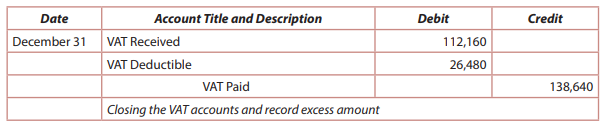
Soru 69
The definition of "payments to employees on an hourly basis" refers to which of the following?
Seçenekler
A
Salaries
B
Wages
C
Loans
D
Compensations
E
Provisions
Açıklama:
Wages are the payments to employees on an hourly basis.
Soru 70
I. Not being paid in less than a period
II. Reliably measurement of the amount
III. The possibility of economic benefit
Which of the above is/are takes place in the general recognition criterions for liabilities?
II. Reliably measurement of the amount
III. The possibility of economic benefit
Which of the above is/are takes place in the general recognition criterions for liabilities?
Seçenekler
A
Only I
B
Only II
C
I and III
D
II anad III
E
I, II and III
Açıklama:
The two general recognition criterion for liabilities are the possibility of economic benefit outflow and reliably measurement of the amount.
Ünite 5
Soru 1
Which of the following consist of an expected outflow of resources arising from present obligations that are payable within a year or the operating cycle of the company whichever is longer?
Seçenekler
A
Current Liabilities
B
Non-Current Liabilities
C
Long-Term Liabilities
D
Bond Indenture
E
Stated Interest Rate
Açıklama:
Short-term (current) liabilities consist of an expected outflow of resources arising from present obligations that are payable within a year or the operating cycle of the company whichever is longer. The correct answer is A.
Soru 2
Which of the following is a contract or loan agreement under which the bonds are issued?
Seçenekler
A
Stated Interest Rate
B
Bond Indenture
C
Bondholder
D
Coupon
E
Secured Bond
Açıklama:
A bond indenture deals with matters such as the interest rate, maturity date and maturity amount, possible restrictions on dividends, repayment plans, and other provisions relating to the debt.
The bond indenture is a contract or loan agreement under which the bonds are issued. The correct answer is B.
The bond indenture is a contract or loan agreement under which the bonds are issued. The correct answer is B.
Soru 3
Which of the following is called for bonds issued in the name of the owner?
Seçenekler
A
Revenue bonds
B
Coupon bonds
C
Registered bonds
D
Secured bonds
E
Serial bonds
Açıklama:
Bonds issued in the name of the owner are called registered bonds, bonds not issued in the name of the owner are called bearer (coupon) bonds. Bonds which pay interest from the profit of issuing company are called “income bonds”, bonds which pay interest from specified revenue sources are called “revenue bonds”. Bond issues that mature on a single date are called term bonds, bond issues that mature in installments are called serial bonds. The correct answer is C.
Soru 4
Which of the following is called for bond issues that mature in installments?
Seçenekler
A
Coupon bond
B
Secured bond
C
Callable bond
D
Serial bond
E
Term bond
Açıklama:
Bonds issued in the name of the owner are called registered bonds, bonds not issued in the name of the owner are called bearer (coupon) bonds. Bonds which pay interest from the profit of issuing company are called “income bonds”, bonds which pay interest from specified revenue sources are called “revenue bonds”. Bond issues that mature on a single date are called term bonds, bond issues that mature in installments are called serial bonds. The correct answer is D.
Soru 5
Anadolu Co. issued 200,000 TL of 12% 5 year bonds on January 1, 2019, interest is payable annually. Market interest rate was 10%. The principal amount borrowed will be paid back once at maturity. Calculate the selling price of bonds and make the necessary journal entry as of the issue date.
Seçenekler
A
Debit:
Cash - 215,163
Credit:
Long Term Bonds Payable - 200,000
Premium on LT Bonds Payable - 15,163
Cash - 215,163
Credit:
Long Term Bonds Payable - 200,000
Premium on LT Bonds Payable - 15,163
B
Debit:
Cash - 215,163
Credit:
Long Term Bonds Payable - 15,163
Premium on LT Bonds Payable - 200,000
Cash - 215,163
Credit:
Long Term Bonds Payable - 15,163
Premium on LT Bonds Payable - 200,000
C
Debit:
Cash - 215,163
Credit:
Long Term Bonds Payable - 200,000
Discount on Long Term Bonds Payable - 15,163
Cash - 215,163
Credit:
Long Term Bonds Payable - 200,000
Discount on Long Term Bonds Payable - 15,163
D
Debit:
Cash - 115,163
Credit:
Long Term Bonds Payable - 100,000
Premium on LT Bonds Payable - 15,163
Cash - 115,163
Credit:
Long Term Bonds Payable - 100,000
Premium on LT Bonds Payable - 15,163
E
Debit:
Cash - 115,163
Credit:
Premium on LT Bonds Payable - 100,000
Long Term Bonds Payable - 15,163
Cash - 115,163
Credit:
Premium on LT Bonds Payable - 100,000
Long Term Bonds Payable - 15,163
Açıklama:
Present Value of the Principal
200,000 TL x 0.62092 (Appendix A, Table 1, n: 5, i: 10%) 124,184 TL
Present Value of the Interest Payments
24,000 x 3.79079 (Appendix A, Table 2, n: 5, i: 10% ) 90,979 TL
Present value (selling price) of the bonds 215,163 TL
Debit:
Cash - 215,163
Credit:
Long Term Bonds Payable - 200,000
Premium on LT Bonds Payable - 15,163
The correct answer is A.
200,000 TL x 0.62092 (Appendix A, Table 1, n: 5, i: 10%) 124,184 TL
Present Value of the Interest Payments
24,000 x 3.79079 (Appendix A, Table 2, n: 5, i: 10% ) 90,979 TL
Present value (selling price) of the bonds 215,163 TL
Debit:
Cash - 215,163
Credit:
Long Term Bonds Payable - 200,000
Premium on LT Bonds Payable - 15,163
The correct answer is A.
Soru 6
On January 2, 2019 Anadolu Co. issued bonds for 150,000 TL due in 5 years with 12 percent interest payable annually. At the time of issue market rate for such bonds is 12 percent. The principal amount borrowed will be paid back once at maturity. Calculate the present value (selling price) of the bonds.
Seçenekler
A
137,865 TL
B
145,000 TL
C
149,145 TL
D
150,000 TL
E
152,365 TL
Açıklama:
Present Value of the Principal
150,000 TL x 0.56743 (Appendix A, Table 1, n: 5, i: 12%) 85,114 TL
Present Value of the Interest Payments
18,000 TL x 3.60478 (Appendix A, Table 2, n: 5, i: 12% ) 64,886 TL
Present value (selling price) of the bonds 150,000 TL
The correct answer is D.
150,000 TL x 0.56743 (Appendix A, Table 1, n: 5, i: 12%) 85,114 TL
Present Value of the Interest Payments
18,000 TL x 3.60478 (Appendix A, Table 2, n: 5, i: 12% ) 64,886 TL
Present value (selling price) of the bonds 150,000 TL
The correct answer is D.
Soru 7
On January 2, 2019 Anadolu Co. issued bonds for 100,000 TL due in 5 years with 8 percent interest payable semiannually. At the time of issue market rate for such bonds is 6 percent. The principal amount borrowed will be paid back once at maturity. Calculate the present value (selling price) of the bonds.
Seçenekler
A
104,890 TL
B
108,530 TL
C
115,563 TL
D
117,472 TL
E
120,563 TL
Açıklama:
Present Value of the Principal
100,000 TL x 0.74726 (Appendix A, Table 1, n: 10, i:3%) 74,409 TL
Present Value of the Interest Payments
4,000 TL x 8.53020 (Appendix A, Table 2, n: 10, i: 3%) 34,121 TL
Present value (selling price) of the bonds 108,530 TL
The correct answer is B.
100,000 TL x 0.74726 (Appendix A, Table 1, n: 10, i:3%) 74,409 TL
Present Value of the Interest Payments
4,000 TL x 8.53020 (Appendix A, Table 2, n: 10, i: 3%) 34,121 TL
Present value (selling price) of the bonds 108,530 TL
The correct answer is B.
Soru 8
On January 2, 2019 Anadolu Co. issued bonds for 100,000 TL due in 5 years with 8 percent interest payable semiannually. At the time of issue market rate for such bonds is 10 percent. The principal amount borrowed will be paid back once at maturity. Calculate the present value (selling price) of the bonds.
Seçenekler
A
90,752 TL
B
91,364 TL
C
92,278 TL
D
93,532 TL
E
95,367 TL
Açıklama:
Present Value of the Principal
100,000 TL x 0.61391 (Appendix A, Table 1, n: 10, i: 5%) 61,391 TL
Present Value of the Interest Payments
4,000 TL x 7.72173 (Appendix A, Table 2, n: 10, i: 5%) 30,887 TL
Present value (selling price) of the bonds 92,278 TL
The correct answer is C.
100,000 TL x 0.61391 (Appendix A, Table 1, n: 10, i: 5%) 61,391 TL
Present Value of the Interest Payments
4,000 TL x 7.72173 (Appendix A, Table 2, n: 10, i: 5%) 30,887 TL
Present value (selling price) of the bonds 92,278 TL
The correct answer is C.
Soru 9
Anadolu Co. borrowed 10,000 TL from AOF Co. as of January 2, 2019, in return signed a three year, 10 percent annually interest bearing note. The market rate for a note of similar risk is 12 percent. Calculate the first year interest expense.
Seçenekler
A
913 TL
B
924 TL
C
1,000 TL
D
1,085 TL
E
1,142 TL
Açıklama:
Present Value of the Principal
10,000 TL x 0.71178 (Appendix A, Table 1, n: 3, i: 12%) 7,118 TL
Present Value of the Interest Payments
1,000 TL x 2.40183 (Appendix A, Table 2, n: 3, i: 12%) 2,402 TL
Present value (selling price) of the bonds 9,520 TL
First year interest expense is 9,520 TL x 12% = 1,142 TL
The correct answer is E.
10,000 TL x 0.71178 (Appendix A, Table 1, n: 3, i: 12%) 7,118 TL
Present Value of the Interest Payments
1,000 TL x 2.40183 (Appendix A, Table 2, n: 3, i: 12%) 2,402 TL
Present value (selling price) of the bonds 9,520 TL
First year interest expense is 9,520 TL x 12% = 1,142 TL
The correct answer is E.
Soru 10
Which of the following is called for bonds not backed by collateral?
Seçenekler
A
Bearer Bonds
B
Callable Bonds
C
Serial Bonds
D
Secured Bonds
E
Debenture Bonds
Açıklama:
Bonds not backed by collateral are called “unsecured bonds” (also called debenture bonds). The correct answer is E.
Soru 11
What are the bond issues that mature in installments called?
Seçenekler
A
Term bonds
B
Serial bonds
C
Callable bonds
D
Secured bonds
E
Unsecured bonds
Açıklama:
With respect to the way they mature, bonds are classified as term bonds, serial bonds and callable bonds. Bond issues that mature on a single date are called “term bonds”. Bond issues that mature in installments are called “serial bonds”. Bond issues that give the issuer the right to call and retire the bonds prior to maturity is called “callable bonds.The correct answer is B.
Soru 12
Which of the following statements is the main characteristics of bearer bonds?
Seçenekler
A
This type of bonds is not recorded in the name of the owner.
B
This type of bonds is issued in the name of the owner.
C
This type of bonds pays no interest unless the issuing company is profitable.
D
This type of bonds pays interest from specified revenue sources.
E
This type of bonds gives the issuer the right to call and retire the bonds prior to maturity.
Açıklama:
Bonds issued in the name of the owner are called “registered bonds” and require surrender of the certificate and issuance of a new certificate to complete a sale. Bonds not recorded in the name of the owner are called “bearer (coupon) bonds” and they can be transferred from one owner to another by mere delivery. The correct answer is A.
Soru 13
When selling price of a bond is different from its face value, which of the following is correct?
Seçenekler
A
It is called an unsecured bond.
B
It is sold at par.
C
It is sold either at premium or discount.
D
It is called serial bonds.
E
It is issued by governmental bodies.
Açıklama:
When selling price of a bond is equal to its face value that means it is sold at face value (at par). When selling price of a bond is different from its face value that means it is sold either at premium or discount. The correct answer is C.
Soru 14
Which of the following can be inferred for the bonds issued at face value?
Seçenekler
A
Stated interest rate is equal to market interest rate.
B
Stated interest rate is less than market interest rate.
C
Stated interest rate is more than market interest rate.
D
There is no stated interest rate.
E
There is no market interest rate.
Açıklama:
Bonds issued at face value (at par value) means stated interest rate is equal to market interest rate and no premium and discount exists. The correct answer is A.
Soru 15
Which of the following situations is the result of amortization of a discount?
Seçenekler
A
Bond interest expense decreases.
B
Bond interest expense increases.
C
There is no bond interest expense.
D
Bond interest expenses doubles.
E
Effective interest rate increases.
Açıklama:
Amortization of a discount increases bond interest expense, amortization of a premium decreases bond interest expense. The correct answer is B.
Soru 16
What is the face amount minus any unamortized discount or plus any unamortized premium?
Seçenekler
A
Face value
B
Interest rate
C
Book value
D
Stated interest rate
E
Bond interest expense
Açıklama:
The carrying value is the face amount minus any unamortized discount or plus any unamortized premium.The term carrying value is synonymous with book value. The correct answer is C.
Soru 17
Which of the following about long term notes is false?
Seçenekler
A
It represents a loan from a bank or other creditor.
B
The term of the notes doesn't exceed one year.
C
It is typically reported in the long-term liabilities section of the balance sheet.
D
The basic difference between short term notes payable and long-term notes payable is the maturity date.
E
It is a promissory note.
Açıklama:
A long-term note is a promissory note that represents a loan from a bank or other creditor. Long-term notes payable is similar to short-term notes payable except that the term of the notes exceeds one year. The basic difference between short term notes payable and long-term notes payable is the maturity date. As we have already mentioned before long term liabilities consist of an expected outflow of resources arising from present obligations that are not payable within a year or the operating cycle of the company whichever is longer. Long-term notes payable is typically reported in the long-term liabilities section of the balance sheet. The correct answer is B.
Soru 18
What is the effective interest method?
Seçenekler
A
It is method to classify bonds.
B
It is a method to compute bond interest expense.
C
It is a method to calculate the selling price of bonds.
D
It is a method to record journal entries.
E
It is a the method used for amortization of a discount or premium.
Açıklama:
Adjustment process to the cost as bond interest expense over the life of bonds called amortization. The method used for amortization of a discount or premium is called effective interest method. The correct answer is E.
Soru 19
Most companies are required to obtain long term financing from banks and other financial institutions. What is this called?
Seçenekler
A
Short term liabilities
B
Long term liabilities
C
Current liabilities
D
Common stock
E
External financing
Açıklama:
In order to finance and expand their operations companies need funds. Although some of the necessary funding can be provided by their own operations, companies usually have to raise some of the funds from external sources. Therefore, these companies are required to obtain longterm financing from banks and other financial institutions and we call this process as “external financing”. The correct answer is E.
Soru 20
Which of the following is false about long-term liabilities?
Seçenekler
A
They consist of an expected outflow of resources arising from present obligation.
B
They have various covenants or restrictions for the protection of both lenders and borrowers.
C
They are the most common way to finance the expansion of a business.
D
They are payable within a year or the operating cycle of the company whichever is longer.
E
Bonds payable, long-term notes payable and mortgages payable are example of long term liabilities.
Açıklama:
In a balance sheet, obligations related with external financing sources named as “liabilities”. Liabilities are first classified as “Current (ShortTerm) Liabilities” and “Non-Current (LongTerm) Liabilities” based on the time period in which expected debt will be paid back. Short term liabilities consist of an expected outflow of resources arising from present obligations that are payable within a year or the operating cycle of the company whichever is longer. Whereas long term liabilities consist of an expected outflow of resources arising from present obligations that are not payable within a year or the operating cycle of the company whichever is longer. The correct answer is D.
Soru 21
Which of the following consists an expected outflow of resources arising from present obligations that are not payable within a year or the operating cycle of the company whichever is longer?
Seçenekler
A
Current assets
B
Non-current assets
C
Short term liabilities
D
Long term liabilities
E
Equity
Açıklama:
Long term liabilities consist of an expected outflow of resources arising from present obligations that are not payable within a year or the operating cycle of the company whichever is longer.
Soru 22
Which of the following is the principal amount or maturity value of the bonds?
Seçenekler
A
Face value
B
Rediscount
C
Imputed value
D
Saving value
E
Current value
Açıklama:
Face value is also called as the par value, principal amount or maturity value of the bonds.
Soru 23
Which of the following is a bond for which a company has pledged specific property to ensure its payment?
Seçenekler
A
Debenture bonds
B
Unsecured bonds
C
Secured bonds
D
Nominal bonds
E
Current bonds
Açıklama:
A secured bond is a bond for which a company has pledged specific property to ensure its payment.
Soru 24
Which of the following is the term that used when all bonds of an issue mature at the same time?
Seçenekler
A
Term bonds
B
Serial bonds
C
Callable bonds
D
Secured bonds
E
Unsecured bonds
Açıklama:
When all bonds of an issue mature at the same time, they are called term bonds.
Soru 25
Which of the following is the term that used when the bonds mature over several dates?
Seçenekler
A
Term bonds
B
Serial bonds
C
Callable bonds
D
Secured bonds
E
Unsecured bonds
Açıklama:
If the bonds mature over several dates, they are called serial bonds.
Soru 26
Which of the following is the term that used for the bonds that issued in the name of the owner?
Seçenekler
A
Registered bonds
B
Bearer bonds
C
Coupon bonds
D
Income bonds
E
Revenue bonds
Açıklama:
Bonds issued in the name of the owner are called “registered bonds” and require surrender of the certificate and issuance of a new certificate to complete a sale.
Soru 27
Which of the following is the term that used for the bonds that pay interest from specified revenue sources?
Seçenekler
A
Registered bonds
B
Bearer bonds
C
Coupon bonds
D
Income bonds
E
Revenue bonds
Açıklama:
Bonds which pay interest from specified revenue sources are called “revenue bonds”.
Soru 28
Which of the following is the amount of bond interest expense minus bond interest paid?
Seçenekler
A
Face Amount
B
Stated Interest Rate
C
Amortization Amount
D
Carrying Value
E
Effective Interest
Açıklama:
Amortization Amount = Bond Interest Expense - Bond Interest Paid
Soru 29
Which of the following is the face amount minus any unamortized discount or plus any unamortized premium?
Seçenekler
A
Fair Value
B
Amortization Amount
C
Interest Expense
D
Interest Rate
E
Carrying Value
Açıklama:
The carrying value is the face amount minus any unamortized discount or plus any unamortized premium.
Soru 30
Which of the following statements is wrong?
Seçenekler
A
Amortization method used for discount or premium is called effective interest method.
B
The term carrying value is synonymous with face value.
C
Bonds not issued in the name of the owner are called bearer bonds.
D
Bonds issued in the name of the owner are called registered bonds.
E
Income bonds pay no interest unless the issuing company is profitable.
Açıklama:
The term carrying value is synonymous with book value.
Soru 31
On January 1, 2018 Call Corporation issued bonds for $100,000 due in 5 years with 10 percent interest payable semiannually (twice a year). At the time of issue market rate for such bonds is 12 percent. The principal amount borrowed will be paid back once at maturity. What is the selling price of bonds?
Seçenekler
A
92,791
B
100,000
C
56,743
D
36,048
E
7,209
Açıklama:
Present Value of the Principal $56,743
Present Value of the Interest Payments 36,048
Selling Price 92,791
Present Value of the Interest Payments 36,048
Selling Price 92,791
Soru 32
Which of the following is not a long term liability item?
Seçenekler
A
Secured bond
B
Unearned revenue
C
Pension liabilities
D
Lease liabilities
E
Mortgages liabilities
Açıklama:
Long-term liabilities are the most common way to finance the expansion of a business. Growth usually requires investment in long-term assets and in research and development and other activities that will generate income in coming years.
Long term liabilities consist of an expected outflow of resources arising from present obligations that are not payable within a year or the operating cycle of the company whichever is longer.
Long term liabilities consist of an expected outflow of resources arising from present obligations that are not payable within a year or the operating cycle of the company whichever is longer.
Soru 33
Which of the following is not a bond type?
Seçenekler
A
Indenture Bonds
B
Unsecured bonds
C
Debenture bonds
D
Callable Bonds
E
Registered bonds
Açıklama:
Bonds can be classified into different categories depending on different face amount, interest rates, interest payment dates, and maturity dates.
Types of bond issues are (1) secured and unsecured bonds; (2) term, serial and callable bonds; (3) registered and bearer bonds; (4) income and revenue bonds.
Types of bond issues are (1) secured and unsecured bonds; (2) term, serial and callable bonds; (3) registered and bearer bonds; (4) income and revenue bonds.
Soru 34
Which of the following is the most common type of long term debt?
Seçenekler
A
Bonds
B
Current liabilities
C
Salary Payables
D
Unearned Revenue
E
Accumulated Depreciation
Açıklama:
Bond is a form of interest-bearing notes payable issued by corporations and governmental agencies.
A bond is the most common type of long-term debt.
A bond is the most common type of long-term debt.
Soru 35
Which of the following situation is suitable when the amount of capital needed is too large for one lender to supply?
Seçenekler
A
Issuing bonds
B
Bank credit
C
Issuing asset
D
Unsecured stocks
E
Paid-in capital
Açıklama:
by issuing bonds, a company can divide a large amount of long-term indebtedness into many small investing units, thus enabling more than one lender to participate in the loan.
The main purpose of issuing bonds is to borrow for the long term when the amount of capital needed is too large for one lender to supply.
The main purpose of issuing bonds is to borrow for the long term when the amount of capital needed is too large for one lender to supply.
Soru 36
Each bondholder receives a bond certificate showing the name of the company that borrowed the money. The certificate specifies .................., which is the amount of the bond issue.
Seçenekler
A
the face value
B
the bond indenture
C
the obligation
D
the liability
E
the responsibility
Açıklama:
The bond’s face value is also called maturity value, principal, or par value.
Each bondholder receives a bond certificate showing the name of the company that borrowed the money, exactly like a note payable. The certificate specifies the face value, which is the amount of the bond issue.
Each bondholder receives a bond certificate showing the name of the company that borrowed the money, exactly like a note payable. The certificate specifies the face value, which is the amount of the bond issue.
Soru 37
Which of the following occurs when market interest rate is less than the stated interest rate of the bond issued?
Seçenekler
A
The bond will be issued at a premium.
B
The bond will be issued at a discount.
C
The bond will be issued at par.
D
The bond will be issued at face value.
E
The bond will be issued at nominal value.
Açıklama:
since the stated interest rate is more than the interest rate offered by any other investment instrument in the market, investors will pay more than the face value of the bond.
Bonds issued at premium means, market interest rate is less than the stated interest rate of the bond issued.
Bonds issued at premium means, market interest rate is less than the stated interest rate of the bond issued.
Soru 38
On January 1, 2019, Saint Corp. issues 100,000 TL, 5-year, 10% due in 5 years with 10 percent interest payable annually at year end. At the time of issue market rate for such bonds is 8 percent. If present value of the bonds is 107,985 TL, the entry to record the issuance of the bonds would include a:
Seçenekler
A
credit to Premium on Long Term Bonds Payable 7,985 TL
B
credit to Discount on Long Term Bonds Payable 7,985 TL
C
debit to Discount on Long Term Bonds Payable 7,985 TL
D
debit to Premium on Long Term Bonds Payable 7,985 TL
E
credit to Long Term Bonds Payable 7,985 TL
Açıklama:
By paying $107,985 at the date of issue, the investors will realize an effective rate or yield of 8 percent over the 5-year term of bonds. These bonds would sell at a premium of $7,985 ($107,985 - $100,000).
Bonds issued at premium means, market interest rate is less than the stated interest rate of the bond issued. In other words, since the stated interest rate is more than the interest rate offered by any other investment instrument in the market, investors will pay more than the face value of the bond.
Bonds issued at premium means, market interest rate is less than the stated interest rate of the bond issued. In other words, since the stated interest rate is more than the interest rate offered by any other investment instrument in the market, investors will pay more than the face value of the bond.
Soru 39
Which of the following describes the bonds issued at discount?
Seçenekler
A
Market interest rate is more than the stated interest rate of the bond issued.
B
Market interest rate is less than the stated interest rate of the bond issued.
C
Stated interest rate is equal to market interest rate.
D
Stated interest rate is known but market interest rate is not known
E
Selling price of a bond is equal to its face value.
Açıklama:
since the stated interest rate is less than the interest rate offered by any other investment instrument in the market, investors will pay less than the face value of the bond.
Bonds issued at discount means, market interest rate is more than the stated interest rate of the bond issued.
Bonds issued at discount means, market interest rate is more than the stated interest rate of the bond issued.
Soru 40
Which of the following method will be used for amortization of a discount or premium on long term bonds payable?
Seçenekler
A
effective interest method
B
Carrying Value of Bonds method
C
Present Value of the Interest method
D
Long Term Bonds Payable method
E
Depreciation method
Açıklama:
Amortization method used for discount or premium is called effective interest method.
The method used for amortization of a discount or premium is called effective interest method.
The method used for amortization of a discount or premium is called effective interest method.
Soru 41
- In a balance sheet, obligations related with external financing sources named as “liabilities”.
- Liabilities are first classified as “Current (ShortTerm) Liabilities” and “Non-Current (LongTerm) Liabilities” based on the time period in which expected debt will be paid back.
- Short term liabilities consist of an expected outflow of resources arising from present obligations that are not payable within a year or the operating cycle of the company whichever is longer.
- Long term liabilities consist of an expected outflow of resources arising from present obligations that are not payable within a year or the operating cycle of the company whichever is longer.
Which of the statements above related to liabilities are correct?
Seçenekler
A
I and II
B
II and III
C
II and IV
D
I, II and IV
E
I, II, III and IV
Açıklama:
Page 121
However, when situations arise that require large amounts of cash, such as the purchase of a land, building, or equipment, corporations …
However, when situations that require large amounts of cash, such as the purchase of a land, building, or equipment arise, corporations …
Page 121
…the operating cycle of the company whichever is longer. Whereas long term liabilities consist of …
…the operating cycle of the company whichever is longer, whereas long term liabilities consist of …
In a balance sheet, obligations related with external financing sources named as “liabilities”. Liabilities are first classified as “Current (ShortTerm) Liabilities” and “Non-Current (LongTerm) Liabilities” based on the time period in which expected debt will be paid back. Short term liabilities consist of an expected outflow of resources arising from present obligations that are not payable within a year or the operating cycle of the company whichever is longer. Long term liabilities consist of an expected outflow of resources arising from present obligations that are not payable within a year or the operating cycle of the company whichever is longer.
As also understood from the information, the correct answer is E. All of the statements related to liabilities in the options are correct.
Solution/Explanation: In a balance sheet, obligations related with external financing sources named as “liabilities”. Liabilities are first classified as “Current (ShortTerm) Liabilities” and “Non-Current (LongTerm) Liabilities” based on the time period in which expected debt will be paid back. Short term liabilities consist of an expected outflow of resources arising from present obligations that are payable within a year or the operating cycle of the company whichever is longer. Long term liabilities consist of an expected outflow of resources arising from present obligations that are not payable within a year or the operating cycle of the company whichever is longer. (Look at the Page 121)
There is no problem in the question but solution is not given correctly. According to the given solution correct answer looks like E but according to the right solution correct answer is D.
However, when situations arise that require large amounts of cash, such as the purchase of a land, building, or equipment, corporations …
However, when situations that require large amounts of cash, such as the purchase of a land, building, or equipment arise, corporations …
Page 121
…the operating cycle of the company whichever is longer. Whereas long term liabilities consist of …
…the operating cycle of the company whichever is longer, whereas long term liabilities consist of …
In a balance sheet, obligations related with external financing sources named as “liabilities”. Liabilities are first classified as “Current (ShortTerm) Liabilities” and “Non-Current (LongTerm) Liabilities” based on the time period in which expected debt will be paid back. Short term liabilities consist of an expected outflow of resources arising from present obligations that are not payable within a year or the operating cycle of the company whichever is longer. Long term liabilities consist of an expected outflow of resources arising from present obligations that are not payable within a year or the operating cycle of the company whichever is longer.
As also understood from the information, the correct answer is E. All of the statements related to liabilities in the options are correct.
Solution/Explanation: In a balance sheet, obligations related with external financing sources named as “liabilities”. Liabilities are first classified as “Current (ShortTerm) Liabilities” and “Non-Current (LongTerm) Liabilities” based on the time period in which expected debt will be paid back. Short term liabilities consist of an expected outflow of resources arising from present obligations that are payable within a year or the operating cycle of the company whichever is longer. Long term liabilities consist of an expected outflow of resources arising from present obligations that are not payable within a year or the operating cycle of the company whichever is longer. (Look at the Page 121)
There is no problem in the question but solution is not given correctly. According to the given solution correct answer looks like E but according to the right solution correct answer is D.
Soru 42
- Long term debt has various covenants or restrictions for the protection of both lenders and borrowers.
- The covenants and other terms of the agreement between the borrower and the lender are stated in the bond indenture or note agreement.
- The management issues related to long-term debt financing are whether to take on long-term debt, how much long-term debt to carry, and what types of long-term debt to incur.
- Bonds payable, long-term notes payable, mortgages payable, pension liabilities and lease liabilities can be given as the example to long term liabilities.
Seçenekler
A
I and II
B
II and III
C
I, II and III
D
II, III and IV
E
I, II, III and IV
Açıklama:
Long-term liabilities are the most common way to finance the expansion of a business. Growth usually requires investment in long-term assets and in research and development and other activities that will generate income in coming years. To finance these assets and activities, a company needs long-term funds. The management issues related to long-term debt financing are whether to take on long-term debt, how much long-term debt to carry, and what types of long-term debt to incur.1 Generally, long term liabilities have various covenants or restrictions for the protection of both lenders and borrowers. The covenants and other terms of the agreement between the borrower and the lender are stated in the bond indenture or note agreement.
Long term debt has various covenants or restrictions for the protection of both lenders and borrowers.
To structure long-term financing to the best advantage of their companies, managers should know the characteristics of the various long-term debts. Bonds payable, long-term notes payable, mortgages payable, pension liabilities and lease liabilities can be given as the example to long term liabilities.
As also understood from the information given, the correct answer is E. All of the statements related to longterm liabilities in the options are correct.
Long term debt has various covenants or restrictions for the protection of both lenders and borrowers.
To structure long-term financing to the best advantage of their companies, managers should know the characteristics of the various long-term debts. Bonds payable, long-term notes payable, mortgages payable, pension liabilities and lease liabilities can be given as the example to long term liabilities.
As also understood from the information given, the correct answer is E. All of the statements related to longterm liabilities in the options are correct.
Soru 43
- Bonds payable
- Long-term notes payable
- Mortgages payable
- Pension liabilities
- Lease liabilities
Seçenekler
A
I and II
B
I and III
C
II, III and IV
D
I, II, IV and V
E
I, II, III, IV and V
Açıklama:
To structure long-term financing to the best advantage of their companies, managers should know the characteristics of the various long-term debts. Bonds payable, long-term notes payable, mortgages payable, pension liabilities and lease liabilities can be given as the example to long term liabilities. As also understood from the information given, the correct answer is E.
Soru 44
- Bond is a form of interest-bearing notes payable issued by corporations and governmental agencies.
- Like a note, a bond requires a promise to pay a sum of money at a designated maturity date, plus periodic interest at a specified rate on the maturity amount (face value).
- Bonds payable are the most common type of long term debts issued to multiple lenders called bondholders.
- The main purpose of issuing bonds is to borrow for the long term when the amount of capital needed is too large for one lender to supply.
- By issuing bonds, a company can divide a large amount of long-term indebtedness into many small investing units, thus enabling more than one lender to participate in the loan.
- Each investor can buy a specified amount of the company’s bonds.
Seçenekler
A
I and II
B
II, III and VI
C
I, II, IV and V
D
I, II, IV, V and VI
E
I, II, III, IV, V and VI
Açıklama:
A bond is the most common type of long-term debt. Bond is a form of interest-bearing notes payable issued by corporations and governmental agencies. A bond is a debt or liability of the issuer. Like a note, a bond requires a promise to pay a sum of money at a designated maturity date, plus periodic interest at a specified rate on the maturity amount (face value). Bonds payable are the most common type of long term debts issued to multiple lenders called bondholders. The main purpose of issuing bonds is to borrow for the long term when the amount of capital needed is too large for one lender to supply. In other words, by issuing bonds, a company can divide a large amount of long-term indebtedness into many small investing units, thus enabling more than one lender to participate in the loan. Each investor can buy a specified amount of the company’s bonds.
As also understood from the information given, the correct answer is E. All of the statements in the options related to bonds are correct.
As also understood from the information given, the correct answer is E. All of the statements in the options related to bonds are correct.
Soru 45
- Each bondholder receives a bond certificate showing the name of the company that borrowed the money, exactly like a note payable.
- The certificate specifies the face value, which is the amount of the bond issue.
- The bond’s face value is also called maturity value, principal, or par value.
- A bond arises from a contract known as a bond indenture and represents a promise to pay a sum of money at a designated maturity rate and periodic interest at a specified rate on the maturity amount (face value).
Seçenekler
A
I and II
B
II and III
C
I, II and IV
D
II, III and IV
E
I, II, III and IV
Açıklama:
Each bondholder receives a bond certificate showing the name of the company that borrowed the money, exactly like a note payable. The certificate specifies the face value, which is the amount of the bond issue. The bond’s face value is also called maturity value, principal, or par value. A bond arises from a contract known as a bond indenture and represents a promise to pay:
- a sum of money at a designated maturity rate, plus
- periodic interest at a specified rate on the maturity amount (face value)
Soru 46
- The interest rate
- Maturity date and maturity amount
- Possible restrictions on dividends
- Repayment plans
- Other provisions relating to the debt
Seçenekler
A
I and II
B
II and IV
C
I, IV and V
D
I, III, IV and V
E
I, II, III, IV and V
Açıklama:
The bond indenture is a contract or loan agreement under which the bonds are issued. A bond indenture deals with matters such as the interest rate, maturity date and maturity amount, possible restrictions on dividends, repayment plans, and other provisions relating to the debt, so the correct answer is E.
Soru 47
- The interest rate written in terms of the bond indenture is known as the stated interest rate.
- Stated interest rate is also called as coupon or nominal rate.
- The interest rate written in terms of the bond indenture is set by the bond issuer.
- Stated interest rate is expressed as a percentage of the face value.
- Face value is also called as the par value, principal amount or maturity value of the bonds.
Seçenekler
A
I and II
B
I, III and IV
C
II, III and IV
D
I, III, IV and V
E
I, II, III, IV and V
Açıklama:
The interest rate written in terms of the bond indenture is known as the stated interest rate.
Stated interest rate is also called as coupon or nominal rate.
The interest rate written in terms of the bond indenture is set by the bond issuer.
Stated interest rate is expressed as a percentage of the face value.
Face value is also called as the par value, principal amount or maturity value of the bonds.
As also understood from the information given, all of the statements related to the stated interest rate in the options are correct, so the correct answer is E.
Stated interest rate is also called as coupon or nominal rate.
The interest rate written in terms of the bond indenture is set by the bond issuer.
Stated interest rate is expressed as a percentage of the face value.
Face value is also called as the par value, principal amount or maturity value of the bonds.
As also understood from the information given, all of the statements related to the stated interest rate in the options are correct, so the correct answer is E.
Soru 48
- Different face amount
- Interest rates
- Interest payment dates
- Maturity dates
Seçenekler
A
I and II
B
I and IV
C
II and III
D
I, III and IV
E
I, II, III and IV
Açıklama:
Bonds can be classified into different categories depending on different face amount, interest rates, interest payment dates, and maturity dates, so the correct answer is E.
Soru 49
- With respect to whether they are backed by a pledge of some collateral or not, bonds are classified as secured and unsecured bonds.
- A secured bond is a bond for which a company has pledged specific property to ensure its payment.
- Secured bonds are backed by a pledge of some collaterals, unsecured bonds are not.
- Unsecured bonds offer high interest rate, they are not backed by a collateral and very risky
- Unsecured bonds are also called debenture bonds.
Seçenekler
A
I and II
B
I and IV
C
II, III and IV
D
I, II, III and V
E
I, II, III, IV and V
Açıklama:
With respect to whether they are backed by a pledge of some collateral or not, bonds are classified as secured and unsecured bonds. A secured bond is a bond for which a company has pledged specific property to ensure its payment. For example, mortgage bonds are secured by a claim on real estate. A mortgage is a legal claim (lien) on specific property that gives the bondholder the right to possess the pledged property if the company fails to make required payments. Bonds not backed by collateral are called “unsecured bonds” (also called debenture bonds). They are very risky and offer a high interest rate.
As also understood from the information given, all of the statements related to secured and unsecured bonds are correct, so the correct answer is E.
As also understood from the information given, all of the statements related to secured and unsecured bonds are correct, so the correct answer is E.
Soru 50
- Bond issues that mature on a single date are called term bonds
- Bond issues that mature in installments are called serial bonds.
- Bonds issued in the name of the owner are called registered bonds
- Bonds not issued in the name of the owner are called bearer (coupon) bonds.
- Bonds which pay interest from the profit of issuing company are called income bonds.
- Bonds which pay interest from specified revenue sources are called revenue bonds.
Seçenekler
A
I and II
B
I, IV and V
C
II, IV, V and VI
D
I, II, III, V and VI
E
I, II, III, IV, V and VI
Açıklama:
Bond issues that mature on a single date are called term bonds, bond issues that mature in installments are called serial bonds.
Bonds issued in the name of the owner are called registered bonds, bonds not issued in the name of the owner are called bearer (coupon) bonds.
Bonds which pay interest from the profit of issuing company are called “income bonds”, bonds which pay interest from specified revenue sources are called “revenue bonds”.
As also understood from the information given, the correct answer is E. All of the statemnts related to the various types of the bonds in the options are correct.
Bonds issued in the name of the owner are called registered bonds, bonds not issued in the name of the owner are called bearer (coupon) bonds.
Bonds which pay interest from the profit of issuing company are called “income bonds”, bonds which pay interest from specified revenue sources are called “revenue bonds”.
As also understood from the information given, the correct answer is E. All of the statemnts related to the various types of the bonds in the options are correct.
Soru 51
- The face value of the bond (the principal amount borrowed)
- The interest payment pattern (annually, semiannually, etc.)
- The market interest rate per period
- Number of periods to maturity
Seçenekler
A
I and II
B
I and III
C
II and IV
D
I, III and IV
E
I, II, III and IV
Açıklama:
To calculate the selling price of bonds we need to know the face value of the bond (the principal amount borrowed), the interest payment pattern (annually, semiannually, etc.), the market interest rate per period and number of periods to maturity, so the correct answer is E.
Soru 52
- When selling price of a bond is equal to its face value that means it is sold at face value (at par).
- When selling price of a bond is different from its face value that means it is sold either at premium or discount.
- Bonds issued at face value (at par value) means stated interest rate is equal to market interest rate and no premium and discount exists.
- Bonds issued at premium means, market interest rate is less than the stated interest rate of the bond issued.
Seçenekler
A
I and II
B
I and III
C
II and IV
D
I, III and IV
E
I, II, III and IV
Açıklama:
When selling price of a bond is equal to its face value that means it is sold at face value (at par).
When selling price of a bond is different from its face value that means it is sold either at premium or discount.
Bonds issued at face value (at par value) means stated interest rate is equal to market interest rate and no premium and discount exists.
Bonds issued at premium means, market interest rate is less than the stated interest rate of the bond issued.,
As also understood from the information given, the correct answer is E. All of the statements related to bond issues in the options are correct.
When selling price of a bond is different from its face value that means it is sold either at premium or discount.
Bonds issued at face value (at par value) means stated interest rate is equal to market interest rate and no premium and discount exists.
Bonds issued at premium means, market interest rate is less than the stated interest rate of the bond issued.,
As also understood from the information given, the correct answer is E. All of the statements related to bond issues in the options are correct.
Soru 53
- By paying more or less at the issuance, investors earn a rate different than the stated rate on the bond.
- The issuing company pays the stated interest rate over the term of the bonds but also must pay the face value at maturity.
- If the bond is issued at a discount, the amount paid at maturity is more than the selling price.
- If issued at premium, the company pays less at maturity relative to the selling price.
- The company records this adjustment to the cost as bond interest expense over the life of the bonds through a process called amortization.
- Amortization of a discount increases bond interest expense.
- Amortization of a premium decreases bond interest expense.
Seçenekler
A
I, II and III
B
III, IV, V and VI
C
I, II, IV, V and VII
D
II, III, IV, V and VI
E
I, II, III, IV, V, VI and VII
Açıklama:
As it has been already mentioned, by paying more or less at the issuance, investors earn a rate different than the stated rate on the bond. Remember that, the issuing company pays the stated interest rate over the term of the bonds but also must pay the face value at maturity. If the bond is issued at a discount, the amount paid at maturity is more than the selling price. If issued at premium, the company pays less at maturity relative to the selling price. The company records this adjustment to the cost as bond interest expense over the life of the bonds through a process called amortization. Amortization of a discount increases bond interest expense. Amortization of a premium decreases bond interest expense.
As also understood from the information given, the correct answer is E. All of the statements related to amortization of bond discounts and premiums in the options are correct.
As also understood from the information given, the correct answer is E. All of the statements related to amortization of bond discounts and premiums in the options are correct.
Soru 54
- A long-term note is a promissory note that represents a loan from a bank or other creditor.
- Long-term notes payable is similar to short-term notes payable except that the term of the notes exceeds one year.
- The basic difference between short term notes payable and long-term notes payable is the maturity date.
- Long-term notes payable is typically reported in the long-term liabilities section of the balance sheet.
Seçenekler
A
I and III
B
II and IV
C
III and IV
D
I, II and IV
E
I, II, III and IV
Açıklama:
A long-term note is a promissory note that represents a loan from a bank or other creditor. Long-term notes payable is similar to short-term notes payable except that the term of the notes exceeds one year. The basic difference between short term notes payable and long-term notes payable is the maturity date. As we have already mentioned before long term liabilities consist of an expected outflow of resources arising from present obligations that are not payable within a year or the operating cycle of the company whichever is longer. Long-term notes payable is typically reported in the long-term liabilities section of the balance sheet.
As also understood from the information given, the correct answer is E. All of the statements related to long term notes payable in the options are correct.
As also understood from the information given, the correct answer is E. All of the statements related to long term notes payable in the options are correct.
Soru 55
- Installment notes are generally used to purchase specific assets such as equipment, and typically secured by the purchased asset.
- When a note is secured by an asset, it is called a mortgage note.
- If the borrower cannot pay the mortgage note, the lender has the right to take ownership of the pledged asset and sell it to pay back the debt.
- Mortgages payable are very similar to long-term notes payable.
- The main difference is the mortgages payable is secured with specific assets, whereas long-term notes are not secured with specific assets.
Seçenekler
A
I and II
B
I, III and IV
C
III, IV and V
D
I, II, IV and V
E
I, II, III, IV and V
Açıklama:
Installment notes are generally used to purchase specific assets such as equipment, and typically secured by the purchased asset. When a note is secured by an asset, it is called a mortgage note. If the borrower cannot pay the mortgage note, the lender has the right to take ownership of the pledged asset and sell it to pay back the debt. Mortgages payable are very similar to long-term notes payable. The main difference is the mortgages payable is secured with specific assets, whereas long-term notes are not secured with specific assets.
As also understood from the information given, the correct answer is E. All of the statements related to long term notes payable in the options are correct.
As also understood from the information given, the correct answer is E. All of the statements related to long term notes payable in the options are correct.
Soru 56
".................. consist of an expected outflow of resources arising from present obligations that are not payable within a year or the operating cycle of the company whichever is longer."
Which of the following best describes the space left blank in the above sentence?
Which of the following best describes the space left blank in the above sentence?
Seçenekler
A
Current assets
B
Fixed assets
C
Short term liabilities
D
Long term liabilities
E
Equity
Açıklama:
Short term liabilities consist of an expected outflow of resources arising from present obligations that are not payable within a year or the operating cycle of the company whichever is longer.
Soru 57
"............... consist of an expected outflow of resources arising from present obligations that are not payable within a year or the operating cycle of the company whichever is longer."
Which of the following best describes the space left blank in the above sentence?
Which of the following best describes the space left blank in the above sentence?
Seçenekler
A
Current assets
B
Fixed assets
C
Short term liabilities
D
Long term liabilities
E
Equity
Açıklama:
Long term liabilities consist of an expected outflow of resources arising from present obligations that are not payable within a year or the operating cycle of the company whichever is longer.
Soru 58
Which of the following is a form of interest-bearing notes payable issued by corporations and governmental agencies?
Seçenekler
A
Cash
B
Check
C
Bond
D
Accrual
E
Deposit
Açıklama:
Bond is a form of interest-bearing notes payable issued by corporations and governmental agencies. A bond is a debt or liability of the issuer.
Soru 59
What is the interest rate written in terms of bond indenture?
Seçenekler
A
Stated interest rate
B
Average interest rate
C
Agreed interest rate
D
Approved interest rate
E
Regular interest rate
Açıklama:
The interest rate written in terms of the bond indenture is known as the stated interest rate.
Soru 60
What are the bond issuances maturing on a single date?
Seçenekler
A
Serial bonds
B
Partnership bonds
C
Ordinary bonds
D
Term bonds
E
Joint bonds
Açıklama:
Bond issues that mature on a single date are called “term bonds”.
Soru 61
"Bond issues that mature in installments are called ................"
Which of the following best describes the space left blank in the above sentence?
Which of the following best describes the space left blank in the above sentence?
Seçenekler
A
Term bonds
B
Serial bonds
C
Callable bonds
D
Accrual bonds
E
Regular bonds
Açıklama:
Bond issues that mature in installments are called “serial bonds”.
Soru 62
Which of the following is a type of bonds which pay no interest unless the issuing company is profitable?
Seçenekler
A
Income bonds
B
Revenue bonds
C
Regular bonds
D
Registered bonds
E
Bearer bonds
Açıklama:
Bonds which pay no interest unless the issuing company is profitable are called “income bonds”.
Soru 63
 Which transaction might the journal entry in the figure be made for?
Seçenekler
A
To record selling merchandise inventory
B
Received cash in exchange for a note
C
To record sale of notes issued at discount
D
Paid principal and interest on installment note
E
To record Interest Payment Only
Açıklama:

Soru 64
Which account must be debited when recording interest payment?
Seçenekler
A
Accounts payable
B
Interest expense
C
Cash
D
Notes payable
E
Accounts receivable
Açıklama:

Soru 65
Face amount minus any unamortized discount or plus any unamortized premium calculation means which of the following?
Seçenekler
A
Current value
B
Optional value
C
Carrying value
D
Deposit value
E
Nominal value
Açıklama:
The carrying value is the face amount minus any unamortized discount or plus any unamortized premium.
Soru 66
Which type of liability is not payable within a year or the operating cycle of the company whichever is longer?
Seçenekler
A
Long Term Liabilities
B
Short term liabilities
C
Short term notes payable
D
Owner's Equity
E
Account payable
Açıklama:
NATURE OF LONG TERM LIABILITIES
Long term liabilities consist of an expected outflow of resources arising from present obligations that are not payable within a year or the operating cycle of the company whichever is longer.
Long term liabilities consist of an expected outflow of resources arising from present obligations that are not payable within a year or the operating cycle of the company whichever is longer.
Soru 67
Which of the following is the definition of terms bonds?
Seçenekler
A
Bonds that mature in installments over a period of time.
B
Unsecured bonds backed only by the good faith of the borrower.
C
Borrower's promises to transfer the legal title to certain assets to the lender if the debt is not paid on schedule.
D
Bonds that all mature at the same time for a particular issue.
E
Bonds that all mature at the different time for a particular issue.
Açıklama:
BONDS AND TYPES OF BONDS
Bond is a form of interest-bearing notes payable issued by corporations and governmental agencies. A bond is a debt or liability of the issuer.
Bond is a form of interest-bearing notes payable issued by corporations and governmental agencies. A bond is a debt or liability of the issuer.
Soru 68
Which of the following is not a bond indenture deals ?
Seçenekler
A
interest rate,
B
maturity date and maturity amount,
C
possible restrictions on dividends,
D
repayment plans,
E
Notes receivables
Açıklama:
BONDS AND TYPES OF BONDS
The bond indenture is a contract or loan agreement under which the bonds are issued. A bond indenture deals with matters such as the interest rate, maturity date and maturity amount, possible restrictions on dividends, repayment plans, and other provisions relating to the debt.
The bond indenture is a contract or loan agreement under which the bonds are issued. A bond indenture deals with matters such as the interest rate, maturity date and maturity amount, possible restrictions on dividends, repayment plans, and other provisions relating to the debt.
Soru 69
Which of the following can set of the interest rate?
Seçenekler
A
Owner's of Company
B
the bond issuer
C
accountant
D
debtor
E
customer
Açıklama:
BONDS AND TYPES OF BONDS
The interest rate written in terms of the bond indenture is set by the bond issuer.
The interest rate written in terms of the bond indenture is set by the bond issuer.
Soru 70
Which type of bonds pay no interest unless the issuing company is profitable?
Seçenekler
A
Callable Bonds
B
Unsecured Bonds
C
Income bonds
D
Serial Bonds,
E
Secured Bonds
Açıklama:
BONDS AND TYPES OF BONDS
Income bonds pay no interest unless the issuing company is profitable.
Income bonds pay no interest unless the issuing company is profitable.
Soru 71
Which of the following occurs as the result of the amortization of the discount on bonds payable?
Seçenekler
A
Interest expense for the period is increased.
B
The carrying amount of bonds payable is increased.
C
The amount of cash paid to bondholders upon maturity is decreased.
D
The carrying amount of bonds payable is decreased.
E
Interest expense for the period is decreased.
Açıklama:
AMORTIZATION OF BOND DISCOUNTS AND PREMIUMS
The company records this adjustment to the cost as bond interest expense over the life of the bonds through a process called amortization. Amortization of a discount increases bond interest expense. Amortization of a premium decreases bond interest expense
The company records this adjustment to the cost as bond interest expense over the life of the bonds through a process called amortization. Amortization of a discount increases bond interest expense. Amortization of a premium decreases bond interest expense
Soru 72
Which of the following is true of the premium on bonds payable?
Seçenekler
A
The premium on bonds payable represents a decrease in interest expense over the life of the bonds.
B
The premium on bonds payable represents an increase in interest expense over the life of the bonds.
C
The premium on bonds payable represents a decrease in interest expense within one year.
D
The premium on bonds payable increased interest expense to the effective interest rate.
E
The premium on bonds payable represents same in interest expense over the life of the bonds.
Açıklama:
Bonds issued at premium means, market interest rate is less than the stated interest rate of the bond issued. In other words, since the stated interest rate is more than the interest rate offered by any other investment instrument in the market, investors will pay more than the face value of the bond
Soru 73
what is the basic difference between short term notes payable and long-term notes payable?
Seçenekler
A
the maturity date.
B
interest rate
C
payment type
D
customer type
E
Account type
Açıklama:
LONG TERM NOTES PAYABLE
Long-term notes payable is similar to short-term notes payable except that the term of the notes exceeds one year. The basic difference between short term notes payable and long-term notes payable is the maturity date.
Long-term notes payable is similar to short-term notes payable except that the term of the notes exceeds one year. The basic difference between short term notes payable and long-term notes payable is the maturity date.
Soru 74
Which of the following is using for journalizing of the payment of interest expense accured ?
Seçenekler
A
Interest Payable on credit
B
Interest Expense on credit
C
Interest Expense on debt
D
Interest Payable on debt
E
Interest ıncome on credit
Açıklama:
Amortization of Bonds Issued at Discount
Recall that if bond issuer offers less interest rate than the market interest rate, they have to sell at premium to offer the same effective interest return to their investors.Journalizes the payment of interest expense accrued which is Interest Payable on debt
Recall that if bond issuer offers less interest rate than the market interest rate, they have to sell at premium to offer the same effective interest return to their investors.Journalizes the payment of interest expense accrued which is Interest Payable on debt
Soru 75
Which of the following situations will be calculated whit this formula "Bond Interest Expense - Bond Interest Paid" ?
Seçenekler
A
Amortization Amount
B
Bond Interest Paid
C
Face Amount of Bonds
D
Stated Interest Rate
E
Bond Interest Expense
Açıklama:
AMORTIZATION OF BOND DISCOUNTS AND PREMIUMS
Amortization Amount = Bond Interest Expense - Bond Interest Paid
Amortization Amount = Bond Interest Expense - Bond Interest Paid
Soru 76
"............. consist of an expected outflow of resources arising from present obligations that are not payable within a year or the operating cycle of the company whichever is longer."
Which of the following would optimally complete the space left blank in the above sentence?
Which of the following would optimally complete the space left blank in the above sentence?
Seçenekler
A
Short term liabilities
B
Long term liabilities
C
Current assets
D
Fixed Assets
E
Owners' equity
Açıklama:
Short term liabilities consist of an expected outflow of resources arising from present obligations that are not payable within a year or the operating cycle of the company whichever is longer.
Soru 77
".............. liabilities consist of an expected outflow of resources arising from present obligations that are not payable within a year or the operating cycle of the company whichever is longer."
Which of the following best completes the space left blank in the above sentence?
Which of the following best completes the space left blank in the above sentence?
Seçenekler
A
Short term liabilities
B
Long term liabilities
C
Current assets
D
Fixed assets
E
Owners' equity
Açıklama:
Long term liabilities consist of an expected outflow of resources arising from present obligations that are not payable within a year or the operating cycle of the company whichever is longer.
Soru 78
Which of the following is a form of interest-bearing notes payable issued by corporations and governmental agencies?
Seçenekler
A
Bond
B
Loan
C
Tax
D
Waybill
E
Bill
Açıklama:
Bond is a form of interest-bearing notes payable issued by corporations and governmental agencies. A bond is a debt or liability of the issuer.
Soru 79
I. A sum of money at a designated maturity rate
II. Periodic interest at a specified rate on the maturity amount
III. Profit shares accrued throughout the term
The bond issuer undertakes to pay which of the above?
II. Periodic interest at a specified rate on the maturity amount
III. Profit shares accrued throughout the term
The bond issuer undertakes to pay which of the above?
Seçenekler
A
Only I
B
Only III
C
I and II
D
II and III
E
I, II and III
Açıklama:
A bond arises from a contract known as a bond indenture and represents a promise to pay:
1. a sum of money at a designated maturity rate, plus
2. periodic interest at a specified rate on the maturity amount (face value)
1. a sum of money at a designated maturity rate, plus
2. periodic interest at a specified rate on the maturity amount (face value)
Soru 80
Which of the following is a contract or loan agreement under which the bonds are issued?
Seçenekler
A
Effective interest
B
Face Value
C
Par Value
D
Stated interest rate
E
Bond indenture
Açıklama:
The bond indenture is a contract or loan agreement under which the bonds are issued.
Soru 81
"The interest rate written in terms of the bond indenture is known as the .................."
Which of the following best completes the space left blank in the above sentence?
Which of the following best completes the space left blank in the above sentence?
Seçenekler
A
Advance rate
B
Saving rate
C
Current rate
D
Nominal rate
E
Book rate
Açıklama:
The interest rate written in terms of the bond indenture is known as the stated interest rate. Stated interest rate is also called as coupon or nominal rate.
Soru 82
Which type of bonds are backed by a pledge of some collaterals?
Seçenekler
A
Secured bonds
B
Unsecured bond
C
Term bonds
D
Serial bonds
E
Callable bonds
Açıklama:
Secured bonds are backed by a pledge of some collaterals
Soru 83
Which type of bond issues that mature on a single date?
Seçenekler
A
Term bonds
B
Serial bonds
C
Callable bonds
D
Unsecured bonds
E
Secured bonds
Açıklama:
Bond issues that mature on a single date are called “term bonds”.
Soru 84
Which of the following describes the calculation of bond interest paid?
Seçenekler
A
Face Amount of Bonds / Stated Interest Rate
B
Face Amount of Bonds x Stated Interest Rate
C
Bond Interest Expense - Bond Value
D
Bond Interest Expense + Bond Value
E
Bond Value + Stated Interest Rate
Açıklama:
Bond Interest Paid = Face Amount of Bonds x Stated Interest Rate
Soru 85
 For which transaction has the journal entry above been made?
Seçenekler
A
To record sale of notes issued at discount
B
To record the first year end interest payment
C
To record sale of notes issued at premium
D
To record Interest Payment
E
To record adjustment at year end
Açıklama:

Soru 86
Which of the following statements is not correct?
Seçenekler
A
Bonds are one of the most common types of long-term debt.
B
The main purpose of issuing bonds is to borrow for the long term.
C
A bond arises from a contract known as a bond indenture.
D
Bonds provide interest rate payments as well as ownership rights to holders.
E
The interest rate written in terms of the bond indenture is set by the bond issuer.
Açıklama:
Bonds provide interest rate payments but do not give ownership rights to holders, as they are debt instruments.
Soru 87
Which of the following is not a long term liability?
Seçenekler
A
Pension liabilities
B
Mortgages payable
C
Interest receivables
D
Lease liabilities
E
Long-term notes payable
Açıklama:
Bonds payable, long-term notes payable, mortgages payable, pension liabilities, and lease liabilities can be given as the example to long term liabilities.
Soru 88
............... bonds are not backed by a pledge of some collaterals, unlike secured bonds for which a company has pledged specific property to ensure its payment?
Seçenekler
A
Debenture
B
Serial
C
Callable
D
Term
E
Registered
Açıklama:
A secured bond is a bond for which a company has pledged specific property to ensure its payment. For example, mortgage bonds are secured by a claim on real estate. A mortgage is a legal claim (lien) on a specific property that gives the bondholder the right to possess the pledged property if the company fails to make required payments. Bonds not backed by collateral are called “unsecured bonds” (also called debenture bonds). They are very risky and offer a high-interest rate.
Soru 89
What does it mean when a bond is issued at a premium?
Seçenekler
A
The bond makes coupon payments.
B
The bond does not make coupon payments.
C
The market interest rate equals the stated interest rate of the bond issued.
D
The market interest rate is less than the stated interest rate of the bond issued.
E
The market interest rate is more than the stated interest rate of the bond issued.
Açıklama:
Bonds issued at premium means, the market interest rate is less than the stated interest rate of the bond issued. In other words, since the stated interest rate is more than the interest rate offered by any other investment instrument in the market, investors will pay more than the face value of the bond.
Soru 90
What is the selling price of a $100,000 bond, due in 5 years with 7% interest payable annually at year-end if at the time of issue market rate for such bonds is 10 percent?
Seçenekler
A
$87,248
B
$88,627
C
$89,714
D
$90,348
E
$91,591
Açıklama:
Present Value of the Principal = $100,000 x 0.62092 = $62,092
Present Value of the Interest Payments = $7,000 x 3.79079 = $26,535
Selling Price of the Bond = $62,092 + $26,535 = $88,627
Present Value of the Interest Payments = $7,000 x 3.79079 = $26,535
Selling Price of the Bond = $62,092 + $26,535 = $88,627
Soru 91
How does the amortization of a discount affect bond interest expense?
Seçenekler
A
It increases bond interest expense.
B
Bond interest expense first increases, then decreases.
C
It does not affect bond interest expense.
D
Bond interest expense first decreases, then increases.
E
It decreases bond interest expense.
Açıklama:
Amortization of a discount increases bond interest expense, amortization of a premium decreases bond interest expense.
Soru 92
What is the effective interest method?
Seçenekler
A
A method used to calculate the selling price of a bond
B
Amortization method used for discounts or premiums of a bond
C
A method used to calculate the interest payable
D
Amortization method used for current assets
E
The method used to calculate the coupon rate
Açıklama:
The amortization method used for discount or premium is called effective interest method.
Soru 93
What is the discount amortized in the first $5,000 interest payment of bond with a selling price of $106,250 and with semiannual interest payments, if the market interest rate is 7%?
Seçenekler
A
$1049
B
$1174
C
$1246
D
$1378
E
$1462
Açıklama:
Discount amortized = $5000 - ($106,250 x 0,07 x 0,5)
= $1246
= $1246
Soru 94
Bond issues that give the issuer the right to retire the bonds prior to maturity are called ...............?
Seçenekler
A
Term bonds
B
Callable bonds
C
Serial bonds
D
Revenue bonds
E
Secured bonds
Açıklama:
Bond issues that give the issuer the right to call and retire the bonds prior to maturity are called “callable bonds”.
Soru 95
Which of the following statements is not correct?
Seçenekler
A
Installment notes are generally used to purchase specific assets such as equipment.
B
When a note is secured by an asset, it is called a mortgage note.
C
Mortgages payable are very similar to long-term notes payable.
D
Notes do not trade as readily as bonds in the organized public securities markets.
E
Despite their similarities, accounting for bonds and notes are very different.
Açıklama:
Accounting for notes and bonds are also similar. Companies, compute the present value of bonds by calculating the present value of its future interest and principal cash flows and amortizes any discount or premium over the life of the note. Inevitably accounting and financial reporting of long term notes payable are quite similar to bonds payable.
Ünite 6
Soru 1
Which of the following is not based on the types of entities?
Seçenekler
A
Common share
B
Ownership
C
Taxation
D
Life
E
Personal liability of the owners
Açıklama:
CHARACTERISTICS OF A CORPORATIONS AND OTHER TYPES OF ENTITIES
Common share is not based on the types of entities but the others are.
Common share is not based on the types of entities but the others are.
Soru 2
What is an entity owned by a single owner?
Seçenekler
A
Corporation
B
Proprietor
C
Partnership
D
Proprietorship
E
Ownership
Açıklama:
CHARACTERISTICS OF A CORPORATIONS AND OTHER TYPES OF ENTITIES
Proprietorship is an entity owned by a single owner.
Proprietorship is an entity owned by a single owner.
Soru 3
What is an entity owned by two or more owners?
Seçenekler
A
Corporation
B
Proprietor
C
Partnership
D
Proprietorship
E
Ownership
Açıklama:
CHARACTERISTICS OF A CORPORATIONS AND OTHER TYPES OF ENTITIES
Partnership is an entity owned by two or more owners.
Partnership is an entity owned by two or more owners.
Soru 4
Which of the following characteristics is a disadvantage of corporation?
Seçenekler
A
Corporations may be subject to double taxation.
B
Corporations are separate legal entities.
C
Corporations have continuous lives.
D
Shareholders have limited liability in corporations.
E
Transferability of ownership is easy in corporations in comparison to other types of entities.
Açıklama:
Advantages and Disadvantages of a Corporation
That corporations may be subject to double taxation is a disadvantage of corporation.
That corporations may be subject to double taxation is a disadvantage of corporation.
Soru 5
Which of the following advantages of corporation is not true?
Seçenekler
A
Corporations are separate legal entities.
B
Corporations have continuous lives.
C
Shareholders have unlimited liability in corporations.
D
Transferability of ownership is easy in corporations in comparison to other types of entities.
E
Raising more capital can be easy in corporations in comparison to other types of entities.
Açıklama:
Advantages and Disadvantages of a Corporation
Shareholders have limited liability in corporations.
Shareholders have limited liability in corporations.
Soru 6
Which of the following statements define the term “Preemption “related to the general rights of shareholders in a corporation?
Seçenekler
A
When declared, shareholders receive a proportionate of some dividend.
B
When a corporation goes out, shareholders may receive their proportion- ate share of any asset that still remains.
C
Shareholders have the right to maintain their proportionate ownership in corporations.
D
Coequal shareholders legally own the corporation.
E
Shareholders have the right to access information related to the corporation.
Açıklama:
Shareholders’ Rights in Corporations
Preemption:Shareholders have the right to maintain their proportionate ownership in corporations.
Preemption:Shareholders have the right to maintain their proportionate ownership in corporations.
Soru 7
Which of the following statements define the term “Liquidation” related to the general rights of shareholders in a corporation?
Seçenekler
A
When declared, shareholders receive a proportionate of some dividend.
B
When a corporation goes out, shareholders may receive their proportion- ate share of any asset that still remains.
C
Shareholders have the right to maintain their proportionate ownership in corporations.
D
Coequal shareholders legally own the corporation.
E
Shareholders have the right to access information related to the corporation.
Açıklama:
Shareholders’ Rights in Corporations
Liquidation: When a corporation goes out, shareholders may receive their proportion- ate share of any asset that still remains.
Liquidation: When a corporation goes out, shareholders may receive their proportion- ate share of any asset that still remains.
Soru 8
What is a special share that provides its owner some advantages more than a common share does?
Seçenekler
A
Authorized share
B
Issued share
C
Outstanding share
D
Common share
E
Preferred share
Açıklama:
Shareholders’ Equity in Corporations
Preferred share is a special share that provides its owner some advantages more than a common share does.
Preferred share is a special share that provides its owner some advantages more than a common share does.
Soru 9
Which of the following shares represents the ownership of a corporation ?
Seçenekler
A
Authorized share
B
Issued share
C
Outstanding share
D
Common share
E
Preferred share
Açıklama:
Common share represents the ownership of a corporation.
Shareholders’ Equity in Corporations
Shareholders’ Equity in Corporations
Soru 10
Which of the following terms is the amount that is received from issuing shares?
Seçenekler
A
Retained earnings
B
Issue price
C
Paid-in capital
D
Par value share
E
Stated value share
Açıklama:
ISSUANCE OF SHARES
Issue price is the amount that is received from issuing shares.
Issue price is the amount that is received from issuing shares.
Soru 11
I. Sole proprietorship
II. Partnership
III. Corporation
Which of the above is/are the common types of entities?
II. Partnership
III. Corporation
Which of the above is/are the common types of entities?
Seçenekler
A
Only I
B
Only II
C
I and II
D
I and III
E
I, II and III
Açıklama:
Most common types of entities are sole proprietorships, partnerships, and corporations.
Soru 12
Which of the following is the term used when an entity owned by a single owner?
Seçenekler
A
Proprietorship
B
Partnership
C
Corporation
D
Co-operation
E
Limited
Açıklama:
Proprietorship is an entity owned by a single owner. This type of entity is the smallest and simplest one among the different types of entities.
Soru 13
Which of the following is the term used when an entity has at least two or more owners?
Seçenekler
A
Proprietorship
B
Partnership
C
Corporation
D
Co-operation
E
Consortium
Açıklama:
Partnership is an entity owned by two or more owners.
Soru 14
Which of the following statements is wrong?
Seçenekler
A
Partnership is an entity owned by two or more owners.
B
Partners are the owners of a partnership
C
A corporation is an entity organized under state law and owned by shareholders.
D
Corporation is an entity owned by a single owner.
E
Proprietor is the owner of a sole proprietorship.
Açıklama:
Proprietorship is an entity owned by a single owner.
Soru 15
Which of the following is the term used for describing a legal entity which is organized under state law and owned by shareholders?
Seçenekler
A
Corporation
B
Partnership
C
Proprietorship
D
Craft
E
Limited Liability Partnership
Açıklama:
A corporation is a legal entity which is organized under state law and owned by shareholders. Thus, the owners in a corporation are called shareholders.
Soru 16
I. Sole proprietorship
II. Partnership
III. Corporation
Which of the above is/are ends with death or choice of proprietor?
II. Partnership
III. Corporation
Which of the above is/are ends with death or choice of proprietor?
Seçenekler
A
Only I
B
Only II
C
I and II
D
I and III
E
I, II and III
Açıklama:
Life of a corporation is indefinite but life of sole proprietorship and partnership ends with death or choice of proprietor.
Soru 17
I. Sole proprietorship
II. Partnership
III. Corporation
Which of the above's owner(s) is/are not personally responsible from the corporation’s liabilities
II. Partnership
III. Corporation
Which of the above's owner(s) is/are not personally responsible from the corporation’s liabilities
Seçenekler
A
Only II
B
Only III
C
I and II
D
II and III
E
I, II and III
Açıklama:
Owners of a corporation are not personally responsible from the corporation’s liabilities.
Soru 18
I. Sole proprietorship
II. Partnership
III. Corporation
Which of the above is/are not a separate taxable entity?
II. Partnership
III. Corporation
Which of the above is/are not a separate taxable entity?
Seçenekler
A
Only I
B
Only II
C
I and II
D
I and III
E
I, II and III
Açıklama:
Sole proprietorship and partnership are not separate taxable entities.
Soru 19
Which of the following is a disadvantage of a corporation?
Seçenekler
A
Corporations are separate legal entities.
B
Shareholders have limited liability in corporations.
C
Corporations have continuous lives.
D
Corporations may be subject to double taxation.
E
Raising more capital can be easy in corporations in comparison to other types of entities.
Açıklama:
Double taxation is a disadvantage of a corporation but others are advantages.
Soru 20
Which of the following is not one of shareholders’ rights in corporations?
Seçenekler
A
Vote
B
Dividend
C
Liquidation
D
Preemption
E
Tax
Açıklama:
Shareholders’ rights in corporations are vote, dividend, liquidation preemption and receiving information.
Soru 21
Which of the following is not a characteristics according to which the types of entities are categorized?
Seçenekler
A
ownership
B
taxation
C
life
D
the personal liability of the owners
E
location
Açıklama:
In compliance with accounting perspective, types of entities are based on their ownership, taxation, life, the personal liability of the owners particularly.
Soru 22
Which of the following is not true about partnerships?
Seçenekler
A
The cancellation of the partnership may be caused by one of the partners’ death.
B
The partners are personally liable for the partnership’s liabilities.
C
The accounting process of a partnership is separate from the personal records of the partners.
D
A partnership needs to have at least two or more owners.
E
Partnerships are separate taxable entities.
Açıklama:
The second type of entity is a partnership which has at least two or more owners. In a partnership, the owners are called as partners. Partnerships are organized as small or medium size entities.
Similar to proprietorship, the cancellation of the partnership may be caused either by one of the partners’ death or choice of cancelling it and the partners are personally liable for the partnership’s liabilities. Surely, based on the entity concept the accounting process of a partnership is separate from the personal records of the partners. Partnerships are not separate taxable entities. The correct answer is E.
Similar to proprietorship, the cancellation of the partnership may be caused either by one of the partners’ death or choice of cancelling it and the partners are personally liable for the partnership’s liabilities. Surely, based on the entity concept the accounting process of a partnership is separate from the personal records of the partners. Partnerships are not separate taxable entities. The correct answer is E.
Soru 23
Which of the following is not true about proprietorships?
Seçenekler
A
A proprietorship is owned by a single owner.
B
Proprietorship is the smallest and simplest one among the different types of entities.
C
A proprietor's equity can be seen as only one item in owner’s equity section of the balance sheet.
D
A proprietorship is a separate taxable entity.
E
The proprietor is personally liable for the proprietorship’s liabilities.
Açıklama:
The first one is proprietorship which is owned by a single owner. This type of entity is the smallest and simplest one among the different types of entities. Proprietorship is an entity owned by a single owner. The owner of proprietorship is called as proprietor and his or her equity can be seen as only one item in owner’s equity section of the balance sheet.
Proprietor is the owner of a sole proprietorship. The expiration of a proprietorship is caused either by the proprietor’s death or his/her choice of ending it. Also, the proprietor is personally liable for the proprietorship’s liabilities. However, the accounting process of the proprietorship is separate from the personal records of the proprietor. Another important characteristic is about taxation.
A proprietorship is not a separate taxable entity. The proprietor pays tax on the income of proprietorship. The correct answer is D.
Proprietor is the owner of a sole proprietorship. The expiration of a proprietorship is caused either by the proprietor’s death or his/her choice of ending it. Also, the proprietor is personally liable for the proprietorship’s liabilities. However, the accounting process of the proprietorship is separate from the personal records of the proprietor. Another important characteristic is about taxation.
A proprietorship is not a separate taxable entity. The proprietor pays tax on the income of proprietorship. The correct answer is D.
Soru 24
Which of the following is true about corporations?
Seçenekler
A
Shareholders are personally responsible for the corporation’s liabilities.
B
Shareholders’ possible loss goes beyond their capital investment.
C
Creditors can make claims on shareholders’ personal assets.
D
Shareholders can transfer corporation’s shares to another one.
E
The cancellation of the corporation depends on the death of any shareholder.
Açıklama:
As an important characteristic, shareholders are not personally responsible for the corporation’s liabilities. This means that shareholders’ possible loss is limited with their capital investment. Hence, the creditors cannot make any claim on shareholders’ personal assets. This characteristic of corporation is essential for the shareholders because their personal assets are protected and the corporation may raise may raise more capital from shareholders. Also, the government and related regulators design more regulations and try to monitor corporations to protect shareholders’ and creditors’ claims. Another characteristic is the transferability of the shares. This characteristic is essential for shareholders since it is flexible. They can transfer corporation’s shares to another one.
The cancellation of the corporation does not depend on the death of any shareholder or their choices to cancel it. In other words, the corporation is a permanent organization. The transfer of the shares, anyone’s death or withdrawal do not put an end to the corporation. The correct answer is D.
The cancellation of the corporation does not depend on the death of any shareholder or their choices to cancel it. In other words, the corporation is a permanent organization. The transfer of the shares, anyone’s death or withdrawal do not put an end to the corporation. The correct answer is D.
Soru 25
I. Proprietorships
II. Partnerships
III. Corporations
Which of the entities above require(s) the responsibilities of their owners for the entities's liabilities?
II. Partnerships
III. Corporations
Which of the entities above require(s) the responsibilities of their owners for the entities's liabilities?
Seçenekler
A
I
B
II
C
III
D
I and II
E
II and III
Açıklama:
As an important characteristic, shareholders are not personally responsible for the corporation’s liabilities. This means that shareholders’ possible loss is limited with their capital investment. Hence, the creditors cannot make any claim on shareholders’ personal assets. This characteristic of corporation is essential for the shareholders because their personal assets are protected and the corporation may raise may raise more capital from shareholders. The correct answer is D.
Soru 26
I. Proprietorships
II. Partnerships
IIII. Corporations
Which of the entities above is/ are considered as separate taxable entities?
II. Partnerships
IIII. Corporations
Which of the entities above is/ are considered as separate taxable entities?
Seçenekler
A
I
B
II
C
III
D
I and II
E
II and III
Açıklama:
Another distinguishing difference of a corporation is about taxation. Corporations are taxable entities. All of the corporations have to pay tax. Besides, when corporations make cash payments to the shareholders, double taxation may occur. The imposed taxation is paid by the corporation and the cash received by the shareholders is reported on the income tax return of the shareholder. The correct answer is C.
Soru 27
I. Proprietorships
II. Partnerships
III. Corporations
For which of the entities above, the cancellation of the entity depends on the death of the owner?
II. Partnerships
III. Corporations
For which of the entities above, the cancellation of the entity depends on the death of the owner?
Seçenekler
A
I
B
II
C
III
D
I and II
E
II and III
Açıklama:
The cancellation of the corporation does not depend on the death of any shareholder or their choices to cancel it. In other words, the corporation is a permanent organization. The transfer of the shares, anyone’s death or withdrawal do not put an end to the corporation. The correct answer is D.
Soru 28
When a corporation goes out, shareholders may receive their proportionate share of any asset that still remains.
Which of the following describes this right of shareholders?
Which of the following describes this right of shareholders?
Seçenekler
A
Vote
B
Dividends
C
Liquidation
D
Receiving information
E
Pre-emption
Açıklama:
Liquidation: When a corporation goes out, shareholders may receive their proportionate share of any asset that still remains. The correct answer is C.
Soru 29
Which account should be credited while selling treasury share above cost?
Seçenekler
A
Cash
B
Paid-in Capital from Treasury Share
C
Paid-in Capital Excess of Par
D
Common share
E
Treasury share
Açıklama:
Treasury share may be resold above cost. In this case, there will be a difference between the cost and the sale price of the treasury share. If the sale price is higher than the cost of treasury share, this positive difference should be recorded in a new shareholders’ equity account named “Paid-in Capital from Treasury Share”. Paid-in Capital from Treasury Share is reported in the Paid-in Capital section of a corporation’s balance sheet. The correct answer is B.
Soru 30
While issuing common shares below par value, which account should be debited?
Seçenekler
A
Discount on Capital Share
B
Paid-in Capital from Treasury Share
C
Paid-in Capital Excess of Par
D
Treasury share
E
Cash
Açıklama:
In very rare cases, shares might be issued below par value. If this seldom transaction occurs, another separate account entitled “Discount on Capital Share” should be debited. The correct answer is A.
Soru 31
Which of the following term is name of the owner(s) in a corporation?
Seçenekler
A
Shareholders
B
Partners
C
Proprietor
D
Limited Proprietors
E
Limited partners
Açıklama:
A person or an organization may own some certificate that represents the ownership in a corporation named shares of a corporation and called shareholders.
A corporation which is organized under state law and owned by shareholders.
A corporation which is organized under state law and owned by shareholders.
Soru 32
Which of the following is a disadvantage of corporations?
Seçenekler
A
Corporations may subject to double taxation
B
Shareholders have limited liability in corporations.
C
Corporations have continuous lives.
D
Transferability of ownership is easy in corporations in comparison to other types of entities.
E
Raising more capital can be easy in corporations in comparison to other types of entities
Açıklama:
Advantages
Based on the different characteristics of corporations, the advantages and disadvantages may be summarized as follow:
Disadvantages
- Corporations are separate legal entities. They are organized independently of their shareholders.
- Shareholders have limited liability in corporations.
- Corporations have continuous lives.
- Transferability of ownership is easy in corporations in comparison to other types of entities.
- Raising more capital can be easy in corporations in comparison to other types of entities.
Based on the different characteristics of corporations, the advantages and disadvantages may be summarized as follow:
Disadvantages
- There are greater regulations for corporations in comparison to other types of entities.
- Corporations may subject to double taxation.
- Because of some legal procedures, the start-up costs may be higher in the corporations comparing to the other types of entities.
Soru 33
Which of the following is not a right of a shareholders in corporations?
Seçenekler
A
Personally liable from the corporation’s liabilities.
B
Shareholders vote on some matters at shareholders’ meetings.
C
When declared, shareholders receive a proportionate of some dividend.
D
When a corporation goes out, shareholders may receive their proportionate share of any asset that still remains.
E
Shareholders have the right to maintain their proportionate ownership in corporations.
Açıklama:
Not personally liable from the corporation’s liabilities
Having shares of a corporation provides some rights to the shareholders. The general rights of shareholders’ in a corporation is summarized:
Having shares of a corporation provides some rights to the shareholders. The general rights of shareholders’ in a corporation is summarized:
- Vote: Even shareholders legally own the corporation they can manage the corporation indirectly through a board of directors they elect. Shareholders vote on some matters at shareholders’ meetings. In normal conditions, each share carries one vote.
- Dividends: When declared, shareholders receive a proportionate of some dividend. Generally, each share receives an equal amount of dividend.
- Liquidation: When a corporation goes out, shareholders may receive their proportionate share of any asset that still remains.
- Preemption: Shareholders have the right to maintain their proportionate ownership in corporations.
- Receiving Information: Shareholders have the right to access information related to the corporation.
Soru 34
In charter, also the maximum number shares that the corporation may issue is determined. This total amount which is allowed by charter is named as ..................
Seçenekler
A
Authorized Share
B
Outstanding Shares
C
common share
D
preferred share
E
Par Value Share
Açıklama:
Authorized share is the total amount of shares that a corporation is authorized to sell as indicated in its charter.
In charter, also the maximum number shares that the corporation may issue is determined. This total amount which is allowed by charter is named as “Authorized Share”.
In charter, also the maximum number shares that the corporation may issue is determined. This total amount which is allowed by charter is named as “Authorized Share”.
Soru 35
How do we call the first time of offering shares to the public?
Seçenekler
A
initial public offering (IPO)
B
Retained Earnings (or earned capital)
C
Paid-in Capital (or contributed capital)
D
Stated value share
E
Authorized Share
Açıklama:
Corporations are operating on a large scale, therefore; they almost always have financing requirements. Hence, corporations prefer to raise more capital by issuing their shares.
The first time of offering shares to the public is called as initial public offering (IPO).
The first time of offering shares to the public is called as initial public offering (IPO).
Soru 36
What is the transaction that journalized in the following journal entry?
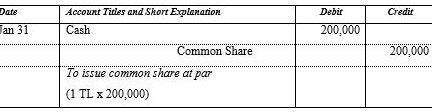
Seçenekler
A
On January 31, (A) Inc. issues 200,000 common shares. The common shares of (A) Inc. carry a par value of 1 TL per share.
B
On January 31, (A) Inc. issues an additional 300,000 common shares of the 1 TL par value common share for cash at 3 TL per share.
C
On January 31, (A) issues 100,000 no-par common shares per share for cash at 2 TL per share.
D
On January 31, (A) issues 10,000 common shares that carry 1 TL stated value per share for cash at 20 TL per share.
E
On January 31, (A) purchased 200,000 previously issued common share at 1 TL.
Açıklama:
Assume that on January 31, 2018, (A) Inc. authorizes 500,000,000 common shares and then issues 200,000 common shares. The common shares of (A) Inc. carry a par value of 1 TL per share. The journal entry, then, as follows:
To record issuance of common share at par value, an asset account, and a new equity account will be used.
Assume that on January 31, 2018, (A) Inc. authorizes 500,000,000 common shares and then issues 200,000 common shares. The common shares of (A) Inc. carry a par value of 1 TL per share. The journal entry, then, as follows:
Date | Account Titles and Short Explanation | Debit | Credit | |
Jan 31 | Cash | 200,000 | ||
Common Share | 200,000 | |||
To issue common share at par |
To record issuance of common share at par value, an asset account, and a new equity account will be used.
Assume that on January 31, 2018, (A) Inc. authorizes 500,000,000 common shares and then issues 200,000 common shares. The common shares of (A) Inc. carry a par value of 1 TL per share. The journal entry, then, as follows:
Soru 37
Slide, Inc. issues 1,000 shares of $1 par value common stock. Which of the following statement is correct if 1,000 shares are issued for $5 per share?
Seçenekler
A
Paid-in Capital in Excess of Par Common account will be credited for 4.000
B
Paid-in Capital in Excess of Par_Common Stock account will be credited for 5.000
C
Common Stock account will be credited for 4.000
D
Common Stock account will be credited for 5.000
E
Retained Earnings account will be credited for 4.000
Açıklama:
“Paid-in Capital in Excess of Par-Common” account represents the total amount received from shareholders above par value at which common shares are issued.
Common shares should be recorded at par value even if they have already issued with a different amount. Then a premium should be recorded in an equity account different than Common Share account is named “Paid-in Capital in Excess of Par-Common”.
Common shares should be recorded at par value even if they have already issued with a different amount. Then a premium should be recorded in an equity account different than Common Share account is named “Paid-in Capital in Excess of Par-Common”.
Soru 38
Which of the following shares do not have dividend rights or voting rights?
Seçenekler
A
Treasury shares
B
Common shares
C
No-par Common Shares
D
Stated Value-Common Shares
E
Premium Common Shares
Açıklama:
Treasury share is a corporation’s own share that has been repurchased and is being held for future use. In other words, treasury shares previously issued shares which have been reacquired by the corporation later. The corporation repurchasing its own shares from the shareholders. In the future, treasury shares may be resold or held for an indefinite time by the corporation.
Remember that outstanding shares are defined as the shares that have already issued and also held by shareholders before. If a corporation has treasury shares they should be subtracted from the number of outstanding shares because of treasury shares held by the corporation not by shareholders. With this perspective, treasury shares don’t have the right to vote and receive dividends as they are not outstanding shares.
Remember that outstanding shares are defined as the shares that have already issued and also held by shareholders before. If a corporation has treasury shares they should be subtracted from the number of outstanding shares because of treasury shares held by the corporation not by shareholders. With this perspective, treasury shares don’t have the right to vote and receive dividends as they are not outstanding shares.
Soru 39
Which of the following statement describes preferred share?
Seçenekler
A
A preferred share which gives shareholders certain preferences an advantage over common share.
B
A preferred share is a corporation’s own share that has been repurchased and is being held for future use.
C
A preferred share that sells for a very high price.
D
A preferred share that is sold to employees of the company as a performance incentive.
E
A preferred share that is sold higher than par value.
Açıklama:
Actually, the way of the accounting process in issuing for preferred shares is similar with common share’s accounting process.
A preferred share is already defined as a type of capital share that provides some advantages to its owner over a common share.
A preferred share is already defined as a type of capital share that provides some advantages to its owner over a common share.
Soru 40
Which of the following types of shares are considered as least risky for investors?
Seçenekler
A
preferred share
B
common share
C
common share at a premium
D
no-par common share
E
common share at a discount
Açıklama:
Declaring and distributing dividends depend on many factors, such as adequate retained earnings and the availability of cash. Therefore, having a dividend preference is an important advantage.
According to the agreements, a preferred share may provide some other priorities and privileges such as convertibility. But the most important priorities of a preferred share are “dividends” and “assets in the event of liquidation”.
According to the agreements, a preferred share may provide some other priorities and privileges such as convertibility. But the most important priorities of a preferred share are “dividends” and “assets in the event of liquidation”.
Soru 41
I. Sole proprietorship
II. Partnership
III. Corporation
IV. Company
Which of them are entities?
II. Partnership
III. Corporation
IV. Company
Which of them are entities?
Seçenekler
A
I, II
B
I, II, III
C
I, II, III, IV
D
III, IV
E
II, III, IV
Açıklama:
In accordance with this perspective the followings are examples of the most common types of entities:
• Sole proprietorship • Partnership • Corporation
• Sole proprietorship • Partnership • Corporation
Soru 42
What is the expiration of a proprietorship caused by?
Seçenekler
A
ends with death or choice of proprietor
B
ends with only death
C
Indefinite
D
ends only with the choice of proprietor
E
ends with shareholders' choice
Açıklama:
The expiration of a proprietorship is caused either by the proprietor’s death or his/her choice of ending it.
Soru 43
What is the smallest type of entity?
Seçenekler
A
Eterprise
B
Company
C
Partnership
D
Corporation
E
Proprietorship
Açıklama:
Proprietorship is owned by a single owner. This type of entity is the smallest and simplest one among the different types of entities.
Soru 44
What are the owner/owners of the limited liability partnership called?
Seçenekler
A
entrepreneurs
B
members
C
shareholders
D
owners
E
investors
Açıklama:
The owner/owners of the limited liability partnership are called member/ members.
Soru 45
Who owns corporations?
Seçenekler
A
Owners
B
Individuals
C
Shareholders
D
Partners
E
CEOs
Açıklama:
A corporation is a legal entity which is organized under state law and owned by shareholders.
Soru 46
Which one of the following is a disadvantage of a corporation?
Seçenekler
A
Corporations are separate legal entities. They are organized independently of their shareholders.
B
Shareholders have limited liability in corporation
C
Corporations have continuous lives.
D
Transferability of ownership is easy in corporations in comparison to other types of entities
E
Tere are greater regulations for corporations in comparison to other types of entities.
Açıklama:
The statement in E option is a disadvantage.
Soru 47
Which one of the following is not a right granted to shareholders in a corporation?
Seçenekler
A
Vote
B
Sharing information
C
Dividends
D
Liquidation
E
Preemption
Açıklama:
Receiving information is a right granted to shareholders.
Soru 48
What is the maximum number of shares that the corporation may issue is called?
Seçenekler
A
Preferred Share
B
Common Share
C
Outstanding Share
D
Authorized Share
E
Issued Share
Açıklama:
In charter, the maximum number of shares that the corporation may issue is determined. This number in total which is allowed by charter is named as “Authorized Share”.
Soru 49
What is the nominal value assigned by a corporation to its shares called?
Seçenekler
A
Par value
B
No-par value
C
Stated value
D
Market value
E
Authorized value
Açıklama:
Par value” is the nominal value assigned by a corporation to its shares in the charter.
Soru 50
A corporation may repurchase its own shares in some cases abide by the legal boundaries. What are these shares called?
Seçenekler
A
Preferred Shares
B
Treasury Shares
C
Common Shares
D
Issued Shares
E
Outstanding Shares
Açıklama:
A corporation may repurchase its own shares in some cases abide by the legal boundaries. These shares are named as Treasury Shares.
Soru 51
"............... is an entity owned by a single owner."
Which of the following best completes the space left blank in the above sentence?
Which of the following best completes the space left blank in the above sentence?
Seçenekler
A
Corporation
B
Partnership
C
Proprietorship
D
Consorsium
E
Joint Venture
Açıklama:
Proprietorship is an entity owned by a single owner.
Soru 52
I. Sole Proprietorship
II. Partnership
III. Corporation
Which of the above is/are ends with death or choice of it's owner(s)?
II. Partnership
III. Corporation
Which of the above is/are ends with death or choice of it's owner(s)?
Seçenekler
A
Only I
B
Only III
C
I and II
D
II and III
E
I, II and III
Açıklama:
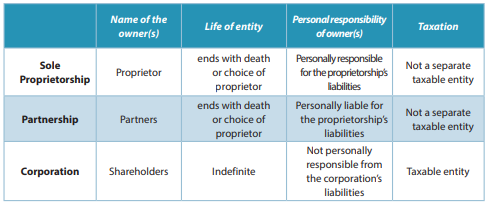
Soru 53
I. Sole Proprietorship
II. Partnership
III. Corporation
Which of the above's owners is/are not personally responsible from the corporation’s liabilities?
II. Partnership
III. Corporation
Which of the above's owners is/are not personally responsible from the corporation’s liabilities?
Seçenekler
A
Only I
B
Only III
C
I and II
D
II and III
E
I, II and III
Açıklama:
Soru 54
I. Sole Proprietorship
II. Partnership
III. Corporation
Which of the above is/are not a separate taxable entity?
II. Partnership
III. Corporation
Which of the above is/are not a separate taxable entity?
Seçenekler
A
Only I
B
Only III
C
I and II
D
II and III
E
I, II and III
Açıklama:
Soru 55
Which of the following does not take place in the advantages of a corporation?
Seçenekler
A
Corporations are separate legal entities
B
Shareholders have limited liability in corporations
C
Corporations have continuous lives
D
Raising more capital can be easy in corporations in comparison to other types of entities.
E
Corporations may be subject to doubletaxation
Açıklama:
Based on the different characteristics of corporations, the advantages may be summarized as follows:
• Corporations are separate legal entities. They are organized independently of their shareholders.
• Shareholders have limited liability in corporations.
• Corporations have continuous lives.
• Transferability of ownership is easy in corporations in comparison to other types of entities.
• Raising more capital can be easy in corporations in comparison to other types of entities.
• Corporations are separate legal entities. They are organized independently of their shareholders.
• Shareholders have limited liability in corporations.
• Corporations have continuous lives.
• Transferability of ownership is easy in corporations in comparison to other types of entities.
• Raising more capital can be easy in corporations in comparison to other types of entities.
Soru 56
Which of the following does not take place in the shareholders’ rights in corporations?
Seçenekler
A
Vote
B
Dividends
C
Liquidation
D
Preemption
E
Audit
Açıklama:
Shareholders’ rights in corporations are vote, dividend, liquidation preemption and receiving information.
Soru 57
".............. is the share number in total that a corporation that a corporation is authorized to sell as indicated in its charter."
Which of the following best completes the space left blank in the above sentence?
Which of the following best completes the space left blank in the above sentence?
Seçenekler
A
Authorized share
B
Issued share
C
Outstanding shares
D
Capital share
E
Common share
Açıklama:
In charter, also the maximum number shares that the corporation may issue is determined. This number in total which is allowed by charter is named as “Authorized Share”.
Soru 58
Which of the following is the total amount above the par value of shares at which a share is issued?
Seçenekler
A
Loan
B
Interest
C
Income
D
Premium
E
Loss
Açıklama:
A “premium” is the total amount above par value at which a share is issued (sold).
Soru 59
Which of the following is a corporation’s own share that has been repurchased and is being held for future use?
Seçenekler
A
Capital Share
B
Common Shares
C
Dividends
D
Preferred Shares
E
Treasury Shares
Açıklama:
Treasury share is a corporation’s own share that has been repurchased and is being held for future use.
Soru 60
I. Common Share
II. Preferred Share
III. Treasury Share
Which of the above is/are reported as negative amount on the balance sheet?
II. Preferred Share
III. Treasury Share
Which of the above is/are reported as negative amount on the balance sheet?
Seçenekler
A
Only I
B
Only III
C
I and II
D
II and III
E
I, II and III
Açıklama:
Treasury Share account is a contra shareholders’ equity account. Treasury Share is reported as a negative amount on the balance sheet.
Soru 61
What is a partnership?
Seçenekler
A
A partnership is a formal arrangement by two or more parties to manage and operate a business and share its profits.
B
If you're a partner of a company, you run your own business as an individual and are self-employed.
C
A partnership is an entity organized under state law and owned by shareholders and banking.
D
A partnership all partners share liabilities, but distribution profits not equally.
E
A partnership is greater management skills, greater possibility of keeping competent employee, greater sources of financing, ease of formation, and freedom to manage.
Açıklama:
The important type of entity is a partnership which has at least two or more owners. In a partnership, the owners are called as partners. Partnerships are organized as small or medium size entities. Partnership is an entity owned by two or more owners. Partners are the owners of a partnership.
Soru 62
What are the responsibilities of a shareholders in a company?
Seçenekler
A
The shareholders are the owners of the company and provide banking relationship for credit and in return for potential dividends over the lifetime of the company.
B
Shareholders have limited liability for business debts and losses.
C
The main duty of shareholders is to pass resolutions at general meetings by voting in their shareholder capacity.
D
Shareholders do not get periodic interest payments or their original investment back from the company.
E
shareholders are people who own a share or percentage of a privately held company.
Açıklama:
Shareholders have limited liability for business debts and losses. The shareholders’ assets are protected from the debts and liabilities of the corporation.
Soru 63
What does a vote mean in a company?
Seçenekler
A
The shareholder is the top senior executive over management while the board chair holders is the head of the board of directors.
B
The shareholder is the top senior executive over management while the board chair holders is the head of the board of directors.
C
Shareholders elect a board of directors to make the company's major decisions, such as the number of shares to be issued to the public.
D
Board of Directors of a company can hold shares in the company.
E
Corporations are separate legal entities. They are organized independently of their shareholders
Açıklama:
Vote: Coequal shareholders legally own the corporation. They can manage the corporation indirectly through a board of directors they elect. Shareholders vote on some matters at shareholders’ meetings. In normal conditions, each share carries one vote.
Soru 64
What is the purpose of pre-emption?
Seçenekler
A
Shareholders have the right to access information related to the corporation.
B
When a corporation goes out, shareholders may receive their proportionate share of any asset that still remains.
C
Corporations are separate legal entities. They are organized independently of their shareholders.
D
Shareholders have the right to maintain their proportionate ownership in corporations.
E
Transferability of ownership is easy in corporations in comparison to other types of entities.
Açıklama:
Pre-emption: Shareholders have the right to maintain their proportionate ownership in corporations.
Soru 65
What does issued shares mean?
Seçenekler
A
Issue shares are the share number in total that a corporation that a corporation is authorized to sell as indicated in its charter
B
Authorized stock is the maximum number of shares a company can issue.
C
Issue shares are the shares that have already been issued and held by shareholders.
D
Issue shares refer to the funds that a company raises in exchange for issuing an ownership interest in the company in the form of shares
E
The share that has been issued by the corporation
Açıklama:
The number of authorized shares includes all issued and unissued shares. Thus, the share that has been issued by the corporation is called “issued share”.
Soru 66
What is the meaning of par value?
Seçenekler
A
Par value is the nominal value assigned by a corporation to its shares in the charter.
B
Par value share is the capital share that has no par value assigned to it.
C
Par value share is a share that assigned to an amount similar to non par value.
D
Par value is the face stated value of a bond.
E
Par value is the percentage of total loan portfolio that is at risk.
Açıklama:
Par value for a share refers to the nominal value stated in the corporate charter.
Soru 67
What are preferred shares and why are they preferred?
Seçenekler
A
Preferred shares are hybrid securities with both equity and non-fixed income characteristics
B
The most important priorities of a preferred share are “dividends” and “assets in the event of liquidation”.
C
A preferred share represents an fix rate bank interest
D
They pay dividends at a fixed rate, preferred can lose value if interest rates climb.
E
Preferred stock is ownership in the company.
Açıklama:
The first important advantage of a preferred share is dividend preference. preferred shareholders have the right to share in the distribution of corporation’s income before common shareholders. The second important advantage of a preferred share is liquidation preference. Most preferred shares have a preference on corporations’ assets if the corporation fails.
Soru 68
What is the characteristics of treasury shares?
Seçenekler
A
Treasury share part and preferred share part should be presented separately on the balance full stop is necessary.
B
Treasury share should be used while recording preferred shares.
C
Treasury share is a corporation’s own share that has been repurchased and is being held for future use.
D
A Treasury share is defined as a type of capital share that provides some advantages to its owner over a common share.
E
Treasury shares are the shares which are bought back by a commercial bank.
Açıklama:
Treasury share is a corporation’s own share that has been repurchased and is being held for future use. In other words, treasury shares are previously issued shares which have been reacquired by the corporation later. The corporation repurchases its own shares from the shareholders. In the future, treasury shares may be resold or held for an indefinite time by the corporation.
Soru 69
What can treasury shares be used for?
Seçenekler
A
Acquisition or buying of competing businesses.
B
To pay off debt from past investments.
C
To obtain equity financing without sacrificing voting rights.
D
To raise funds or pay for future investments for the company.
E
The company redeems shares when it decides to pay back the shareholders.
Açıklama:
Treasury shares are previously issued shares which have been reacquired by the corporation later. The corporation repurchases its own shares from the shareholders. In the future, treasury shares may be resold, future investment or held for an indefinite time by the corporation.
Soru 70
Where is the capital paid from the treasury share reported?
Seçenekler
A
Section of an income statement.
B
Section of a common share.
C
Section of a preferred share
D
Section of a capital share
E
Section of a corporation’s balance sheet.
Açıklama:
As a second possibility in a sale, treasury share may be resold above cost. In this case, there will be a difference between the cost and the sale price of the treasury share. If the sale price is higher than the cost of treasury share, this positive difference should be recorded in a new shareholders’ equity account named “Paid-in Capital from Treasury Share”. Paid-in Capital from Treasury Share is reported in the Paid-in Capital section of a corporation’s balance sheet.
Soru 71
Which of the following statements is FALSE about proprietorships?
Seçenekler
A
A proprietorship is owned by a single owner.
B
A proprietorship is the smallest and simplest types of entity.
C
A proprietorship is regarded as a separate taxable entity.
D
A proprietorship can be ended by the owner’s choice of ending it.
E
Proprietor (owner) is personally liable for the proprietorship’s liabilities.
Açıklama:
The first one is proprietorship which is owned by a single owner. This type of entity is the smallest and simplest one among the different types of entities. The owner of proprietorship is called as proprietor and his or her equity can be seen as only one item in owner’s equity section of the balance sheet. The expiration of a proprietorship is caused either by the proprietor’s death or his/her choice of ending it. Also, the proprietor is personally liable for the proprietorship’s liabilities. However, the accounting process of the proprietorship is separate from the personal records of the proprietor. Another important characteristic is about taxation. A proprietorship is not a separate taxable entity. The proprietor pays tax on the income of proprietorship.
The correct answer is C.
The correct answer is C.
Soru 72
Which of the following statements is TRUE about partnerships?
Seçenekler
A
A partnership has one or more owners.
B
Partnerships are the largest entities.
C
Partnership continues despite the death of the partners.
D
The partners are personally liable for the partnership’s liabilities.
E
Partnerships are considered as separate taxable entities.
Açıklama:
The second type of entity is a partnership which has at least two or more owners. In a partnership, the owners are called as partners. Partnerships are organized as small or medium size entities.
Similar to proprietorship, the cancellation of the partnership may be caused either by one of the partners’ death or choice of cancelling it and the partners are personally liable for the partnership’s liabilities. Surely, based on the entity concept the accounting process of a partnership is separate from the personal records of the partners. Partnerships are not separate taxable entities.3 Being responsible for the partnership’s liability is an important disadvantage for the partners. Especially if the number of the partners are high, it may be riskier. If a partner commits fraud or if there is a black hole because of a failure of one partner in the partnership, the result of these all negative possibilities may affect all of the partners. The correct answer is D.
Similar to proprietorship, the cancellation of the partnership may be caused either by one of the partners’ death or choice of cancelling it and the partners are personally liable for the partnership’s liabilities. Surely, based on the entity concept the accounting process of a partnership is separate from the personal records of the partners. Partnerships are not separate taxable entities.3 Being responsible for the partnership’s liability is an important disadvantage for the partners. Especially if the number of the partners are high, it may be riskier. If a partner commits fraud or if there is a black hole because of a failure of one partner in the partnership, the result of these all negative possibilities may affect all of the partners. The correct answer is D.
Soru 73
Which of the following statements is TRUE about corporations?
Seçenekler
A
Shareholders are personally responsible for the corporation’s liabilities.
B
Shareholders can transfer corporation’s shares to another one.
C
The cancellation of the corporation depends on the death of any shareholder.
D
The withdrawal of a shareholder puts an end to the corporation.
E
The creditors can make any claim on shareholders’ personal assets.
Açıklama:
As an important characteristic, shareholders are not personally responsible for the corporation’s liabilities. This means that shareholders’ possible loss is limited with their capital investment. Hence, the creditors cannot make any claim on shareholders’ personal assets. This characteristic of corporation is essential for the shareholders because their personal assets are protected and the corporation may raise may raise more capital from shareholders. Also, the government and related regulators design more regulations and try to monitor corporations to protect shareholders’ and creditors’ claims. Another characteristic is the transferability of the shares. This characteristic is essential for shareholders since it is flexible. They can transfer corporation’s shares to another one. The cancellation of the corporation does not depend on the death of any shareholder or their choices to cancel it. In other words, the corporation is a permanent organization. The transfer of the shares, anyone’s death or withdrawal do not put an end to the corporation. Another distinguishing difference of a corporation is about taxation. Corporations are taxable entities. The correct answer is B.
Soru 74
Which of the following indicates to the shareholders’ right to receive their proportionate share of any asset that still remains when a corporation goes out?
Seçenekler
A
Vote
B
Dividends
C
Preemption
D
Liquidation
E
Receiving Information
Açıklama:
Liquidation: When a corporation goes out, shareholders may receive their proportionate share of any asset that still remains. The correct answer is D.
Soru 75
Which of the following indicates to the shareholders’ right to receive a proportionate of some dividend when declared?
Seçenekler
A
Liquidation
B
Receiving information
C
Preemption
D
Vote
E
Dividends
Açıklama:
Dividends: When declared, shareholders receive a proportionate of some dividend. Generally, each share receives an equal amount of dividend. The correct answer is E.
Soru 76
Which of the following refers to the total amount of contribution to the corporation by shareholders?
Seçenekler
A
Paid-in Capital
B
Stated Value Share
C
Preferred Share
D
Par Value
E
Retained Earnings
Açıklama:
As it is known, owners’ equity means shareholders’ equity in a corporation. The structure of the shareholders’ equity is very important for a corporation. There may be two different sources for a shareholders’ equity: First one is “Paid-in Capital (or contributed capital)” which represents the total amount of contribution to the corporation by shareholders. In other words, it represents the total amount of assets received from shareholders. Thus, it is generated from external parties. The correct answer is A.
Soru 77
What is the amount that is received from issuing shares called?
Seçenekler
A
Earned capital
B
Preferred share
C
Market value
D
Stated value share
E
Issue price
Açıklama:
After selling their issues to the shareholders, corporations receive an amount for shares. The amount that is received from issuing shares is called issue price. The correct answer is E.
Soru 78
Which of the following refers to a special share that provides its owner some advantages more than a common share does?
Seçenekler
A
Preferred Shares
B
Stated Value Share
C
Treasury Shares
D
Outstanding Shares
E
Par Value Share
Açıklama:
But a “preferred share” is a special share that provides its owner some advantages more than a common share does. For example, preferred shareholders can receive dividends before the others or in a liquidation, preferred shareholders can receive remaining assets before the others. Corporations issue common share and according to their preference, they may also issue some preferred shares. In this case, share capital consists of common and preferred shares. The correct answer is A.
Soru 79
I. to avoid a takeover and be cautious about outsiders.
II. to reissue the shares to employees and reward them.
III. to resell its own shares with a higher price.
Which of the above are among the possible reasons for a corporation to repurchase its own shares?
II. to reissue the shares to employees and reward them.
III. to resell its own shares with a higher price.
Which of the above are among the possible reasons for a corporation to repurchase its own shares?
Seçenekler
A
I.
B
II.
C
I. and II.
D
II. and III.
E
I., II., and III.
Açıklama:
There may be several reasons for a corporation to repurchase its own shares, but the main possible reasons may be summarized as follows:
The management of the corporation may want;
• to avoid a takeover and be cautious about outsiders.
• to reissue the shares to employees and reward them.
• to promote the price of the shares by increasing the trading of the shares.
• to resell its own shares with a higher price.
• to reduce the number of outstanding shares for some ratio analysis.
The correct answer is E.
The management of the corporation may want;
• to avoid a takeover and be cautious about outsiders.
• to reissue the shares to employees and reward them.
• to promote the price of the shares by increasing the trading of the shares.
• to resell its own shares with a higher price.
• to reduce the number of outstanding shares for some ratio analysis.
The correct answer is E.
Soru 80
What is the total amount above par value at which a share is issued (sold)?
Seçenekler
A
Preferred share
B
Dividend
C
Premium
D
Treasury share
E
Authorized share
Açıklama:
A “premium” is the total amount above par value at which a share is issued (sold). A premium on the issue of stock is not a gain, income, or profit for the corporation because the company is dealing with its own stock. The correct answer is C.
Soru 81
A partnership possesses which of the following characteristics?
Seçenekler
A
A partnership is owned by shareholders or stockholders.
B
If a partnership cannot pay its debts, lenders cannot take the owners' personal assets to satisfy the obligations.
C
A partnership joins two or more individuals as co-owners.
D
Corporate shareholders have limited liability for the debts of the corporation.
E
Most corporations are big sized.
Açıklama:
CHARACTERISTICS OF A CORPORATIONS AND OTHER TYPES OF ENTITIES
Partnership is an entity owned by two or more owners.The second type of entity is a partnership which has at least two or more owners. In a partnership, the owners are called as partners. Partnerships are organized as small or medium size entities.
Partnership is an entity owned by two or more owners.The second type of entity is a partnership which has at least two or more owners. In a partnership, the owners are called as partners. Partnerships are organized as small or medium size entities.
Soru 82
A proprietorship possesses which of the following characteristics?
Seçenekler
A
A proprietorship has a single owner.
B
A proprietorship joins two or more individuals as co-owners.
C
If a proprietorship cannot pay its debts, lenders cannot take the owners' personal assets to satisfy the obligations.
D
A partnership joins two or more individuals as co-owners.
E
A corporation is usually managed by the owners.
Açıklama:
CHARACTERISTICS OF A CORPORATIONS AND OTHER TYPES OF ENTITIES
The first one is proprietorship which is owned by a single owner. This type of entity is the smallest and simplest one among the different types of entities.
The first one is proprietorship which is owned by a single owner. This type of entity is the smallest and simplest one among the different types of entities.
Soru 83
MR. Brown has owned and operated a bicycle sales and repair shop for many years. Which of the following business types would provide the owner's personal assets with protection from product liability exposure?
Seçenekler
A
Partnership
B
Limited liability company
C
Proprietorship
D
Limited liability partnership
E
corporation
Açıklama:
CHARACTERISTICS OF A CORPORATIONS AND OTHER TYPES OF ENTITIES
Partnership (LLP) occurs. The owner/owners of the limited liability partnership are called member/members.4 In a Limited Liability Partnerships, all of the members have limited liability. Thus, a Limited Liability Partnership can protect other members from negative possibilities like unethical behaviors that result from some members.
Partnership (LLP) occurs. The owner/owners of the limited liability partnership are called member/members.4 In a Limited Liability Partnerships, all of the members have limited liability. Thus, a Limited Liability Partnership can protect other members from negative possibilities like unethical behaviors that result from some members.
Soru 84
Which of the following is a major reason that corporate ownership is popular?
Seçenekler
A
Most corporations are small or medium-sized.
B
The life of a corporation is limited by the death of an owner.
C
A corporation is usually managed by the owners.
D
A partnership joins two or more individuals as co-owners.
E
Corporate shareholders have limited liability for the debts of the corporation.
Açıklama:
Characteristics of a Corporations
A corporation is a legal entity which is organized under state law and owned by shareholders. Thus, the owners in a corporation are called shareholders. A person or an organization may own some certificate that represents the ownership in a corporation named shares of a corporation and called shareholders. Generally, corporations are organized as very large entities and sometimes their shares can be purchased on an organized stock exchange market. These are called publicly held corporations. In this case, a corporation may have many shareholders.
A corporation is a legal entity which is organized under state law and owned by shareholders. Thus, the owners in a corporation are called shareholders. A person or an organization may own some certificate that represents the ownership in a corporation named shares of a corporation and called shareholders. Generally, corporations are organized as very large entities and sometimes their shares can be purchased on an organized stock exchange market. These are called publicly held corporations. In this case, a corporation may have many shareholders.
Soru 85
Which one is not one of the advantages of a Corporation?
Seçenekler
A
Corporations have continuous lives.
B
Transferability of ownership is easy in cor-porations in comparison to other types of entities.
C
Shareholders have limited liability in cor-porations.
D
There are greater regulations for corporations in comparison to other types of entities
E
Corporations are separate legal entities. They are organized independently of their shareholders
Açıklama:
Advantages and Disadvantages of a Corporation
Advantages
• Corporations are separate legal entities. They are organized independently of their shareholders
• Shareholders have limited liability in cor-porations.
• Corporations have continuous lives.
• Transferability of ownership is easy in cor-porations in comparison to other types of entities.
• Raising more capital can be easy in cor-porations in comparison to other types of entities.
Advantages
• Corporations are separate legal entities. They are organized independently of their shareholders
• Shareholders have limited liability in cor-porations.
• Corporations have continuous lives.
• Transferability of ownership is easy in cor-porations in comparison to other types of entities.
• Raising more capital can be easy in cor-porations in comparison to other types of entities.
Soru 86
Which one is not one of the Shareholders’ Rights in Corporations?
Seçenekler
A
vote,
B
dividend,
C
liquidation
D
receiving information
E
non preemption
Açıklama:
Shareholders’ Rights in Corporations
The general rights of shareholders in a corporation are summarized:
• Vote: Coequal shareholders legally own the corporation. They can manage the corpora-tion indirectly through a board of directors they elect. Shareholders vote on some mat-ters at shareholders’ meetings. In normal conditions, each share carries one vote.
• Dividends: When declared, shareholders receive a proportionate of some dividend. Generally, each share receives an equal amount of dividend.
• Liquidation: When a corporation goes out, shareholders may receive their proportion-ate share of any asset that still remains.
• Preemption: Shareholders have the right to maintain their proportionate ownership in corporations.
• Receiving Information: Shareholders have the right to access information related to the corporation
The general rights of shareholders in a corporation are summarized:
• Vote: Coequal shareholders legally own the corporation. They can manage the corpora-tion indirectly through a board of directors they elect. Shareholders vote on some mat-ters at shareholders’ meetings. In normal conditions, each share carries one vote.
• Dividends: When declared, shareholders receive a proportionate of some dividend. Generally, each share receives an equal amount of dividend.
• Liquidation: When a corporation goes out, shareholders may receive their proportion-ate share of any asset that still remains.
• Preemption: Shareholders have the right to maintain their proportionate ownership in corporations.
• Receiving Information: Shareholders have the right to access information related to the corporation
Soru 87
What does it means of the transferable units that represent the ownership of a corporation?
Seçenekler
A
Capital share
B
Side note
C
Authorized Share
D
Issued Share
E
Outstanding Shares
Açıklama:
Shareholders’ Equity in Corporations
Capital share means the transferable units thatrepresent the ownership of a corporation.
Capital share means the transferable units thatrepresent the ownership of a corporation.
Soru 88
What does it means of the Paid-in capital?
Seçenekler
A
it is the earned amount which is not distributed to the shareholders as dividends.
B
the nominal value stated in the corporate charter
C
the total amount of contribution to the corporation by shareholders.
D
the capital share that has no par value assigned to it.
E
the shares that have already been issued and held by shareholders
Açıklama:
Sources of Shareholders’ Equity
“Paid-in Capital(or contributed capital)” which represents the total amount of contribution to the corporation by shareholders. In other words, it represents the total amount of assets received from shareholders. Thus, it is generated from external parties.
“Paid-in Capital(or contributed capital)” which represents the total amount of contribution to the corporation by shareholders. In other words, it represents the total amount of assets received from shareholders. Thus, it is generated from external parties.
Soru 89
What is the amount received from the issuance of share?
Seçenekler
A
Retained Earnings
B
initial public offering
C
contributed capital
D
Founder shares
E
issue price
Açıklama:
ISSUANCE OF SHARES
After selling their issues to the shareholders, corporations receive an amount for shares. The amount that is received from issuing shares is called issue price. Usually, the issue price will be higher than the par value.
After selling their issues to the shareholders, corporations receive an amount for shares. The amount that is received from issuing shares is called issue price. Usually, the issue price will be higher than the par value.
Soru 90
Which is not one of the reasons for a corporation to repurchase its own shares?
Seçenekler
A
to avoid a takeover and be cautious about outsiders.
B
to reissue the shares to employees and reward them.
C
to raise the number of outstanding shares for some ratio analysis
D
to promote the price of the shares by in-creasing the trading of the shares.
E
to resell its own shares with a higher price.
Açıklama:
Definition and Characteristics of Treasury Shares
There may be several reasons for a corporation to repurchase its own shares, but the main possible reasons may be summarized as follows:
The management of the corporation may want;
• to avoid a takeover and be cautious about outsiders.
• to reissue the shares to employees and reward them.
• to promote the price of the shares by in-creasing the trading of the shares.
• to resell its own shares with a higher price.
• to reduce the number of outstanding shares for some ratio analysis
There may be several reasons for a corporation to repurchase its own shares, but the main possible reasons may be summarized as follows:
The management of the corporation may want;
• to avoid a takeover and be cautious about outsiders.
• to reissue the shares to employees and reward them.
• to promote the price of the shares by in-creasing the trading of the shares.
• to resell its own shares with a higher price.
• to reduce the number of outstanding shares for some ratio analysis
Ünite 7
Soru 1
Which of the following is the amount earned through profitable operations of corporations and that is kept in the corporation?
Seçenekler
A
Retained earnings
B
Cash dividend
C
Book value
D
Return on equity
E
Comprehensive income
Açıklama:
Retained earnings is the amount earned through profitable operations of corporations and that is kept in the corporation?
Soru 2
If a corporation wants to pay cash dividends, Which of the following conditions are required below?
- Sufficient retained earnings
- Adequate cash
- Declared dividends by the board of directors
Seçenekler
A
Yalnız I
B
I ve II
C
II ve III
D
I ve III
E
I, II ve III
Açıklama:
If a corporation wants to pay cash dividends, three conditions required are as follows:
1. Sufficient retained earnings
2. Adequate cash
3. Declared dividends by the board of directors
The correct answer is E.
1. Sufficient retained earnings
2. Adequate cash
3. Declared dividends by the board of directors
The correct answer is E.
Soru 3
Anadolu Inc has 50,000 outstanding preferred shares of 7%, 15 TL par preferred share. Calculate the preferred dividend.
Seçenekler
A
45,000 TL
B
47,500 TL
C
50,000 TL
D
52,500 TL
E
55,000 TL
Açıklama:
The preferred dividend = Outstanding preferred shares x Par value x Preferred dividend rate
50,000 x 15 x 7% = 52,500 TL
The correct answer is D.
50,000 x 15 x 7% = 52,500 TL
The correct answer is D.
Soru 4
Anadolu Inc has 77,000 outstanding preferred shares of 13%, 12 TL par preferred share. Calculate the preferred dividend.
Seçenekler
A
100,600 TL
B
102,400 TL
C
108,360 TL
D
114,850 TL
E
120,120 TL
Açıklama:
The preferred dividend = Outstanding preferred shares x Par value x Preferred dividend rate
77,000 x 12 x 13% = 120,120 TL
77,000 x 12 x 13% = 120,120 TL
Soru 5
Which of the following is a distribution of a corporation’s own shares to the shareholders as dividends?
Seçenekler
A
Book value
B
Cash dividend
C
Share dividend
D
Cumulative preferred share
E
Preferred dividend
Açıklama:
Share dividend is a distribution of a corporation’s own shares to the shareholders as dividends. The correct answer is C.
Soru 6
Which of the following is a measure of a corporation’s profitability that presents how much profit it generates with each item (TL) of shareholders’ equity?
Seçenekler
A
Paid-in Capital
B
Comprehensive Income
C
Book Value Per Share
D
Earnings Per Share
E
Return on Equity
Açıklama:
Return on Equity is a measure of a corporation’s profitability that presents how much profit it generates with each item (TL) of shareholders’ equity. The correct answer is E.
Soru 7
How can Return on Equity be calculated?
Seçenekler
A
Return Equity=Net Income/Average shareholders' equity
B
Return Equity=Average shareholders' equity/Net Income
C
Return Equity=(Net Income-Preferred dividends)/Average shareholders' equity
D
Return Equity=Net Income/Earnings Per Share
E
Return Equity=(Total shareholders' equity-Preference equity)/Number of common shares outstanding
Açıklama:
Return Equity=Net Income/Average shareholders' equity
The correct answer is A.
The correct answer is A.
Soru 8
Which of the following is all changes in the shareholders’ equity from all sources except owners’ investments and dividends?
Seçenekler
A
Share dividends
B
Share Splits
C
Comprehensive income
D
Statement of shareholders’ equity
E
Restriction on retained earnings
Açıklama:
A Comprehensive income is all changes in the shareholders’ equity from all sources except owners’ investments and dividends. The correct answer is C.
Soru 9
Which of the following is a financial report that represents the details about the changes in shareholders’ equity for a period of time?
Seçenekler
A
Retained Earning
B
Statement of shareholders’ equity
C
Share split
D
Return on Equity
E
Comprehensive income
Açıklama:
Statement of shareholders’ equity is a financial report that represents the details about the changes in shareholders’ equity for a period of time. The correct answer is B.
Soru 10
Which of the following represents the amount of the owner’s equity on the corporation’s books for each common share?
Seçenekler
A
Earnings Per Share
B
Book value per share
C
Return on Equity
D
Preferred dividends
E
Average shareholders' equity
Açıklama:
Book value per share represents the amount of the owner’s equity on the corporation’s books for each common share. The correct answer is B.
Soru 11
What is the amount that is earned through profitable operations of corporations and kept in the corporation?
Seçenekler
A
Sales revenue
B
Net income
C
Dividends
D
Retained earnings
E
Paid-in capital
Açıklama:
The term "Retained Earnings" represents the amount earned through profitable operations of a corporation and that is kept in the corporation. The correct answer is D.
Soru 12
What is a distribution of some portion of earnings to the shareholders by a corporation?
Seçenekler
A
Retained earning
B
Net income
C
Deficit
D
Dividend
E
Debit
Açıklama:
Dividends are distributions of cash, other property, or share of the business to the shareholders of a corporation on a pro rata (proportional to ownership) basis. In other words, a dividend is a distribution of some portion of earnings to the shareholders by a corporation. The correct answer is D.
Soru 13
I. Sufficient retained earnings
II. Adequate cash
III. Debit balance
IV. Declared dividends by the board of directors
If a corporation wants to pay cash dividends, which of the things above are required?
II. Adequate cash
III. Debit balance
IV. Declared dividends by the board of directors
If a corporation wants to pay cash dividends, which of the things above are required?
Seçenekler
A
I and II
B
I, II and III
C
I, II and IV
D
II, III and IV
E
II and IV
Açıklama:
If a corporation wants to pay cash dividends, three conditions required are as follows: 1. Sufficient retained earnings 2. Adequate cash 3. Declared dividends by the board of directors. The correct answer is C.
Soru 14
A company has 50,000 outstanding preferred shares of 5%, 10 TL par preferred share. In this case, what is the preferred dividend?
Seçenekler
A
5.000
B
25.000
C
50.000
D
500.000
E
1.000.000
Açıklama:
Usually, the dividend rate on preferred shares is expressed as a percentage of preferred share par value (such as 5%) on the certificate.
The preferred dividend is calculated as follow: The preferred dividend = Outstanding preferred shares x Par value x Preferred dividend rate
50,000 x 10 x 5% = 25,000 TL
The preferred dividend is calculated as follow: The preferred dividend = Outstanding preferred shares x Par value x Preferred dividend rate
50,000 x 10 x 5% = 25,000 TL
Soru 15
A company has already determined the total dividend of 200,000 TL. The preferred dividend for this case is also know as 40.000. What is the common share dividend?
Seçenekler
A
40.000
B
80.000
C
120.000
D
160.000
E
200.000
Açıklama:
Then the common dividend amount is calculated just by subtracting the preferred dividend. Then the remaining amount will be the common share dividend amount:
200.000- 40.000 = 160.000
200.000- 40.000 = 160.000
Soru 16
What is a distribution of a corporation’s own shares to the shareholders as dividends?
Seçenekler
A
Dividend
B
Cash dividend
C
Share dividend
D
Preferred dividend
E
Dividend in arrears
Açıklama:
The second popular way to distributing dividends to the shareholders is to share dividends. In this case, the distributed item is different than cash dividends. Share dividend is a distribution of a corporation’s own shares to the shareholders as dividend. The correct answer is C.
Soru 17
Which of the following is not a component of comprehensive income?
Seçenekler
A
Owners’ investments
B
Foreign-currency translation adjustments
C
Gains (losses) from post-retirement benefit plans
D
Deferred gains (losses) derivatives
E
Unrealized gains or losses
Açıklama:
A Comprehensive income is all changes in the shareholders’ equity from all sources except owners’ investments and dividends.Comprehensive income components are as follows:14 • Unrealized gains or losses • Foreign-currency translation adjustments • Gains (losses) from post-retirement benefit plans • Deferred gains (losses) derivatives. The correct answer is A.
Soru 18
________ is a measure of a corporation’s profitability that presents how much profit it generates with each item (TL) of shareholders’ equity.
Which of the following completes the sentence best?
Which of the following completes the sentence best?
Seçenekler
A
Net income
B
Return on equity
C
Average shareholder's equity
D
Comprehensive income
E
Preferred dividend
Açıklama:
By some ratios, the relationship between shareholders’ equity items, their positions, results, and effects can be understood clearly. Thus the information on the financial statements can be used in some decision making processes.One of the ratios that is used for analysis is the Return on Equity (ROE). It measures a corporation’s profitability by presenting how much profit it generates with each item (TL) of shareholders’ equity. The correct answer is B.
Soru 19
What represents the amount of the owner’s equity on the corporation’s books for each common share?
Seçenekler
A
Book value per share
B
Earnings per share
C
Return on equity
D
Common shares outstanding
E
Return on investment
Açıklama:
Book value per share ratio is used to calculate the per share value of a corporation. In other words, it represents the amount of the owner’s equity on the corporation’s books for each common share. The correct answer is A.
Soru 20
What are the dividends which are greater than 20%-25% of the corporation’s issued shares called?
Seçenekler
A
Small share dividend
B
Large share dividends
C
Preffered dividends
D
Common share dividend
E
Cash dividends
Açıklama:
Large share dividends: These are the dividends which are greater than 20%-25% of the corporation’s issued shares. These types of dividends are rare. But, if a corporation decides on a large share dividend, par value or stated value should be used to record related transactions instead of market value because of the possible important effect of this transaction on the market price of the shares. The correct answer is B.
Soru 21
Which of the following is the term used for the amount earned through profitable operations of a corporation and that is kept in the corporation?
Seçenekler
A
Shareholders’ equity
B
Retained earnings
C
Current assets
D
Non-current assets
E
Short term liabilities
Açıklama:
Retained earnings represents the amount earned through profitable operations of a corporation and that is kept in the corporation. In other words, it is the earned amount which is not distributed to the shareholders as dividends.
Soru 22
Which of the following is the term used for the distributions from the earnings to the shareholders?
Seçenekler
A
Interest
B
Tax
C
Dividend
D
Cost
E
Income
Açıklama:
The distributions from the earnings to the shareholders is named as dividends.
Soru 23
Which of the following is the equation of retained earnings account’s credit balance?
Seçenekler
A
Lifetime earnings + lifetime losses + lifetime dividends
B
Lifetime earnings - lifetime losses + lifetime dividends
C
Lifetime earnings + lifetime losses - lifetime dividends
D
Lifetime earnings - lifetime losses - lifetime dividends
E
Lifetime losses - lifetime earnings + lifetime dividends
Açıklama:
Retained earnings account’s credit balance indicates that the corporation’s lifetime earnings exceed lifetime losses and dividends
Soru 24
Lifetime earnings: 1.000.000 TL
Lifetime losses: 200.000 TL
Lifetime dividends: 700.000 TL
According to the above; please calculate the retained earnings account’s credit balance of the firm.
Lifetime losses: 200.000 TL
Lifetime dividends: 700.000 TL
According to the above; please calculate the retained earnings account’s credit balance of the firm.
Seçenekler
A
100.000
B
300.000
C
500.000
D
800.000
E
1.500.000
Açıklama:
Retained earnings account’s credit balance indicates that the corporation’s lifetime earnings exceed lifetime losses and dividends.
1.000.000 - 200.000 - 700.000 = 100.000
1.000.000 - 200.000 - 700.000 = 100.000
Soru 25
I. Sufficient retained earnings
II. Adequate cash
III. Declared dividends by the board of directors
Which of the conditions above is/are necessary to pay cash dividends?
II. Adequate cash
III. Declared dividends by the board of directors
Which of the conditions above is/are necessary to pay cash dividends?
Seçenekler
A
Only I
B
Only II
C
I and II
D
II and III
E
I, II and III
Açıklama:
If a corporation wants to pay cash dividends, three conditions required are as follows:
1. Sufficient retained earnings
2. Adequate cash
3. Declared dividends by the board of directors
1. Sufficient retained earnings
2. Adequate cash
3. Declared dividends by the board of directors
Soru 26
Assume that (A) Inc has 50,000 outstanding preferred shares of 10%, 30 TL par preferred share. Given this, please calculate the preferred dividend.
Seçenekler
A
120,000
B
130,000
C
140,000
D
150,000
E
160,000
Açıklama:
The preferred dividend = Outstanding preferred shares x Par value x Preferred dividend rate
50,000 x 30 x 10% = 150,000 TL
50,000 x 30 x 10% = 150,000 TL
Soru 27
Which of the following is the term used for the preferred share that can also receive all dividends in arrears while receiving a new preferred dividend?
Seçenekler
A
Cumulative preferred share
B
Divided preferred share
C
Special preferred share
D
Total preferred share
E
Real preferred share
Açıklama:
A cumulative preferred share is a preferred share that can also receive all dividends in arrears while receiving a new preferred dividend.
Soru 28
Which of the following is the term used for the distribution of a corporation’s own shares to the shareholders as dividends?
Seçenekler
A
Cumulative dividents
B
Share dividends
C
Common dividends
D
Preferred dividends
E
Cash dividends
Açıklama:
Share dividend is a distribution of a corporation’s own shares to the shareholders as dividends.
Soru 29
Which of the following must be debited to record the declaration of a small share dividend with its market value?
Seçenekler
A
Cash Dividends
B
Common Share Dividend Distributable
C
Retained Earnings
D
Paid-in Capital in Excess of Par
E
Dividends payable
Açıklama:
To record the declaration of a small share dividend with its market value, the Retained Earnings account should be debited for market value. A shareholders’ equity account named Common Share Dividend Distributable is credited with the par or stated value and Paid-in Capital in Excess of Par is credited with the remaining amount.
Soru 30
Which of the following is not a component of comprehensive income
Seçenekler
A
Unrealized gains or losses
B
Foreign-currency translation adjustments
C
Gains (losses) from post-retirement benefit plans
D
Deferred gains (losses) derivatives
E
Average shareholders’ equity
Açıklama:
Comprehensive income components are as follows:
• Unrealized gains or losses
• Foreign-currency translation adjustments
• Gains (losses) from post-retirement benefit plans
• Deferred gains (losses) derivatives.
• Unrealized gains or losses
• Foreign-currency translation adjustments
• Gains (losses) from post-retirement benefit plans
• Deferred gains (losses) derivatives.
Soru 31
How do we call the amount which is earned through profitable operations of a corporation and kept in the corporation?
Seçenekler
A
Retained Earnings
B
Paid-in Capital
C
Net Income
D
Dividends
E
Profit share
Açıklama:
In other words, it is the earned amount which is not distributed to the shareholders as dividends as it is briefly mentioned before
The first source of shareholders’ equity part is Paid-in Capital which was discussed in the previous chapter. The second one is Retained Earnings that represents the amount earned through profitable operations of a corporation that keeps in the corporation.
The first source of shareholders’ equity part is Paid-in Capital which was discussed in the previous chapter. The second one is Retained Earnings that represents the amount earned through profitable operations of a corporation that keeps in the corporation.
Soru 32
Which of the following is internally generated equity in a corporation?
Seçenekler
A
Retained earnings
B
Shareholders’ equity
C
Paid-in Capital
D
additional paid-in capital
E
Paid-in Capital in Excess of Par-Common
Açıklama:
Retained earnings is an item of shareholders’ equity and it represents the shareholders’ claims on assets and shown on the shareholders’ equity part of the balance sheet.
Retained earnings represents the amount of the assets that generated through profitable operations of corporations and not distributed to the shareholders in the form of dividend. It means corporations retain some part of their net income in the corporation is internally generated equity because it results from corporate decisions to retain net income to be used in future operations or for expansion.
Retained earnings represents the amount of the assets that generated through profitable operations of corporations and not distributed to the shareholders in the form of dividend. It means corporations retain some part of their net income in the corporation is internally generated equity because it results from corporate decisions to retain net income to be used in future operations or for expansion.
Soru 33
If a corporation wants to pay cash dividends, which of the following should be considerd as an important condition by the management of corporation?
Seçenekler
A
Dividends will be paid from retained earnings, so management should evaluate whether corporation has suficient retained earnings.
B
Payment of dividends from paid-in capital will require cash so management should evaluate whether corporation has suficient paid-in capital.
C
In considering whether to declare cah dividends, managers must conclude that declaring dividends is only legally (both in accordance with the law and contract) desirable.
D
Corporations want to earn return or premium on their cash dividends.
E
Cash dividend distribution shall be started at the date of fiscal year end.
Açıklama:
Dividends will be paid from retained earnings. Payment of dividends from retained earnings is legal in all states. This is why a corporation has to have retained earnings at first while planning to pay cash dividends.
If a corporation wants to pay cash dividends, three conditions are as follows:
If a corporation wants to pay cash dividends, three conditions are as follows:
- Sufficient retained earnings
- Adequate cash
- Declared dividends by the board of directors
Soru 34
A share split will ......
Seçenekler
A
increase the number of issued and outstanding shares
B
decrease the amount of contributed capital
C
increase the amount of contributed capital
D
decrease retained earnings
E
increase retained earnings
Açıklama:
It is significantly different than Share Dividends. If a corporation decides to split its common shares 2 for 1, it has twice shares after the split and par value of per share is cut in half.
A share split is increasing the number of issued and outstanding shares of a corporation that results in decreasing of shares’ par value.
A share split is increasing the number of issued and outstanding shares of a corporation that results in decreasing of shares’ par value.
Soru 35
After the decision of paying dividends, three dates are important for a corporation. Which is the order in which the dates related to cash dividends occur?
Seçenekler
A
Declaration date, record date, and payment date.
B
Calculation date, payment date, and evaluation date
C
Earning date, payment date, and calculating date
D
Earning date, communicating date, and payment date
E
Communicating date, calculating date, and payment date
Açıklama:
As explained before, shareholders are waiting for reasonable returns but in some cases payment of dividends may cause some liquidity problems in the corporation. Thus the board of directors should evaluate all possible results of dividend distribution.
After the decision of paying dividends, three dates are important for a corporation. These are
Declaration date, the Record date, and Payment date.
After the decision of paying dividends, three dates are important for a corporation. These are
Declaration date, the Record date, and Payment date.
Soru 36
The Return on Equity (ROE) ratio measures a corporation’s ......
Seçenekler
A
profitability by presenting how much profit it generates with each item (TL) of shareholders’ equity.
B
dividends per share divided by earnings per share.
C
the dividend yield plus the capital gains yield.
D
how much income is earned for each common share
E
comprehensive income per each common share
Açıklama:
It can be calculated as follows:
Return on Equity (ROE) = Net Income / Average shareholders’ equity
Average shareholders’ equity can be calculated as an average amount of beginning and ending balance of shareholders’ equity
One of the ratios that is used for analysis is the Return on Equity (ROE). It measures a corporation’s profitability by presenting how much profit it generates with each item (TL) of shareholders’ equity
Return on Equity (ROE) = Net Income / Average shareholders’ equity
Average shareholders’ equity can be calculated as an average amount of beginning and ending balance of shareholders’ equity
One of the ratios that is used for analysis is the Return on Equity (ROE). It measures a corporation’s profitability by presenting how much profit it generates with each item (TL) of shareholders’ equity
Soru 37
Which type of dividend distribution involves the issue of new shares?
Seçenekler
A
Share dividends
B
Cash dividends
C
Scrip dividends
D
Liquidating dividends
E
Slit dividends
Açıklama:
When the company distributes share dividends, asset amount of company will not change. Items of the shareholders’ equity will be affected. In other words, the amount of issued and outstanding shares are also increasing and retained earnings are decreasing
Share dividend is a distribution of a corporation’s own shares to the shareholders as dividends.
Share dividend is a distribution of a corporation’s own shares to the shareholders as dividends.
Soru 38
The declaration date is the date on which:
Seçenekler
A
a liability occurs for a corporation, thus, a journal entry is required at that time.
B
the corporation determines the shareholders who will receive dividends.
C
dividend checks are mailed.
D
bank trustee approves a dividend payment.
E
holders of record are determined for a dividend payment.
Açıklama:
At first, on the declaration date a liability occurs for a corporation, thus, a journal entry is required at that time. Secondly, the corporation determines the shareholders who receive dividends separately on the record date. In this case, a new journal entry is not required because this determination has no financial effect. Finally, the corporation pays the dividend that is determined for the shareholders on the payment date and a new journal entry should be prepared because while paying dividends, corporation’s assets (cash) and
Soru 39
A payment made by a firm to its owners in the form of new shares is called a ......
Seçenekler
A
Share dividend.
B
Special dividend.
C
Normal dividend.
D
Split dividend.
E
Extraordinary dividend.
Açıklama:
If a corporation decides to distribute share dividends, assets, liabilities the total shareholders’ equity will not change
Share dividend is a distribution of a corporation’s own shares to the shareholders as dividends.
Share dividend is a distribution of a corporation’s own shares to the shareholders as dividends.
Soru 40
An increase in the number of shares outstanding which does not affect shareholders' equity is called a ........
Seçenekler
A
share split.
B
cash dividend.
C
share repurchase.
D
share investment.
E
treasury share.
Açıklama:
Briefly, the number of outstanding shares are increasing while the par values are decreasing in the same proportiona with a share split.
A share split is increasing the number of issued and outstanding shares of a corporation that results in decreasing of shares’ par value.
A share split is increasing the number of issued and outstanding shares of a corporation that results in decreasing of shares’ par value.
Soru 41
Which of the followings represents the amount earned through profitable operations of a corporation and that is kept in the corporation?
Seçenekler
A
Book value per share
B
Retained Earning
C
Dividend
D
Return on equity
E
Share dividend
Açıklama:
INTRODUCTION
Retained earnings is the amount earned through profitable operations of corporations and that is kept in the corporation
Retained earnings is the amount earned through profitable operations of corporations and that is kept in the corporation
Soru 42
Which of the following statements is not true regarding retained earnings?
Seçenekler
A
Retained earnings is internally generated equity because it results from corporate decisions.
B
Retained earnings is an item of shareholders’ equity and it represents the shareholders’ claims on assets.
C
Retained earnings are the assets and it is related to the corporation’s cash account.
D
Retained earnings and cash are separate accounts.
E
Retained earnings account’s credit balance indicates that the corporation’s lifetime earnings exceed lifetime losses and dividends.
Açıklama:
Retained earnings are not the assets themselves and it is not related to the corporation’s cash account.
Soru 43
Which of the followings is a distribution of some portion of earnings to the shareholders by a corporation?
Seçenekler
A
Book value per share
B
Comprehensive income
C
Earnings per share
D
Dividend
E
Return on equity
Açıklama:
ACCOUNTING FOR CASH DIVIDENDS
A dividend is a distribution of some portion of earnings to the shareholders by a corporation.
A dividend is a distribution of some portion of earnings to the shareholders by a corporation.
Soru 44
Which of the followings is current liability account in which debts about the preferred dividend and common dividend should be recorded?
Seçenekler
A
Dividends payable
B
Retained Earning
C
Cash dividend
D
Comprehensive income
E
Return on equity
Açıklama:
Recording Declaration and Payment of Cash Dividends
Dividend Payable accounts are current liability accounts in which debts about the preferred dividend and common dividend should be recorded.
Dividend Payable accounts are current liability accounts in which debts about the preferred dividend and common dividend should be recorded.
Soru 45
Which of the followings is a distribution of a corporation’s own shares to the shareholders as dividends?
Seçenekler
A
Comprehensive income
B
Cash dividend
C
Earnings per share
D
Return on equity
E
Share dividend
Açıklama:
ACCOUNTING FOR SHARE DIVIDENDS AND SHARE SPLITS
Share dividend is a distribution of a corporation’s own shares to the shareholders as dividends.
Share dividend is a distribution of a corporation’s own shares to the shareholders as dividends.
Soru 46
Which of the followings is not one of the comprehensive income components?
Seçenekler
A
Unrealized gains
B
Realized losses
C
Gains (losses) from post-retirement benefit plans
D
Deferred gains (losses) derivatives.
E
Foreign-currency translation adjustments
Açıklama:
EARNINGS AND EVALUATING RATIOS
Comprehensive income components are as follows:
Comprehensive income components are as follows:
- Unrealized gains or losses
- Foreign-currency translation adjustments
- Gains (losses) from post-retirement benefit plans
- Deferred gains (losses) derivatives.
Soru 47
Which of the followings measures a corporation’s profitability by presenting how much profit it generates with each item (TL) of shareholders’ equity?
Seçenekler
A
Book value per share
B
Cash dividend
C
Earnings per share
D
Retained earnings
E
Return on equity
Açıklama:
EARNINGS AND EVALUATING RATIOS
One of the ratios that is used for analysis is the Return on Equity (ROE). It measures a corporation’s profitability by presenting how much profit it generates with each item (TL) of shareholders’ equity.
One of the ratios that is used for analysis is the Return on Equity (ROE). It measures a corporation’s profitability by presenting how much profit it generates with each item (TL) of shareholders’ equity.
Soru 48
Which of the followings presents how much income is earned for each common share?
Seçenekler
A
Return on equity
B
Earnings per share
C
Cash dividend
D
Book value per share
E
Share splits
Açıklama:
EARNINGS AND EVALUATING RATIOS
Another ratio is Earnings Per Share (EPS) that presents how much income is earned for each common share.
Another ratio is Earnings Per Share (EPS) that presents how much income is earned for each common share.
Soru 49
Which of the followings represents the amount of the owner’s equity on the corporation’s books for each common share?
Seçenekler
A
Earnings Per Share
B
Return on Equity
C
Book value per share
D
Share dividend
E
Share splits
Açıklama:
EARNINGS AND EVALUATING RATIOS
Another ratio that may be considered is book value per share. This ratio is used to calculate the per share value of a corporation. In other words, it represents the amount of the owner’s equity on the corporation’s books for each common share.
Another ratio that may be considered is book value per share. This ratio is used to calculate the per share value of a corporation. In other words, it represents the amount of the owner’s equity on the corporation’s books for each common share.
Soru 50
Which of the followings is an amount of retained earnings that is unavailable for dividends?
Seçenekler
A
A restriction on retained earnings
B
Changes in Shareholders’ Equity
C
Earnings and Evaluating Ratios
D
Accounting for Cash Dividends
E
Accounting for Share Dividends and Share Splits
Açıklama:
RESTRICTIONS ON RETAINED EARNINGS
A restriction on retained earnings is an amount of retained earnings that is unavailable for dividends.
A restriction on retained earnings is an amount of retained earnings that is unavailable for dividends.
Soru 51
I. Retained Earnings represents the distributions from the earnings to the shareholders,
II. Retained Earnings represents the amount earned through profitable operations of a corporation and that is kept in the corporation,
III. Retained earnings account’s credit balance indicates that the corporation’s lifetime earnings exceed lifetime losses and dividends.
Which of the premises above is/are correct?
II. Retained Earnings represents the amount earned through profitable operations of a corporation and that is kept in the corporation,
III. Retained earnings account’s credit balance indicates that the corporation’s lifetime earnings exceed lifetime losses and dividends.
Which of the premises above is/are correct?
Seçenekler
A
Only I
B
I and II
C
II and III
D
I and III
E
I, II and III
Açıklama:
Retained Earnings represents the amount earned through profitable operations of a corporation and that is kept in the corporation. Retained earnings account’s credit balance indicates that the corporation’s lifetime earnings exceed lifetime losses and dividends. But, the distributions from the earnings to the shareholders is called dividends.
Soru 52
I. Retained earnings represents the amount of the assets that are generated through profitable operations of corporations
II. They are not distributed to the shareholders in the form of dividend.
II. They are internally generated equity because it results from corporate decisions to retain net income to be used in future operations or for expansion.
Which of the premises about retained earnings above are correct?
II. They are not distributed to the shareholders in the form of dividend.
II. They are internally generated equity because it results from corporate decisions to retain net income to be used in future operations or for expansion.
Which of the premises about retained earnings above are correct?
Seçenekler
A
Only I
B
I and II
C
II and III
D
I and III
E
I, II and III
Açıklama:
Retained earnings represents the amount of the assets that are generated through profitable operations of corporations and are not distributed to the shareholders in the form of dividend. It means corporations retain some part of their net income in the corporation. Retained earnings is internally generated equity because it results from corporate decisions to retain net income to be used in future operations or for expansion. Retained earnings is an item of shareholders’ equity and it represents the shareholders’ claims on assets and are shown on the shareholders’ equity part of the balance sheet.
Soru 53
I. A corporation closes its revenue accounts and expense accounts.
II. To close all the revenue accounts, they should be debited while Income Summary account is credited with the total amount of the revenues.
III. Contrarily, to close all the expense accounts they should be credited while the Income Summary account is debited with the total amount of the expenses.
IV. In the end, the financial result of the corporation (net income or net loss) for a specific accounting period could be seen on the balance of the Income Summary account.
Which of the premise(s) about the closing process occurs at the end of the accounting period above is/are correct?
II. To close all the revenue accounts, they should be debited while Income Summary account is credited with the total amount of the revenues.
III. Contrarily, to close all the expense accounts they should be credited while the Income Summary account is debited with the total amount of the expenses.
IV. In the end, the financial result of the corporation (net income or net loss) for a specific accounting period could be seen on the balance of the Income Summary account.
Which of the premise(s) about the closing process occurs at the end of the accounting period above is/are correct?
Seçenekler
A
I and III
B
II and IV.
C
III and IV.
D
I, II and IV
E
I, II, III and IV
Açıklama:
To understand the retained earnings account, recall the closing process at the end of the accounting period. A corporation closes its revenue accounts and expense accounts. To close all the revenue accounts, they should be debited while Income Summary account is credited with the total amount of the revenues. Thus, the total amount of revenues for an accounting period could be seen on the credit side of the Income Summary account. Contrarily, to close all the expense accounts they should be credited while the Income Summary account is debited with the total amount of the expenses. Thus, the total amount of expenses for an accounting period could be seen on the debit side of the Income Summary account. In the end, the financial result of the corporation (net income or net loss) for a specific accounting period could be seen on the balance of the Income Summary account.
Soru 54
I. Profitable corporations may make distributions to their shareholders in the form of dividends.
II. Dividends are distributions of cash, other property, or share of the business to the shareholders of a corporation on a pro rata (proportional to ownership) basis.
III. A dividend is a distribution of some portion of earnings to the shareholders by a corporation.
which of the premise(s) about the dividends above is/are correct?
II. Dividends are distributions of cash, other property, or share of the business to the shareholders of a corporation on a pro rata (proportional to ownership) basis.
III. A dividend is a distribution of some portion of earnings to the shareholders by a corporation.
which of the premise(s) about the dividends above is/are correct?
Seçenekler
A
Only I
B
I and II
C
II and III
D
I and III
E
I, II and III
Açıklama:
Profitable corporations may make distributions to their shareholders in the form of dividends.
Dividends are distributions of cash, other property, or share of the business to the shareholders of a corporation on a pro rata (proportional to ownership) basis. In other words, a dividend is a distribution of some portion of earnings to the shareholders by a corporation.
Dividends are distributions of cash, other property, or share of the business to the shareholders of a corporation on a pro rata (proportional to ownership) basis. In other words, a dividend is a distribution of some portion of earnings to the shareholders by a corporation.
Soru 55
I. Sufficient retained earnings,
II. Adequate cash,
III. Declared dividends by the board of directors.
Which of the premise(s) above is/are among the conditions that required if a corporation wants to pay cash dividends?
II. Adequate cash,
III. Declared dividends by the board of directors.
Which of the premise(s) above is/are among the conditions that required if a corporation wants to pay cash dividends?
Seçenekler
A
Only I
B
I and II
C
II and III
D
I and III
E
I, II and III
Açıklama:
A cash dividend is a cash distribution of earnings by a corporation to its shareholders. Although dividends may be paid in other assets or properties, cash dividends are the most common types of dividends. If a corporation wants to pay cash dividends, three conditions required are as follows:
1. Sufficient retained earnings
2. Adequate cash
3. Declared dividends by the board of directors
1. Sufficient retained earnings
2. Adequate cash
3. Declared dividends by the board of directors
Soru 56
"..... is a cash distribution of earnings by a corporation to its shareholders."
Which of the followings can fill the blank in the sentence above?
Which of the followings can fill the blank in the sentence above?
Seçenekler
A
Cash dividend
B
Deficit
C
Retained earnings
D
Cumulative preferred shares
E
Dividend in arrears
Açıklama:
A cash dividend is a cash distribution of earnings by a corporation to its shareholders.
Soru 57
I. Declaration date,
II. Record date,
III. Dividend date.
After the decision of paying dividends, there are some dates that are important for a corporation. Which of the above is/are among these important dates?
II. Record date,
III. Dividend date.
After the decision of paying dividends, there are some dates that are important for a corporation. Which of the above is/are among these important dates?
Seçenekler
A
Only I
B
I and II
C
II and III
D
I and III
E
I, II and III
Açıklama:
After the decision of paying dividends, three dates are important for a corporation. These are
Declaration date, the Record date, and Payment date.
Declaration date, the Record date, and Payment date.
Soru 58
Which of the following is not correct?
Seçenekler
A
On the declaration date a liability occurs for a corporation, thus, a journal entry is required at that time.
B
The corporation determines the shareholders who receive dividends separately on the record date.
C
The corporation pays the dividend that is determined for the shareholders on the record date.
D
A new journal entry should be prepared since while paying dividends, corporation’s assets (cash) and also equity (retained earnings) are both decreasing.
E
On the declaration date and payment date, journal entries are required in the process of accounting for cash dividends.
Açıklama:
At first, on the declaration date a liability occurs for a corporation, thus, a journal entry is required at that time. Secondly, the corporation determines the shareholders who receive dividends separately on the record date. In this case, a new journal entry is not required because this determination has no financial effect. Finally, the corporation pays the dividend that is determined for the shareholders on the payment date and a new journal entry should be prepared because while paying dividends, corporation’s assets (cash) and also equity (retained earnings) are both decreasing. Briefly, on the declaration date and payment date journal entries are required in the process of accounting for cash dividends.
Soru 59
Assume that (A) Inc has 40,000TL outstanding preferred shares of 8%, 20 TL par preferred share. In this case, what is the preferred dividend?
Seçenekler
A
44000TL
B
54000TL
C
56000TL
D
64000TL
E
76000TL
Açıklama:
Assume that (A) Inc has 40,000TL outstanding preferred shares of 8%, 20 TL par preferred share. In this case, the preferred dividend is calculated as follows:
4,000 x 20 x 8% = 64,000 TL
4,000 x 20 x 8% = 64,000 TL
Soru 60
Assume that (A) Inc has 40,000TL outstanding preferred shares of 8%, 20 TL par preferred share. Also, assume that (A) Inc. has already determined the total dividend of 100,000 TL. In this case, what is the common share dividend?
Seçenekler
A
16000TL
B
26000TL
C
36000TL
D
46000TL
E
56000TL
Açıklama:
Assume that (A) Inc has 40,000 outstanding preferred shares of 8%, 20 TL par preferred share. In this case, the preferred dividend is calculated as follows:
4,000 x 20 x 8% = 64,000 TL
Assume that (A) Inc. has already determined the total dividend of 100,000 TL. Then the common dividend amount is calculated just by subtracting the preferred dividend. Then the remaining amount will be the common share dividend amount:
100,000 TL - 64,000 TL = 36,000 TL common share dividend
4,000 x 20 x 8% = 64,000 TL
Assume that (A) Inc. has already determined the total dividend of 100,000 TL. Then the common dividend amount is calculated just by subtracting the preferred dividend. Then the remaining amount will be the common share dividend amount:
100,000 TL - 64,000 TL = 36,000 TL common share dividend
Soru 61
What is retained earnings on the balance sheet?
Seçenekler
A
Retained earnings is the amount earned through profitable operations of corporations and that is kept in the corporation.
B
Retained earnings is the earned amount which is distributed to the shareholders as dividends every 10 years.
C
The retained earnings are the assets themselves and it is related to the corporation’s cash account.
D
Retained earnings are a part of companies' equity.
E
Retained earnings are affected by any increases or decreases in net income and own of company.
Açıklama:
Retained Earnings that represents the amount earned through profitable operations of a corporation and that is kept in the corporation. In other words, it is the earned amount which is not distributed to the shareholders as dividends as it is briefly mentioned before. On the other hand, the distributions from the earnings to the shareholders is named as dividends.
Soru 62
What is the best meaning of deficit?
Seçenekler
A
A deficit indicates that the corporation’s lifetime earnings exceed lifetime losses and dividends.
B
A deficit is an amount by which a resource, especially money, falls short of what is required.
C
A budget deficit increases the level of public sector debt.
D
Large deficits will cause national debt as a % of GDP to increase.
E
Deficit spending increases the amount of money in the economy.
Açıklama:
If there is a debit balance in Retained Earnings, this is called a deficit (debit balance) in Retained Earnings.
Soru 63
What is dividend in simple words?
Seçenekler
A
You only need to own a stock for two business days to get a dividend payout.
B
A dividend is a distribution of some portion of loan to the shareholders by a corporation.
C
Dividends are payments made by a company to its shareholders.
D
Profitable companies can distribute to their shareholders in the form of salaries.
E
A dividend is a cash distribution of earnings by a corporation to shareholders.
Açıklama:
A dividend is a distribution of some portion of earnings to the shareholders by a corporation.
Soru 64
After the decision of paying dividends, what dates are important for a corporation?
Seçenekler
A
This statement includes the dividend's size for ex-dividend date.
B
The declaration date is referred to as the "announcement date".
C
This statement includes ex-dividend date, and record date.
D
İmpartant tree days are declaration date, the record date, and payment date.
E
A portion of a company's profits that have been decided to be paid out as dividends at a determinated time.
Açıklama:
After the decision of paying dividends, three dates are important for a corporation. These are Declaration date, the Record date, and Payment date.
Soru 65
A company primarily wants to distrubite dividends to privileged shareholders. Having 30.000 outstanding preferred shares of 8% privileged shares and a nominal value of 25 TL. How to calculate this preferred dividend? (The preferred dividend = (Outstanding preferred shares x Par value) x Preferred dividend rate)
Seçenekler
A
70.000 TL
B
64.000 TL
C
30.000 TL
D
65.000 TL
E
60.000 TL
Açıklama:
Not; Kitaptaki formülün çözümünde, 40.000 TL yazılması gereken yerde 4.000 yazılmıştır, Sayfa 190
If a corporation has already issued both common and preferred shares, the shareholders who have preferred shares should receive dividends at first. After the preferred shareholders receive cash dividends, the common shareholders may receive cash if there is still any remaining amount from the total amount of dividends. Because preferred shares have some priorities over the common shares.
Usually, the dividend rate on preferred shares is expressed as a percentage of preferred share par value (such as 5%) on the certificate. The preferred dividend is calculated as follow:
The preferred dividend = Outstanding preferred shares x Par value x Preferred dividend rate
Assume that (A) Inc. has 40,000 outstanding preferred shares of 8%, 20 TL par preferred share. In this
case, the preferred dividend is calculated as follows: 40,000 x 20 x 8% = 64,000 TL
If a corporation has already issued both common and preferred shares, the shareholders who have preferred shares should receive dividends at first. After the preferred shareholders receive cash dividends, the common shareholders may receive cash if there is still any remaining amount from the total amount of dividends. Because preferred shares have some priorities over the common shares.
Usually, the dividend rate on preferred shares is expressed as a percentage of preferred share par value (such as 5%) on the certificate. The preferred dividend is calculated as follow:
The preferred dividend = Outstanding preferred shares x Par value x Preferred dividend rate
Assume that (A) Inc. has 40,000 outstanding preferred shares of 8%, 20 TL par preferred share. In this
case, the preferred dividend is calculated as follows: 40,000 x 20 x 8% = 64,000 TL
Soru 66
What does cumulative preferred shares mean?
Seçenekler
A
A cumulative preferred share is a preferred share that can also receive all dividends in arrears while receiving a new preferred dividend.
B
If a corporation cannot pay any dividends, the preferred share is called cumulative preferred shares.
C
A cumulative preferred shares is a dividend payment associated with cumulative preferred stock that has not been paid by the expected date.
D
The dividends paid on cumulative preferred stock in arrears, however, are reported in the footnotes.
E
You can get the amount of the additional salary (Arrears) from the arrear document given by your employer.
Açıklama:
Preferred share cannot guarantee that a corporation will pay a dividend equal to the preferred amount and sometimes a corporation may fail to pay any dividends. If a corporation cannot pay any dividends, the preferred share is called dividend in arrears. But, generally preferred shares are issued as cumulative preferred shares and preferred shareholders can receive all the dividends in arrears before the common shareholders receive any dividend in the next period.
Soru 67
What is a share dividend?
Seçenekler
A
Dividends are payments from companies to their shareholders, usually pay additional share.
B
Share dividend is a distribution of a corporation’s own shares to its shareholders.
C
This is the declaration date on which a company's board of directors declares that a dividend will be paid.
D
Share Dividends are payments made by a company to its customers.
E
A dividend is a distribution of profits or debt by a corporation to its shareholders.
Açıklama:
The second popular way to distributing dividends to the shareholders is to share dividends. In this case, the distributed item is different than cash dividends. Share dividend is a distribution of a corporation’s own shares to the shareholders as dividends. It must be an effective alternative to conserve cash while continuing to distribute a dividend to the shareholders and reward them. Besides distributions of share, dividends may provide some advantages by reducing the market price of shares. Thanks to low market price, a corporation’s shares may be seen more attractive by the investors. For whatever reason it might be, it is important to understand the effects and differences of share dividends.
Soru 68
What is a small share dividend?
Seçenekler
A
These are the dividends which are greater than 20%-25% of the corporation’s issued shares.
B
A small share dividend is a stock dividend that distributes less than 50% of the outstanding shares of the company.
C
A small share dividend is distribution of 25 percent or less outstanding company shares to existing stockholders.
D
A share dividend is the issuance by a corporation of its common share to shareholders without any consideration.
E
Share dividends are recorded by moving amounts from retained earnings to paid-in capital.
Açıklama:
Small share dividends: These are the dividends which are less than 20%-25% of the corporation’s issued shares. To record small share dividends fair market value should be used. This practice is based on the assumption that a small share dividend will have little effect on the market price of the shares previously outstanding.
Soru 69
When a company declares a stock split, the number of stock of that company increases, but what is the result of the market value?
Seçenekler
A
However, its market cap moves upwards.
B
However, its market value moves down.
C
But its market value increases by at least ten percent.
D
But the market cap remains the same.
E
But its market value is left to fluctuate in the market.
Açıklama:
Usually, the reason for share splits is to decrease the market price and make the shares more appropriate and attractive for the investors. But share splits have no financial effect on any account balance. Thus no classical journal entry is required. It should be recorded in a memorandum entry that represents a note without any balance.
Soru 70
if your net profit is 100,000 and the Return on Equity (ROE) equity is 62,500, How do you calculate return on equity?
Seçenekler
A
Your return on equity, is 1.5 or 150 percent.
B
Your return on equity, is 1.4 or 140 percent.
C
Your return on equity, is 1.7 or 170 percent.
D
Your return on equity, is 1.8 or 180 percent.
E
Your return on equity, is 1.6 or 160 percent.
Açıklama:
One of the ratios that is used for analysis is the Return on Equity (ROE). It measures a corporation’s profitability by presenting how much profit it generates with each item (TL) of shareholders’ equity. It can be calculated as follows: Return on Equity (ROE)=Net income/ Return on Equity (ROE)
Soru 71
Which account is close to the retained Earnings account?
Seçenekler
A
the balance of the Income Summary account
B
the balance of the Recaivable account
C
the balance of the Account Payable account.
D
the balance of the Inventory account
E
the balance of the Income statement account
Açıklama:
Finally, the balance of the Income Summary account is close to the Retained Earnings account. Thus, it means a net income increases the retained earnings but net loss decreases the retained earnings.
Soru 72
Which one of the following is a payment of either cash or shares of stock that is paid out of earnings to a firm's shareholders?
Seçenekler
A
Interest
B
Distribution
C
Retained earnings
D
Dividend
E
Stock repurchase
Açıklama:
ACCOUNTING FOR CASH DIVIDENDS
Corporations distribute dividends on a pro rata (proportional to ownership) basis to shareholders regarding the portion of shares they have. Usually, a corporation may pay dividends in cash, other assets, or shares of its common stock.
Corporations distribute dividends on a pro rata (proportional to ownership) basis to shareholders regarding the portion of shares they have. Usually, a corporation may pay dividends in cash, other assets, or shares of its common stock.
Soru 73
Which one of the following is the date on which the board of directors agrees to pay a dividend and passes a resolution to do so?
Seçenekler
A
Date of record
B
Ex-dividend date
C
Declaration date
D
Payment date
E
Public announcement date
Açıklama:
ACCOUNTING FOR CASH DIVIDENDS
After the decision of paying dividends, three dates are important for a corporation. These are Declaration date, the Record date, and Payment date. At first, on the declaration date a liability occurs for a corporation, thus, a journal entry is required at that time.
After the decision of paying dividends, three dates are important for a corporation. These are Declaration date, the Record date, and Payment date. At first, on the declaration date a liability occurs for a corporation, thus, a journal entry is required at that time.
Soru 74
What is the measure of a corporation’s profita-bility that presents how much profit it generates with each item (TL) of shareholders’ equity called?
Seçenekler
A
Deficit
B
Earnings per share
C
Return on equity
D
Preferred share
E
Book value per share
Açıklama:
EARNINGS AND EVALUATING RATIOS
Earnings Per Share presents how much income is earned by a corporation for each common share
Earnings Per Share presents how much income is earned by a corporation for each common share
Soru 75
Which one of the following is a financial report that represents the details about the changes in shareholders’ equity for a period of time?
Seçenekler
A
Trial balance
B
Cash flow Statement
C
Statement of Shareholder’s Equity
D
Income Statement
E
balance Sheet
Açıklama:
Statement of shareholders’ equity is a financial report that represents the details about the changes in shareholders’ equity for a period of time.
Ünite 8
Soru 1
I. Where cash comes from
II. How cash was spent
III. The increase and decrease of profit
IV. The increase and decrease of cash
Which of the things above does the cash statement report?
II. How cash was spent
III. The increase and decrease of profit
IV. The increase and decrease of cash
Which of the things above does the cash statement report?
Seçenekler
A
I, II and III
B
II, III and IV
C
I, II and IV
D
I and II
E
III and IV
Açıklama:
The statement of cash flows reports: • Where cash came from (receipts) and how cash was spent (payments) • Why cash increased or decreased during period • Covers a span of time and is dated the same as the income statement. The correct answer is C.
Soru 2
Which of the following is false regarding the cash flow statement?
Seçenekler
A
It takes into account expenses or revenues whether or not they create cash movements.
B
It takes into account the transactions that require cash.
C
It helps to predict future cash flows.
D
It helps to evaluate management.
E
It helps to predict ability to pay debts and dividends.
Açıklama:
Cash flows statement takes into account the transactions that require cash, related to the activities whether or not they provide income.Income statement takes into account expenses or revenues whether or not they create cash movements. The correct answer is A.
Soru 3
Which of the following cash inflows come from operating activities?
Seçenekler
A
The sale of property, plant, equipment, and investments
B
The the collection of long term notes receivable
C
Issuance of share and selling treasury share
D
Receipt of borrowing money
E
Interest and dividend income
Açıklama:
Cash inflows from operating activities are either from customers for the sales of merchandise inventory and services or interest and dividend income. The correct answer is E.
Soru 4
Which of the following cash outflows is related to financing activities?
Seçenekler
A
The purchase of merchandise inventory and payment of operating expenses
B
The interest expense and income tax expense
C
The purchase of property, plant, equipment, and investments
D
The repayments of loans
E
The loans made to borrowers
Açıklama:
The cash outflows from financing activities are for payment of dividends and buying treasury share and for repayments of loans. The correct answer is D.
Soru 5
"It has no effect on cash, but like all other expenses decreases net income. So in order to reconcile net income to net cash flows from operations we have to add it back to net income."
Which of the following terms is described above?
Which of the following terms is described above?
Seçenekler
A
Gains and Losses on the Sale of Long Term Assets
B
Depreciation Expenses
C
Changes in the Current Asset and Current Liabilities
D
An increase in a current liability
E
An decrease in a current liability
Açıklama:
Depreciation Expenses: As you can remember from previous chapters, depreciation has no effect on cash, but like all other expenses decreases net income. So in order to reconcile net income to net cash flows from operations we have to add depreciation back to net income.The correct answer is B.
Soru 6
1. Cash collections from customers
2. Payments for operating expenses
3. Payments to suppliers
4. Payments of interests and income taxes
5. Payments to employes
To calculate operating cash flows for the direct method, what is the correct of the order of the steps listed above?
2. Payments for operating expenses
3. Payments to suppliers
4. Payments of interests and income taxes
5. Payments to employes
To calculate operating cash flows for the direct method, what is the correct of the order of the steps listed above?
Seçenekler
A
1-2-3-4-5
B
1-3-2-4-5
C
1-3-2-4-5
D
2-1-4-3-5
E
3-2-1-5-4
Açıklama:
1. Cash collections from customers
3. Payments to suppliers
2. Payments for operating expenses
5. Payments to employes
4. Payments of interests and income taxes
To calculate operating cash flows for the direct method you can follow the steps in the given order above. The correct answer is C.
3. Payments to suppliers
2. Payments for operating expenses
5. Payments to employes
4. Payments of interests and income taxes
To calculate operating cash flows for the direct method you can follow the steps in the given order above. The correct answer is C.
Soru 7
Which of the following is the sum of payments for inventory and payments for operating expenses.
Seçenekler
A
Payments to suppliers
B
Payments to employees
C
Payments of interest and income taxes
D
Payments for operating expenses
E
Cash collection from customers
Açıklama:
Payments to suppliers is the sum of payments for inventory and payments for operating expenses. The correct answer is A.
Soru 8
Which of the following is FALSE about direct method for reporting operating cash flows?
Seçenekler
A
It shows each major class of gross cash receipts and gross cash payments.
B
It shows all cash receipts and cash payments from operating activities.
C
It adjusts accrual basis net profit or loss for the effects of non-cash transactions.
D
It shows cash inflows and outflows more clearly.
E
It is more comprehensible than indirect method.
Açıklama:
The indirect method adjusts accrual basis net profit or loss for the effects of non-cash transactions. Indirect method relies on necessary additions and subtractions from net profit to find operating cash flows. Indirect method starts with net income and reconciles to net cash provided by operating activities. The direct method shows each major class of gross cash receipts and gross cash payments. The direct method shows all cash receipts and cash payments from operating activities. It shows cash inflows and outflows more clearly, and it is more comprehensible than indirect method. The correct answer is C.
Soru 9
Which of the following category does the following statement belong?
"the collection of long term notes receivable"
"the collection of long term notes receivable"
Seçenekler
A
Cash inflow from investing activities
B
Cash inflow from operating activities
C
Cash inflow from financing activities
D
Cash outflow from investing activities
E
Cash outflow from financing activities
Açıklama:
Cash flows from investing activities are as follows:
Cash inflows
From the sale of property, plant, equipment, and investments
From the collection of long term notes receivable
Cash outflows
To purchase property, plant, equipment, and investments
For loans made to borrowers
Therefore, the correct answer is A.
Cash inflows
From the sale of property, plant, equipment, and investments
From the collection of long term notes receivable
Cash outflows
To purchase property, plant, equipment, and investments
For loans made to borrowers
Therefore, the correct answer is A.
Soru 10
_________ activities are the activities that increase or decrease long term liabilities and equity.
Which option completes the sentence best?
Which option completes the sentence best?
Seçenekler
A
Investing
B
Financing
C
Operating
D
Cash flow
E
Current liabilities
Açıklama:
Financing activities are the activities that increase or decrease long term liabilities and equity. So in the cash flow statement, financing activities include cash inflows and outflows involved in long term liabilities and equity such as issuing shares, paying dividends and buying and selling treasury shares, borrowing money and paying off long term liabilities such as notes payable, bonds payable. The correct answer is B.
Soru 11
I. Operating activities
II. Manufacturing activities
III. Financing activities
Which of the above is/are included in the cash flow table sections?
II. Manufacturing activities
III. Financing activities
Which of the above is/are included in the cash flow table sections?
Seçenekler
A
Only I
B
Only II
C
I and II
D
I and III
E
I, II and III
Açıklama:
In the statement of cash flows, there are three basic types of cash flow activities. These activities have a separate section which reports cash inflows and cash outflows in the statement of cash flows. These activities are:
• Operating activities
• Investing activities
• Financing activities
• Operating activities
• Investing activities
• Financing activities
Soru 12
Which of the following must be reported in "Cash Flows from Operating Activities" in the cash flow statement?
Seçenekler
A
Cash inflows from customers for the sales of merchandise inventory and services
B
Cash outflows to purchase property, plant, equipment, and investments
C
Cash inflows from the collection of long term notes receivable
D
Cash inflows from issuance of share and selling treasury share
E
Cash outflows for repayments of loans
Açıklama:
Cash Flows from Operating Activities (CFO) contains:
- Cash inflow
- From customers for the sales of merchandise inventory and services
- From interest and dividend income
- Cash outflows
- For the purchase of merchandise inventory and payment of operating expenses
- For the interest expense and income tax expense
Soru 13
Which of the following must be reported in "Cash Flows from Investing Activities" in the cash flow statement?
Seçenekler
A
Cash outflows for the purchase of merchandise inventory and payment of operating expenses
B
Cash outflows for the interest expense and income tax expense
C
Cash outflows for loans made to borrowers
D
Cash outflows for repayments of loans
E
Cash outflows for payment of dividends and buying treasury share
Açıklama:
Cash Flows from Investing Activities (CFI) contains:
- Cash inflows
- From the sale of property, plant, equipment, and investments
- From the collection of long term notes receivable
- Cash outflows
- To purchase property, plant, equipment, and investments
- For loans made to borrowers
Soru 14
Which of the following must be reported in "Cash Flows from Financing Activities" in the cash flow statement?
Seçenekler
A
Cash inflows from customers for the sales of merchandise inventory and services
B
Cash inflows for interest and dividend income
C
Cash inflows from the sale of property, plant, equipment, and investments
D
Cash inflows from the collection of long term notes receivable
E
Cash inflows from receipt of borrowing money
Açıklama:
Cash Flows from Financing Activities (CFF) contains:
- Cash inflows
- From issuance of share and selling treasury share
- From receipt of borrowing money
- Cash outflows
- For payment of dividends and buying treasury share
- For repayments of loans
Soru 15
Which part of the cash flow statement is the most important?
Seçenekler
A
Operating Activities
B
Financing Activities
C
Investing Activities
D
Managerial Activities
E
Accounting Activities
Açıklama:
The most important part of the statement of cash flows is operating cash flows as they reflect the basis of the business.
Soru 16
Which part of the cash flow statement takes form according to increase or decrease long term assets?
Seçenekler
A
Operating Activities
B
Investing Activities
C
Financing Activities
D
Managerial Activities
E
Accounting Activities
Açıklama:
Investing activities are the activities that increase or decrease long term assets such as property, plant, equipment, notes receivable and investments. This section of statement of cash flows shows cash inflows from selling long term assets and collecting of long term notes receivable and cash outflows for the purchase of long term assets and loaning long term notes receivable.
Soru 17
Which part of the cash flow statement takes form according to the increase or decrease in long term liabilities and equity?
Seçenekler
A
Operating Activities
B
Investing Activities
C
Financing Activities
D
Managerial Activities
E
Accounting Activities
Açıklama:
Financing activities are the activities that increase or decrease long term liabilities and equity. So in the cash flow statement, financing activities include cash inflows and outflows involved in long term liabilities and equity such as issuing shares, paying dividends and buying and selling treasury shares, borrowing money and paying off long term liabilities such as notes payable, bonds payable.
Soru 18
Which reporting method starts with net income and reconciles to net cash provided by operating activities?
Seçenekler
A
Direct method
B
Indirect method
C
Frontal method
D
Straight Method
E
Incisive method
Açıklama:
The indirect method adjusts accrual basis net profit or loss for the effects of non-cash transactions. Indirect method relies on necessary additions and subtractions from net profit to find operating cash flows. Indirect method starts with net income and reconciles to net cash provided by operating activities.
Soru 19
Which reporting method shows each major class of gross cash receipts and gross cash payments?
Seçenekler
A
Direct method
B
Indirect method
C
Remote method
D
Backstair method
E
Oblique method
Açıklama:
The direct method shows each major class of gross cash receipts and gross cash payments. The direct method shows all cash receipts and cash payments from operating activities.
Soru 20
Which part of the cash flow statement could be reported by two different methods?
Seçenekler
A
Operating Activities
B
Investing Activities
C
Financing Activities
D
Managerial Activities
E
Accounting Activities
Açıklama:
Two different methods can be used for reporting operating cash flows. These are;
• Indirect Method
• Direct Method
Indirect or direct methods are only used in the operating cash flows section. These methods use different computations but produce the same amount of cash from operating activities.
• Indirect Method
• Direct Method
Indirect or direct methods are only used in the operating cash flows section. These methods use different computations but produce the same amount of cash from operating activities.
Soru 21
I. Capital II. Borrowing III. Assets Which of the factors above is/are considered as the source of cash?
Seçenekler
A
Only I
B
Only II
C
I and II
D
II and III
E
I, II and III
Açıklama:
Cash flows can be defined as cash inflows and cash outflows in a certain period of time. Every company needs cash to pay its bills, business expenses and to pay off scheduled liabilities on time. Cash generally comes from the sources that mentioned below:
• Capital - setting up business, or getting new partners;
• Borrowing - customers, vendors, employees, and financial institutions;
• Conversion of assets to cash - selling inventory, equipment, plant, property or collection of accounts receivable.
• Capital - setting up business, or getting new partners;
• Borrowing - customers, vendors, employees, and financial institutions;
• Conversion of assets to cash - selling inventory, equipment, plant, property or collection of accounts receivable.
Soru 22
Which of the following information about the statement of cash flows is FALSE?
Seçenekler
A
It reports cash receipts and cash payments for a period.
B
It reports why cash has increased or decreased.
C
It explains the inequality of cash and profit.
D
It takes into account the transactions that require cash, related to the activities whether or not they provide income.
E
It takes into account expenses or revenues whether or not they create cash movements.
Açıklama:
Income statement, not cash flow statement, takes into account expenses or revenues whether or not they create cash movements.
Soru 23
Which of the following is one of cash outflows from financing activities?
Seçenekler
A
For repayments of loans
B
For loans made to borrowers
C
From the collection of long term notes receivable
D
For the interest expense and income tax expense
E
To purchase property, plant, equipment, and investments
Açıklama:
Cash outflows from financing activities are:
• For payment of dividends and buying treasury share
• For repayments of loans
• For payment of dividends and buying treasury share
• For repayments of loans
Soru 24
Which of the following shows each major class of gross cash receipts and gross cash payments?
Seçenekler
A
Direct method
B
Indirect method
C
Investing activities
D
Financing activities
E
Operating activities
Açıklama:
Indirect method shows each major class of gross cash receipts and gross cash payments.
Soru 25
Which of the following must be removed from net income on the statement of cash flows to avoid double counting?
Seçenekler
A
A decrease in a current liability decreases cash
B
Depreciation expenses
C
Gains and losses on the sale of long term assets
D
An increase in a current liability increases cash
E
Changes in the current asset and current liabilities
Açıklama:
Gains and Losses on the Sale of Long Term Assets: Selling out of long term assets such as buildings and lands are investing activities and this create gain or loss. But this gain or loss is included in determining net income. This gain or loss must be removed from net income on the statement of cash flows to avoid double counting. So the total cash receipts from the sale of the long term asset can be reported in the investing section.
Soru 26
Which of the following information about direct method is FALSE?
Seçenekler
A
Cash flow items and amounts are reported.
B
It clearly demonstrates cash amounts paid for business activities.
C
It clearly demonstrates cash amounts collected for business activities.
D
It requires less computations than indirect method.
E
It is easy to apply.
Açıklama:
In this method, cash flow items and amounts are reported. This method clearly demonstrates cash amounts paid and collected for business activities. This method is easy to apply. This method requires more computations than indirect method. To compute operating cash flows, we use income statement and changes in balance sheet accounts.
Soru 27
I. Accrual expense at year end
II. Sales revenue
III. Beginning and ending balance of accounts receivable
Which of the information above do you need to calculate cash collections from customers in direct method?
II. Sales revenue
III. Beginning and ending balance of accounts receivable
Which of the information above do you need to calculate cash collections from customers in direct method?
Seçenekler
A
Only I
B
Only III
C
I and II
D
II and III
E
I, II and III
Açıklama:
To calculate cash collections from customers you will need sales revenue (from income statement) and beginning and ending balance of accounts receivable.
Soru 28
I. Acquiring a building by issuing common share
II. Acquiring a land by issuing notes payable
III. Retiring notes payable by issuing common share
Which of the activities above is/are the example(s) for non-cash investing and financing activities?
II. Acquiring a land by issuing notes payable
III. Retiring notes payable by issuing common share
Which of the activities above is/are the example(s) for non-cash investing and financing activities?
Seçenekler
A
Only II
B
Only III
C
I and II
D
I and III
E
I, II and III
Açıklama:
Acquiring a building by issuing common share, acquiring a land by issuing notes payable and retiring notes payable by issuing common share are the examples for non-cash investing and financing activities.
Soru 29
Which of the following information is NOT needed to calculate payments of long term debt in financing activities?
Seçenekler
A
Bonds Payable
B
Acquisitions of PPE
C
Notes Payable
D
Beginning and ending balances of Long Term Debt
E
New issuances
Açıklama:
To calculate payments of long term debt you will need balance sheet (New issuances-if known, Beginning and ending balances of Long Term Debt, Notes Payable, Bonds Payable).
Soru 30
Which of the following equals the cost of goods sold divided by the average inventory?
Seçenekler
A
Inventory Turnover
B
Long Term Liabilities
C
Total Assets
D
Receivables turnover
E
Current Liabilities
Açıklama:
The inventory turnover ratio shows how effectively inventory is managed by comparing cost of goods sold with average inventory for a period. Also, it measures how many times a company sold its total average inventory amount during the year. The equation for inventory turnover equals the cost of goods sold divided by the average inventory.
Soru 31
Cash flows can be defined as.....
Seçenekler
A
cash inflows and cash outflows in a certain period of time.
B
cash outflows in a certain period of time.
C
cash inflows in a certain period of time.
D
cash inflows and cash outflows at the end of period.
E
Cash flows and cash profits in a certain period of time.
Açıklama:
Cash flows can be defined as cash inflows and cash outflows in a certain period of time.
Soru 32
Company (X) has profit, but there will be some problems ........ due to long time wait to collect cash from receivables and to make sales.
Seçenekler
A
to pay liabilities
B
to collect receivables
C
to distrubute dividend share
D
to make profit
E
to receive money
Açıklama:
Profit and cash flows may not move in the same direction
Company (X) has profit, but there will be some problems to pay liabilities due to long time wait to collect cash from receivables and to make sales
Company (X) has profit, but there will be some problems to pay liabilities due to long time wait to collect cash from receivables and to make sales
Soru 33
Which of the following statement shows why cash is increased or decreased?
Seçenekler
A
the cash flows statement
B
the balance sheet
C
the income statement
D
the funds flow statement
E
the profit or loss statement
Açıklama:
When you compare the balance sheets for two periods, you can only see either the cash is increased or decreased. But the balance sheet does not show why cash is increased or decreased
Cash flows statement takes into account the transactions that require cash, related to the activities whether or not they provide income.
The statement of cash flows reports cash inflows and outflows related to operating activities, investment activities and financing activities that occur in an operating period.
Cash flows statement takes into account the transactions that require cash, related to the activities whether or not they provide income.
The statement of cash flows reports cash inflows and outflows related to operating activities, investment activities and financing activities that occur in an operating period.
Soru 34
The basic types of cash flow activities are ....
Seçenekler
A
operating, investing, and financing.
B
direct and indirect.
C
short term and long-term.
D
profit related and cash related.
E
cash and cash equivalents
Açıklama:
The main purpose of this statement is to focus on cash flows from operating, investment and financing activitie
In the statement of cash flows, there are three basic types of cash flow activities. These activities have a separate section which reports cash inflows and cash outflows in the statement of cash flows. These activities are:
• Operating activities
• Investing activities
• Financing activities
In the statement of cash flows, there are three basic types of cash flow activities. These activities have a separate section which reports cash inflows and cash outflows in the statement of cash flows. These activities are:
• Operating activities
• Investing activities
• Financing activities
Soru 35
Operating activities are mainly related to ...
Seçenekler
A
current assets and current liabilities.
B
long-term assets and capital structure.
C
long-term liabilities and shareholders’ equity.
D
non-cash investing and financing
E
purchases and sales of non-current assets
Açıklama:
Operating activities create revenue or expense in entity’s business and these activities affect the income statement.
Operating activities reflects day to day operations of the business such as cash receipts form customers for sales of merchandise inventory and services and cash outflows for purchases of merchandise inventory or payment of operating expenses.
Operating activities reflects day to day operations of the business such as cash receipts form customers for sales of merchandise inventory and services and cash outflows for purchases of merchandise inventory or payment of operating expenses.
Soru 36
Which item is an example of a cash flows from an operating activity?
Seçenekler
A
receipt of cash from customers for the sales of merchandise inventory
B
payment for purchases of non-current assets
C
Receipt of cash from the sale of common stock.
D
Payment of cash dividends to the company’s shareholders.
E
receipt of cash from issuance and selling treasury shares
Açıklama:
Operating activities create revenue or expense in entity’s business and these activities affect the income statement.
Cash Flows from Operating Activities (CFO)
Cash inflows
• From customers for the sales of merchandise inventory and services
• For interest and dividend income
Cash outflows
• For the purchase of merchandise inventory and payment of operating expenses
• For the interest expense and income tax expense
Cash Flows from Operating Activities (CFO)
Cash inflows
• From customers for the sales of merchandise inventory and services
• For interest and dividend income
Cash outflows
• For the purchase of merchandise inventory and payment of operating expenses
• For the interest expense and income tax expense
Soru 37
Which item is an example of a cash flows from an investing activity?
Seçenekler
A
sales of plant assets
B
issuance of shares
C
repurchase of shares
D
cash collections from customers
E
Payments to suppliers
Açıklama:
Cash inflows from investing activities include sales of plant assets, long term investments, collections of loans to others and etc. Cash outflows from operations include purchase of plant assets, long term investments, making loans to others, and etc
Investing activities affect long term assets such as
Investments in Property, Plant and Equipment (PPE) assets, and etc. Thus, so investing cash flows is about cash inflows and cash outflows related with long term assets.
Investing activities affect long term assets such as
Investments in Property, Plant and Equipment (PPE) assets, and etc. Thus, so investing cash flows is about cash inflows and cash outflows related with long term assets.
Soru 38
Which item is an example of a cash flows from a financing activity?
Seçenekler
A
From receipt of borrowing money
B
Receipt of cash from sale of factory building
C
payments for employees salaries
D
From the collection of long term notes receivable
E
For the payment of operating expenses
Açıklama:
Cash inflows from finance activities include issuance of shares, proceeds from selling treasury shares, loans and borrowings. Cash outflows include repurchase of shares, repayment of loans and borrowing
Financing activities affect the long term liability and equity accounts. So cash flows from financing activities is about the firm’s capital structure and owners of the entity.
Financing activities affect the long term liability and equity accounts. So cash flows from financing activities is about the firm’s capital structure and owners of the entity.
Soru 39
"The Plant Assets account of compny BB gives 100.000 TL debit balance and Accumulated Depreciation_Plant Assets account gives the 60.000 TL credit balance. The asset is sold on credit and sales price is 55.000 TL."
Where on the statement of cash flows should BB company report the sale of plant assets?
Where on the statement of cash flows should BB company report the sale of plant assets?
Seçenekler
A
not reported on cash flows statement
B
Financing cash flows- 55,000 TL
C
Investing cash flows- 55,000 TL
D
Investing cash flows- 40,000 TL
E
Investing cash flows- 15,000 TL
Açıklama:
Cash inflows from investing activities include sales of plant assets, long term investments, collections of loans to others and etc. Cash outflows from operations include purchase of plant assets, long term investments, making loans to others, and etc.
Investing activities affect long term assets such as
Investments in Property, Plant and Equipment (PPE) assets, and etc. Thus, so investing cash flows is about cash inflows and cash outflows related with long term assets.
Investing activities affect long term assets such as
Investments in Property, Plant and Equipment (PPE) assets, and etc. Thus, so investing cash flows is about cash inflows and cash outflows related with long term assets.
Soru 40
Which method starts with net income and reconciles to net cash provided by operating activities on cash flows statement?
Seçenekler
A
Indirect method
B
direct method
C
classified method
D
Non-recurring method
E
profitable method
Açıklama:
The direct method shows each major class of gross cash receipts and gross cash payments
Indirect method starts with net income and reconciles to net cash provided by operating activities.
Indirect method starts with net income and reconciles to net cash provided by operating activities.
Soru 41
Which of the following is a cash flow from operating activities?
Seçenekler
A
Issuing shares
B
Buying treasury shares
C
Dividend income
D
Borrowing money
E
Sale of property
Açıklama:
Operating activities create revenues, expenses, gains, and losses net income, which is a product of accrual basis accounting. Operating activities reflects day to day operations of the business such as cash receipts form customers for sales of merchandise inventory and services and cash outflows for purchases of merchandise inventory or payment of operating expenses. This section also includes cash receipts for interest and dividend income and cash payments for interest expense and income tax expense. The correct answer is C.
Soru 42
Which of the following is a cash flow from investing activities?
Seçenekler
A
Selling long term assets
B
Dividend income
C
Income tax expense
D
Selling treasury share
E
Borrowing money
Açıklama:
Investing activities are the activities that increase or decrease long term assets such as property, plant, equipment, notes receivable and investments. This section of statement of cash flows shows cash inflows from selling long term assets and collecting of long term notes receivable and cash outflows for the purchase of long term assets and loaning long term notes receivable The. orrect answer is A.
Soru 43
Which of the following is not a cash flow from financing activities?
Seçenekler
A
Issuing shares
B
Paying dividends
C
Buying treasury shares
D
Property purchase
E
Borrowing money
Açıklama:
Financing activities are the activities that increase or decrease long term liabilities and equity. So in the cash flow statement, financing activities include cash inflows and outflows involved in long term liabilities and equity such as issuing shares, paying dividends and buying and selling treasury shares, borrowing money and paying off long term liabilities such as notes payable, bonds payable. The correct answer is D.
Soru 44
Which of the following is a cash flow from financing activities?
Seçenekler
A
Interest income
B
Paying off long term liabilities
C
Income tax expense
D
Purchases of non-current assets
E
Collecting of long term notes receivable
Açıklama:
Financing activities are the activities that increase or decrease long term liabilities and equity. So in the cash flow statement, financing activities include cash inflows and outflows involved in long term liabilities and equity such as issuing shares, paying dividends and buying and selling treasury shares, borrowing money and paying off long term liabilities such as notes payable, bonds payable. The correct answer is B.
Soru 45
I.Where cash came from (receipts) and how cash was spent (payments)
II. Why cash increased or decreased during period
III. Covers a span of time and is dated the same as the income statement
Which of the above does the statement of cash flows report?
II. Why cash increased or decreased during period
III. Covers a span of time and is dated the same as the income statement
Which of the above does the statement of cash flows report?
Seçenekler
A
I.
B
II.
C
I. and III.
D
II. and III.
E
I., II, and III.
Açıklama:
The statement of cash flows reports:
• Where cash came from (receipts) and how cash was spent (payments)
• Why cash increased or decreased during period
• Covers a span of time and is dated the same as the income statement
The correct answer is E.
• Where cash came from (receipts) and how cash was spent (payments)
• Why cash increased or decreased during period
• Covers a span of time and is dated the same as the income statement
The correct answer is E.
Soru 46
Which of the following statements is FALSE about the statement of cash flows and income statements?
Seçenekler
A
The statement of cash flows explains the inequality of cash and profit.
B
Income statement takes into account expenses or revenues whether or not they create cash movements.
C
Items such credit sales, accrued but not yet collected revenues, depreciation expenses, provision expenses are included in the income statement.
D
The cash flows statement takes into account the transactions that require cash, related to the activities whether or not they provide income.
E
Transactions such as the collection of receivables, payment of debts and the prepayment of fixed assets are reported in the income statement.
Açıklama:
The statement of cash flows explains the inequality of cash and profit. The reason of the difference between cash and profit is the application of different rules for income statement and the statement of cash flows. Income statement takes into account expenses or revenues whether or not they create cash movements. Items such credit sales, accrued but not yet collected revenues, depreciation expenses, provision expenses are included in the income statement and they are not included in the cash flows statement.
On the other hand, the cash flows statement takes into account the transactions that require cash, related to the activities whether or not they provide income. For example, transactions such as the collection of receivables, payment of debts and the prepayment of fixed assets are not reported in the income statement, but they are considered in the cash flow statement because they cause cash flow. In addition, income and expense items included in the income statement on a cash basis are also included in the statement of cash flows.
The correct answer is E.
On the other hand, the cash flows statement takes into account the transactions that require cash, related to the activities whether or not they provide income. For example, transactions such as the collection of receivables, payment of debts and the prepayment of fixed assets are not reported in the income statement, but they are considered in the cash flow statement because they cause cash flow. In addition, income and expense items included in the income statement on a cash basis are also included in the statement of cash flows.
The correct answer is E.
Soru 47
Which of the following is an example for a cash inflow?
Seçenekler
A
Interest expense
B
Purchase of merchandise inventory
C
Payment of operating expenses
D
Collecting of long term notes receivable
E
Repayments of loans
Açıklama:
Investing activities are the activities that increase or decrease long term assets such as property, plant, equipment, notes receivable and investments. This section of statement of cash flows shows cash inflows from selling long term assets and collecting of long term notes receivable and cash outflows for the purchase of long term assets and loaning long term notes receivable. The correct answer is D.
Soru 48
Which fo the following statements is FALSE about the direct and indirect methods used for reporting operating cash flows?
Seçenekler
A
These two methods differ in the calculation manner for reporting operating cash flows.
B
The indirect method adjusts accrual basis net profit or loss for the effects of non-cash transactions.
C
Indirect method shows cash inflows and outflows more clearly, and it is more comprehensible than direct method.
D
Indirect method relies on necessary additions and subtractions from net profit to find operating cash flows.
E
Indirect method starts with net income and reconciles to net cash provided by operating activities.
Açıklama:
These two methods differ in the calculation manner for reporting operating cash flows. The indirect method adjusts accrual basis net profit or loss for the effects of non-cash transactions. Indirect method relies on necessary additions and subtractions from net profit to find operating cash flows. Indirect method starts with net income and reconciles to net cash provided by operating activities. The direct method shows each major class of gross cash receipts and gross cash payments. The direct method shows all cash receipts and cash payments from operating activities. It shows cash inflows and outflows more clearly, and it is more comprehensible than indirect method. The correct answer is C.
Soru 49
Which of the following is a non-cash investing and financing activity?
Seçenekler
A
Interest expense and income tax expense
B
Interest and dividend income
C
Payment of operating expenses
D
Cash receipts from customers
E
Acquiring a building by issuing common share
Açıklama:
Acquiring a building by issuing common share, acquiring a land by issuing notes payable and retiring notes payable by issuing common share are the examples for non-cash investing and financing activities. These transactions don’t create a cash activity, but they are important. For this reason, non-cash investing and financing activities are reported in a separate part of the statement of cash flows. The correct answer is E.
Soru 50
Which of the following statements is FALSE about the changes in the current assets and current liability accounts that create adjustments to net income?
Seçenekler
A
An increase in a current asset other than cash causes a decrease in cash.
B
A decrease in a current asset other than cash causes an increase in cash.
C
A decrease in a current liability decreases cash.
D
An increase in a current liability increases cash.
E
An increase in a current liability decreases cash.
Açıklama:
Below you will find some explanations about the changes in the current assets and current liability accounts that create adjustments to net income:
• An increase in a current asset other than cash causes a decrease in cash.
• A decrease in a current asset other than cash causes an increase in cash.
• A decrease in a current liability decreases cash.
• An increase in a current liability increases cash.
The correct answer is E.
• An increase in a current asset other than cash causes a decrease in cash.
• A decrease in a current asset other than cash causes an increase in cash.
• A decrease in a current liability decreases cash.
• An increase in a current liability increases cash.
The correct answer is E.