Mıcroeconomıc Theory (ENG) - Tüm Sorular
Ünite 1
Soru 1
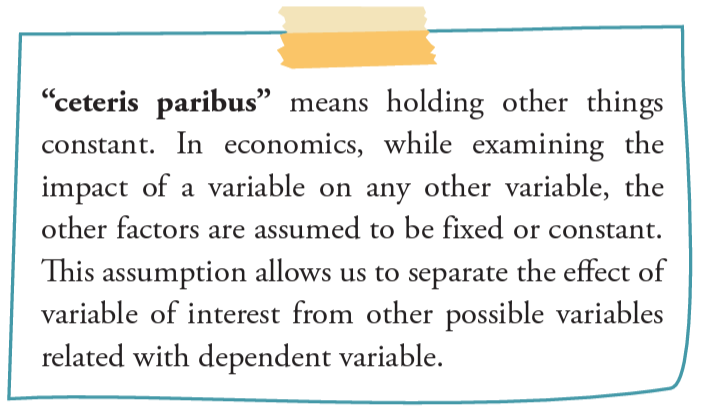
What is the assumption allows us to separate the effect of variable of interest from other possible related variables called?
Seçenekler
A
Gauss-Markoff assumptions
B
Ceteris paribus assumption
C
Gauss-Markov assumptions
D
Utility maximization
E
Axiom of choice
Açıklama:
If your answer is wrong, please review the “Introduction” section.
Soru 2
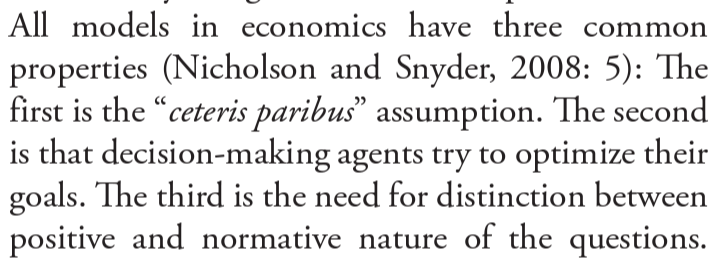
Which below is one of the three common properties in all models in economics according to Nicholson and Snyder?
Seçenekler
A
The need for distinction between positive and normative nature of the questions.
B
The axiom of extensionality which states if for every set X, X is a member of A if and only if X is a member of B, then A is equal to B.
C
Gauss-Markov assumptions which must hold for the theorem of the same name to be valid.
D
A reference to a standard or choice-free presentation of some mathematical object.
E
The responsiveness of the dependent variable to the change in the independent variable.
Açıklama:
If your answer is wrong, please review the “Introduction” section.
Soru 3
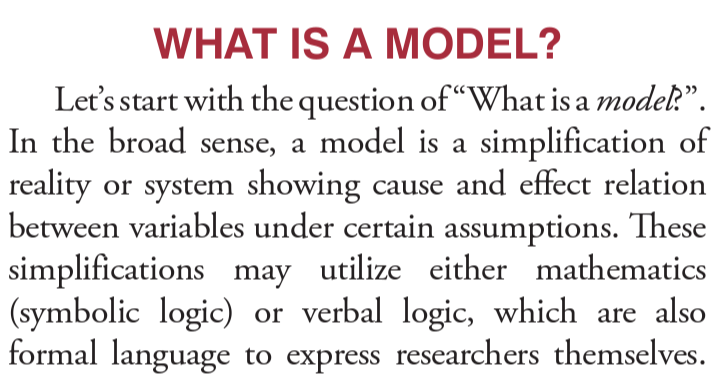
A model is a simplification of reality or system showing cause and effect relation between variables under certain assumptions. Which of the items from the list below these simplifications may utilize?
- Symbolic logic
- Programming
- Formal language
- Informal diagrams
- Theories
Seçenekler
A
I-II-III
B
II-V
C
I-II-V
D
I-III
E
I-III-V
Açıklama:
If your answer is wrong, please review the “What is a Model?” section.
Soru 4
In examining the marginal relation between variables, we kept the unit of measurement of the variables. Keeping the unit of measurement of the variables usually causes problems especially in interpretation. What can be used to cope with this problem in measuring the relations between variables?
Seçenekler
A
Optimality
B
Marginality
C
Elasticity
D
Equality
E
Tenacity
Açıklama:
If your answer is wrong, please review the “What is a Model?” section.
In examining the marginal relation between variables, we kept the unit of measurement of the variables. Keeping the unit of measurement of the variables usually causes problems especially in interpretation. To cope with this problem in measuring the relations between variables, one can use what is called elasticity. Elasticity measures the responsiveness of dependent variable (y) to the changes in independent variable (x).
In examining the marginal relation between variables, we kept the unit of measurement of the variables. Keeping the unit of measurement of the variables usually causes problems especially in interpretation. To cope with this problem in measuring the relations between variables, one can use what is called elasticity. Elasticity measures the responsiveness of dependent variable (y) to the changes in independent variable (x).
Soru 5
A firm lowered its prices 10% and observed 10% increase in her sales. What is the price elasticity of demand for the product of this firm?
Seçenekler
A
10
B
Perfectly elastic
C
Unit elastic
D
Inelastic
E
Zero
Açıklama:
If your answer is wrong, please review the “What is a Model?” section as well as the the fourth question in "Test Yourself".
εq,p = (% change in price) / (% change in quantitiy) = 10% / -10% =-1
Unit elastic
εq,p = (% change in price) / (% change in quantitiy) = 10% / -10% =-1
Unit elastic
Soru 6
The cost function of a firm is given by
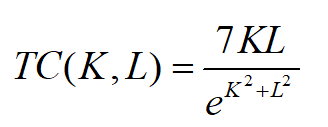
Which of the below is its total differential?
Which of the below is its total differential?
Seçenekler
A 
B 
C 
D 
E 
Açıklama:
If your answer is wrong, please review the “What is a Model?” section.
Soru 7
What is the second derivative of the function Y=8K3?
Seçenekler
A
24K2
B
48K
C
24K
D
48K2
E
24K3
Açıklama:
If your answer is wrong, please review the “What is a Model?” section.
The first derivative is 24K2
The second derivative is the derivativeof 24K2 , which is 48K.
The first derivative is 24K2
The second derivative is the derivativeof 24K2 , which is 48K.
Soru 8
What method uses the information that the maximum or minimum point is a situation in which the function has no change with respect to the independent variable at that point to solve constrained optimization?
Seçenekler
A
Total differential method
B
Petrilli lines method
C
Substitution method
D
Dedekind cuts method
E
Lagrange Multiplier method
Açıklama:
If your answer is wrong, please review the “Constrained Optimization” section.
We can solve a constrained optimization problem by using the total differential method. As you can imagine, the maximum or minimum point is in fact a situation in which the function has no change with respect to the independent variable at that point. T his method basically uses this information to solve constrained optimization.
We can solve a constrained optimization problem by using the total differential method. As you can imagine, the maximum or minimum point is in fact a situation in which the function has no change with respect to the independent variable at that point. T his method basically uses this information to solve constrained optimization.
Soru 9
The inverse demand function for a firm’s product is p(q)=700000e-0.002q where q is the daily demand and p is the price. What is production level that maximizes the daily revenue?
Seçenekler
A
200
B
500
C
800
D
1100
E
1400
Açıklama:
If your answer is wrong, please review the “Unconstrained Optimization” section.
TR=p(q)q=700000e-0.002qq
MR=e-0.002q(700000-1400q)
The daily revenue is maximum when MR=0. Since e-0.002q is zero asymptotically we check the term in paranthesis: 700000-1400q=0 when q=500.
TR=p(q)q=700000e-0.002qq
MR=e-0.002q(700000-1400q)
The daily revenue is maximum when MR=0. Since e-0.002q is zero asymptotically we check the term in paranthesis: 700000-1400q=0 when q=500.
Soru 10
What is the profit maximization condition for all markets?
Seçenekler
A
MR=0
B
MR>TC
C
MC=0
D
TC=0
E
MC=MR
Açıklama:
If your answer is wrong, please review the “Unconstrained Optimization” section.
Soru 11
Which of the following is not considered as an economic decision-making
agents?
agents?
Seçenekler
A
consumers
B
firms
C
institutions
D
governments
E
markets
Açıklama:
The economic decision-making agents are consumers, firms, institutions, and the government.
Soru 12
Which of the following is used by economists to explain an economic or social phenomenon?
Seçenekler
A
Economic models.
B
Hypothesis.
C
Assumptions.
D
Economic concepts.
E
Ceteris Paribus
Açıklama:
Economists usually use economic models to explain an economic or social phenomenon.
Soru 13
I. “Ceteris paribus” assumption
II. decision-making agents
III. the need for distinction between positive and normative nature of the questions
Which of the above property or properties are common in economic models?
II. decision-making agents
III. the need for distinction between positive and normative nature of the questions
Which of the above property or properties are common in economic models?
Seçenekler
A
Only I
B
I and II
C
I and III
D
II and III.
E
I, II and III.
Açıklama:
All models in economics have three common properties: The first is the “ceteris paribus” assumption. The second is that decision-making agents try to optimize their goals. The third is the need for distinction between positive and normative nature of the questions.
Soru 14
As a consumer which of the following you pursue?
Seçenekler
A
maximize benefit.
B
minimize well-being.
C
fight against poverty.
D
maximize profit
E
maximize your prestige.
Açıklama:
the fundamental agents of the economy, pursue their interest and
maximize their benefits.
maximize their benefits.
Soru 15
Which of the following constraint is faced by household?
Seçenekler
A
Number of children in household
B
Government regulations
C
Product prices
D
Wealth of a person
E
Disposable income of a household
Açıklama:
In making decisions in our daily life, we face some constraints. These may be the disposable income of a household or the capacity constraint of a firm.
Soru 16
Which of the following is shown by a model?
Seçenekler
A
Normative statements about variables
B
Cause and effect relation between variables
C
Prediction of future values of a variable
D
Past observations on variable
E
Hypothesis about variables
Açıklama:
In the broad sense, a model is a simplification of reality or system showing cause and effect relation between variables under certain assumptions.
Soru 17
In the simplest model of y=f(x), which is the following best describe the y?
Seçenekler
A
Independent variable.
B
Exogeneous variable.
C
Predetermined variable.
D
Dependent variable.
E
Explanatory variable
Açıklama:
In the equation above, y is the dependent variable whose value is identified within model.
Soru 18
If we just consider gender’s effect on wage and ignore the other factors affecting wage, our predictions about wage will be
Seçenekler
A
Perfect.
B
Approximately correct.
C
Biased.
D
Unbiased.
E
Efficient.
Açıklama:
According to Mincer (1958), wage income is basically a function of schooling and labor market experience of workers. If we ignore these variables, our predictions about the wage differentials of men and women may be biased.
Soru 19
In a model of y=a+bx+cw+dz, which of the folowing is a constant parameter?
Seçenekler
A
a.
B
x.
C
b
D
c
E
d
Açıklama:
a is a constant parameter, which is also called intercept whose value and magnitude remain unchanged. b, c, d are defined as slope terms
Soru 20
y=a+bx+cw+dz
Which of the following gives us an information on what extent x affects y separately?
Which of the following gives us an information on what extent x affects y separately?
Seçenekler
A
a
B
b
C
c
D
d
E
sum of b, c, d.
Açıklama:
b gives us information on what extent x affects y separately.
Soru 21
In a two-variable function, if second order derivatives exist and are themselves continuous, cross partial derivatives are equal.
This is known as ............
This is known as ............
Seçenekler
A
Young’s theorem
B
Langrange theorem
C
Browns's theorem
D
Marshall's theorem
E
Tailor's theorem
Açıklama:
In a two-variable function, if second order derivatives exist and are themselves continuous, cross partial derivatives are equal.
This is known as Young’s theorem
This is known as Young’s theorem
Soru 22
..... is the responsiveness of the dependent variable to the change in the independent variable. It measures the responsiveness of dependent variable (y) to the changes in independent variable (x).
Seçenekler
A
Derivation
B
Elasticity
C
Linear function
D
Partial derivative
E
Differentiation
Açıklama:
Elasticity is the responsiveness of the dependent variable to the change in the independent variable. It measures the responsiveness of dependent variable (y) to the changes in independent variable (x).
Soru 23
Suppose we have a function of a function: y=f(w) and w=g(x). This means that y=f [g(x)] The derivative of y with respect to x will be
equal to;
dy/dx= dy/dw * dw/dx
This rule is called as .............
equal to;
dy/dx= dy/dw * dw/dx
This rule is called as .............
Seçenekler
A
The constant function rule
B
The product rule
C
The chain rule
D
The power function rule
E
The linear function rule
Açıklama:
Suppose we have a function of a function: y=f(w) and w=g(x). This means that y=f [g(x)] The derivative of y with respect to x will be
equal to;
dy/dx= dy/dw * dw/dx
This rule is called as the chain rule.
equal to;
dy/dx= dy/dw * dw/dx
This rule is called as the chain rule.
Soru 24
Ford offered a 20% discount off the average list price of Egea model in December. This reduction in price increased the sales of Egea model by 40% over the previous month’s level.
What is the price elasticity of demand for Egea model?
What is the price elasticity of demand for Egea model?
Seçenekler
A
-0.5
B
-1
C
-1.5
D
-2
E
-3
Açıklama:
ε y,x = %change in y / %change in x
ε y,x = +40% / −20%
ε y,x = −2
ε y,x = +40% / −20%
ε y,x = −2
Soru 25
A ..... is a simplification of reality or system showing cause and effect relation between variables under certain assumptions.
Seçenekler
A
Model
B
Theory
C
Hypothesis
D
Axiom
E
Slope
Açıklama:
A model is a simplification of reality or system showing cause and effect relation between variables under certain assumptions.
Soru 26
I) “Ceteris Paribus” means holding other things constant.
II) A theory is a simplification of reality or system showing cause and effect relation between variables under certain assumptions.
III) Elasticity is the responsiveness of the dependent variable to the change in the independent variable.
Which of the following indicates true definition(s)?
II) A theory is a simplification of reality or system showing cause and effect relation between variables under certain assumptions.
III) Elasticity is the responsiveness of the dependent variable to the change in the independent variable.
Which of the following indicates true definition(s)?
Seçenekler
A
Only I
B
Only II
C
Only III
D
I and II
E
I and III
Açıklama:
“Ceteris paribus” means holding other things constant
A model is a simplification of reality or system showing cause and effect relation
Elasticity is the responsiveness of the dependent variable to the change in the independent variable.
A model is a simplification of reality or system showing cause and effect relation
Elasticity is the responsiveness of the dependent variable to the change in the independent variable.
Soru 27
Which of the following is not one of the rules of taking derivatives?
Seçenekler
A
The constant function rule
B
The linear function rule
C
The power function rule
D
The exponantial rule
E
The product rule
Açıklama:
The constant function rule, the linear function rule, s the power function rule and the product rule is one of the rules for taking derivatives. However exponantial rule is not.
Soru 28
If there is no constraint in the process of optimization of an objective function, this is called ................ optimization
Seçenekler
A
Constrained
B
Static
C
Marginal
D
Dynamic
E
Unconstrained
Açıklama:
If there is no constraint in the process of optimization of an objective function, this is called unconstrained optimization
Soru 29
I) Total differential method
II) The substitution method
III) Lagrange multiplier method
Which of the following indicates the different ways to solve a constrained optimization problem?
II) The substitution method
III) Lagrange multiplier method
Which of the following indicates the different ways to solve a constrained optimization problem?
Seçenekler
A
Only I
B
Only II
C
I and II
D
II and III
E
I, II and III
Açıklama:
There are different ways to solve a constrained optimization problem. Here, in this chapter, we’ll examine three of them. Firstly, we can solve a constrained optimization problem by using the total differential method.
Second method for constrained optimization is to define the constraint in terms of x or z and put them into the objective function. In other words, we make the objective function “unconstrained”. This method is called “the substitution method”.
The third and easiest way to solve the constrained optimization problems is to use the Lagrange Multiplier method
Second method for constrained optimization is to define the constraint in terms of x or z and put them into the objective function. In other words, we make the objective function “unconstrained”. This method is called “the substitution method”.
The third and easiest way to solve the constrained optimization problems is to use the Lagrange Multiplier method
Soru 30
The easiest way to solve the constrained optimization problems is to use the ............ method
Seçenekler
A
Lagrange multiplier
B
Substitution
C
Total differential
D
Derivative
E
Objetive function
Açıklama:
The easiest way to solve the constrained optimization problems is to use the Lagrange Multiplier method
Ünite 2
Soru 1
What is the level of satisfaction an individual receives from consuming goods and services called?
Seçenekler
A
Utility
B
Electricity
C
Margin
D
Cardinality
E
Marginality
Açıklama:
If your answer is wrong, please review the “Cardinal Utility” section.
Soru 2
What is the unit of measurement of utility when utility is assumed to be cardinal?
Seçenekler
A
UU (Unit'o Utilitiy)
B
MU (Measure of Utility)
C
Happiness
D
Util
E
Utility has never been given a unit of measure.
Açıklama:
If your answer is wrong, please review the “Cardinal Utility” section.
Soru 3
Which utility theory assumes that the satisfaction level a consumer receives from consuming goods and services is measurable just like prices and quantities?
Seçenekler
A
The vicar general utility theory
B
The cardinal utility theory
C
The sluggard wake utility theory
D
The ordinal utility theory
E
The marginal utility theory
Açıklama:
If your answer is wrong, please review the “Cardinal Utility” section.
The cardinal utility theory assumes that the satisfaction level a consumer receives from consuming goods and services is measurable just like prices and quantities.
The cardinal utility theory assumes that the satisfaction level a consumer receives from consuming goods and services is measurable just like prices and quantities.
Soru 4
Which below represents a basket of various combinations of goods and services that the consumer wants to consume?
Seçenekler
A
A consumer price index
B
An indifference Curve
C
A consumption bundle
D
A commodity
E
An indifference map
Açıklama:
If your answer is wrong, please review the “Consumer Preferences and Ordinal Utility” section.
Soru 5
Which below is not one of the four basic axioms about the consumer preferences?
Seçenekler
A
Axiom of Transitivity
B
Axiom of Completeness
C
Axiom of Extensionality
D
Axiom of Continuity
E
Axiom of Reflexivity
Açıklama:
If your answer is wrong, please review the “Consumer Preferences and Ordinal Utility” section.
Axiom of Extensionality is not one of the four basic axioms about the consumer preferences
Axiom of Extensionality is not one of the four basic axioms about the consumer preferences
Soru 6
Which basic axiom of about the consumer preferences states that if two consumption
bundles are identical then the consumer is indifferent between the two bundles?
bundles are identical then the consumer is indifferent between the two bundles?
Seçenekler
A
Axiom of Reflexivity
B
Axiom of Extensionality
C
Axiom of Continuity
D
Axiom of Completeness
E
Axiom of Transitivity
Açıklama:
If your answer is wrong, please review the “Consumer Preferences and Ordinal Utility” section.
Soru 7
________ is a curve representing all combinations of commodity bundles that provide the same level of satisfaction to a consumer.
Which of the following fills the blank in the sentence above?
Which of the following fills the blank in the sentence above?
Seçenekler
A
Indifference curve
B
Non-satiation
C
Consumption bundle
D
Marginal rate of substitution
E
Perfect substitutes
Açıklama:
If your answer is wrong, please review the “Consumer Preferences and Ordinal Utility” section.
Soru 8
Which below is an important property of indifference curves that stems from the axioms and assumptions of the consumer preference theory?
Seçenekler
A
Indifference curves are concave to the origin.
B
Indifference curves closer to the origin represent higher satisfaction levels for the
consumer.
consumer.
C
Indifference curves never intersect each other.
D
Indifference curves farther away the origin represent lower satisfaction levels for the
consumer.
consumer.
E
Indifference curves are everywhere thick and they cannot be thin.
Açıklama:
If your answer is wrong, please review the “Consumer Preferences and Ordinal Utility” section.
Indifference curves never intersect each other. This property follows from the axioms of completeness and transitivity.
Indifference curves never intersect each other. This property follows from the axioms of completeness and transitivity.
Soru 9
Which below is not an important property of indifference curves based on the axioms and assumptions of the consumer preference theory?
Seçenekler
A
Indifference curves have a negative slope.
B
Indifference curves closer to the origin represent lower satisfaction levels for the consumer.
C
Indifference curves are everywhere thin and they cannot be thick.
D
Indifference curves farther away from the origin represent higher satisfaction levels for the consumer.
E
Indifference curves can intersect each other.
Açıklama:
If your answer is wrong, please review the “Consumer Preferences and Ordinal Utility” section.
Soru 10
If two functions differ by a positive multiplicative constant, an exponential constant or an additive positive or negative constant, they are ____________ of each other.
Which of the following fills the blank in the sentence above?
Which of the following fills the blank in the sentence above?
Seçenekler
A
perfect substitutes
B
positive monotonic transformations
C
axiom of transitivity
D
axiom of substitution
E
perfect complements
Açıklama:
If your answer is wrong, please review the “Consumer Preferences and Ordinal Utility” section.
Soru 11
Which theory assumes that the satisfaction level a consumer receives from
consuming goods and services is measurable just like prices and quantities?
consuming goods and services is measurable just like prices and quantities?
Seçenekler
A
The Total Utility Theory
B
The Marginal Utility Theory
C
The Cardinal Utility Theory
D
The Ordinal Utility Theory
E
The Critical Theory
Açıklama:
The cardinal utility theory assumes that the satisfaction level a consumer receives from consuming goods and services is measurable just like prices and quantities.
Soru 12
What is the unit of measurement of utility when utility is assumed to be cardinal.
Seçenekler
A
Quantity
B
Util
C
Cubic meters
D
Profit
E
Ordinal exposure
Açıklama:
Util is the unit of measurement of utility when utility is assumed to be cardinal.
Soru 13
What is marginal Utility?
Seçenekler
A
The minumum satisfaction an individual receives from consuming one more unit of the good.
B
The average satisfaction an individual receives from consuming one more unit of the good.
C
The possible satisfaction an individual receives from consuming one more unit of the good.
D
The extra satisfaction an individual receives from consuming one more unit of the good.
E
The calculated satisfaction an individual receives from consuming one more unit of the good.
Açıklama:
Marginal Utility refers to the extra satisfaction an individual receives from consuming one more unit of the good.
Soru 14
Which of the following represents a basket of various combinations of goods and services that the consumer wants to consume?
Seçenekler
A
Consumption bundle
B
Target Consumer
C
Consumer preference
D
Inflation rate
E
Consumption loop
Açıklama:
A consumption bundle represents a basket of various combinations of goods and services that the consumer wants to consume.
Soru 15
With how many basic axioms about the consumer preferences can we start the theory of consumer behaviour?
Seçenekler
A
2
B
3
C
4
D
5
E
6
Açıklama:
The theory of consumer behaviour begins with four basic axioms about the consumer preferences
Soru 16
Which curve represents all combinations of commodity bundles that provide
the same level of satisfaction to a consumer?
the same level of satisfaction to a consumer?
Seçenekler
A
Non-satiation curve
B
Continuity curve
C
Transitivity curve
D
Indifference curve
E
Consumer curve
Açıklama:
Indifference Curve is a curve representing all combinations of commodity bundles that provide the same level of satisfaction to a consumer.
Soru 17
Which of the following refers to the maximum amount of a good that a consumer
is willing to give up in order to obtain one more unit of another good while the satisfaction level of the consumer is constant?
is willing to give up in order to obtain one more unit of another good while the satisfaction level of the consumer is constant?
Seçenekler
A
MRA
B
MRS
C
VAT
D
MRC
E
MMT
Açıklama:
Marginal Rate of Substitution (MRS) is the maximum amount of a good that a consumer is willing to give up in order to obtain one more unit of another good while the satisfaction level of the consumer is constant.
Soru 18
If the marginal rate of substitution between two goods is infinite, what do we call them?
Seçenekler
A
The perfect substitutes
B
The perfect ratios
C
The perfect complements
D
The ordinal preference
E
The ordinal substitudes
Açıklama:
If the marginal rate of substitution between two goods is infinite, they are called perfect complements.
Soru 19
The consumer, however, is also bound by ............. which is his/her budget.
Fill in the blank with the most suitable term.
Fill in the blank with the most suitable term.
Seçenekler
A
An opportunity
B
A chance
C
An obligation
D
A matrix
E
A constraint
Açıklama:
The consumer is also bound by a constraint which is his/her budget.
Soru 20
What is an indifference map?
Seçenekler
A
It is a graph containing a set of indifference curves that shows the bundles among which a consumer is indifferent.
B
It is a graph containing a set of indifference curves that shows the bundles among which a consumer is loyal.
C
It is a graph containing a set of declining curves that shows the bundles among which a consumer is different.
D
It is a graph containing a set of indifference curves that shows the bundles among which a consumer is unsatisfied.
E
It is a graph containing a set of indifference curves that shows the bundles among which a consumer is willing.
Açıklama:
An indifference map is a graph containing a set of indifference curves that shows
the bundles among which a consumer is indifferent.
the bundles among which a consumer is indifferent.
Soru 21
......... is the level of satisfaction an individual receives from consuming goods and services.
Seçenekler
A
Utility
B
Demand
C
Supply
D
Prefence
E
Budget constraint
Açıklama:
Utility: The level of satisfaction an individual receives from consuming goods and services.
Soru 22
................ is the extra satisfaction an individual receives from consuming one more unit of the good
Seçenekler
A
Total utility
B
Marginal utulity
C
Average utility
D
Cardinal utility
E
Ordinal utility
Açıklama:
Marginal Utility: The extra satisfaction an individual receives from consuming one more unit of the good.
Soru 23
Given that MUx = 50, Px = 10 and MUy = 100 respectively, what would be "Py" if the consumer is in equilibrium?
Seçenekler
A
10
B
20
C
50
D
100
E
200
Açıklama:
Remember that the condition;
MUx/Px= MUY/PY should be satisfied at the equilibrium.
Therefore, we can solve for Py from
50/10=100/Py
which is Py= 20 .
MUx/Px= MUY/PY should be satisfied at the equilibrium.
Therefore, we can solve for Py from
50/10=100/Py
which is Py= 20 .
Soru 24
Given that MUY = 60, Px = 5 and PY = 20 respectively, what would be the marginal utility of good X for the consumer if the consumer is in equilibrium?
Seçenekler
A
5
B
10
C
15
D
20
E
60
Açıklama:
Remember that the condition MUx/Px=MUY/PY should be satisfied at the equilibrium.
Therefore, we can solve for MUx from MUx/5 = 60/20
which is 15 units.
Therefore, we can solve for MUx from MUx/5 = 60/20
which is 15 units.
Soru 25
I) A consumption bundle represents a basket of various combinations of goods and services that the consumer wants to consume
II) Indifference Curve is a curve representing all combinations of commodity bundles that provide the same level of satisfaction to a consumer
III) Every commodity is a good that brings utility to the consumer.
Which of the following is true according to consumer preferences_
II) Indifference Curve is a curve representing all combinations of commodity bundles that provide the same level of satisfaction to a consumer
III) Every commodity is a good that brings utility to the consumer.
Which of the following is true according to consumer preferences_
Seçenekler
A
Only I
B
Only II
C
I and II
D
II and III
E
I, II and III
Açıklama:
A consumption bundle represents a basket of various combinations of goods and services that the consumer wants to consume.
Indifference Curve is a curve representing all combinations of commodity bundles that provide the same level of satisfaction to a consumer
Not every commodity is a good that brings utility to the consumer. There may be bad commodities such as pollution etc. that decreases the satisfaction level of the consumer.
Indifference Curve is a curve representing all combinations of commodity bundles that provide the same level of satisfaction to a consumer
Not every commodity is a good that brings utility to the consumer. There may be bad commodities such as pollution etc. that decreases the satisfaction level of the consumer.
Soru 26
Which of the following is not true about the properties of the indifferences curves?
Seçenekler
A
Indifference curves are everywhere thin and they cannot be thick
B
Indifference curves farther away from the origin represent higher satisfaction levels for the consumer
C
Indifference curves never intersect each other
D
Indifference curves are convex to the origin
E
Indifference curves have a positive slope
Açıklama:
Indifference curves have a negative slope. As we have discussed above, this property directly comes from the axiom of non-satiation (more is better) as long as the commodities are “goods” but not “bads”. Remember that, a good is a commodity that gives positive satisfaction to the consumer as opposed to bad commodities such as air pollution or asbestos that decreases consumer’s utility. A rational consumer is going to choose more of a good to less, so he/she cannot be indifferent between two bundles, when one of the bundles has more of at least one good while the quantity of the other is the same.
Soru 27
I) Indifference curves are concave to the origin.
II) Indifference curves never intersect each other
III) Indifference curves have a positive slope
Which of the following is true about indeference curves?
II) Indifference curves never intersect each other
III) Indifference curves have a positive slope
Which of the following is true about indeference curves?
Seçenekler
A
Only I
B
Only II
C
Only III
D
I and II
E
II and III
Açıklama:
Indifference curves are convex to the origin.
Indifference curves have a negative slope.
Indifference curves never intersect each other.
Indifference curves have a negative slope.
Indifference curves never intersect each other.
Soru 28
Two functions with identical ordinal properties are called ........ monotonic transformations of each other.
Seçenekler
A
Positive
B
Negative
C
Neutral
D
Linear
E
Quadratic
Açıklama:
Two functions with identical ordinal properties are called positive monotonic transformations of each other.
Soru 29
If the marginal rate of substitution between two goods is infinite, they are called perfect complements. Indifference curves are ....-shaped.
Seçenekler
A
V
B
L
C
W
D
N
E
U
Açıklama:
If the marginal rate of substitution between two goods is infinite, they are called perfect complements. Indifference curves are L-shaped.
Soru 30
.......................... is the maximum amount of a good that a consumer is willing to give up in order to obtain one more unit of another good while the satisfaction level of the consumer is constant.
Seçenekler
A
Marginal Utility
B
Indifference Curve
C
Perfect Substitution
D
Positive Monotonic Transformations
E
Marginal Rate of Substitution
Açıklama:
Marginal Rate of Substitution (MRS) is the maximum amount of a good that a consumer is willing to give up in order to obtain one more unit of another good while the satisfaction level of the consumer is constant.
Ünite 3
Soru 1
What is the result of a change in the price of a good considering a typical demand curve?
Seçenekler
A
A change in the quantity demanded.
B
A change in the demand.
C
A shift of the demand curve.
D
A change in the slope of the demand curve.
E
A change in the consumer's nominal income.
Açıklama:
If your answer is incorrect, please refer to Chapter 3 in your textbook.
A change in the price results in a movement along the demand curve, which follows a change in the quantity demanded. Other factors affecting the quantity demanded results in a shift of the whole demand curve as none of those factors are represented on the figure that shows the demand curve. A shift of the demand is also called a change in demand. Since a typical demand curve is straight line, movement along that curve does not change the slope. Lastly, a change in the price of a good only affects the real income, not the nominal income.
A change in the price results in a movement along the demand curve, which follows a change in the quantity demanded. Other factors affecting the quantity demanded results in a shift of the whole demand curve as none of those factors are represented on the figure that shows the demand curve. A shift of the demand is also called a change in demand. Since a typical demand curve is straight line, movement along that curve does not change the slope. Lastly, a change in the price of a good only affects the real income, not the nominal income.
Soru 2
Which of the following sets of goods are complements?
Seçenekler
A
Automobile - Tire
B
e-Bike - e-Scooter
C
JetSki - Motor Yacht
D
Bus - Train
E
Plane - Helicopter
Açıklama:
If your answer is incorrect, please refer to Chapter 3 in your textbook.
Complements are used in a combination and by definition, do not produce utility by themselves. Thus, the correct answer is the "Automobile - Tire" set. All other options contain alternatives, which economists call "substitutes".
Complements are used in a combination and by definition, do not produce utility by themselves. Thus, the correct answer is the "Automobile - Tire" set. All other options contain alternatives, which economists call "substitutes".
Soru 3
Which of the following statements is true regarding the income-consumption curve?
Seçenekler
A
Income-consumption curve shows the constant utility levels of commodity bundles traced out as the monetary income changes.
B
If the demand for a good is positively related with income, it is "inferior good".
C
If the demand for a good is negatively related with income, it is "normal good".
D
Some goods start becoming inferior once a certain level of income is reached.
E
Not every good is "normal" for lower levels of income.
Açıklama:
If your answer is incorrect, please refer to Chapter 3 in your textbook.
Income-consumption curve shows the maximized utility levels of commodity bundles traced out as the monetary income changes. If the demand for a good is positively related with income, it is "normal good". If the demand for a good is negatively related with income, it is "inferior good". Every type of goods are "normal" for lower levels of income. This is a fact as the income-consumption curve starts from the origin. As the income level increases, some goods start becoming inferior.
Income-consumption curve shows the maximized utility levels of commodity bundles traced out as the monetary income changes. If the demand for a good is positively related with income, it is "normal good". If the demand for a good is negatively related with income, it is "inferior good". Every type of goods are "normal" for lower levels of income. This is a fact as the income-consumption curve starts from the origin. As the income level increases, some goods start becoming inferior.
Soru 4
Which of the following describes the effect when the price of a good increases and consumers demand less of this commodity since the commodity has become more expensive relative to other goods consumed?
Seçenekler
A
Income effect
B
Substitution effect
C
Cross-price effect
D
Marginal effect
E
Average effect
Açıklama:
If your answer is incorrect, please refer to Chapter 3 in your textbook.
One of the goods is more expensive (is cheaper) relative to other goods, so demand less (more) of this commodity. This response
is called the substitution effect (SE).
The aforementioned effect describes the substitution effect as a consumer substitutes other goods to keep his or her utility maximized under the budget constraint.
One of the goods is more expensive (is cheaper) relative to other goods, so demand less (more) of this commodity. This response
is called the substitution effect (SE).
The aforementioned effect describes the substitution effect as a consumer substitutes other goods to keep his or her utility maximized under the budget constraint.
Soru 5
- A consumer only consumes two goods, potatoes and meatballs, to prepare meal.
- Meatballs are significantly more expensive compared to potatoes.
- When income is constant and the price of the potatoes increases it is observed that people consume more potatoes.
Taking into account the constraints above, which of the following terms describes the potatoes the best?
Seçenekler
A
Normal good
B
Inferior good
C
Giffen good
D
Luxury good
E
Substitute good
Açıklama:
If your answer is incorrect, please refer to Chapter 3 in your textbook.
The example produced with the constraints in the question body have actually happened in the past. When people used two main ingredients (potatoes and meat pieces) to prepare meal, their response to a price increase in potatoes was an increased demand towards potatoes, making its demand curve positively sloped. Note that this happened due to income effect being greater than the substitution effect. In other words, people had to use more potatoes in their meal to keep their stomach full, as it was much cheaper compared to meat.
Giffen good is a type of good whose demand curve slopes upward because the good is inferior and the positive income effect outweighs the negative substitution effect in response to a price change.
The example produced with the constraints in the question body have actually happened in the past. When people used two main ingredients (potatoes and meat pieces) to prepare meal, their response to a price increase in potatoes was an increased demand towards potatoes, making its demand curve positively sloped. Note that this happened due to income effect being greater than the substitution effect. In other words, people had to use more potatoes in their meal to keep their stomach full, as it was much cheaper compared to meat.
Giffen good is a type of good whose demand curve slopes upward because the good is inferior and the positive income effect outweighs the negative substitution effect in response to a price change.
Soru 6
- Utility function
- Budget constraint
- Type of goods
Seçenekler
A
Only I
B
Only II
C
I and II
D
I and III
E
I, II and III
Açıklama:
If your answer is incorrect, please refer to Chapter 3 in your textbook.
To set up a Lagrangian function, only two sets of functions are needed: The function to be maximized and the function that states the constraints. These are the utility function and the budget constraint, respectively.
To set up a Lagrangian function, only two sets of functions are needed: The function to be maximized and the function that states the constraints. These are the utility function and the budget constraint, respectively.
Soru 7
Which of the following correctly specifies the price elasticity of demand?
Seçenekler
A
(Total change in quantity demanded of X) / (Total change in price of X)
B
(Percentage change in quantity demanded of X) / (Total change in price of X)
C
(Total change in quantity demanded of X) / (Percentage change in price of X)
D
(Percentage change in quantity demanded of X) / (Percentage change in price of X)
E
(Percentage change in quantity demanded of Y) / (Total change in price of X)
Açıklama:
If your answer is incorrect, please refer to Chapter 3 in your textbook.
Elasticities in general track the percentage responses in quantity demanded to percentage changes in factors such as price, income and other goods' prices.
Own-price elasticity of demand (or in short price elasticity) is defined as the percentage change in quantity demanded over the percentage change in the own-price of the commodity
Elasticities in general track the percentage responses in quantity demanded to percentage changes in factors such as price, income and other goods' prices.
Own-price elasticity of demand (or in short price elasticity) is defined as the percentage change in quantity demanded over the percentage change in the own-price of the commodity
Soru 8
The drugs to treat cancer have a very low income elasticity, often much closer to _______ , making them ________ .
Seçenekler
A
zero , necessity
B
infinite , necessity
C
zero , luxury
D
one , luxury
E
negative 1 , necessity
Açıklama:
If your answer is incorrect, please refer to Chapter 3 in your textbook.
Drugs for treating cancer are necessities and have close-to-zero income elasticities.
Drugs for treating cancer are necessities and have close-to-zero income elasticities.
Soru 9
If the demand for automobiles drops 10% as a response to 50% increases in tire prices, this means that the cross price elasticity is ______ . Also it means that automobiles and tires ______ each other.
Seçenekler
A
0.2 , complement
B
-0.2 , complement
C
5 , substitute
D
-5 , substitute
E
-0.2 , substitute
Açıklama:
If your answer is incorrect, please refer to Chapter 3 in your textbook.
Automobiles and tires complement each other. This means that the cross-price elasticity has to be a negative value. The value can be calculated by dividing the percentage change in the quantity demanded of X with the percentage change in the price of Y:
-10% / 50% = -0.2
Automobiles and tires complement each other. This means that the cross-price elasticity has to be a negative value. The value can be calculated by dividing the percentage change in the quantity demanded of X with the percentage change in the price of Y:
-10% / 50% = -0.2
Soru 10
Considering a price elasticity value of 2 for the good X, what happens when the price of X increases?
Seçenekler
A
Total expenditure increases.
B
Total expenditure decreases.
C
Total expenditures does not change.
D
X becomes an inferior good.
E
X stays as a normal good.
Açıklama:
If your answer is incorrect, please refer to Chapter 3 in your textbook.
A price elasticity of 2 is sign of high elasticity. For example, 10% increase in price gets a 20% decrease in quantity demanded as a response. As a result, an overall decrease in total expenditure is inevitable in case of a price increase.
A price elasticity of 2 is sign of high elasticity. For example, 10% increase in price gets a 20% decrease in quantity demanded as a response. As a result, an overall decrease in total expenditure is inevitable in case of a price increase.
Soru 11
In ordinary demand function, which of the following variable affect the quantity demanded of a commodity?
Seçenekler
A
own-price of the commodity
B
consumers tastes and preferences
C
Complement good price
D
substitute god price
E
consumer income
Açıklama:
In ordinary demand function, quantity demanded of commodity is taken a function of its own price.
Soru 12
In cross-price demand function, which of the following variable affect the quantity demanded of a commodity?
Seçenekler
A
substitute good price
B
consumers tastes and preferences
C
expected future price of commodity
D
own-price of the commodity
E
consumer income
Açıklama:
In cross-price demand function demand function, quantity demanded of commodity is taken a function of either substitute or complement good price
Soru 13
The Engel curve shows the relationship between which of the following pairs of variables?
Seçenekler
A
quantity demanded of a commodity and income
B
quantity demanded of a commodity and own price of commodity
C
quantity demanded of a commodity and consumer tastes
D
quantity demanded of a commodity and price of substitute of commodity
E
quantity demanded of a commodity and expectations about income
Açıklama:
The Engel curve shows the relationship between quantity demanded of a commodity and income.
Soru 14
At every point on the demand curve, which of the following condition holds?
Seçenekler
A
The marginal rate of substitution between the two commodities is equal to the relative price between two commodities.
B
The marginal rate of substitution between the two commodities is equal to price of commodity on the vertical axis.
C
The marginal rate of substitution between the two commodities is equal to price of commodity on the horizontal axis.
D
The marginal rateof substitution between the two commodities is decreasing as the relative price between two commodity falls.
E
The marginal rateof substitution between the two commodities is decreasing as the relative price between two commodity rises.
Açıklama:
the consumer utility maximization condition is satisfied at every point on the demand curve. This means that the marginal rate of substitution between the two commodities is equal to the relative price ratio of those two commodities at each point on the demand curve.
Soru 15
As we move from left to right on the demand curve, which of the following will not take place?
Seçenekler
A
the real income of consumer decreases.
B
the consumer faces lower prices.
C
the real income of consumer increases.
D
the consumer reaches a higher indifference curve.
E
the consumer will have a higher utility.
Açıklama:
As we move from left to right on the demand curve, the consumer faces
lower prices. This means that the purchasing power, the real income, of the consumer increases and the consumer reaches a higher indifference curve indicating higher utility levels for the consumer.
lower prices. This means that the purchasing power, the real income, of the consumer increases and the consumer reaches a higher indifference curve indicating higher utility levels for the consumer.
Soru 16
When we derive demand curve, we assume that all the other prices and monetary (nominal) income of the consumer are constant. Unlike this assumption which of the following is not correct when there is a fall in the own price of commodity?
Seçenekler
A
Purchasing power of consumer income falls.
B
The real income rises.
C
The utility level of consumer changes.
D
The demand for substitute commodity falls.
E
There is an increase in the quantity demanded of commodity.
Açıklama:
when we change own-price of the commodity, the real income and the utility level of the consumer clearly changes.
Soru 17
If the price-consumption curve is downward sloped, then which is the following best describes the relationship between two commodities?
Seçenekler
A
they are substitutes.
B
they are compliments.
C
they are normal commodities.
D
One of the commodities is inferior commodity.
E
they are inferior commodities.
Açıklama:
The price-consumption curve is downward sloped in this case indicating that when demand for good X increases the demand for good Y decreases, since they are substitutes.
Soru 18
If X and Y are substitutes, what will be the shape of cross-demand curve for good Y when the price of X increases?
Seçenekler
A
Upward sloping.
B
Downward sloping.
C
Vertical.
D
Horizontal.
E
U-shaped.
Açıklama:
we obtain a positively sloped cross-demand curve for good Y when the price of X increases.
Soru 19
What will be the shape of the price-consumption curve between X and Y when the goods are complements?
Seçenekler
A
Upward sloping.
B
Downward sloping.
C
Vertical.
D
Horizontal.
E
U-shaped.
Açıklama:
The price-consumption curve is upward sloped in this case indicating that the goods are complements.
Soru 20
To derive the income-consumption curve, which of the following determinants of demand is allowed to change?
Seçenekler
A
monetary income of the consumer.
B
own price of commodity.
C
substitute good price.
D
complement good price.
E
consumer tastes.
Açıklama:
To derive the income-consumption curve, we allow consumer’s monetary income to change.
Soru 21
Which of the following is true if the consumer's total expenditure is maximum when the elasticity of demand is equal to one?
Seçenekler
A
Total expenditure of the consumer always decreases when the price of the commodity decreases.
B
The demand curve is linear and has a downward slope.
C
Total expenditure of the consumer is constant when price decreases.
D
The demand curve has a constant elasticity of demand.
E
Total expenditure of the consumer always decreases when the price of the commoditydecreases
Açıklama:
If your answer is wrong, please review the “Elasticities of Demand” section.
For a linear and downward sloped demand curve the total expenditure of the consumer is at the maximum when elasticity of demand is equal to one.
For a linear and downward sloped demand curve the total expenditure of the consumer is at the maximum when elasticity of demand is equal to one.
Soru 22
What is the change in the quantity demanded of a good in response to a change in purchasing power, keeping relative prices constant?
Seçenekler
A
The income effect
B
Pre-whitening effect
C
The GARCH effect
D
The substitution effect
E
The White effect
Açıklama:
If your answer is wrong, please review the “Income and Substitution Effects” section.
Soru 23
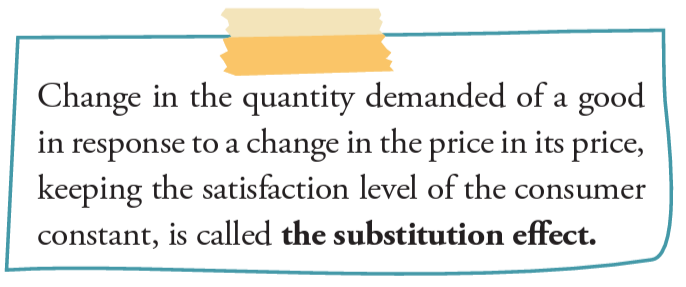
What is the change in the quantity demanded of a good in response to a change in its price, keeping the satisfaction level of the consumer constant?
Seçenekler
A
The income effect
B
Pre-Whitening effect
C
The GARCH effect
D
The substitution effect
E
The White effect
Açıklama:
If your answer is wrong, please review the “Income and Substitution Effects” section.
Soru 24
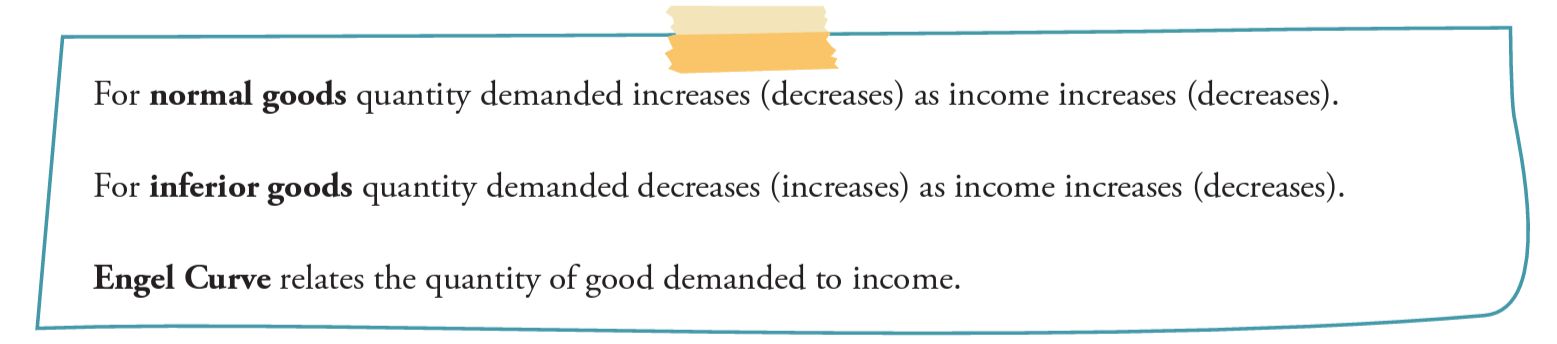
What does relate the quantity of good demanded to income?
Seçenekler
A
The income effect
B
Pre-whitening
C
Engel curve
D
Okun's law
E
The substitution effect
Açıklama:
If your answer is wrong, please review the “Demand Curve” section.
Soru 25
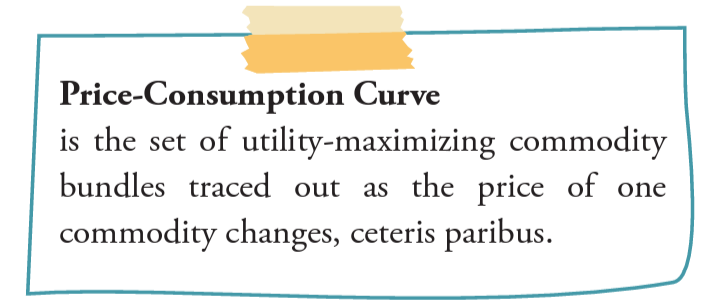
What is the set of utility-maximizing commodity bundles traced out as the price of one commodity changes, ceteris paribus?
Seçenekler
A
Income-Consumption curve
B
The income effect
C
Engel curve
D
The substitution effect
E
Price-Consumption curve
Açıklama:
If your answer is wrong, please review the “Demand Curve” section.
Soru 26
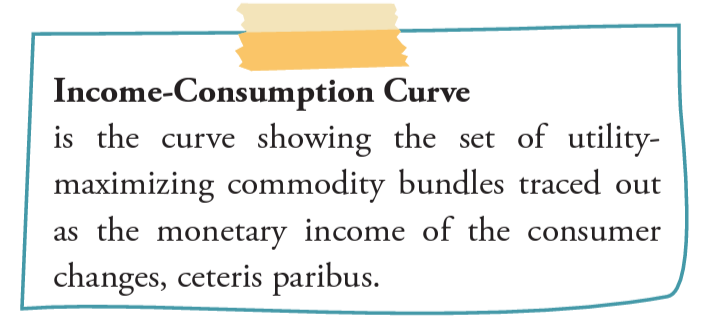
What does show the geometric description of the set of utility-maximizing commodity bundles traced out as the monetary income of the consumer changes, ceteris paribus?
Seçenekler
A
Income-Consumption curve
B
The income effect
C
Engel curve
D
The substitution effect
E
Price-Consumption curve
Açıklama:
If your answer is wrong, please review the “Demand Curve” section.
Soru 27
What would one call the goods when the price of one decreases, the demand of the other increases?
Seçenekler
A
Inferior goods
B
Complement goods
C
Giffen goods
D
Substitute goods
E
No goods
Açıklama:
If your answer is wrong, please review the “Demand Curve” section.
Soru 28
What is a type of good whose demand curve slopes upward and the positive income effect outweighs the negative substitution effect in response to a price change?
Seçenekler
A
Normal good
B
Substitute good
C
Giffen good
D
Inferior good
E
No good
Açıklama:
If your answer is wrong, please review the “Income and Substitution Effects” section.

Soru 29
What would one say about the elasticity of demand if the percentage change in the quantity is equal to the percentage change in price, making the absolute value of the price elasticity equal to one?
Seçenekler
A
Demand is elastic.
B
Demand is inelastic.
C
Demand is perfectly elastic.
D
Demand is unitary elastic
E
Demand is perfectly inelastic.
Açıklama:
If your answer is wrong, please review the “Elasticities of Demand” section.

Soru 30
What is a type of good whose demand curve slopes downward and the substitution effect is greater than the income effect in response to a price change?
Seçenekler
A
Giffen good
B
Substitute good
C
Inferior good
D
Normal good
E
Complement good
Açıklama:
If your answer is wrong, please review the “Income and Substitution Effects” section.
Soru 31
I) Price-Consumption Curve is the set of utility-maximizing commodity bundles traced out as the price of one commodity changes, ceteris paribus.
II) A change in the demand is the movement along the demand curve.
III) A change in the quantity demanded the shift of the entire demand curve
Which of the following is true for demand curve?
II) A change in the demand is the movement along the demand curve.
III) A change in the quantity demanded the shift of the entire demand curve
Which of the following is true for demand curve?
Seçenekler
A
Only I
B
Only II
C
Only III
D
I and II
E
II and III
Açıklama:
Price-Consumption Curve is the set of utility-maximizing commodity bundles traced out as the price of one commodity changes, ceteris paribus.
A change in the demand is the shift of the entire demand curve.
A change in the quantity demanded is the movement along the demand curve.
A change in the demand is the shift of the entire demand curve.
A change in the quantity demanded is the movement along the demand curve.
Soru 32
I) Two goods that satisfy similar needs are called substitutes.
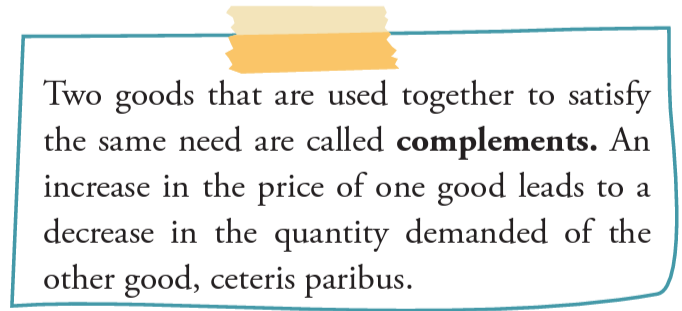
II) Two goods that are used together to satisfy the same need are called complements.
III) Income-Consumption Curve is the curve showing the set of utilitymaximizing commodity bundles traced out as the monetary income of the consumer changes, ceteris paribus.
Which of the following is true for cross price demand fuction?
II) Two goods that are used together to satisfy the same need are called complements.
III) Income-Consumption Curve is the curve showing the set of utilitymaximizing commodity bundles traced out as the monetary income of the consumer changes, ceteris paribus.
Which of the following is true for cross price demand fuction?
Seçenekler
A
Only I
B
Only II
C
I and II
D
II and III
E
I,II and III
Açıklama:
Two goods that satisfy similar needs are called substitutes.
Two goods that are used together to satisfy the same need are called complements.
Income-Consumption Curve is the curve showing the set of utilitymaximizing commodity bundles traced out as the monetary income of the consumer changes, ceteris paribus.
Two goods that are used together to satisfy the same need are called complements.
Income-Consumption Curve is the curve showing the set of utilitymaximizing commodity bundles traced out as the monetary income of the consumer changes, ceteris paribus.
Soru 33
If the good Y is an ........... good for the consumer, quantity demanded of the good would decrease as the income of the consumer increases. In this case the Engel curve would be ........... sloped.
Seçenekler
A
Inferior/ downward
B
Inferior/ upward
C
Normal/downward
D
Normal/upward
E
Giffen/ downward
Açıklama:
If the good Y is an inferior good for the consumer, quantity demanded of the good would decrease as the income of the consumer increases. In this case the Engel curve would be downward sloped.
Soru 34
The good Y is a ........ good as the Engel Curve is ...... sloped for good Y.
Seçenekler
A
Inferior/upward
B
Inferior/downward
C
Giffen/downward
D
Normal/downward
E
Normal/upward
Açıklama:
The good Y is a normal good as the Engel Curve is upward sloped for good Y.
Soru 35
I) For normal goods quantity demanded increases (decreases) as income increases (decreases).
II) For inferior goods quantity demanded decreases (increases) as income increases (decreases).
III) Beveridge Curve relates the quantity of good demanded to income.
Which of the statements given above is not true about demand curve?
II) For inferior goods quantity demanded decreases (increases) as income increases (decreases).
III) Beveridge Curve relates the quantity of good demanded to income.
Which of the statements given above is not true about demand curve?
Seçenekler
A
Only I
B
Only II
C
Only III
D
I and II
E
II and III
Açıklama:
For normal goods quantity demanded increases (decreases) as income increases (decreases).
For inferior goods quantity demanded decreases (increases) as income increases (decreases).
Engel Curve relates the quantity of good demanded to income.
For inferior goods quantity demanded decreases (increases) as income increases (decreases).
Engel Curve relates the quantity of good demanded to income.
Soru 36
Change in the quantity demanded of a good in response to a change in purchasing power, keeping relative prices constant, is called the
.......... effect.
.......... effect.
Seçenekler
A
Income
B
Substitution
C
Demand
D
Price
E
Supply
Açıklama:
Change in the quantity demanded of a good in response to a change in purchasing power, keeping relative prices constant, is called the
income effect.
income effect.
Soru 37
Change in the quantity demanded of a good in response to a change in the price in its price, keeping the satisfaction level of the consumer constant, is called the ................. effect.
Seçenekler
A
Income
B
Substitution
C
Demand
D
Price
E
Supply
Açıklama:
Change in the quantity demanded of a good in response to a change in the price in its price, keeping the satisfaction level of the consumer constant, is called the substitution effect.
Soru 38
I) For giffen good, demand curve is downward sloped
II) For normal good, demand curve is upward sloped
III) For inferior good, demand curve is downward sloped
Which of the following is true for normal, inferior and giffen goods?
II) For normal good, demand curve is upward sloped
III) For inferior good, demand curve is downward sloped
Which of the following is true for normal, inferior and giffen goods?
Seçenekler
A
Only I
B
Only II
C
Only III
D
I and II
E
II and III
Açıklama:
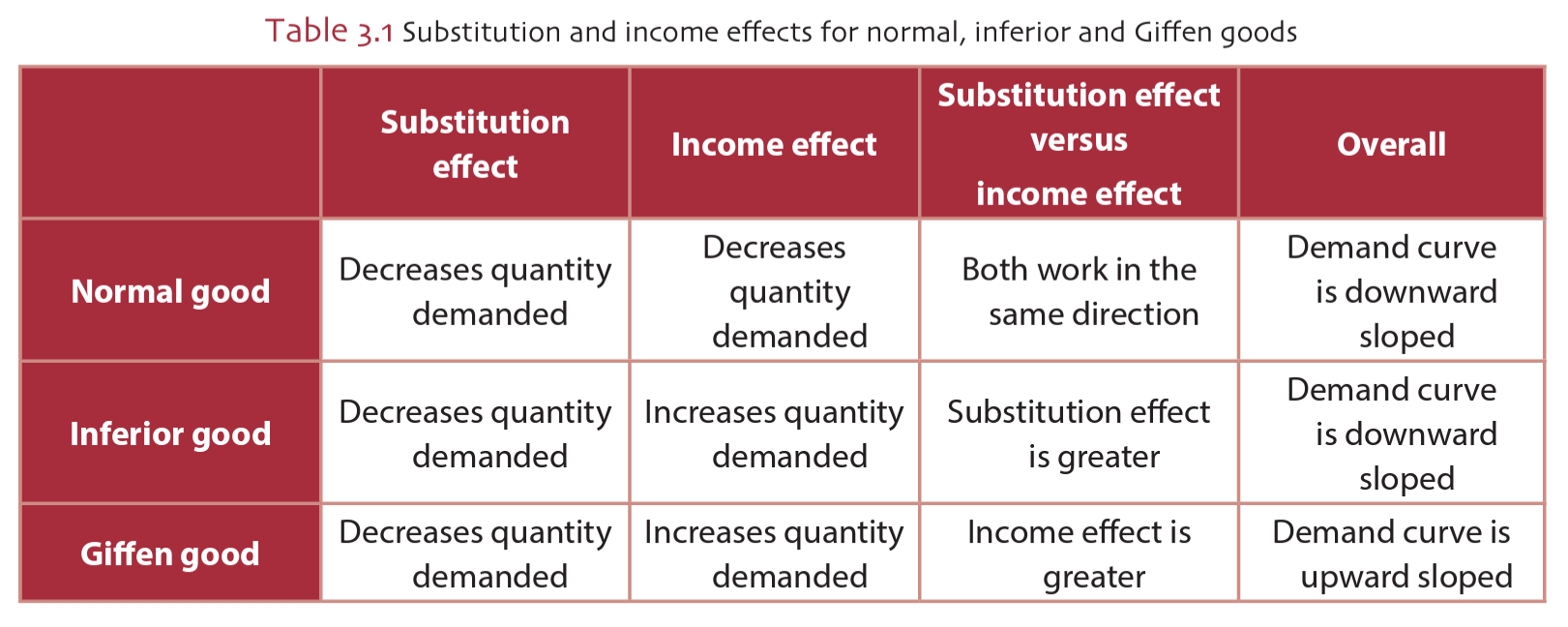
The answer is in Table 3.1.
For Giffen good, Demand curve is upward sloped
For Normal Good, Demand curve is downward sloped
For Inferior good, Demand curve is downward sloped
For Giffen good, Demand curve is upward sloped
For Normal Good, Demand curve is downward sloped
For Inferior good, Demand curve is downward sloped
Soru 39
I) Demand is ELASTIC if the percentage change in the quantity is greater than the percentage change in
price making the absolute value of the price elasticity greater than 1.
II) Demand is INELASTIC if the percentage change in the quantity is less than the percentage change in
price, making absolute value of the elasticity between 0 and 1
II) Demand is UNITARY ELASTIC if the percentage change in the quantity is equal to the percentage
change in price, making the absolute value of the price elasticity equal to 1.
Which of the following is true for elasticity of demand?
price making the absolute value of the price elasticity greater than 1.
II) Demand is INELASTIC if the percentage change in the quantity is less than the percentage change in
price, making absolute value of the elasticity between 0 and 1
II) Demand is UNITARY ELASTIC if the percentage change in the quantity is equal to the percentage
change in price, making the absolute value of the price elasticity equal to 1.
Which of the following is true for elasticity of demand?
Seçenekler
A
Only I
B
Only II
C
I and II
D
II and III
E
I, II and III
Açıklama:
Demand is ELASTIC if the percentage change in the quantity is greater than the percentage change in
price making the absolute value of the price elasticity greater than 1.
Demand is INELASTIC if the percentage change in the quantity is less than the percentage change in
price, making absolute value of the elasticity between 0 and 1
Demand is UNITARY ELASTIC if the percentage change in the quantity is equal to the percentage
change in price, making the absolute value of the price elasticity equal to 1.
price making the absolute value of the price elasticity greater than 1.
Demand is INELASTIC if the percentage change in the quantity is less than the percentage change in
price, making absolute value of the elasticity between 0 and 1
Demand is UNITARY ELASTIC if the percentage change in the quantity is equal to the percentage
change in price, making the absolute value of the price elasticity equal to 1.
Soru 40
| Price Elasticity | Effect on Total Expenditure when price decreases | Effect on Total Expenditure when price increases |
| Inelastic | ? | ? |
Seçenekler
A
No change / No change
B
Decrease / Increase
C
Increase/ Decrease
D
Decrease / No change
E
Increase / No change
Açıklama:
| Price Elasticity | Effect on Total Expenditure when price decreases | Effect on Total Expenditure when price increases |
| Inelastic | Decrease | Increase |
| Unitary | No change | No change |
| Elastic | Increase | Decrease |
Ünite 4
Soru 1
What is a business organization under a single management that makes, buys and sells goods and services in exchange for money?
Seçenekler
A
Firm
B
Value
C
Output
D
Capital goods
E
Isoquant
Açıklama:
Firm is a business organization under a single management that makes, buys and sells goods and services in exchange for money. The answer is A.
Soru 2
I. It criticizes the profit maximization assumption as unrealistic and proposes an alternative theory based on empirical observations of actual decision-making processes in business firms.
II. It suggests the firms would certainly prefer to earn more profit, but they cannot maximize profits.
III. Managers have all the information and the computational capability necessary to maximize profits.
What can be said to be true about the behavioral theory of the firm?
II. It suggests the firms would certainly prefer to earn more profit, but they cannot maximize profits.
III. Managers have all the information and the computational capability necessary to maximize profits.
What can be said to be true about the behavioral theory of the firm?
Seçenekler
A
Only I
B
Only II
C
I and II
D
I and III
E
II and III
Açıklama:
The behavioral theory of the firm criticizes the profit maximization assumption as unrealistic and proposes an alternative theory based on empirical observations of actual decision-making processes in business firms (see Cyert and March, 1963). The behavioral theory suggests that the firms, or to be more specific, the managers of the firms, would certainly prefer to earn more profit, but they cannot maximize profits. Managers do not have all the information and computational capability necessary to maximize profit because of the complexity of real life, and, moreover, they may
have other objectives as well. The managers follow an incremental process to increase profits and
search for better actions (“decision rules”) by trial and error until they reach a “good enough” level
(or rate) of profit. This process, in contrast to profit maximization, is called satisficing behavior, i.e., the firm settles for a “satisfactory” and “sufficient” level of profit. What is satisfactory and sufficient depends on the firm’s history as well as competitors’ profit. The answer is C.
have other objectives as well. The managers follow an incremental process to increase profits and
search for better actions (“decision rules”) by trial and error until they reach a “good enough” level
(or rate) of profit. This process, in contrast to profit maximization, is called satisficing behavior, i.e., the firm settles for a “satisfactory” and “sufficient” level of profit. What is satisfactory and sufficient depends on the firm’s history as well as competitors’ profit. The answer is C.
Soru 3
I. It is the dominant theory in economics.
II. It considers the firm as a “black box” and ignores how the decisions are made within the firm.
III. The firm has many objectives, including profit maximization.
What can be said to be true about the neo-classical theory of the firm?
II. It considers the firm as a “black box” and ignores how the decisions are made within the firm.
III. The firm has many objectives, including profit maximization.
What can be said to be true about the neo-classical theory of the firm?
Seçenekler
A
Only I
B
Only II
C
I and II
D
I and III
E
II and III
Açıklama:
The neo-classical theory of the firm is the dominant theory in economics. The neo-classical theory
considers the firm as a “black-box” and ignores how the decisions are made within the firm. The firm is an organization that transforms inputs (“factors of production”) into an output (or outputs), and that transformation is represented by a “well-behaved” production function. The firm has only one objective, profit maximization, and has knowledge and information to maximize its profit, i.e., the firm does indeed maximize the profit. The answer is C.
considers the firm as a “black-box” and ignores how the decisions are made within the firm. The firm is an organization that transforms inputs (“factors of production”) into an output (or outputs), and that transformation is represented by a “well-behaved” production function. The firm has only one objective, profit maximization, and has knowledge and information to maximize its profit, i.e., the firm does indeed maximize the profit. The answer is C.
Soru 4
I. Modern capitalism is characterized by large companies where a large number of small shareholders own the company, and the company is run by professional managers.
II. The owner cannot replace a manager if they fail to maximize profit, but because of information asymmetries, the managers can pursue other objectives for their own interests.
III. The managerial theory of the firm says that managers are interested in their own utility, not the profit of the firm.
What can be said to be true about the managerial theory of the firm?
II. The owner cannot replace a manager if they fail to maximize profit, but because of information asymmetries, the managers can pursue other objectives for their own interests.
III. The managerial theory of the firm says that managers are interested in their own utility, not the profit of the firm.
What can be said to be true about the managerial theory of the firm?
Seçenekler
A
Only I
B
Only II
C
I and II
D
I and III
E
II and III
Açıklama:
Modern capitalism is characterized by large companies where a large number of small shareholders own the company, and the company is run by professional managers. The managerial theory of the firm says that managers are interested in their own utility, not the profit of the firm. This is a typical principal-owner problem where the principal is the manager, and the owner is the shareholder. The owner can replace a manager if she fails to maximize profit, i.e., the return to the shareholders, but because of information asymmetries (the managers have more information about the company), the managers can pursue other objectives for their own interests. For example, the managers try to maximize sales, not profits, because the managers’ compensation and prestige may depend on the size of the firm. The answer is D.
Soru 5
I. The evolutionary theory of the firm combines the behavioral theory with the Schumpterian idea
of innovation and suggests that firms try to be more profitable but they cannot maximize profit
because of the lack of perfect information and computational capability
II. Compatible with the perfect information assumption, it is explicitly recognized that firms have perfect information, and they are excluded from the learning and innovation processes.
III. The evolutionary theory also assumes the satisficing behavior: firms adopt certain decision rules (“heuristics” or “routines”) to make decisions, and as long as they earn a satisfying level of profit, they do not search for new rules.
What can be said to be true about the evolutionary theory of the firm?
of innovation and suggests that firms try to be more profitable but they cannot maximize profit
because of the lack of perfect information and computational capability
II. Compatible with the perfect information assumption, it is explicitly recognized that firms have perfect information, and they are excluded from the learning and innovation processes.
III. The evolutionary theory also assumes the satisficing behavior: firms adopt certain decision rules (“heuristics” or “routines”) to make decisions, and as long as they earn a satisfying level of profit, they do not search for new rules.
What can be said to be true about the evolutionary theory of the firm?
Seçenekler
A
Only I
B
Only II
C
I and II
D
I and III
E
II and III
Açıklama:
The evolutionary theory of the firm combines the behavioral theory with the Schumpterian idea
of innovation, and suggests that firms try to be more profitable but they cannot maximize profit
because of the lack of perfect information and computational capability (Nelson and Winter,
1982). The evolutionary theory also assumes the satisficing behavior: firms adopt certain
decision rules (“heuristics” or “routines”) to make decisions, and as long as they earn a satisfying
level of profit, they do not search for new rules. Contrary to the perfect information assumption,
it is explicitly recognized that firms have local information, and they are involved actively in
learning and innovation processes. Firms generate product, process and organizational innovations
in pursuit of (temporary) monopolist profit, and these innovations lead to increasing diversity
among firms, whereas competition drives out those firms that are not successful in adopting new
technologies, and reduces diversity in the market. This is the so-called “creative destruction” process. The diversity of firms makes the representative firm approach useless, and one needs to analyze the evolution of the population of firms in order to understand industrial dynamics. The answer is D.
of innovation, and suggests that firms try to be more profitable but they cannot maximize profit
because of the lack of perfect information and computational capability (Nelson and Winter,
1982). The evolutionary theory also assumes the satisficing behavior: firms adopt certain
decision rules (“heuristics” or “routines”) to make decisions, and as long as they earn a satisfying
level of profit, they do not search for new rules. Contrary to the perfect information assumption,
it is explicitly recognized that firms have local information, and they are involved actively in
learning and innovation processes. Firms generate product, process and organizational innovations
in pursuit of (temporary) monopolist profit, and these innovations lead to increasing diversity
among firms, whereas competition drives out those firms that are not successful in adopting new
technologies, and reduces diversity in the market. This is the so-called “creative destruction” process. The diversity of firms makes the representative firm approach useless, and one needs to analyze the evolution of the population of firms in order to understand industrial dynamics. The answer is D.
Soru 6
What is the Production function?
Seçenekler
A
The functional relationship between inputs (factors of production) and the maximum amount of
output that can be produced with a given technology within a given period of time.
output that can be produced with a given technology within a given period of time.
B
The rate at which one input can be substituted for another one while holding output constant along an isoquant.
C
The decline in marginal productivity of an input while the use of that factor increases, keeping all other inputs constant.
D
A way of consuming a product. It can be defined by a specific combination of factors of production.
E
It gives the maximum consumption of a representative consumer.
Açıklama:
Production function is the functional relationship between inputs (factors of production) and the maximum amount of output that can be produced with a given technology within a given period of time. The answer is A.
Soru 7
What can be said to be true about efficiency?
Seçenekler
A
The concept of (technical) efficiency defines a relationship between actual output and potential output.
B
All firms operating on the production function produce a potential output and are not 100% technically efficient.
C
All firms operating on the isoquant produce the maximum potential output, and, by definition, are 100% technically efficient.
D
Technical efficiency is defined as the ratio between actual output and potential output.
E
The profit maximization assumption of the neo-classical theory requires that all firms are 100% efficient.
Açıklama:
The concept of (technical) efficiency defines a relationship between actual output and potential output. Technical efficiency is defined as the ratio between actual output and potential output. All firms operating on the isoquant (the production function) produce the maximum potential output, and, by definition, are 100% technically efficient. The profit maximization assumption of the neo-classical theory requires that all firms are 100% efficient.
The answer is B.
The answer is B.
Soru 8
What is the marginal technical rate of substitution for q = K2L at K=2 and L=5?
Seçenekler
A
0,5
B
0,2
C
1
D
-0,1
E
-0,2
Açıklama:
The marginal technical rate of substitution for q = K2L at K=2 and L=5 can be found by taking the partial derivatives:
dK/dL = - (∂q/∂L)/(∂q/∂K) = -fL/fK = - MPL/MPK = MRTSL for K
∂q/∂L =K2
∂q/∂K =2K.L
- (∂q/∂L)/(∂q/∂K) = - (K2)/(2K.L) = -K/2L
At K=2 and L=5 this expression will become -2/2*5 = -1/5 = -0,2
The answer is E.
dK/dL = - (∂q/∂L)/(∂q/∂K) = -fL/fK = - MPL/MPK = MRTSL for K
∂q/∂L =K2
∂q/∂K =2K.L
- (∂q/∂L)/(∂q/∂K) = - (K2)/(2K.L) = -K/2L
At K=2 and L=5 this expression will become -2/2*5 = -1/5 = -0,2
The answer is E.
Soru 9
I. In the case of labor augmenting change, capital becomes more productive.
II. In the case of neutral change, total factor productivity increases.
III. In the case of capital augmenting change, labor becomes more productive.
What can be said to be true about technological changes?
II. In the case of neutral change, total factor productivity increases.
III. In the case of capital augmenting change, labor becomes more productive.
What can be said to be true about technological changes?
Seçenekler
A
Only I
B
Only II
C
I and II
D
I and III
E
II and III
Açıklama:
The production function with two inputs, capital and labor, can shift because of three types of technological change: labor augmenting, capital augmenting, and neutral change. In the case of labor (capital) augmenting change, labor (capital) becomes more productive. Total factor productivity (the A parameter) increases in the case of neutral change.
The answer is B.
The answer is B.
Soru 10
What is the marginal rate of technical substitution (MRTS)?
Seçenekler
A
The concept relating to the changes in output to changes in inputs.
B
The combinations of factors of production (capital and labor) that can produce a given level of output.
C
The ratio between the output and one of the inputs.
D
The decline in marginal productivity of an input while the use of that factor increases, keeping all other inputs constant.
E
The rate at which one input can be substituted for another one while holding output constant along an isoquant.
Açıklama:
Marginal rate of technical substitution (MRTS) is the rate at which one input can be substituted for another one while holding output constant along an isoquant. The answer is E.
Soru 11
Which of the following is/are the reason(s) why the behavior of firms important? Why is it important to know how firms behave?
- to predict the effects of productivity growth on the levels of output, prices, and employment
- to analyze why there are only a few firms in a given sector
- to analyze how the income distribution may change as a results of a decline in the number of firms in the market
Seçenekler
A
only I
B
only II
C
I and II
D
II and III
E
I, II, III
Açıklama:
We need to know how firms behave under specific conditions in order to understand and make predictions about how the economy evolves. For example, if we know how firms behave, we can predict the effects of productivity growth on the levels of output, prices, and employment. We can also analyze why there are only a few firms in a given sector (i.e., oligopolistic sectors), and how the income distribution may change as a results of a decline in the number of firms in the market.
Soru 12
In which type of firms is the liability of the owners are limited to capital invested?
Seçenekler
A
Limited liability company
B
Sole proprietorship
C
Simple partnership
D
Government owned company
E
Non-profit organizations
Açıklama:
The types of firms differ in terms of the number, rights and obligations of the owners. For example, a sole proprietorship is a business owned and managed by a single natural person whereas a simple partnership is owned and managed by two or more natural persons. In both cases, the liability of the owners is unlimited, and the owners are personally responsible for all debts and obligations that the firm takes on.
In the case of limited liability and joint stock companies, the owners own shares of the company, the firm is managed by professional managers, and the liability of the owners is limited to the capital invested in the company, i.e., the face value of the shares held by the owners. Therefore, an owner, i.e., a shareholder, of a limited liability company or a joint stock company is not personally liable for any of the debts of the company. In the case of government owned companies, the government, as a legal identity, owns partially or fully the company that is managed by professional managers.
In the case of limited liability and joint stock companies, the owners own shares of the company, the firm is managed by professional managers, and the liability of the owners is limited to the capital invested in the company, i.e., the face value of the shares held by the owners. Therefore, an owner, i.e., a shareholder, of a limited liability company or a joint stock company is not personally liable for any of the debts of the company. In the case of government owned companies, the government, as a legal identity, owns partially or fully the company that is managed by professional managers.
Soru 13
Which of the following theories assume(s) that the profit maximization assumption is unrealistic?
Seçenekler
A
Neo-classical
B
Behavioral
C
Managerial
D
Behavioral and Evolutionary
E
Neo-classical and Managerial
Açıklama:
The behavioral theory of the firm criticizes profit maximization assumption as unrealistic and proposes an alternative theory based on empirical observations of actual decision making processes in business firms
Soru 14
When should the size of a company growth be stopped?
Seçenekler
A
When the increase in the material prices is too high
B
Labor cost is higher than the transaction costs
C
Managerial cost is higher than transaction cost
D
Energy cost is higher than the transaction cost
E
When demand starts decreasing
Açıklama:
The size of a firm is bounded because when the firm gets larger, the managerial costs will increase, and the firm will stop growing at the point where managerial costs exceed transaction costs.
Soru 15
Which of the following is/are true of production function?
- Production function is the functional relationship between the quantities of output and inputs
- Production function determines the behavior of a firm
- There are different types of production functions and the choice depends on the characteristics of technology and the modeling approach under consideration
- For sectoral production functions, only gross output is used as the output measure.
Seçenekler
A
I, II
B
II, III
C
III, IV
D
I, II, III
E
I, II, III, IV
Açıklama:
All except IV are true of production function. For sectoral production functions, one may use either gross output or value added as an output measure depending on the type of analysis. However, if value added is used for “output”, only labor and capital can be used for inputs, and in the case of gross output, raw materials should be used as input in addition to labor and capital. At the firm level, gross output is the preferred output measure.
Soru 16
Which of the following is NOT true of returns to scale?
Seçenekler
A
Returns to scale relates changes in output to changes in inputs.
B
There are two types of returns to scale: increasing and decreasing returns to scale.
C
Increasing returns to scale can arise due to the division of labor and specialized resources.
D
Returns to scale is related to the degree of homogeneity of a production function.
E
Returns to scale is closely related with average productivity and total factor productivity.
Açıklama:
There are three types of returns to scale: increasing, constant and decreasing returns to scale.
Soru 17
Which of the following defines the relationship between actual output and potential output?
Seçenekler
A
Efficiency
B
Elasticity
C
Returns to scale
D
Productivity
E
Marginal productivity
Açıklama:
The concept of (technical) efficiency defines a relationship between actual output and potential output.
Soru 18
Which of the following are true for marginal rate of technical substitution (MRTS)?
- MRTS is defined as the rate at which one input is substituted for another while the output is constant
- MRTS depends positively on the capital labor ratio
- MRTS is equal to the ratio between changes in the quantities of inputs
- when the MRTS depends on only the ratio of the inputs (K/L), the production function is called “homothetic”
Seçenekler
A
I, II
B
II, III
C
I, II, III
D
I, II, III, IV
E
II, III, IV
Açıklama:
All of the above are true of MRTS.
Soru 19
Which of the following are true of the elasticity of substitution?
- The elasticity of substitution measures the curvature of the isoquant.
- The elasticity of substitution is equal to the percentage change in the ratio between two inputs.
- The elasticity of substitution shows the proportional change in the KL ratio in response to one percentage point change in MRTS.
- The elasticity of substitution measures percentage change in the ratio of capital to labor in response to a change in relative prices (the price ratio of capital to labor).
Seçenekler
A
I, II
B
II, III
C
I, II, III
D
I, II, III, IV
E
I, III, IV
Açıklama:
The elasticity of substitution is equal to the percentage change in the ratio between two inputs (say, capital-labor ratio, K/L) divided by the percentage change in MRTS when output is fixed.
Soru 20
Which of the following is the outcome of neutral technological change?
Seçenekler
A
Total factor productivity increases
B
Productivity of labor increases
C
The quality of capital increases
D
Input decreases
E
The number of employees decreases
Açıklama:
Total factor productivity (the A parameter) increases in the case of neutral change.
Ünite 5
Soru 1
After a firm determines the technologically efficient production process, this is followed by
Seçenekler
A
Determining the output level that maximize firm’s profits.
B
Determining the input prices.
C
Selecting production method.
D
Selecting input combinations.
E
Selecting the top managers of firm.
Açıklama:
After a firm determines the technologically efficient production process, the next decision is to select a production method that is also efficient in terms of economics.
Soru 2
Which of the following is important for a typical firm before making a decision about the profit-maximizing output level?
Seçenekler
A
How its cost varies with output.
B
Input prices.
C
Product price.
D
Degree of competition in the market.
E
Market power of firm.
Açıklama:
A firm should have knowledge on how its costvaries with output to make profit-maximizing decisions.
Soru 3
Which of the following is not a factor for determining the cos of production of a firm?
Seçenekler
A
Corporate taxes paid by firm.
B
Production technology.
C
Productivity of workers.
D
Wages paid to workers.
E
Interest paid to capital.
Açıklama:
Corporate taxes paid by firm is not part of cost of production.
Soru 4
Which of the following is not considered as part of accounting costs?
Seçenekler
A
Wages paid to workers.
B
Opportunity costs of capital owned and used by the firm.
C
actual expenses.
D
historical costs.
E
depreciation.
Açıklama:
The accounting cost relies on actual expenses, historical costs and depreciation.
Soru 5
Which of the following is an example of economic costs?
Seçenekler
A
Wages paid to workers.
B
Opportunity costs of capital owned and used by the firm.
C
actual expenses.
D
historical costs.
E
depreciation.
Açıklama:
the economists’ definition of cost relies on the opportunity cost concept and what that input would be paid in its best alternative use is defined as the cost of any input.
Soru 6
Which of the following is part of a firm’s fixed costs?
Seçenekler
A
Machinery used in production.
B
Number of workers.
C
Electricity.
D
postage for mailing.
E
Raw materials used to produce goods.
Açıklama:
Fixed costs are associated with the fixed inputs in production.
These are costs that are not related to the level of output.
These are costs that are not related to the level of output.
Soru 7
A firm’s total cost (TC) in the short-run equals to
Seçenekler
A
the sum of its fixed cost plus its marginal cost.
B
the sum of its fixed plus variable cost.
C
the sum of variable plus marginal cost.
D
the sum of accounting and economic costs.
E
only its variable costs
Açıklama:
A firm’s total cost (TC) in the short-run equals to the sum of both fixed and
variable costs.
variable costs.
Soru 8
In this equation of total costs, TC = TFC + TVC, what does TVC stand for?
Seçenekler
A
Firm’s accounting costs.
B
Firm’s economic costs.
C
Firm’s total variable costs.
D
Firm’s total fixed costs.
E
Sunk costs.
Açıklama:
TVC denotes total variable costs
Soru 9
Which of the following will be true if there is decrease in the cost of capital?
Seçenekler
A
marginal cost of firm increases.
B
marginal cost remains constant.
C
marginal cost of firm decreases.
D
variable cost of firm increases.
E
total cost of firm increases.
Açıklama:
Decrease in the cost of capital decreases the total cost of firm and its variables cost are not affected. Thus, marginal cost of firm remains unchanged.
Soru 10
If a firm increase the number of workers to produce more quantities of product that it produces, then which of the following will be true?
Seçenekler
A
manage to reduce its marginal cost.
B
manage to reduce average variable cost.
C
manage to reduce average total cost.
D
manage to reduce average fixed cost
E
manage to reduce total variable cost.
Açıklama:
If a firm increase the number of workers it hires to produce more output, as output increase, it can reduce its average fixed costs, since as output increase the average fixed cost falls.
Soru 11
What is economic cost?
Seçenekler
A
The value of the best alternative use of any capital.
B
The value of the best alternative use of any input.
C
The remaining value of the best alternative use of any input.
D
The increase in the value of the best alternative use of any input.
E
The decrease in the value of the best alternative use of any input.
Açıklama:
The value of the best alternative use of any input is the economic cost of that input.
Soru 12
How do we name the costs that are related with variable inputs and change with output level?
Seçenekler
A
Total costs
B
Permanent costs
C
Variable costs
D
Fixed costs
E
Extra costs
Açıklama:
The costs that are related with variable inputs and change with output level are called variable costs.
Soru 13
What are sunk costs?
Seçenekler
A
Expenses that have been made and cannot be retrieved.
B
Expenses that have been collected.
C
Expenses that have been paid in full.
D
Expenses that are beyond avarege costs.
E
Expenses that have not been calculated.
Açıklama:
Sunk costs are expenses that have been made and cannot be retrieved.
Soru 14
How do we name the increase in cost that results from producing one more unit of output?
Seçenekler
A
Total variable cost
B
Fixed cost
C
Sunk cost
D
Average cost
E
Marginal cost
Açıklama:
The increase in cost that results from producing one more unit of output is called marginal cost (MC).
Soru 15
What is "the ratio of the total cost to the output" called?
Seçenekler
A
Average cost
B
Maximum cost
C
Sunk cost
D
Fixed cost
E
Declared cost
Açıklama:
The average cost (AC) is the ratio of the total cost to the output produced.
Soru 16
Which of the followings provides information on changing structure of inputs as output increases while holding the prices of these inputs the same?
Seçenekler
A
Index path
B
Expense path
C
Diversion path
D
Expansion path
E
Tangant path
Açıklama:
Expansion path provides information on changing structure of inputs as output increases while holding the prices of these inputs the same.
Soru 17
What is the term used for "when an increase in a firm’s scale of production causes lower average costs"?
Seçenekler
A
Increasing returns to scale.
B
Decreasing returns to scale.
C
Long run average cost
D
Long run marginal cost
E
Dual problem of cost minimization
Açıklama:
If an increase in a firm’s scale of production causes lower average costs, increasing returns to scale, or economies of scale occurs.
Soru 18
If long run average cost is constant across all output levels, what will this lead to?
Seçenekler
A
A linear short term total cost curve.
B
A linear long run sunk cost curve.
C
A linear long run total cost curve.
D
A linear short term defecit.
E
A u-curve of long run total cost.
Açıklama:
If long run average cost is constant across all output levels, this will lead to a linear long run total cost curve.
Soru 19
What is "economic profits"?
Seçenekler
A
The sum of expenses and sunk costs
B
The difference between revenues and costs
C
The average cost of services
D
The difference between sunk cost and all expenses
E
The difference between variable costs and sunk costs
Açıklama:
The difference between revenues and costs is called economic profits.
Soru 20
What is the term used for " all pairs of the inputs and the output that give a constant level of profit"?
Seçenekler
A
Isoprofit lines
B
The demand curves for a factor
C
Marginal revenue products
D
The (unconditional) demand function for capital
E
The economic profits
Açıklama:
Isoprofit lines are all pairs of the inputs and the output that give a constant level of profit.
Ünite 6
Soru 1
In a perfectly competitive market firms and consumers are _____________ . This means that all economic agents take the market-determined ________ as given for their economic behavior.
Seçenekler
A
price takers - price
B
rational - utility
C
homogenous - utility
D
different - goods
E
underpaid - wage
Açıklama:
If your answer is incorrect, please refer to Chapter 6 in your textbook.
In a perfectly competitive market firms and consumers are price takers. This means that all economic agents take the market-determined price as given for their economic behavior. In other words, economic agents cannot affect the market price by themselves.
In a perfectly competitive market firms and consumers are price takers. This means that all economic agents take the market-determined price as given for their economic behavior. In other words, economic agents cannot affect the market price by themselves.
Soru 2
- Price (P)
- Marginal revenue (MR)
- Average Revenue (AR)
Seçenekler
A
Only I
B
Only II
C
I and II
D
I and III
E
I, II and III
Açıklama:
If your answer is incorrect, please refer to Chapter 6 in your textbook.
For a competitive firm, P=MR=AR . This is shown in Figure 6.1 in the textbook.
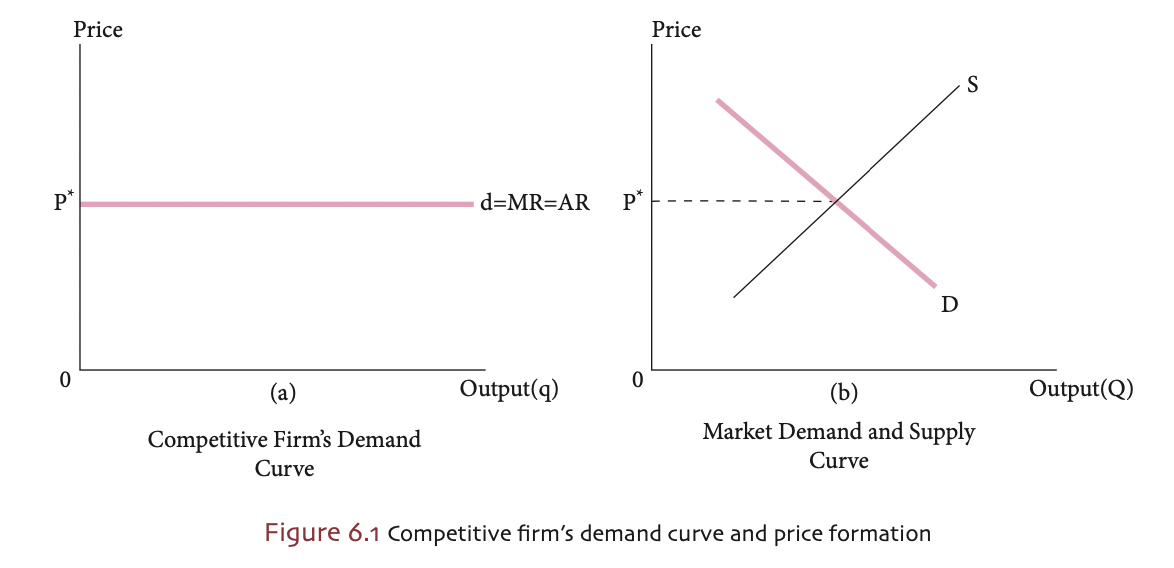
For a competitive firm, P=MR=AR . This is shown in Figure 6.1 in the textbook.
Soru 3
Which of the following produces the optimal output level for a competitive firm in the short-run?
Seçenekler
A
AR = MR
B
AC = MR
C
MC = MR
D
MR > P
E
MC < P
Açıklama:
If your answer is incorrect, please refer to Chapter 6 in your textbook.
MR = MC is the profit maximization condition for all types of firms and produces the optimal output level for a competitive firm in the short-run.
MR = MC is the profit maximization condition for all types of firms and produces the optimal output level for a competitive firm in the short-run.
Soru 4
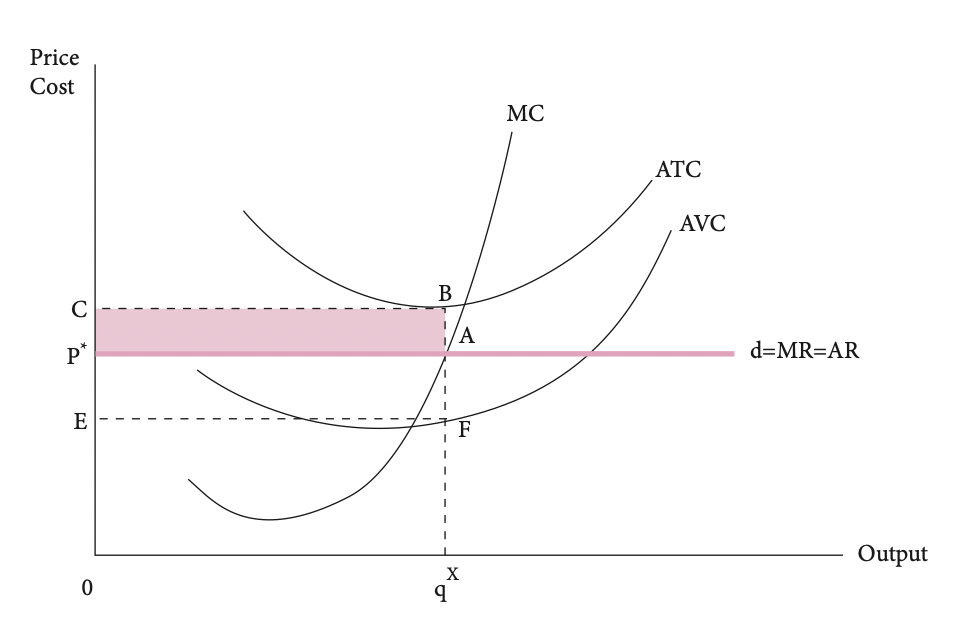 What does the figure above indicate for a competitive firm?
Seçenekler
A
Loss in the short-run and going out of business in the long-run
B
Loss in the short-run and recovery in the long-run
C
Breakeven in the short-run and going out of business in the long-run
D
Economic profit in the short-run and normal profit in the long-run
E
Economic profit in the short-run and economic profit in the long-run
Açıklama:
If your answer is incorrect, please refer to Chapter 6 in your textbook.
The figure shows that the firm's current level of ATC is higher than the price level. This means that whether the firm continues to produce or not, it s going to face losses. However, continuing to the production is a better option as stopping production creates a loss that equals the area of CBFE rectangle whereas continuing to the production is going to reduce the cost that equals the area of CBAP rectangle.
The figure shows that the firm's current level of ATC is higher than the price level. This means that whether the firm continues to produce or not, it s going to face losses. However, continuing to the production is a better option as stopping production creates a loss that equals the area of CBFE rectangle whereas continuing to the production is going to reduce the cost that equals the area of CBAP rectangle.
Soru 5
All inputs i.e. labor, capital, natural resources are ___________ in the long-run. Therefore, firms are able to change their plant size and production capacities in the long-run, resulting in a larger production site, more workers, more machinery etc.
Seçenekler
A
Constant
B
Decreasing
C
Zero
D
Variable
E
Maximum
Açıklama:
If your answer is incorrect, please refer to Chapter 6 in your textbook.
The long-run condition removes all the restrictions regarding the availability of factors of production. In other words, all the factors of production (inputs) are variable in the long-run and do not face a restriction as they do in short-run.
The long-run condition removes all the restrictions regarding the availability of factors of production. In other words, all the factors of production (inputs) are variable in the long-run and do not face a restriction as they do in short-run.
Soru 6
Monopoly is a type of market that has the same profit maximization rule as the competitive market, which is _______ . In a monopoly, however, there is only a single seller of a homogenous product with no close ___________ . This means that no other firm can produce an item that fulfills the needs of the consumers as the monopolist's product does.
Seçenekler
A
MC = MR , substitutes
B
AC = AR , substitutes
C
MR = P , substitutes
D
MC = P , complements
E
AC = AR , complements
Açıklama:
If your answer is incorrect, please refer to Chapter 6 in your textbook.
MC = MR is the profit maximization condition for all types of firms. However, in a monopoly there is only a single firm that produces a homogenous product and that product has not close substitutes. This means that no other firm can produce a good that fulfills the needs of the consumers as the monopolist's product does.
MC = MR is the profit maximization condition for all types of firms. However, in a monopoly there is only a single firm that produces a homogenous product and that product has not close substitutes. This means that no other firm can produce a good that fulfills the needs of the consumers as the monopolist's product does.
Soru 7
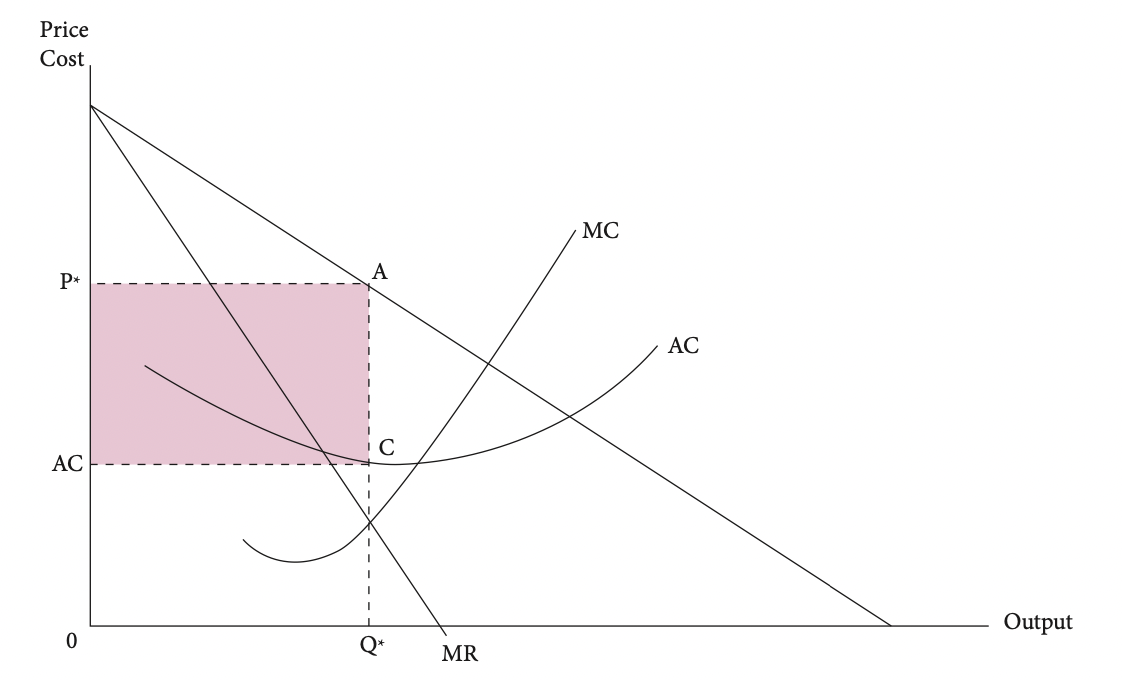
The figure above belongs to a firm. What does the pink area indicate?
Seçenekler
A
Total cost
B
Total profit
C
Marginal cost
D
Marginal revenue
E
Total revenue
Açıklama:
If your answer is incorrect, please refer to Chapter 6 in your textbook.
By looking at the MR curve we can understand that the firm is not a competitive one. Taking into account the profit maximization rule of MC = MR, the pink area, which is above the AC curve, is indeed indicate the economic profit of the firm.
By looking at the MR curve we can understand that the firm is not a competitive one. Taking into account the profit maximization rule of MC = MR, the pink area, which is above the AC curve, is indeed indicate the economic profit of the firm.
Soru 8
_____________ occurs when the market is not competitive and resulting total level of output is lower than the competitive level. The term refers to the combined loss from consumer and producer surpluses.
Seçenekler
A
Deadweight loss
B
Marginal cost
C
Average total cost
D
Negative economic profit
E
Breakeven level of production
Açıklama:
If your answer is incorrect, please refer to Chapter 6 in your textbook.
The social cost of imperfect competition is a loss in total production. This loss occurs due to partial losses captured in consumer surplus and producer surplus. Combined together, economists call it "deadweight loss".
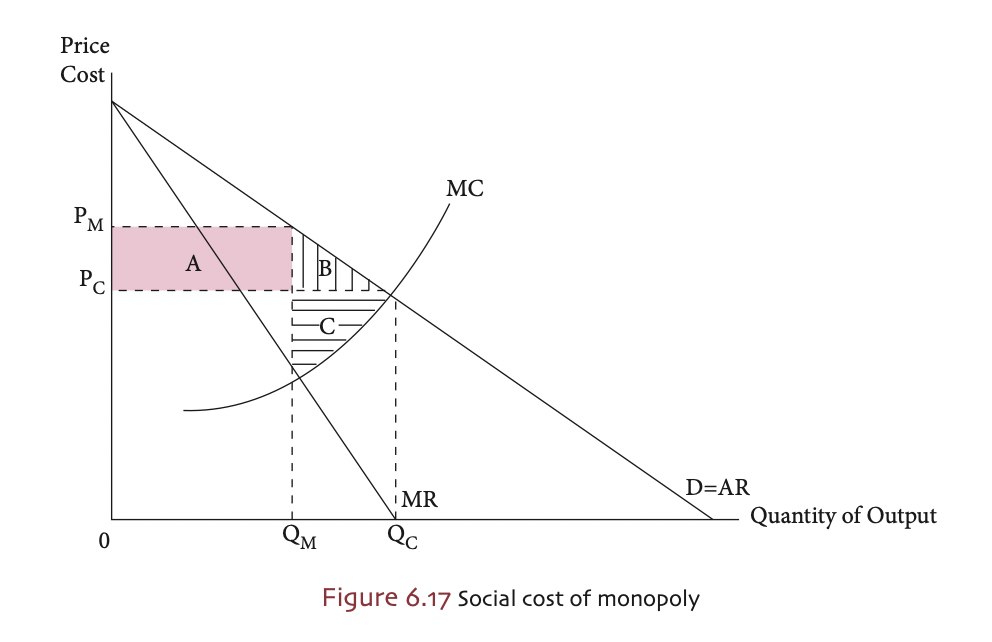
The social cost of imperfect competition is a loss in total production. This loss occurs due to partial losses captured in consumer surplus and producer surplus. Combined together, economists call it "deadweight loss".
Soru 9
In which type of market the firms act as if they were monopolists even if their respective products exhibit slight differences?
Seçenekler
A
Perfect competition
B
Monopoly
C
Monopsony
D
Monopolistic competition
E
Oligopoly
Açıklama:
If your answer is incorrect, please refer to Chapter 6 in your textbook.
In monopolistic competition, the firms sell only slightly different products and yet they act like their respective products were unique.
In monopolistic competition, the firms sell only slightly different products and yet they act like their respective products were unique.
Soru 10
Which is equal to marginal revenue product of labor (MRPL) ?
Seçenekler
A
MPL
B
MPL . w
C
MR. w
D
w
E
P . w
Açıklama:
If your answer is incorrect, please refer to Chapter 6 in your textbook.
To calculate the marginal revenue product of labor, we multiply MPL with MR. For a competitive market MR happens to be equal to the price level (P). The result of that multiplication can thereby be stated as "w", which denotes wage.
(MPL . MR) = (MPL . P) = w
To calculate the marginal revenue product of labor, we multiply MPL with MR. For a competitive market MR happens to be equal to the price level (P). The result of that multiplication can thereby be stated as "w", which denotes wage.
(MPL . MR) = (MPL . P) = w
Soru 11
Which of the following is not one of the assumptions of perfect competition theory?
Seçenekler
A
Many Firms and Many Consumers
B
No Entry and Exit Barriers
C
Homogenous Products
D
Hypothetical market
E
Full Information
Açıklama:
Perfect competition comprises four pillars as simplifying assumptions:
Perfect competition is a hypothetical market type but this is not one of the assumptions of the theory
Many Firms and Many Consumers
No Entry and Exit Barriers
Homogenous Products
Full Information
Perfect competition is a hypothetical market type but this is not one of the assumptions of the theory
Soru 12
Which of the following is the name given to the products being the same in terms of size, shape, quality, smell, packaging, etc.?
Seçenekler
A
Homogeneous products
B
Complementary goods
C
Perfect Competition
D
Heterogeneous products
E
Ful information
Açıklama:
Goods sold and bought in perfectly competitive markets are homogenous. In other words, all products are the same in terms of their size, shape, quality, smell, package, etc.
Soru 13
Which of the following is the name given to the price level that causes the firms to incur losses as much as the fixed costs in the short run and therefore causes the firm to stop production?
Seçenekler
A
Shut-down point
B
Market price
C
Market clearance price
D
Maximum price
E
Minimum price
Açıklama:
Shut-Down (Break-even) Point is a price level which leads firms to obtain a loss equal to fixed costs in the short run, thus the firm should stop production. If price is higher than this level the firm should continue to produce in the short run despite the loss obtained to cover at least a part of fixed costs.
Soru 14
In the figure, which of the following is the level of output that maximizes the firm's profits?
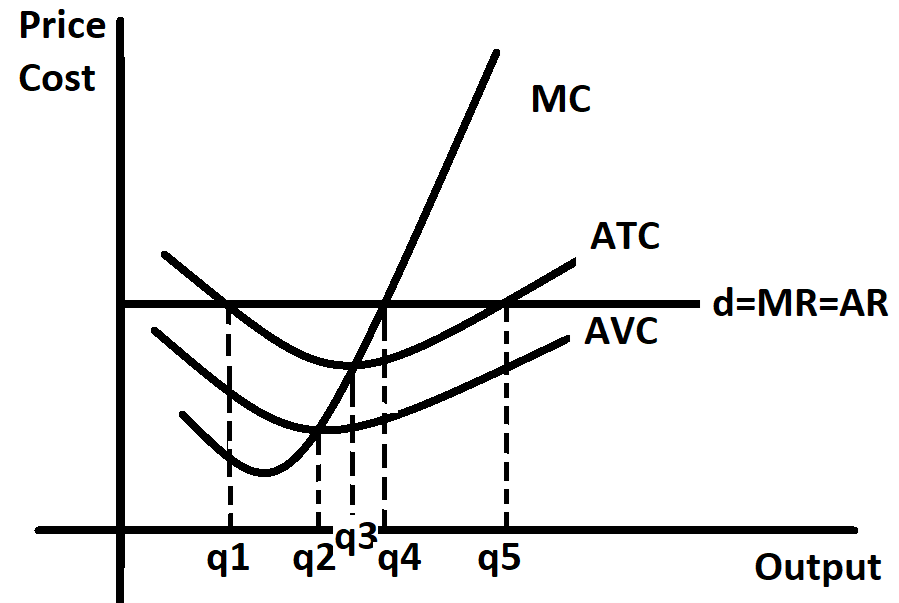
Seçenekler
A
q1
B
q2
C
q3
D
q4
E
q5
Açıklama:
The level of production that maximizes the firm's profit is determined at the point where MR=MC. Thus, in the figure, this point is achieved at the q4 production level.
Soru 15
- if one firm has own the entire supply of any critical input or raw material
- if one firm has technological knowledge by patents, know-how, copyrights, etc.
- If there is an opportunity for huge cost advantages in large scales in any industry. Which of the above are barriers to entry that create a monopoly?
Seçenekler
A
İ ve İİ
B
Yalnız i
C
Yalnız İİ
D
Yalnız İİİ
E
İ,İİ ve İİİ
Açıklama:
The most important characteristic of a monopoly market is the barriers to entry. These barriers can arise from several reasons. For example, one firm can own the entire supply of any critical input or raw material used in the production of an output which grants the monopoly position to this firm in that market. If output cannot be produced without this input, then no other firm can enter into the market and produce it. Secondly, technological knowledge possessed formally or informally builds an entry barrier. Some outputs may require very high technical expertise. If only one firm keeps this expertise, this firm will be the only producer of this output. Also, intellectual property rights bestow a firm to be the sole owner of technological knowledge used in the production process, i.e., patents, know-how, copyrights, etc. Sometimes, the entry barrier arises naturally. If there is an opportunity for huge cost advantages in large scales in any industry, then one firm can capture the entire market naturally due to this scale of economy. In some cases, managers in public administrations endow some firms with the authority of producing and selling certain products due to feasibility reasons. For example, a water distribution network is run by municipalities. Otherwise, the water network would be too complicated and unproductive.
Soru 16
What is the name given to this market if there is only one firm to produce a homogeneous good with no close substitutes in a market?
Seçenekler
A
Pure monopoly
B
Oligopoly
C
Monopsony
D
Monopolistic Competition
E
Perfect Competition
Açıklama:
If there is only a firm in a market producing a homogeneous product with no close substitute, that market is called a pure monopoly.
Soru 17
The figure shows the revenue and cost curves for the monopoly market. Which of the following is the equilibrium output that maximizes profits for the monopoly firm?
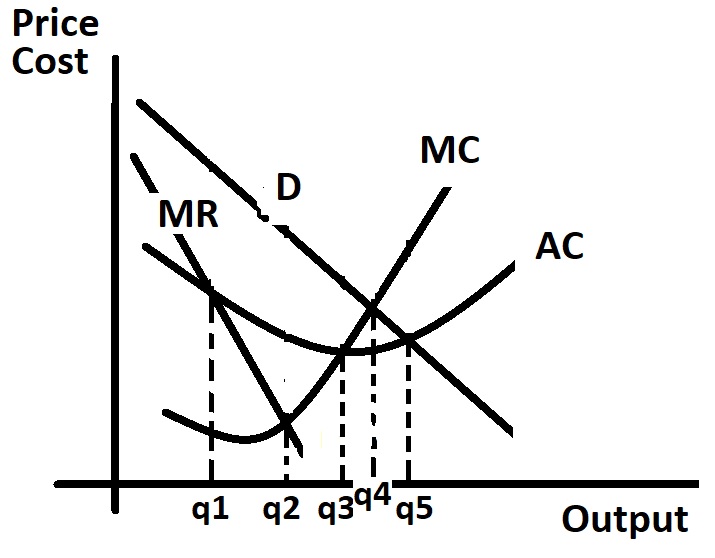
Seçenekler
A
q1
B
q2
C
q3
D
q4
E
q5
Açıklama:
Profit maximization for the monopolist is established at the point MR=MC, as for a perfectly competitive firm.
Therefore the production output level is q2.
Therefore the production output level is q2.
Soru 18
What is the name that the loss of a part of consumer and producer surpluses because the output level is less than the competitive output level and the price is higher than the competitive price in an imperfect competitive market?
Seçenekler
A
Equilibrium
B
Shut-Down (Break-even) Point
C
Pure Monopoly
D
Monopoly power
E
Deadweight loss
Açıklama:
Deadweight loss is the loss of a part consumer and producer surpluses because the output level is less than the competitive output level and the price is higher than the competitive price in an imperfect competitive market.
Soru 19
Which of the following is not a characteristic of the Cournot Model?
Seçenekler
A
The model assumes that there are two firms and they produce a homogeneous product.
B
The model assumes that firms have an identical cost structure and full information on the demand for their products.
C
In the model, firms compete with each other just to gain a larger market share.
D
In the model, firms are in price competition with each other because they have no other options.
E
In the model, it is important that firms predict a rival’s output level.
Açıklama:
In 1838, French Economist Antoine Augustin Cournot developed a duopoly model in which two firms produce a homogenous product. The model assumes that two firms produce a homogenous product.
The model assumes that firms have an identical cost structure and full information on the demand for their products. ...Firms in the Cournot model compete with each other to capture a greater market share because of the homogenous product. . In other words, price competition is not necessary as they both produce the same product.
The model assumes that firms have an identical cost structure and full information on the demand for their products. ...Firms in the Cournot model compete with each other to capture a greater market share because of the homogenous product. . In other words, price competition is not necessary as they both produce the same product.
Soru 20
Which of the following is a market where the price is given and cannot be changed by individual action, there is no barrier to entry and exit, and a homogeneous good is produced?
Seçenekler
A
Imperfect Competition
B
Monopolistic Competition
C
Perfect Competition
D
Oligopoly
E
Duopoly
Açıklama:
In a perfectly competitive market, the price is given and does not change with individual movements; there are no entry and exit barriers, and a homogeneous good is produced.
Ünite 7
Soru 1
Choose the option that completes the following sentence correctly.
"The state of simultaneous clearance of all goods and factor markets at a certain set of prices is called ..........."
"The state of simultaneous clearance of all goods and factor markets at a certain set of prices is called ..........."
Seçenekler
A
partial equilibrium
B
general equilibrium
C
productive equilibrium
D
seeeker equilibrium
E
Nash equilibrium
Açıklama:
The state of simultaneous clearance of all goods and factor markets at a certain set of prices is called general equilibrium.
Soru 2
Choose the option that completes the following sentence correctly.
"There are infinitely many tangency points between -invisible- isoquants that lie in the interval between A and B. The allocations that correspond to points of tangency between isoquants within this interval are called .......... allocations."
"There are infinitely many tangency points between -invisible- isoquants that lie in the interval between A and B. The allocations that correspond to points of tangency between isoquants within this interval are called .......... allocations."
Seçenekler
A
general
B
partial
C
core
D
productive
E
game
Açıklama:
There are infinitely many tangency points between -invisible- isoquants that lie in the interval between A and B. The allocations that correspond to points of tangency between isoquants within this interval are called core allocations.
Soru 3
Choose the option that completes the following sentence correctly.
".......... efficiency in production refers to allocations of resources at which it is impossible to increase the output of one good without reducing the output of the other."
".......... efficiency in production refers to allocations of resources at which it is impossible to increase the output of one good without reducing the output of the other."
Seçenekler
A
Game
B
General
C
Partial
D
Pareto
E
Utility
Açıklama:
Pareto efficiency in production refers to allocations of resources at which it is impossible to increase the output of one good without reducing the output of the other.
Soru 4
Which of the following is defined as the constraint limiting the spending capacity of the household?
Seçenekler
A
Relative price ratio
B
General equilibrium
C
Budget constraint
D
Pareto constraint
E
Producers's constraint
Açıklama:
Budget constraint is defined as the constraint limiting the spending capacity of the household.
Soru 5
Choose the option that completes the following statement correctly.
"A commonly used method of analysis in economics is ........... It is based on comparison of the equilibrium values of the endogenous variables in the model before and after an exogenous shock for the purpose of measuring the changes resulting from that shock."
"A commonly used method of analysis in economics is ........... It is based on comparison of the equilibrium values of the endogenous variables in the model before and after an exogenous shock for the purpose of measuring the changes resulting from that shock."
Seçenekler
A
consumer paradox
B
risk utility
C
pareto efficiency
D
Walras' law
E
comparative statics
Açıklama:
A commonly used method of analysis in economics is comparative statics. It is based on comparison of the equilibrium values of the endogenous variables in the model before and after an exogenous shock for the purpose of measuring the changes resulting from that shock.
Soru 6
Which of the following states that the value of excess demands in all markets in the model always adds up to zero?
Seçenekler
A
Ralative Cost
B
Comparative Statics
C
Walras' Law
D
Budget Constraint
E
Game Theory
Açıklama:
Walras' Law tates that the value of excess demands in all markets in the model always adds up to zero.
Walras' Law states that the value of excess demands in all markets in the model always adds up to zero.
Walras' Law states that the value of excess demands in all markets in the model always adds up to zero.
Soru 7
Choose the option that completes the following statement correctly.
".......... is the good that is chosen as the unit of measurement. All nominal values in a general equilibrium model can be expressed in terms of that good by dividing each of the other prices by its price."
".......... is the good that is chosen as the unit of measurement. All nominal values in a general equilibrium model can be expressed in terms of that good by dividing each of the other prices by its price."
Seçenekler
A
Numéraire
B
Price
C
Utility
D
Risk
E
Adjustment
Açıklama:
Numéraire is the good that is chosen as the unit of measurement. All nominal values in a general equilibrium model can be expressed in terms of that good by dividing each of the other prices by its price.
Soru 8
Which of the following is a very useful and commonly used method of analysis in economics?
Seçenekler
A
Production statics
B
Utility statics
C
Consumer statics
D
Comparative statics
E
Risk statics
Açıklama:
Comparative statics is a very useful and commonly used method of analysis in economics.
Soru 9
Choose the option that completes the following sentence correctly.
"The term .......... equilibrium itself refers to a state of simultaneous equilibrium in all goods and factor markets."
"The term .......... equilibrium itself refers to a state of simultaneous equilibrium in all goods and factor markets."
Seçenekler
A
relative
B
general
C
comparative
D
equal
E
efficient
Açıklama:
The term general equilibrium itself refers to a state of simultaneous equilibrium in all goods and factor markets.
Soru 10
Choose the option that completes the following sentence correctly.
".......... equilibrium framework describes how a market for a particular good is cleared through price movements."
".......... equilibrium framework describes how a market for a particular good is cleared through price movements."
Seçenekler
A
General
B
Utility
C
Partial
D
Risk
E
Productive
Açıklama:
Partial equilibrium framework describes how a market for a particular good is cleared through price movements.
Soru 11
The state of simultaneous clearance of all goods and factor markets at a certain set of prices is called .............
Which of the following completes the sentence above?
Which of the following completes the sentence above?
Seçenekler
A
partial equilibrium
B
general equilibrium
C
Pareto efficiency
D
perfect equilibrium
E
demand-supply equilibrium
Açıklama:
If your answer is wrong, please review the “Partial Equilibrium versus General Equilibrium” section.
The state of simultaneous clearance of all goods and factor markets at a certain set of prices is called general equilibrium.
The state of simultaneous clearance of all goods and factor markets at a certain set of prices is called general equilibrium.
Soru 12
What can be said to combinations inside the production possibilities frontier?
Seçenekler
A
they are not feasible
B
they are feasible but inefficient
C
they are feasible and efficient
D
they are not feasible but efficient
E
they are both not feasible and inefficient
Açıklama:
If your answer is wrong, please review the “Partial Equilibrium versus General Equilibrium” section.
Combinations outside the production possibilities frontier (PPF) are not feasible to produce with available resources and production technologies. Those combinations lying inside the PPF are feasible but inefficient. They lead to a waste of scarce resources. Only the combinations that lie on the PPF itself are feasible and efficient.
Combinations outside the production possibilities frontier (PPF) are not feasible to produce with available resources and production technologies. Those combinations lying inside the PPF are feasible but inefficient. They lead to a waste of scarce resources. Only the combinations that lie on the PPF itself are feasible and efficient.
Soru 13
Many products compete for shares in the _____________budgets of households that need or desire to consume them, even if they are not substitutes or complements in the conventional sense.
Seçenekler
A
consumption
B
consumer
C
calculation
D
development
E
demand
Açıklama:
PARTIAL EQUILIBRIUM VERSUS GENERAL EQUILIBRIUM
In real life, markets for different products constantly interact with each other, as there are many complicated linkages between them beyond simple complementarity or substitutability relations. For one thing, all products produced in a certain location often need to rely on a common pool of the factors of production and other inputs. In fact, many pairs of products are themselves connected through input-output relations. Furthermore, many products compete for shares in the consumption budgets of households that need or desire to consume them, even if they are not substitutes or complements in the conventional sense.
In real life, markets for different products constantly interact with each other, as there are many complicated linkages between them beyond simple complementarity or substitutability relations. For one thing, all products produced in a certain location often need to rely on a common pool of the factors of production and other inputs. In fact, many pairs of products are themselves connected through input-output relations. Furthermore, many products compete for shares in the consumption budgets of households that need or desire to consume them, even if they are not substitutes or complements in the conventional sense.
Soru 14
The state of simultaneous clearance of all goods and factor markets at a certain set of prices is called _____________________.
Which term is explained by the above sentences?
Which term is explained by the above sentences?
Seçenekler
A
substitutability relation
B
general equilibrium
C
input-output relation
D
partial equilibrium
E
interconnected system
Açıklama:
PARTIAL EQUILIBRIUM VERSUS GENERAL EQUILIBRIUM
The state of simultaneous clearance of all goods and factor markets at a certain set of prices is called general equilibrium.
The state of simultaneous clearance of all goods and factor markets at a certain set of prices is called general equilibrium.
Soru 15
There are infinitely many tangency points between -invisible- isoquants that lie in the interval between A and B.
What is the name of allocations that correspond to points of tangency between isoquants within this interval?
What is the name of allocations that correspond to points of tangency between isoquants within this interval?
Seçenekler
A
detailed
B
side
C
supporting
D
core
E
firm
Açıklama:
PARTIAL EQUILIBRIUM VERSUS GENERAL EQUILIBRIUM
There are infinitely many tangency points between -invisible- isoquants that lie in the interval between A and B. The allocations that correspond to points of tangency between isoquants within this interval are called core allocations.
There are infinitely many tangency points between -invisible- isoquants that lie in the interval between A and B. The allocations that correspond to points of tangency between isoquants within this interval are called core allocations.
Soru 16
“It requires that total consumption expenditures on different goods be equal to total income of the household (from ownership of the factors of production)”.
Which term is explained by the above sentences?
Which term is explained by the above sentences?
Seçenekler
A
Budget constraint
B
The relative price ratio
C
The representative household
D
Consumers’ Equilibrium
E
Pareto efficient point
Açıklama:
PARTIAL EQUILIBRIUM VERSUS GENERAL EQUILIBRIUM
Budget constraint is defined as the constraint limiting the spending capacity of the household. It requires that total consumption expenditures on different goods be equal to total income of the household (from ownership of the factors of production)
Budget constraint is defined as the constraint limiting the spending capacity of the household. It requires that total consumption expenditures on different goods be equal to total income of the household (from ownership of the factors of production)
Soru 17
Comparative statics is based on comparison of the _____________ values of the endogenous variables in the model before and after an exogenous shock for the purpose of measuring the changes resulting from that shock.
Seçenekler
A
imbalance
B
agitation
C
equilibrium
D
unevenness
E
asymmetry
Açıklama:
COMPARATIVE STATIC ANALYSIS OF GENERAL EQUILIBRIUM EFFECTS OF SHOCKS
A commonly used method of analysis in economics is comparative statics. It is based on comparison of the equilibrium values of the endogenous variables in the model before and after an exogenous shock for the purpose of measuring the changes resulting from that shock.
A commonly used method of analysis in economics is comparative statics. It is based on comparison of the equilibrium values of the endogenous variables in the model before and after an exogenous shock for the purpose of measuring the changes resulting from that shock.
Soru 18
_________________ states that in a general equilibrium model with n perfectly competitive (product and factor) markets, the following equation always holds:
i=1 n Σpi.EDi ( p) = 0 (9) where p is an nx1 vector of prices, pi is the price prevailing in the ith market, and EDi is the excess demand in that market (expressed as a function of all prices).
i=1 n Σpi.EDi ( p) = 0 (9) where p is an nx1 vector of prices, pi is the price prevailing in the ith market, and EDi is the excess demand in that market (expressed as a function of all prices).
Seçenekler
A
Numéraire
B
Relative Price Adjustment
C
Consumers’ Equilibrium
D
Walras’ Law
E
Pareto efficiency in production
Açıklama:
COMPARATIVE STATIC ANALYSIS OF GENERAL EQUILIBRIUM EFFECTS OF SHOCKS
It follows directly from Walras’ Law which states that in a general equilibrium model with n perfectly competitive (product and factor) markets, the following equation always holds:
i=1 n Σpi.EDi ( p) = 0 (9)
where p is an nx1 vector of prices, pi is the price prevailing in the ith market, and EDi is the excess demand in that market (expressed as a function of all prices).
It follows directly from Walras’ Law which states that in a general equilibrium model with n perfectly competitive (product and factor) markets, the following equation always holds:
i=1 n Σpi.EDi ( p) = 0 (9)
where p is an nx1 vector of prices, pi is the price prevailing in the ith market, and EDi is the excess demand in that market (expressed as a function of all prices).
Soru 19
“It is the good that is chosen as the unit of measurement. All nominal values in a general equilibrium model can be expressed in terms of that good by dividing each of the other prices by its price”.
Which term is explained by the above sentences?
Which term is explained by the above sentences?
Seçenekler
A
Neoclassical general equilibrium
B
Numéraire
C
Simultaneous equation
D
Endogenous variable
E
Labor intensity
Açıklama:
COMPARATIVE STATIC ANALYSIS OF GENERAL EQUILIBRIUM EFFECTS OF SHOCKS
Numéraire is the good that is chosen as the unit of measurement. All nominal values in a general equilibrium model can be expressed in terms of that good by dividing each of the other prices by its price.
Numéraire is the good that is chosen as the unit of measurement. All nominal values in a general equilibrium model can be expressed in terms of that good by dividing each of the other prices by its price.
Soru 20
The (simplified) general equilibrium framework is useful for showing the efficiency of general competitive equilibrium or in a broader sense, the overall efficiency of perfect _____________.
Seçenekler
A
measurement
B
independence
C
competition
D
comparison
E
discussion
Açıklama:
The (simplified) general equilibrium framework that we have described so far is useful not just for analyzing the effects of various shocks on relative prices and hence, allocation of resources. It is also useful for showing the efficiency of general competitive equilibrium or in a broader sense, the overall efficiency of perfect competition.
Soru 21
PPT shows how big a drop in the production of Y is required to increase production of X by one unit.
What does PPT refer to?
What does PPT refer to?
Seçenekler
A
Production Possibilities Frontier
B
Production Payment Fare
C
Payment Production Frontier
D
Product Payment Fix
E
Product Profit Fare
Açıklama:
THE EFFICIENCY OF GENERAL COMPETITIVE EQUILIBRIUM
Marginal rate of product transformation (MRPT) is the negative of the slope of production possibilities frontier (PPT). It shows how big a drop in the production of Y is required to increase production of X by one unit.
Marginal rate of product transformation (MRPT) is the negative of the slope of production possibilities frontier (PPT). It shows how big a drop in the production of Y is required to increase production of X by one unit.
Soru 22
Which of the following is true about efficiency in output mix?
I. Productive efficiency alone is sufficient to establish efficiency of general competitive equilibrium.
II. The right mix of products that comply with consumers’ choices must be produced to satisfy demand for the goods produced.
III. Obviously, no matter how technically efficient it may be, production of goods that are not demanded by anyone is useful.
I. Productive efficiency alone is sufficient to establish efficiency of general competitive equilibrium.
II. The right mix of products that comply with consumers’ choices must be produced to satisfy demand for the goods produced.
III. Obviously, no matter how technically efficient it may be, production of goods that are not demanded by anyone is useful.
Seçenekler
A
Only I
B
Only III
C
I and III
D
Only II
E
I, II and III
Açıklama:
THE EFFICIENCY OF GENERAL COMPETITIVE EQUILIBRIUM
Productive efficiency alone is not sufficient to establish efficiency of general competitive equilibrium. The right mix of products that comply with consumers’ choices must be produced to satisfy demand for the goods produced. Obviously, no matter how technically efficient it may be, production of goods that are not demanded by anyone is pointless.
Productive efficiency alone is not sufficient to establish efficiency of general competitive equilibrium. The right mix of products that comply with consumers’ choices must be produced to satisfy demand for the goods produced. Obviously, no matter how technically efficient it may be, production of goods that are not demanded by anyone is pointless.
Soru 23
Which of the following corresponds to the efficient allocation of all available resources in which it is not possible to increase the output of one good without reducing the output of another?
Seçenekler
A
Pareto efficient points
B
Core allocations.
C
Production possibilities frontier
D
Constant returns to scale
E
General equilibrium
Açıklama:
If your answer is wrong, please review the “Partial Equilibrium versus General Equilibrium” section.
Pareto efficient points correspond to efficient allocations of all available resources at which it is impossible to increase the output of one good without reducing the output of the other.
Pareto efficient points correspond to efficient allocations of all available resources at which it is impossible to increase the output of one good without reducing the output of the other.
Soru 24
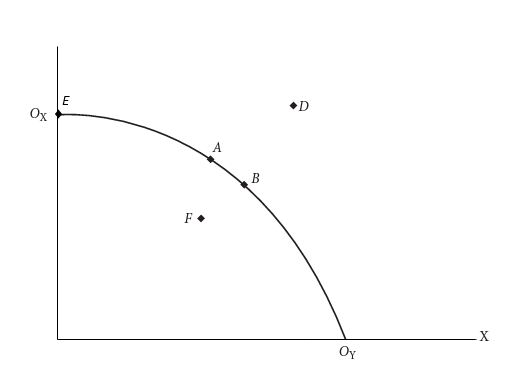 Which dot in the figure above shows a feasible but combination of X and Y?
Seçenekler
A
A
B
B
C
C
D
D
E
E
Açıklama:
If your answer is wrong, please review the “Partial Equilibrium versus General Equilibrium” section.
Combinations of X and Y lying inside the PPF are feasible but inefficient. They lead to a waste of scarce resources.
Combinations of X and Y lying inside the PPF are feasible but inefficient. They lead to a waste of scarce resources.
Soru 25
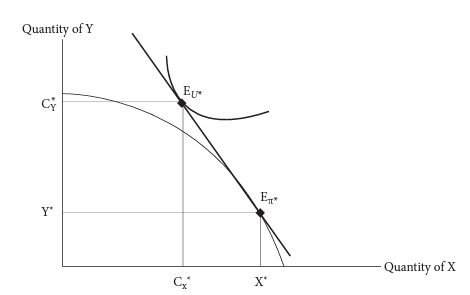 Which of the following does the figure above describe?
Seçenekler
A
Product markets are not cleared and resources are wasted.
B
The markets in the economy are in equilibrium simultaneously.
C
The economy is facing a supply side shock.
D
Consumers' demand for product X has increased due to a sudden change in preferences.
E
There is a mass emigration of the country’s labor force.
Açıklama:
If your answer is wrong, please review the “Partial Equilibrium versus General Equilibrium” section.
The figure describes a situation where product markets are not cleared and resources are wasted. Luckily, this disequilibrium state will not last. It is only temporary.
The figure describes a situation where product markets are not cleared and resources are wasted. Luckily, this disequilibrium state will not last. It is only temporary.
Soru 26
Which method of anlysis is used for a comparison of the equilibrium values of the endogenous variables in the model before and after an exogenous shock for the purpose of measuring the changes resulting from taht shock?
Seçenekler
A
Comparative analysis
B
Comparative statics
C
Partial comparative statics
D
Comparative stationary analysis
E
Comparative stationary statics
Açıklama:
If your answer is wrong, please review the “Comparative Static Analysis of General Equilibrium Effects of Shocks” section.
A commonly used method of analysis in economics is comparative statics. It is based on comparison of the equilibrium values of the endogenous variables in the model before and after an exogenous shock for the purpose of measuring the changes resulting from that shock.
A commonly used method of analysis in economics is comparative statics. It is based on comparison of the equilibrium values of the endogenous variables in the model before and after an exogenous shock for the purpose of measuring the changes resulting from that shock.
Soru 27
Who is the founder of neoclassical theory of general equilibrium?
Seçenekler
A
Alfred Marshall
B
Francis Edgeworth
C
Vilfredo Pareto
D
Leon Walras
E
David Ricardo
Açıklama:
If your answer is wrong, please review the “Comparative Static Analysis of General Equilibrium Effects of Shocks” section.
Walras’ Law is a fundamental feature of neoclassical general equilibrium models. Named after French economist Léon Walras (1834-1910) who is the founder of neoclassical theory of general equilibrium, the law states that the value of excess demands in all markets in the model always adds up to zero. Thus, when n-1 markets in the model are in equilibrium, the nth market will also have to be in equilibrium.
Walras’ Law is a fundamental feature of neoclassical general equilibrium models. Named after French economist Léon Walras (1834-1910) who is the founder of neoclassical theory of general equilibrium, the law states that the value of excess demands in all markets in the model always adds up to zero. Thus, when n-1 markets in the model are in equilibrium, the nth market will also have to be in equilibrium.
Soru 28
Which of the following equations represents Walras' Law?
Seçenekler
A 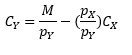
B 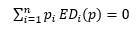
C 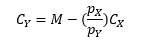
D 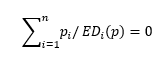
E 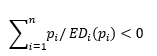
Açıklama:
If your answer is wrong, please review the “Comparative Static Analysis of General Equilibrium Effects of Shocks” section.
Walras’ Law which states that in a general equilibrium model with n perfectly competitive (product and factor) markets, the following equation always holds:
Walras’ Law which states that in a general equilibrium model with n perfectly competitive (product and factor) markets, the following equation always holds:
Soru 29
- It is the negative of the slope of production possibilities frontier.
- It shows how big a drop in the production of Y is required to increase production of X by one unit.
- It measures the opportunity cost of increasing the output of one good in terms of the other good.
Seçenekler
A
I
B
I, II
C
I, II, III
D
II, III
E
I, III
Açıklama:
If your answer is wrong, please review the “THE EFFICIENCY OF GENERAL COMPETITIVE EQUILIBRIUM” section.
Marginal rate of product transformation (MRPT) is the negative of the slope of production possibilities frontier (PPT). It shows how big a drop in the production of Y is required to increase production of X by one unit. In other words, RPT measures the opportunity cost of increasing the output of one good in terms of the other good.
Marginal rate of product transformation (MRPT) is the negative of the slope of production possibilities frontier (PPT). It shows how big a drop in the production of Y is required to increase production of X by one unit. In other words, RPT measures the opportunity cost of increasing the output of one good in terms of the other good.
Soru 30
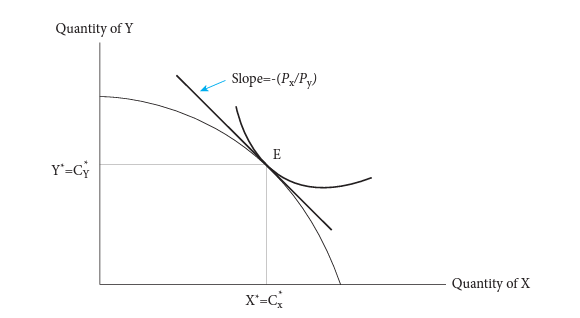 Which of the following statements is true about point E in the figure above?
Seçenekler
A
E is the point of maximum social welfare that can be attained under the given resource availability and technology constraints, and the given preferences of consumers.
B
At point E marginal rate of substitution (MRS) of CX for CY in consumption is equal to the marginal rate of product transformation along the PPT.
C
The amount of Y that the consumers are willing to give up to get one more unit of X (dCY /dCX) is the more than the amount of Y that the producers are willing to give up to produce one more unit of X (dY /dX) at this point.
D
Point E is a general equilibrium point.
E
E is a point of tangency between the highest social indifference curve and PPT.
Açıklama:
If your answer is wrong, please review the “THE EFFICIENCY OF GENERAL COMPETITIVE EQUILIBRIUM” section.
General equilibrium point E represents an output mix that makes not only (profit maximizing) producers, but also consumers happy. At this point, consumers maximize their utility subject to their budget constraint. Since this is also the output mix that the producers would choose to supply, product markets clear. At this point, marginal rate of substitution (MRS) of CX for CY in consumption is equal to the marginal rate of product transformation (MRPT), or the marginal rate of transformation (MRT), along the PPT. Mathematically, the MRS is negative of the slope of the highest social indifference curve that the society can reach, whereas the RPT is negative of the slope of PPT. Since E is a point of tangency between these two curves, their slopes must be equal at that point. Thus, the amount of Y that the consumers are willing to give up to get one more unit of X (dCY /dCX) is the same as the amount of Y that the producers are willing to give up to produce one more unit of X (dY /dX) at this point. So, E is the point of maximum social welfare that can be attained under the given resource availability and technology constraints, and the given preferences of consumers.
General equilibrium point E represents an output mix that makes not only (profit maximizing) producers, but also consumers happy. At this point, consumers maximize their utility subject to their budget constraint. Since this is also the output mix that the producers would choose to supply, product markets clear. At this point, marginal rate of substitution (MRS) of CX for CY in consumption is equal to the marginal rate of product transformation (MRPT), or the marginal rate of transformation (MRT), along the PPT. Mathematically, the MRS is negative of the slope of the highest social indifference curve that the society can reach, whereas the RPT is negative of the slope of PPT. Since E is a point of tangency between these two curves, their slopes must be equal at that point. Thus, the amount of Y that the consumers are willing to give up to get one more unit of X (dCY /dCX) is the same as the amount of Y that the producers are willing to give up to produce one more unit of X (dY /dX) at this point. So, E is the point of maximum social welfare that can be attained under the given resource availability and technology constraints, and the given preferences of consumers.
Ünite 8
Soru 1
What is the sum of all possible outcomes weighted, where each possible value is weighted by its respective probability?
Seçenekler
A
Expected Value
B
Expected Utility
C
Risk
D
Moral Hazard
E
Game
Açıklama:
Expected Value is the sum of all possible outcomes weighted, where each possible value is weighted by its respective probability. The answer is A.
Soru 2
In a gamble using a head-tail coin, if the coin comes up heads, you will win 300₺; if tails come you will lose 60₺. What is the expected value?
Seçenekler
A
120
B
130
C
140
D
150
E
160
Açıklama:
In a gamble using a head-tail coin, if the coin comes up heads, you will win 300₺; if tails come you will lose 60₺.
The expected value is [(1/2)*300]+[(1/2)*(-60)] = 150 - 30 = 120
The answer is A.
The expected value is [(1/2)*300]+[(1/2)*(-60)] = 150 - 30 = 120
The answer is A.
Soru 3
What is a "fair gamble" ?
Seçenekler
A
A gamble whose expected value is the maximum value
B
A gamble whose expected value is the minimum value
C
A gamble whose expected value is a negative number
D
A gamble whose expected value is a positive number
E
A gamble whose expected value is zero
Açıklama:
Fair gamble: Fair gamble is a gamble whose expected value is zero. The answer is E.
Soru 4
I. Risk-seeking or Risk-taker, preferences described by a utility function with increasing marginal
utility of wealth.
II. Risk averse is a person who only agrees to a gamble when the expected value is zero, therefore agrees to fair gambles.
III. Risk Neutral, preferences are described by a utility function with the constant marginal utility of wealth.
Which of the given statement about attitudes towards risk can be said to be true?
utility of wealth.
II. Risk averse is a person who only agrees to a gamble when the expected value is zero, therefore agrees to fair gambles.
III. Risk Neutral, preferences are described by a utility function with the constant marginal utility of wealth.
Which of the given statement about attitudes towards risk can be said to be true?
Seçenekler
A
Only I
B
Only II
C
I and II
D
I and III
E
II and III
Açıklama:
Risk-seeking or Risk-taker, preferences are described by a utility function with increasing marginal
utility of wealth. Risk-averse is a person who refuses a gamble when the expected value is zero, therefore refuses fair gambles. Risk Neutral, preferences are described by a utility function with the constant marginal utility of wealth.
The answer is D.
utility of wealth. Risk-averse is a person who refuses a gamble when the expected value is zero, therefore refuses fair gambles. Risk Neutral, preferences are described by a utility function with the constant marginal utility of wealth.
The answer is D.
Soru 5
What is a set of strategies in which each player does the best they can, given their opponent’s strategies?
Seçenekler
A
Moral hazard
B
Game
C
Payoff matrix
D
Prisoners’ dilemma
E
Nash equilibrium
Açıklama:
Nash equilibrium is a set of strategies in which each player does the best they can, given their opponent’s strategies. The answer is E.
Soru 6
I. Adverse selection arises when an informed individual’s decisions in the market affect adversely
uninformed market participation.
II. Asymmetric information causes the adverse selection problem, a phenomenon in which there is a hidden characteristic problem.
III. Insurance companies offer the same premiums for their customers for insurance so adverse selection does not arise in the insurance markets.
What can be said to be true about adverse selection?
uninformed market participation.
II. Asymmetric information causes the adverse selection problem, a phenomenon in which there is a hidden characteristic problem.
III. Insurance companies offer the same premiums for their customers for insurance so adverse selection does not arise in the insurance markets.
What can be said to be true about adverse selection?
Seçenekler
A
Only I
B
Only II
C
I and II
D
I and III
E
II and III
Açıklama:
Adverse selection arises when an informed individual’s decisions in the market affect adversely
uninformed market participation. Asymmetric information causes the adverse selection problem, a phenomenon in which there is a hidden characteristic problem. Insurance companies offer mostly the same premiums for their customers for insurance. Adverse selection arises in the insurance markets too. The answer is C.
uninformed market participation. Asymmetric information causes the adverse selection problem, a phenomenon in which there is a hidden characteristic problem. Insurance companies offer mostly the same premiums for their customers for insurance. Adverse selection arises in the insurance markets too. The answer is C.
Soru 7
I. If someone has car insurance then she might drive recklessly, this can be termed as moral hazard.
II. Moral hazard occurs when insurance gives incentives to people to engage in fraudulent behavior.
III. When people who know their car, house, etc. are covered by insurance then they take more precautions this is called moral hazard.
What can be said to be true about moral hazard?
II. Moral hazard occurs when insurance gives incentives to people to engage in fraudulent behavior.
III. When people who know their car, house, etc. are covered by insurance then they take more precautions this is called moral hazard.
What can be said to be true about moral hazard?
Seçenekler
A
Only I
B
Only II
C
I and II
D
I and III
E
II and III
Açıklama:
There is another phenomenon mostly related to insurance markets. This phenomenon occurs when
insurance gives incentives to people to engage in fraudulent behavior (Frank, 2007: 190). People take some cautions, like buying fire extinguishers for houses in case of a fire, for the probability that a risky event will occur. We know insurance is one of those cautions. But in the case of insurance, the attitudes of people might change. For example, if someone has car insurance then she might drive recklessly. Or if the insurance protects her against theft, then she might not be willing to install an alarm. This phenomenon is termed moral hazard. So, people who know their car, house etc. are covered by insurance may not take some precautions because these precautions are also costly.
The answer is C.
insurance gives incentives to people to engage in fraudulent behavior (Frank, 2007: 190). People take some cautions, like buying fire extinguishers for houses in case of a fire, for the probability that a risky event will occur. We know insurance is one of those cautions. But in the case of insurance, the attitudes of people might change. For example, if someone has car insurance then she might drive recklessly. Or if the insurance protects her against theft, then she might not be willing to install an alarm. This phenomenon is termed moral hazard. So, people who know their car, house etc. are covered by insurance may not take some precautions because these precautions are also costly.
The answer is C.
Soru 8
I. Game theory is a branch of applied mathematics that models situations where payoffs arise from players’ strategic interactions with each other.
II. In each game, players have certain gains and losses that they get as a result of each decision they make, which we call expected values.
III. In the game theory models, decision-makers are called players. In a game in strategic form, every one of the given possible actions of a player is called a strategy.
What can be said to be true about game theory?
II. In each game, players have certain gains and losses that they get as a result of each decision they make, which we call expected values.
III. In the game theory models, decision-makers are called players. In a game in strategic form, every one of the given possible actions of a player is called a strategy.
What can be said to be true about game theory?
Seçenekler
A
Only I
B
Only II
C
I and II
D
I and III
E
II and III
Açıklama:
Game theory is a branch of applied mathematics that models situations where payoffs arise from
players’ strategic interactions with each other. In each game, players have certain gains and losses that they get as a result of each decision they make, which we call payoff. In the game theory models, decision-makers are called players. In a game in strategic form, every one of the given possible actions of a player is called a strategy. The answer is D.
players’ strategic interactions with each other. In each game, players have certain gains and losses that they get as a result of each decision they make, which we call payoff. In the game theory models, decision-makers are called players. In a game in strategic form, every one of the given possible actions of a player is called a strategy. The answer is D.
Soru 9
What is a static games of complete information?
Seçenekler
A
Games in which players choose their strategies sequentially and they have incomplete information are called dynamic games of incomplete information.
B
Games in which players choose their strategies simultaneously and they have complete information are called static games of complete information.
C
Games in which players choose their strategies sequentially and they have complete information are called dynamic games of complete information.
D
Games in which players choose their strategies simultaneously and they have incomplete information are called static games of incomplete information.
E
The players’ winnings and losses for each possible strategy.
Açıklama:
Static games of complete information: Games in which players choose their strategies simultaneously and they have complete information are called static games of complete information.
Static games of incomplete information: Games in which players choose their strategies simultaneously and they have incomplete information are called static games of incomplete information.
Dynamic games of complete information: Games in which players choose their strategies sequentially and they have complete information are called dynamic games of complete information.
Dynamic games of incomplete information: Games in which players choose their strategies sequentially and they have incomplete information are called dynamic games of incomplete information.
The answer is B.
Static games of incomplete information: Games in which players choose their strategies simultaneously and they have incomplete information are called static games of incomplete information.
Dynamic games of complete information: Games in which players choose their strategies sequentially and they have complete information are called dynamic games of complete information.
Dynamic games of incomplete information: Games in which players choose their strategies sequentially and they have incomplete information are called dynamic games of incomplete information.
The answer is B.
Soru 10
What is a "Game"?
Seçenekler
A
The players’ winnings and losses for each possible strategy.
B
A formal description of a strategic situation.
C
A set of strategies in which each player does the best they can, given their opponent’s strategies.
D
A utility function with constant marginal utility of wealth.
E
The expected value of utility over all possible outcomes.
Açıklama:
A game is a formal description of a strategic situation. The answer is B.
Soru 11
Under what conditions of decision making, there will be no risk and uncertainty for participants?
Seçenekler
A
Complete information.
B
When firms produce homogeneous product.
C
If the market is monopolistic competition.
D
If the market is monopoly.
E
If there is no externality.
Açıklama:
When participants make a decision under complete information, there will be no risk, but if there is incomplete information then there will be uncertainty and risk.
Soru 12
Not knowing the exact quality of a product we are going to buy as well as the seller implies that…
Seçenekler
A
Information is asymmetrical to market participants.
B
Information is symmetrical to market participants.
C
Information is complete to market participants.
D
Information is incomplete to market participants.
E
Information is fair.
Açıklama:
Information is asymmetrical to market participants.
Soru 13
Which of the following generally best describes economic decisions under uncertainty
Seçenekler
A
they are gambles.
B
they are symmetric decisions.
C
they are asymmetric decisions.
D
they are fair decisions.
E
they use complete information.
Açıklama:
Generally, economic decisions under uncertainty are like gambles
Soru 14
Which of following is not a one of the characteristics of a fair game
Seçenekler
A
it is played with complete information.
B
It is a random game.
C
It’s expected value is equal to zero.
D
the sets of prizes are known.
E
the corresponding probabilities of winning the prizes are also known.
Açıklama:
A “fair game” is a random game with a given set of prizes and corresponding probabilities with an expected value of zero.
Soru 15
Who developed the expected utility theory?
Seçenekler
A
John von Neumann and Oskar Morgenstern.
B
Daniel Bernoulli.
C
Alfred Marshall.
D
John Nash.
E
G.A. Akerlof
Açıklama:
John von Neumann and Oskar Morgenstern developed the mathematical model of expected utility theory
Soru 16
Which of the following statement is false about the relationship between utility and wealth?
Seçenekler
A
Utility is mostly a linear function of wealth.
B
Utility is mostly a nonlinear function of wealth.
C
Utility is mostly a concave function of wealth.
D
Marginal utility is the slope of the wealth.
E
Diminishing marginal utility will prevail.
Açıklama:
We know that utility is mostly a nonlinear and concave function of final wealth. Marginal utility is the slope of the wealth and in this situation diminishing marginal utility will prevail.
Soru 17
The person who has concave utility function relative to total wealth is said to be
Seçenekler
A
risk averse.
B
risk seeker.
C
gambler.
D
risk neutral.
E
good decision maker
Açıklama:
The person who has concave utility function relative to total wealth is said to be risk averse.
Soru 18
What will be the shape of the risk averter person’s expected utility function?
Seçenekler
A
it has a positive slope.
B
it has a negative slope.
C
it has a constant slope.
D
concave downward.
E
concave upward.
Açıklama:
the risk averter person’s expected utility function has a positive slope.
Soru 19
Which of the following best describes the utility function of risk seeker?
Seçenekler
A
convex utility function.
B
concave utility function.
C
vertical utility function.
D
horizontal utility function.
E
constant sloped utility function.
Açıklama:
A person with convex utility function is called a risk seeker.
Soru 20
Which of the following best describes the utility function of risk neutral?
Seçenekler
A
it has a constant slope.
B
it is concave downward.
C
it is convex downward.
D
it has a diminishing slope
E
it has an increasing slope.
Açıklama:
If a person is risk neutral, then that means she is indifferent between refusing or accepting the fair gamble and her utility function will have constant slope
Soru 21
Which of the following is the sum of all possible outcomes weighted, where each possible value is weighted by its respective probability?
Seçenekler
A
Game Value
B
Expected Value
C
Gamble Value
D
Reduced Value
E
Paradox Value
Açıklama:
Expected Value is the sum of all possible outcomes weighted, where each possible value is weighted by its respective probability.
Soru 22
Which of the following is a gamble whose expected value is zero?
Seçenekler
A
Fair Gamble
B
Paradox Gamble
C
Expected Gamble
D
Value Gamble
E
Utility Gamble
Açıklama:
Fair gamble is a gamble whose expected value is zero.
Soru 23
Which of the following is the expected value of utility over all possible outcomes?
Seçenekler
A
Paradox Utility
B
Fair Game
C
Paradox Gamble
D
Expected Utility
E
Game Theory
Açıklama:
Expected Utility is the expected value of utility over all possible outcomes.
Soru 24
Which of the following refers to the variability of the outcomes of some uncertain activity?
Seçenekler
A
Gamble
B
Value
C
Risk
D
Paradox
E
Utility
Açıklama:
Risk refers to the variability of the outcomes of some uncertain activity.
Soru 25
Which of the following is a person who refuses a gamble when the expected value is zero, therefore refuses fair gambles?
Seçenekler
A
Risk averse
B
Risk seeker
C
Risk taker
D
Risk neutral
E
Risk saver
Açıklama:
Risk averse is a person who refuses a gamble when the expected value is zero, therefore refuses fair gambles.
Soru 26
Choose the option that completes the following sentence correctly.
"A person with convex utility function is called a ..........."
"A person with convex utility function is called a ..........."
Seçenekler
A
risk averse
B
risk neutral
C
risk positive
D
risk saver
E
risk seeker
Açıklama:
A person with convex utility function is called a risk seeker.
Soru 27
Choose the option that completes the following sentence correctly.
"If a person is .........., then that means she is indifferent between refusing or accepting the fair gamble and her utility function will have constant slope."
"If a person is .........., then that means she is indifferent between refusing or accepting the fair gamble and her utility function will have constant slope."
Seçenekler
A
risk seeker
B
risk neutral
C
risk taker
D
risk averse
E
risk positive
Açıklama:
If a person is risk neutral, then that means she is indifferent between refusing or accepting the fair gamble and her utility function will have constant slope.
Soru 28
Which of the following is a formal description of a strategic situation?
Seçenekler
A
Gamble
B
Utility
C
Paradox
D
Game
E
Risk
Açıklama:
Game is a formal description of a strategic situation.
Soru 29
Which of the following shows the players’ winnings and losses for each possible strategy?
Seçenekler
A
Utility paradox
B
Payoff matrix
C
Game theory
D
Risk averse
E
Risk formation
Açıklama:
Payoff matrix shows the players’ winnings and losses for each possible strategy.
Soru 30
Which of the following is a set of strategies in which each player does the best he can, given his opponent’s strategies?
Seçenekler
A
Risk utility
B
Utility paradox
C
Nash equilibrium
D
Gamble paradox
E
Game matrix
Açıklama:
Nash equilibrium is a set of strategies in which each player does the best he can, given his opponent’s strategies.