Industrıal Economıcs (ENG) - Tüm Sorular
Ünite 1
Soru 1
According to the neo-classical theory in Industrial Economics, what is the primary objective of firms?
Seçenekler
A
Market dominance
B
Social welfare
C
Profit maximization
D
Consumer surplus
E
Technological innovation
Açıklama:
According to the text, the neo-classical theory assumes that firms have the primary objective of profit maximization. This assumption simplifies the analysis, and the behavior of the firm is reduced to finding profit-maximizing values of the variables under the control of the firm.
Soru 2
In a limited liability company, what is the extent of personal liability for the owners?
Seçenekler
A
Owners have full personal liability
B
Owners are not personally responsible for anything
C
Owners have limited liability up to the capital they invested
D
Owners are responsible only for profit maximization
E
Owners are not allowed to invest in the firm
Açıklama:
In a limited liability company, owners are not personally responsible for anything beyond the capital they invested in the firm. This limited liability protects their personal assets from the firm's debts.
Soru 3
How does market structure affect the conduct of firms in Industrial Economics?
Seçenekler
A
Market structure is irrelevant to firm conduct
B
Market structure determines firm conduct
C
Firm conduct determines market structure
D
Market structure and conduct are independent
E
Market structure is only influenced by consumer preferences
Açıklama:
market structure determines the conduct of firms. Different market structures lead to different behaviors by firms, such as pricing strategies, output levels, and competition intensity.
Soru 4
What are the two methodological implications of the assumption of profit maximization in the neo-classical analysis?
Seçenekler
A
Comparative statics and equilibrium solutions
B
Perfect competition and monopoly
C
Full information and market dominance
D
Consumer surplus and producer surplus
E
Consumer preferences and factor endowments
Açıklama:
the assumption of profit maximization leads to two methodological implications: comparative statics and equilibrium solutions.
Soru 5
What is the most critical aspect of market structure that determines the degree of competition?
Seçenekler
A
Product characteristics
B
Market size
C
Consumer preferences
D
The number of sellers
E
Laws and regulations
Açıklama:
the most critical aspect of market structure determining the degree of competition is the number of sellers.
Soru 6
At the national level, what does social welfare represent in Industrial Economics?
Seçenekler
A
Total market revenue
B
The sum of consumer and producer surplus
C
The market share of dominant firms
D
Profitability of firms
E
Consumer preferences
Açıklama:
At the national level, social welfare represents the sum of consumer and producer surplus.
Soru 7
In Industrial Economics, what role does technology play in the production decisions of firms?
Seçenekler
A
It has no impact on production decisions
B
It influences the market structure
C
It determines the conduct of firms
D
It affects cost functions and production processes
E
It is only relevant for monopolist firms
Açıklama:
technology plays a significant role in influencing cost functions and production processes of firms.
Soru 8
How does the cost function relate to the profit of a firm?
Seçenekler
A
Cost function is irrelevant to profit
B
Cost function and profit are inversely related
C
Profit is determined solely by market structure
D
Cost function influences the level of profit
E
Profit depends only on consumer preferences
Açıklama:
The cost function is relevant to the profit of a firm, and the cost function influences the level of profit
Soru 9
Which of the following is NOT mentioned as a factor determining market structure?
Seçenekler
A
Technology
B
Consumer preferences
C
Market size
D
Wage payments
E
Laws and regulations
Açıklama:
factors determining market structure include technology, consumer preferences, market size, laws, and regulations. However, wage payments are not mentioned as a factor in determining market structure.
Soru 10
What is the most critical aspect of market structure according to Industrial Economics?
Seçenekler
A
The number of sellers
B
The size distribution of firms
C
Product characteristics
D
The degree of competition
E
The market's persistent characteristics
Açıklama:
the most critical aspect of market structure is the number of sellers, as it determines the degree of competition in the market. The text mentions examples such as monopolist, duopolist, oligopolist, and perfectly competitive markets based on the number of sellers.
Ünite 2
Soru 1
What is a characteristic of perfect competition?
Seçenekler
A
High barriers to entry
B
Many sellers and buyers
C
Single seller dominates the market
D
Limited product differentiation
E
Heavy government regulation
Açıklama:
Perfect competition is characterized by a large number of buyers and sellers, homogeneous products, and ease of entry and exit.
Soru 2
In a monopoly, the market structure is characterized by:
Seçenekler
A
Numerous sellers with differentiated products
B
Few sellers with identical products
C
A single seller with a unique product
D
Many sellers with similar products
E
Perfect information among buyers and sellers
Açıklama:
A monopoly exists when there is only one seller dominating the market with a unique product, leading to no close substitutes.
Soru 3
Oligopoly is characterized by:
Seçenekler
A
Many sellers with identical products
B
A single seller dominating the market
C
A few sellers with differentiated products
D
Perfect competition
E
No barriers to entry
Açıklama:
Oligopoly is a market structure where a small number of large firms dominate the market, often with differentiated products.
Soru 4
What is a key feature of monopolistic competition?
Seçenekler
A
Identical products
B
A single seller in the market
C
Many sellers with similar products
D
Perfect information
E
Low product differentiation
Açıklama:
Monopolistic competition involves many sellers offering products that are similar but not identical, with some product differentiation.
Soru 5
Market power refers to:
Seçenekler
A
The ability of a firm to set prices in the market
B
Perfect competition
C
High barriers to entry
D
Identical products
E
Government intervention
Açıklama:
Market power refers to a firm's ability to influence and set prices, which is more prevalent in markets with less competition.
Soru 6
Barriers to entry in a market are likely to result in:
Seçenekler
A
Perfect competition
B
Oligopoly
C
Monopoly
D
Increased market information
E
Monopolistic competition
Açıklama:
Barriers to entry can lead to a monopoly, where a single firm dominates the market with no close substitutes.
Soru 7
The Herfindahl-Hirschman Index (HHI) is used to measure:
Seçenekler
A
Consumer surplus
B
Market concentration
C
Producer surplus
D
Elasticity of demand
E
Government intervention
Açıklama:
The Herfindahl-Hirschman Index (HHI) is a measure of market concentration, indicating the extent of competition or monopoly in a market.
Soru 8
Cartels are most likely to be found in which market structure?
Seçenekler
A
Perfect competition
B
Monopolistic competition
C
Oligopoly
D
Monopoly
E
Monopsony
Açıklama:
Cartels, where firms collude to control prices and production, are more likely to occur in oligopolistic market structures.
Soru 9
What is a potential disadvantage of a monopoly for consumers?
Seçenekler
A
Increased product variety
B
Lower prices due to competition
C
Higher prices due to market power
D
Perfect information
E
Government subsidies
Açıklama:
One potential disadvantage of a monopoly for consumers is the ability of the monopolist to set higher prices due to lack of competition.
Soru 10
What is a feature of a contestable market?
Seçenekler
A
High barriers to entry
B
Low exit costs
C
Identical products
D
Perfect information
E
Government regulation
Açıklama:
Contestable markets have low exit costs, encouraging new firms to enter and compete.
Ünite 3
Soru 1
Which of the following is the sale of the same good to different buyers at different prices?
Seçenekler
A
Price discrimination
B
Flexible pricing
C
Consumer discrimination
D
Marginal pricing
E
Maximum pricing
Açıklama:
Definition of Price Discrimination
Soru 2
Price discrimination is caused by differences in …….., not ……… . Which of the following completes the sentence above?
Seçenekler
A
Supply / Demands
B
Demands / Costs
C
Costs / Demands
D
Demands / Supply
E
Supply / Costs
Açıklama:
Definition of Price Discrimination
Price discrimination is caused by differences in Demands, not Costs.
Price discrimination is caused by differences in Demands, not Costs.
Soru 3
The classification of types of price discrimination was first proposed by whom?
Seçenekler
A
Pigou
B
Pepall
C
Richards
D
Norman
E
Church
Açıklama:
TYPES OF PRICE DISCRIMINATION
The classification of types of price discrimination was first proposed by Pigou.
The classification of types of price discrimination was first proposed by Pigou.
Soru 4
Which of the following is not a condition of Price Discrimination?
Seçenekler
A
Sellers should have market power
B
The market should be divisible
C
Different markets should have different price elasticities of demand
D
There shoud be no resale (no arbitrage) principle
E
There should be crossovers between markets
Açıklama:
Conditions of Price Discrimination
Conditions of Price Discrimination:
Conditions of Price Discrimination:
- Sellers should have market power
- The market should be divisible
- Different markets should have different price elasticities of demand
- There shoud be no resale (no arbitrage) principle
- There should be no crossovers between markets
Soru 5
Which of the following means that if a firm sets different prices, consumers who buy at a lower price resell the product to other consumers who pay a higher price?
Seçenekler
A
Arbitrage
B
Degree Price
C
Consumer Surplus
D
Marginal Price
E
Profit-maximizing price
Açıklama:
Conditions of Price Discrimination
Arbitrage
Arbitrage
Soru 6
Which of the following is the equation that determines the profit-maximizing price?
Seçenekler
A
TR = TC
B
MR = MC
C
TR = PQ
D
MR = TC/Q
E
MC = TC + MR
Açıklama:
Third-Degree Price Discrimination (Group Pricing)
The equation that determines the profit-maximizing price:
MR = MC
The equation that determines the profit-maximizing price:
MR = MC
Soru 7
Assume that you can purchase one kilogram of bananas at a price of $1.75 per kg, and a five-kilogram bag of bananas at a price of $7.00. This is most likely an example of -----. Which of the following completes the sentence above?
Seçenekler
A
higher total benefit
B
quantity discounts
C
lower total cost
D
higher profit
E
block pricing
Açıklama:
Second-Degree Price Discrimination (Non-Linear Pricing)
Assume that you can purchase one kilogram of bananas at a price of $1.75 per kg, and a five-kilogram bag of bananas at a price of $7.00. This is most likely an example of quantity discounts.
Assume that you can purchase one kilogram of bananas at a price of $1.75 per kg, and a five-kilogram bag of bananas at a price of $7.00. This is most likely an example of quantity discounts.
Soru 8
A monopoly in the soccer ball market applies perfect price discrimination. The worldwide demand function for a soccer ball is P = 30 - Q/2. Total cost for a soccer ball is TC = 0,125Q2 + 8,000. Accordingly, find the production quantity that maximizes the profit of the monopolist firm.
Seçenekler
A
10
B
20
C
30
D
40
E
50
Açıklama:
First-Degree (Perfect) Price Discrimination
MC = dTC/ dQ
= 0.25 Q
= Q /4
P = MC ⇒ 30 - Q/2 = Q/4
3 Q/4 = 30
Q/4 = 10
Q=40
MC = dTC/ dQ
= 0.25 Q
= Q /4
P = MC ⇒ 30 - Q/2 = Q/4
3 Q/4 = 30
Q/4 = 10
Q=40
Soru 9
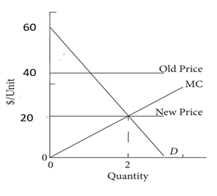 Calculate the consumer surplus according to the graph on the side!
Seçenekler
A
20
B
30
C
40
D
50
E
60
Açıklama:
Two-Part Tariffs as Perfect Price Discrimination
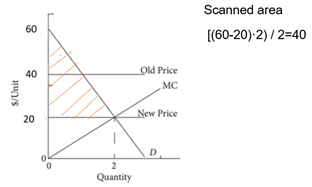
Soru 10
Which one degree of price discrimination example is charging different prices in the markets for football tickets to different supporters or supporters groups?
Seçenekler
A
First-Degree Price Discrimination
B
Second-Degree Price Discrimination
C
Third-Degree Price Discrimination
D
Fourth-Degree Price Discrimination
E
Fifth-Degree Price Discrimination
Açıklama:
Second-Degree Price Discrimination (Non-Linear Pricing)
Charging different prices to different supporters or groups of supporters in the markets for tickets of football is an example of third-degree price discrimination.
Charging different prices to different supporters or groups of supporters in the markets for tickets of football is an example of third-degree price discrimination.
Soru 11
What is the main difference between first-degree (perfect) price discrimination and third-degree price discrimination?
Seçenekler
A
First-degree discriminates based on willingness to pay, third-degree discriminates based on product features.
B
First-degree involves setting a uniform price, third-degree involves personalized pricing.
C
First-degree aims to capture all consumer surplus, third-degree involves different pricing for different consumer groups.
D
First-degree is commonly used in perfect competition, third-degree is used in monopolistic competition.
E
First-degree relies on fixed fees, third-degree relies on variable fees.
Açıklama:
First-Degree (Perfect) Price Discrimination
First-degree aims to capture all consumer surplus, third-degree involves different pricing for different consumer groups.
First-degree aims to capture all consumer surplus, third-degree involves different pricing for different consumer groups.
Soru 12
What distinguishes third-degree price discrimination (market segmentation) from second-degree price discrimination?
Seçenekler
A
Third-degree price discrimination requires perfect information about each consumer's willingness to pay
B
Second-degree price discrimination relies on self-selection mechanisms to identify different consumer groups
C
Third-degree price discrimination involves setting different prices for individual consumers.
D
Second-degree price discrimination acknowledges variations in willingness to pay among different consumer groups.
E
Third-degree price discrimination aims to achieve uniform pricing across all consumer groups.
Açıklama:
The firm’s capacity to engage in price discrimination is contingent upon the level of information it possesses regarding the consumers’ willingness to pay for its product. Price discrimination aims to capture a greater surplus than what can be achieved under uniform pricing.
Classification of the types of price discrimination was first proposed by Pigou (1920). In first-degree or perfect price discrimination, a firm has perfect information about each consumer’s willingness to pay. In second-degree price discrimination, a firm cannot identify the consumers to discriminate on prices. However, the firm knows that there are different groups of consumers and can use selfselection mechanisms to induce consumers to rank themselves in a way that generates additional profit. Third-degree price discrimination, also known as market segmentation, occurs when a firm acknowledges variations in the willingness to pay among different consumer groups and knows which consumer belongs to which group. In recent times, these pricing strategies have been alternatively labeled as personalized pricing, menu pricing, and group pricing, respectively.
Classification of the types of price discrimination was first proposed by Pigou (1920). In first-degree or perfect price discrimination, a firm has perfect information about each consumer’s willingness to pay. In second-degree price discrimination, a firm cannot identify the consumers to discriminate on prices. However, the firm knows that there are different groups of consumers and can use selfselection mechanisms to induce consumers to rank themselves in a way that generates additional profit. Third-degree price discrimination, also known as market segmentation, occurs when a firm acknowledges variations in the willingness to pay among different consumer groups and knows which consumer belongs to which group. In recent times, these pricing strategies have been alternatively labeled as personalized pricing, menu pricing, and group pricing, respectively.
Soru 13
Which of the following is a necessary condition for the successful application of price discrimination?
Seçenekler
A
Perfect competition in the market
B
Homogeneous price elasticities of demand across different markets
C
Resale (arbitrage) is allowed and encouraged
D
The market should be indivisible
E
Sellers should have no control over pricing policies
Açıklama:
Conditions of Price Discrimination
Price discrimination can be applied under the following certain conditions: • Sellers should have market power: Price discrimination aims to raise profits by charging various prices to different buyers or different prices for different units purchased by the same buyer. In order to charge different prices to different individuals or businesses or different prices for different quantities of the same buyer, the seller must have market power, or the group of sellers must have an explicit or implicit agreement on price policies. When a firm discriminates prices, at least one price will be higher than the marginal cost, and only a firm with market power can do that. • The market should be divisible: The seller should be able to identify different groups of consumers. Examples of market segmentation are domestic and foreign markets, medical treatment for the rich and poor, and electricity supplied to homes and businesses. • Different markets should have different price elasticities of demand: The target of price discrimination is to increase total revenue by setting a relatively higher (lower) price in the market where demand is relatively inelastic around the current price in the market. Thus, if the price elasticity of demand in various markets is the same, there will be no scope for price discrimination. • No resale (no arbitrage) principle: If a firm sets different prices, consumers who buy at a lower price should not be able to resell the product to other consumers who pay a higher price. Otherwise, there will be no incentive for the firm to discriminate prices because nobody will buy the product at a higher price. Similarly, if a firm applies a quantity discount for its product, the discount should be such that it does not encourage high-volume purchasers to resell it to other consumers.
Price discrimination can be applied under the following certain conditions: • Sellers should have market power: Price discrimination aims to raise profits by charging various prices to different buyers or different prices for different units purchased by the same buyer. In order to charge different prices to different individuals or businesses or different prices for different quantities of the same buyer, the seller must have market power, or the group of sellers must have an explicit or implicit agreement on price policies. When a firm discriminates prices, at least one price will be higher than the marginal cost, and only a firm with market power can do that. • The market should be divisible: The seller should be able to identify different groups of consumers. Examples of market segmentation are domestic and foreign markets, medical treatment for the rich and poor, and electricity supplied to homes and businesses. • Different markets should have different price elasticities of demand: The target of price discrimination is to increase total revenue by setting a relatively higher (lower) price in the market where demand is relatively inelastic around the current price in the market. Thus, if the price elasticity of demand in various markets is the same, there will be no scope for price discrimination. • No resale (no arbitrage) principle: If a firm sets different prices, consumers who buy at a lower price should not be able to resell the product to other consumers who pay a higher price. Otherwise, there will be no incentive for the firm to discriminate prices because nobody will buy the product at a higher price. Similarly, if a firm applies a quantity discount for its product, the discount should be such that it does not encourage high-volume purchasers to resell it to other consumers.
Soru 14
What does group pricing, within the context of third-degree price discrimination, involve?
Seçenekler
A
Setting the same price for all customer groups
B
Adjusting prices based on production costs
C
Setting different prices for distinct customer groups based on their willingness to pay
D
Offering quantity discounts to all customers
E
Allowing customers to engage in resale (arbitrage)
Açıklama:
TYPES OF PRICE DISCRIMINATION
Group pricing, within the context of thirddegree price discrimination, refers to the practice of setting different prices for distinct customer groups based on their varying levels of willingness to pay for a product. This allows the firm to maximize profit by capturing more surplus.
Group pricing, within the context of thirddegree price discrimination, refers to the practice of setting different prices for distinct customer groups based on their varying levels of willingness to pay for a product. This allows the firm to maximize profit by capturing more surplus.
Soru 15
Under third-degree price discrimination, what is the key condition for profit maximization when a firm can divide its markets into two groups?
Seçenekler
A
The average cost should be minimal.
B
The marginal revenues in all market segments should be the same.
C
The quantity of the firm's supply should be maximized.
D
The demand elasticity for each market should be identical.
E
The prices in different market segments should be determined solely by the firm's production cost.
Açıklama:
Third-Degree Price Discrimination (Group Pricing)
Three key features characterize third-degree price discrimination or group pricing. First, consumers have characteristics that are observable by the firm, such as age, income, geographical location, or educational attainment. A firm with market power can group consumers according to these characteristics in terms of their willingness to pay for its product. Second, the same firm can prevent arbitrage between different groups. Finally, a key feature of third-degree price discrimination is that all consumers in a given group are offered the same price, which differs between groups. Within each group, consumers make individual decisions regarding the quantity they wish to purchase at the given price. In the real world, for example, young people are likely to respond flexibly to air travel discounts, but businesspeople do not. This brings us to the third degree of price discrimination or market segmentation.
Three key features characterize third-degree price discrimination or group pricing. First, consumers have characteristics that are observable by the firm, such as age, income, geographical location, or educational attainment. A firm with market power can group consumers according to these characteristics in terms of their willingness to pay for its product. Second, the same firm can prevent arbitrage between different groups. Finally, a key feature of third-degree price discrimination is that all consumers in a given group are offered the same price, which differs between groups. Within each group, consumers make individual decisions regarding the quantity they wish to purchase at the given price. In the real world, for example, young people are likely to respond flexibly to air travel discounts, but businesspeople do not. This brings us to the third degree of price discrimination or market segmentation.
Soru 16
What is another term for perfect price discrimination?
Seçenekler
A
Second-degree price discrimination
B
Third-degree price discrimination
C
Personalized pricing
D
Monopolistic pricing
E
Group-based pricing
Açıklama:
First-Degree (Perfect) Price
Discrimination
Perfect price discrimination, also known as first-degree price discrimination or personalized pricing.
Discrimination
Perfect price discrimination, also known as first-degree price discrimination or personalized pricing.
Soru 17
What is the primary characteristic of second-degree price discrimination, also known as menu pricing?
Seçenekler
A
Differentiating prices based on individual consumer characteristics
B
Extracting the entire consumer surplus for each transaction
C
Offering personalized pricing based on willingness to pay
D
Implementing non-linear price schedules, such as quantity discounts
E
Maximizing profit by capturing the entire consumer surplus
Açıklama:
Second-Degree Price Discrimination (Non-Linear Pricing)
Second-degree price discrimination is generally called non-linear price discrimination in the literature and application... Quantity discounts are commonly used to implement second-degree price discrimination among various consumer types.
Second-degree price discrimination is generally called non-linear price discrimination in the literature and application... Quantity discounts are commonly used to implement second-degree price discrimination among various consumer types.
Soru 18
Find the profit (π), consumer surplus (CS), total surplus (TS), and deadweight loss (DWL) in a monopolist market where the inverse demand function is p = 120 - Q, the marginal and average costs are constant ($30), and the monopolist firm applies perfect price discrimination.
Seçenekler
A
π = 3000, CS = 1500, PS = 2500, DWL = 750
B
π = 4000, CS = 0, PS = 4000, DWL = 0
C
π = 3000, CS = 2500, PS = 2500, DWL = 125
D
π = 3000, CS = 0, PS = 3200, DWL = 0
E
π = 4000, CS = 4000, PS = 4000, DWL = 4000
Açıklama:
First-degree price discrimination”
With perfect price discrimination, consumer surplus is reduced to zero because the monopolist captures all surplus.
Total surplus is the sum of producer and consumer surplus. In this case, since consumer surplus is zero, total surplus is equal to producer surplus.
With perfect price discrimination, there is no deadweight loss because the monopolist efficiently allocates resources, capturing the entire surplus.
Finally: π = 4000, CS = 0, PS = 4000, DWL = 0
With perfect price discrimination, consumer surplus is reduced to zero because the monopolist captures all surplus.
Total surplus is the sum of producer and consumer surplus. In this case, since consumer surplus is zero, total surplus is equal to producer surplus.
With perfect price discrimination, there is no deadweight loss because the monopolist efficiently allocates resources, capturing the entire surplus.
Finally: π = 4000, CS = 0, PS = 4000, DWL = 0
Soru 19
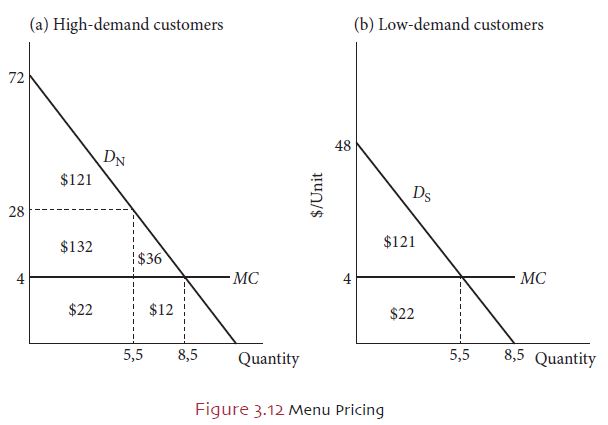
According to the graph on above, which statement is WRONG?
Seçenekler
A
a high-demand can buy the large package only if her consumer surplus is at least $121.
B
The firm will offer the large package at $202.
C
The firm will earn $168 profit from a high-demand consumer.
D
low-demand customers will buy the large package.
E
the second package offers a volume discount compared to the first one.
Açıklama:
Second-Degree Price Discrimination (Non-Linear Pricing)
Any attempt to implement differentiated two-part tariff and block pricing policies will not work in this case. Therefore, the firm has to use second-degree price discrimination (menu pricing).
In the case of menu pricing, the firm will sell two packages: a small package for low-demand consumers and a large package for high-demand consumers. The small package includes 5.5 units and is sold for $143, which is equal to the area under the demand function. High-demand consumers can buy either the small or the large package.
If a high-demand consumer buys a small package, she will pay $143, and her consumer surplus will be $121 (see Figure ). Therefore, a high-demand can buy the large package only if her consumer surplus is at least $121. The firm will offer the large package at $202 to allow highdemand consumers to realize a surplus of $121 when they buy this package, which is enough to make
them opt out of the small package (5.5 units for $143) package.
The firm will earn $168 profit from a high-demand consumer ($202 - (4 × 8.5) = $168) and $121 from a low-demand consumer ($143 - (4 × 5.5) = $121). Of course, low-demand customers will not buy the large package because their maximum willingness to pay for 8.5 products is only $144.
The firm designed the two menu options to solve identification and arbitrage problems by enabling consumers to reveal who they are through their purchases. The firm now offers a menu of 5.5 products for $143 and another menu of 8.5 products for $202. Menu pricing has a very important feature. The average price per product of the small package ($143 for 5.5 products) is $26, but the average price of the large package is $23.76 ($202 / 8.5). Therefore, the second package offers a volume discount compared to the first one
Any attempt to implement differentiated two-part tariff and block pricing policies will not work in this case. Therefore, the firm has to use second-degree price discrimination (menu pricing).
In the case of menu pricing, the firm will sell two packages: a small package for low-demand consumers and a large package for high-demand consumers. The small package includes 5.5 units and is sold for $143, which is equal to the area under the demand function. High-demand consumers can buy either the small or the large package.
If a high-demand consumer buys a small package, she will pay $143, and her consumer surplus will be $121 (see Figure ). Therefore, a high-demand can buy the large package only if her consumer surplus is at least $121. The firm will offer the large package at $202 to allow highdemand consumers to realize a surplus of $121 when they buy this package, which is enough to make
them opt out of the small package (5.5 units for $143) package.
The firm will earn $168 profit from a high-demand consumer ($202 - (4 × 8.5) = $168) and $121 from a low-demand consumer ($143 - (4 × 5.5) = $121). Of course, low-demand customers will not buy the large package because their maximum willingness to pay for 8.5 products is only $144.
The firm designed the two menu options to solve identification and arbitrage problems by enabling consumers to reveal who they are through their purchases. The firm now offers a menu of 5.5 products for $143 and another menu of 8.5 products for $202. Menu pricing has a very important feature. The average price per product of the small package ($143 for 5.5 products) is $26, but the average price of the large package is $23.76 ($202 / 8.5). Therefore, the second package offers a volume discount compared to the first one
Soru 20
What is a potential negative impact of third-degree price discrimination on social welfare?
Seçenekler
A
Higher prices for low-income consumers
B
Increased producer surplus
C
Enhanced resource allocation
D
Greater consumer surplus redistribution
E
Reduced market power abuse
Açıklama:
Analyze the effects of price discrimination on social welfare
Potential Negative Effects on Low-Income Consumers: Third-degree price discrimination, which involves segmenting consumers based on characteristics like age or income, can result in higher prices for certain groups, potentially burdening low-income consumers
Potential Negative Effects on Low-Income Consumers: Third-degree price discrimination, which involves segmenting consumers based on characteristics like age or income, can result in higher prices for certain groups, potentially burdening low-income consumers
Ünite 4
Soru 1
Which of the following is a characteristic of perfectly competitive markets?
Seçenekler
A
Free entry and exit in the long run
B
There is only one seller in the market
C
Each company produces and sells different products
D
Buyers and sellers have missing information about the market
E
The firm's determination of the market price alone
Açıklama:
MARKET STRUCTURE OVER TIME
Free entry and exit in the long run.
Free entry and exit in the long run.
Soru 2
Which of the following is the rule that states that the distribution of the size of firms in a market is log-normal and that the market share of an individual firm over time is a random variable?
Seçenekler
A
Limit Law
B
Gibrat’s Law
C
Universal Law
D
Grassman's Laws
E
Campbell's Law
Açıklama:
MARKET STRUCTURE OVER TIME
Gibrat’s Law
Gibrat’s Law
Soru 3
Which of the following equations refers to the Theory of Proportional Growth?
Seçenekler
A
St = (1 - vt) ꞏ St -1
B
St = (1 - vt) / St -1
C
St = (1 + vt) ꞏ St -1
D
St = (1 + vt) / St -1
E
St = (1 + vt + St -1)
Açıklama:
MARKET STRUCTURE OVER TIME
The equations refers to the Theory of Proportional Growth:
St = (1 + vt) ꞏ St -1
The equations refers to the Theory of Proportional Growth:
St = (1 + vt) ꞏ St -1
Soru 4
Which of the following refers to a set of strategies that are conducted by firms to discourage or deter other firms from competing in the market?
Seçenekler
A
Rational competitive behavior
B
Predatory conduct
C
Strategic behavior
D
Structural behavior
E
Competitive behavior
Açıklama:
PREDATORY CONDUCT
Soru 5
Which of the following is an “irrationally” low pricing set by a firm to deter rival firms from competing and ultimately to drive them out of the market?
Seçenekler
A
Rational pricing
B
Limit pricing
C
Predatory pricing
D
Competitor pricing
E
Strategic pricing
Açıklama:
PREDATORY CONDUCT
Predatory pricing
Predatory pricing
Soru 6
Which of the following is an entry deterrence strategy conducted by the incumbent firm by setting the price too low so that potential market entrants would find entry unprofitable?
Seçenekler
A
Rational pricing
B
Predatory pricing
C
Competitor pricing
D
Limit pricing
E
Strategic pricing
Açıklama:
PREDATORY CONDUCT
Limit pricing
Limit pricing
Soru 7
Which of the following, refers to the ability of the player being better than the competitors due to having the chance to choose its strategy before the competitors in sequential games?
Seçenekler
A
First-mover advantage
B
Capacity advantage
C
Pareto advantage
D
Cartel advantage
E
Tacit advantage
Açıklama:
PREDATORY CONDUCT
First-mover advantage: Refers to the ability of the player being better than the competitors due to having the chance to choose its strategy before the competitors in sequential games.
First-mover advantage: Refers to the ability of the player being better than the competitors due to having the chance to choose its strategy before the competitors in sequential games.
Soru 8
….. is a type of predatory conduct with the ultimate aim of driving the rivals out of the market, ….. is a strategy to preempt potential rivals from entering the market, to begin with. Which of the following completes the sentence above?
Seçenekler
A
Rational pricing / Limit pricing
B
Competitor pricing / Predatory pricing
C
Limit pricing / Strategic pricing
D
Strategic pricing / Predatory Pricing
E
Predatory Pricing / Limit pricing
Açıklama:
PREDATORY CONDUCT
Predatory Pricing is a type of predatory conduct with the ultimate aim of driving the rivals out of the market, Limit pricing is a strategy to preempt potential rivals from entering the market, to begin with.
Predatory Pricing is a type of predatory conduct with the ultimate aim of driving the rivals out of the market, Limit pricing is a strategy to preempt potential rivals from entering the market, to begin with.
Soru 9
While the ….. strategy generally takes place when an incumbent firm has the absolute cost advantage, ….. is a strategy of the incumbent firms in industries requiring large-scale production and excessive capital expenditures. Which of the following completes the sentence above?
Seçenekler
A
Limit pricing / Capacity investment
B
Capacity investment / Predatory pricing
C
Predatory pricing / Limit pricing
D
Limit pricing / First-mover advantage
E
First-mover advantage / Limit pricing
Açıklama:
PREDATORY CONDUCT
While the Limit Pricing strategy generally takes place when an incumbent firm has the absolute cost advantage, Capacity investment is a strategy of the incumbent firms in industries requiring large-scale production and excessive capital expenditures.
While the Limit Pricing strategy generally takes place when an incumbent firm has the absolute cost advantage, Capacity investment is a strategy of the incumbent firms in industries requiring large-scale production and excessive capital expenditures.
Soru 10
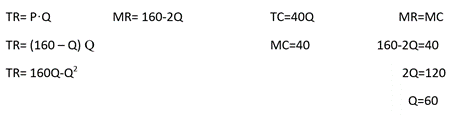
Calculate the level of production that maximizes the profit of a good with an inverse demand function P = 150 - Q and a total cost function TC = 40Q.
Seçenekler
A
40
B
45
C
50
D
60
E
80
Açıklama:
Entry Deterrence and Limit Pricing
Soru 11
How does the Federal Trade Commission define price-fixing in the context of regulating competitive behavior in the markets?
Seçenekler
A
An agreement to maximize profits
B
A written agreement among competitors to stabilize prices
C
A verbal agreement to lower price levels
D
An inferred conduct to raise prices
E
A regulatory action to maintain competitive behavior
Açıklama:
Cartels and Instability of Cartels
Price-fixing: According to the Federal Trade Commission, the main regulatory authority in the USA to protect consumers via ensuring
competitive behavior in the markets, “Price fixing is an agreement (written, verbal, or inferred from conduct) among competitors to raise, lower, maintain, or stabilize prices or price levels.”
Price-fixing: According to the Federal Trade Commission, the main regulatory authority in the USA to protect consumers via ensuring
competitive behavior in the markets, “Price fixing is an agreement (written, verbal, or inferred from conduct) among competitors to raise, lower, maintain, or stabilize prices or price levels.”
Soru 12
What characterizes Pareto-optimality or Pareto-efficiency in game theory?
Seçenekler
A
An outcome where one player always benefits at the expense of others
B
An equilibrium where players can deviate without affecting each other's well-being
C
A situation where all players experience equal gains
D
An outcome where players can improve their positions without affecting others
E
An equilibrium where any deviation makes one player better off without affecting others
Açıklama:
Cartels and Instability of Cartels, Pareto-optimal equilibrium
In game theory, Pareto-optimality or Paretoefficiencyis an equilibrium outcome, from
which if any of the players deviate, it is impossible to make one player better off without making the other(s) worse off.
In game theory, Pareto-optimality or Paretoefficiencyis an equilibrium outcome, from
which if any of the players deviate, it is impossible to make one player better off without making the other(s) worse off.
Soru 13
According to the structure-conduct-performance paradigm, firms can influence market structure through their conduct. In the context of strategies to protect or improve market shares, what is the significance of credible and non-credible threats?
Seçenekler
A
Credible threats are effective in reducing competitors' profits, while non-credible threats have no impact
B
Non-credible threats are more powerful in influencing market structure compared to credible threats.
C
Credible threats are based on irrational behavior, while non-credible threats are rational strategies for firms
D
Firms, being rational actors, recognize that credible threats can reduce competitors' profits, making them effective.
E
Non-credible threats are solely focused on the firm's profit, whereas credible threats consider the overall market performance
Açıklama:
PREDATORY CONDUCT
We have seen in the first chapter that the structure-conduct-performance paradigm suggests that the market structure determines the behavior of firms. However, firms can behave in such a way that they can maintain their market power and remain monopolist even if they do not have a cost advantage over their competitors. In other words, the conduct may also determine the market structure. In this section, we will study strategies that firms may use to protect or improve their market shares. We will first analyze the difference between credible and non-credible threats because we assume that firms are rational actors, and they know that their competitors are also rational. A rational firm cares only about its own profit, and if a threat against a competitor reduces its profit, it will not be a credible threat. After studying credible and non-credible threats, we will analyze entry deterrence strategies.
We have seen in the first chapter that the structure-conduct-performance paradigm suggests that the market structure determines the behavior of firms. However, firms can behave in such a way that they can maintain their market power and remain monopolist even if they do not have a cost advantage over their competitors. In other words, the conduct may also determine the market structure. In this section, we will study strategies that firms may use to protect or improve their market shares. We will first analyze the difference between credible and non-credible threats because we assume that firms are rational actors, and they know that their competitors are also rational. A rational firm cares only about its own profit, and if a threat against a competitor reduces its profit, it will not be a credible threat. After studying credible and non-credible threats, we will analyze entry deterrence strategies.
Soru 14
According to Gibrat's Law, what does it propose about the distribution of firms' size in a market and the evolution of individual firms' market share over time?
Seçenekler
A
The distribution of firms' size is uniform, and individual firms' market share remains constant over time
B
The distribution of firms' size is log-normal, and individual firms' market share over time is a deterministic variable.
C
The distribution of firms' size is random, and individual firms' market share follows a predictable pattern.
D
The distribution of firms' size is log-normal, and individual firms' market share over time is a random variable.
E
The distribution of firms' size is exponential, and individual firms' market share tends to increase continuously.
Açıklama:
MARKET STRUCTURE OVER TIME
Gibrat’s Law: The rule proposed by Robert Gibrat in 1931, stating that the distribution of firms’ size in a market is log-normal and that an individual firm’s market share over time is a random variable.
Gibrat’s Law: The rule proposed by Robert Gibrat in 1931, stating that the distribution of firms’ size in a market is log-normal and that an individual firm’s market share over time is a random variable.
Soru 15
What is a common form of anti-competitive strategy in markets?
Seçenekler
A
Capacity expansion
B
Predatory conduct
C
Entry deterrence
D
Price fixing agreements
E
Log-normal distribution
Açıklama:
the stability of cartels and the factors affecting market collusion.
Another type of anti-competitive strategy in the markets is collusion. Price fixing agreements are the most commonly observed collusion strategy to drive some of the firms out of the marke
Another type of anti-competitive strategy in the markets is collusion. Price fixing agreements are the most commonly observed collusion strategy to drive some of the firms out of the marke
Soru 16
What is the aim of entry-deterrent strategies, such as limit pricing and capacity expansion?
Seçenekler
A
To encourage new firms to enter the market
B
To facilitate collaboration among firms
C
To restrict entry by new firms
D
To promote market competition
E
To achieve economies of scale
Açıklama:
the predatory conduct behavior in the market.
Firms with a large market share are likely to adopt strategies that restrict entry by new firms, and force small firms to exist from the market. Predatory conduct strategies of incumbent firms are generally in the form of entry deterrence, namely, to avoid entry of a potential entrant firm to begin with. In this section, we have analyzed limit pricing and capacity expansion as entry-deterring strategies and shown under which conditions these strategies would be credible.
Firms with a large market share are likely to adopt strategies that restrict entry by new firms, and force small firms to exist from the market. Predatory conduct strategies of incumbent firms are generally in the form of entry deterrence, namely, to avoid entry of a potential entrant firm to begin with. In this section, we have analyzed limit pricing and capacity expansion as entry-deterring strategies and shown under which conditions these strategies would be credible.
Soru 17
What factors foster collusion in markets?
Seçenekler
A
High market concentration, existing entry barriers, and low price elasticity of demand
B
Random growth rates of firms
C
Log-normal distribution of firms' size
D
Technological improvements and economies of scale
E
Predatory conduct strategies
Açıklama:
the stability of cartels and the factors affecting market collusion.
Another type of anti-competitive strategy in the markets is collusion. Price fixing agreements are the most commonly observed collusion strategy to drive some of the firms out of the market. We have seen that some factors, such as high market concentration, existing entry barriers, and low price elasticity of demand, foster collusion in the markets.
Another type of anti-competitive strategy in the markets is collusion. Price fixing agreements are the most commonly observed collusion strategy to drive some of the firms out of the market. We have seen that some factors, such as high market concentration, existing entry barriers, and low price elasticity of demand, foster collusion in the markets.
Soru 18
What defines the Bertrand Paradox in a duopoly situation with two firms producing a homogenous product and a symmetrical cost structure?
Seçenekler
A
Firms act cooperatively and set prices above their marginal costs
B
Firms set prices equal to their average costs
C
Firms gradually increase prices to maximize profits
D
Firms set prices equal to their marginal costs at the Nash equilibrium
E
Firms engage in price discrimination to capture the market
Açıklama:
Cartels and Instability of Cartels
The Bertrand Paradox is defined as the situation in which two firms producing a homogenous product with a symmetrical cost structure do not act cooperatively and ultimately set their prices equal to their marginal costs at the Nash equilibrium
The Bertrand Paradox is defined as the situation in which two firms producing a homogenous product with a symmetrical cost structure do not act cooperatively and ultimately set their prices equal to their marginal costs at the Nash equilibrium
Soru 19
According to Bain's paper on barriers to market entry, which are anticompetitive entry-deterring strategies?
I. Absolute cost advantage of the incumbent firm
II. The requirement of large capital expenditures
III. Product differentiation
IV. Non-Credible threats
V. Transparent pricing by the incumbent
I. Absolute cost advantage of the incumbent firm
II. The requirement of large capital expenditures
III. Product differentiation
IV. Non-Credible threats
V. Transparent pricing by the incumbent
Seçenekler
A
I and II
B
II and V
C
I, II and V
D
I and IV
E
I, II and III
Açıklama:
Credible/Non-Credible Threats
Bain (1956), in a seminal paper on the barriers
to market entry, identifies three barriers: the
absolute cost advantage of the incumbent firm,
the requirement of large capital expenditures, and
product differentiation. This section will focus on
two anticompetitive entry-deterring strategies: (1)
limit pricing and (2) capacity investments. While
the limit pricing strategy generally takes place when
an incumbent firm has the absolute cost advantage,
capacity investment is a strategy of the incumbent
firms in industries requiring large-scale production
and excessive capital expenditures.
Before moving to work on formal models
of limit pricing following Bain (1956) and
Sylos-Labini (1962) and of capacity investment
following Dixit (1980), we need to understand
the differences between credible and non-credible
threats within the context of the game theoretical
approach to entry deterrence.
Bain (1956), in a seminal paper on the barriers
to market entry, identifies three barriers: the
absolute cost advantage of the incumbent firm,
the requirement of large capital expenditures, and
product differentiation. This section will focus on
two anticompetitive entry-deterring strategies: (1)
limit pricing and (2) capacity investments. While
the limit pricing strategy generally takes place when
an incumbent firm has the absolute cost advantage,
capacity investment is a strategy of the incumbent
firms in industries requiring large-scale production
and excessive capital expenditures.
Before moving to work on formal models
of limit pricing following Bain (1956) and
Sylos-Labini (1962) and of capacity investment
following Dixit (1980), we need to understand
the differences between credible and non-credible
threats within the context of the game theoretical
approach to entry deterrence.
Soru 20
Consider a market with an incumbent firm(I) and a potential entrant(E). The inverse market demand function is P = 150 - Q. While the total cost function of the incumbent is defined as TCı = 40 . qI, that of the entrant is TCE = 100 + 50qE, hence, there is a sunk cost associated with the entry. Use the Stackelberg model to find the equilibrium profit of firm I.
Seçenekler
A
1787.5
B
406.25
C
609.35
D
720.50
E
787.25
Açıklama:
Predatory Conduct and Collusion
ΠI* = 72.5 . 55 - 40 . 55 = 32.5 . 55 = 1787.5
ΠI* = 72.5 . 55 - 40 . 55 = 32.5 . 55 = 1787.5
Ünite 5
Soru 1
Which one of the following is true about the product diversifications forms?
Seçenekler
A
Product extension - market extension - pure conglomerate
B
Product offering - market extension - pure market
C
Demand extension - market extension - pure extension
D
Product extension - Supply extension - mix conglomerate.
E
Horizontal extension - market extension - vertical conglomerate
Açıklama:
Product diversification can take various forms, such as i) product extension, ii) market extension, and iii) pure conglomerate.
Soru 2
Which of the following is the name given to the product diversification made by the clothing company that produces chocolate?
Seçenekler
A
Product extension
B
Pure conglomerate
C
Market extension
D
Supply extension
E
Product demand
Açıklama:
in the case of pure conglomerate diversification, a firm starts to
produce a completely different product, like an apparel company producing chocolates.
produce a completely different product, like an apparel company producing chocolates.
Soru 3
Which one of the following refers to the differentiation of products in terms of one characteristic, usually the quality of the product, on which there is consensus among consumers?
Seçenekler
A
Horizontal product differentiation
B
Local product differentiation
C
Vertical product differentiation
D
Consumers' preferences product differentiation
E
Vertical demand differentiation
Açıklama:
Vertical product differentiation refers tothe differentiation of products in terms of one characteristic, usually the quality of the
product, on which there is consensus among consumers.
product, on which there is consensus among consumers.
Soru 4
Which of the following companies in different locations It is the name given to the differentiation of prices of products that have the same features in all other aspects?
Seçenekler
A
Product differentiation by demand
B
Product differentiation by supply
C
Product differentiation by the weather
D
Product differentiation by location
E
Product differentiation by age
Açıklama:
Product differentiation by location is one
of the forms of horizontal differentiation in
which the market is not considered a point
but a spatial area where firms are located at
different points.
of the forms of horizontal differentiation in
which the market is not considered a point
but a spatial area where firms are located at
different points.
Soru 5
Which of the following is the practice of selling two or more goods jointly
at a price to the advantage of sellers?
at a price to the advantage of sellers?
Seçenekler
A
Cleaning
B
Supplying
C
Purchasing
D
Shopping
E
Bundling
Açıklama:
The practice of selling two or more goods jointly at a price to the advantage of sellers is
called bundling.
called bundling.
Soru 6
Which one of the following is the practice of offering consumers to buy goods separately or bundled together?
Seçenekler
A
Mixed bundling
B
Entry barrier
C
Substitute product
D
Potantial entrant
E
Second price
Açıklama:
Mixed bundling is the practice of offering consumers to buy goods separately or
bundled together.
bundled together.
Soru 7
Smartphone - phone line
Printers - toners
cameras - memory cards
Which one of the following is the practice of selling complementary goods like mentioned above?
Printers - toners
cameras - memory cards
Which one of the following is the practice of selling complementary goods like mentioned above?
Seçenekler
A
Bundling sales
B
Tie-in sales
C
Long term sales
D
Constant sales
E
Marginal sales
Açıklama:
If you want to use the internet on your smartphone, you must also purchase a phone line. In short, we purchas and use two different services, both phone calls and internet use, on mobile phones. Printers and toners, cameras and memory cards, cars and spare
parts are other examples of tie-in sales.The practice of selling complementary goods
is called tie-in sales.
parts are other examples of tie-in sales.The practice of selling complementary goods
is called tie-in sales.
Soru 8
Mobile phone operators provide service that allows to make calls on the mobile phones.
Which one of the following is called the relationship described above?
Which one of the following is called the relationship described above?
Seçenekler
A
Tie-in sales
B
Mixed sales
C
Whole sales
D
Retail sales
E
Conditional sales
Açıklama:
The concept of tie-in sales indicates situations where it is not possible to use one of
these products without the other. In other words, products are complementary. Companies make the sale of any good conditional on the purchase of another good. For example, mobile phone operators provide a service that allows us to make calls on the mobile phones we use. These operators also sell smartphones.
these products without the other. In other words, products are complementary. Companies make the sale of any good conditional on the purchase of another good. For example, mobile phone operators provide a service that allows us to make calls on the mobile phones we use. These operators also sell smartphones.
Soru 9
Which one of the followings are the aim of the adverises?
Seçenekler
A
To promote its products - to wider audiences - to ensure that they have full knowledge
of their qualities.
of their qualities.
B
To abonden its products - to wider products - to ensure that they have full knowledge
of their qualities.
of their qualities.
C
To abolish its products - to wider audiences - to ensure that they have little knowledge
of their qualities.
of their qualities.
D
To promote its products - to constrict audiences - to ensure that they have less knowledge of their qualities.
E
To promote its auidences - to lessen products - to ensure that they have full knowledge
of their cheapness.
of their cheapness.
Açıklama:
A firm advertises to promote its products to wider audiences and to ensure that they have full knowledge of their qualities.
Soru 10
The term shows that when advertising expenditure increases by one unit, marginal cost
increases due to the increase in output while it will increase the cost by TL 1 if ad expenditure increases by TL 1.
Which one of the following is the name given to the term?
increases due to the increase in output while it will increase the cost by TL 1 if ad expenditure increases by TL 1.
Which one of the following is the name given to the term?
Seçenekler
A
Marginal return on advertising
B
Marginal return on cost
C
Marginal benefit on advertising
D
Marginal benefit on cost
E
Average return on advertising
Açıklama:
The left side of the equation shows the marginal return on advertising, and the right side shows the marginal cost of advertising. The first term to the right of the equation shows that when advertising expenditure increases by one unit, marginal cost increases due to the increase in output while it will increase the cost by Tl 1 if ad expenditure increases by Tl 1 .
Ünite 6
Soru 1
Which of the following refers to a merger between two or more firms operating in the same market?
Seçenekler
A
vertical merger
B
horizontal merger
C
cournot dupoly
D
duopoly
E
oligopoly
Açıklama:
A merger between two or more firms operating
in the same market is called a “horizontal merger.”
in the same market is called a “horizontal merger.”
Soru 2
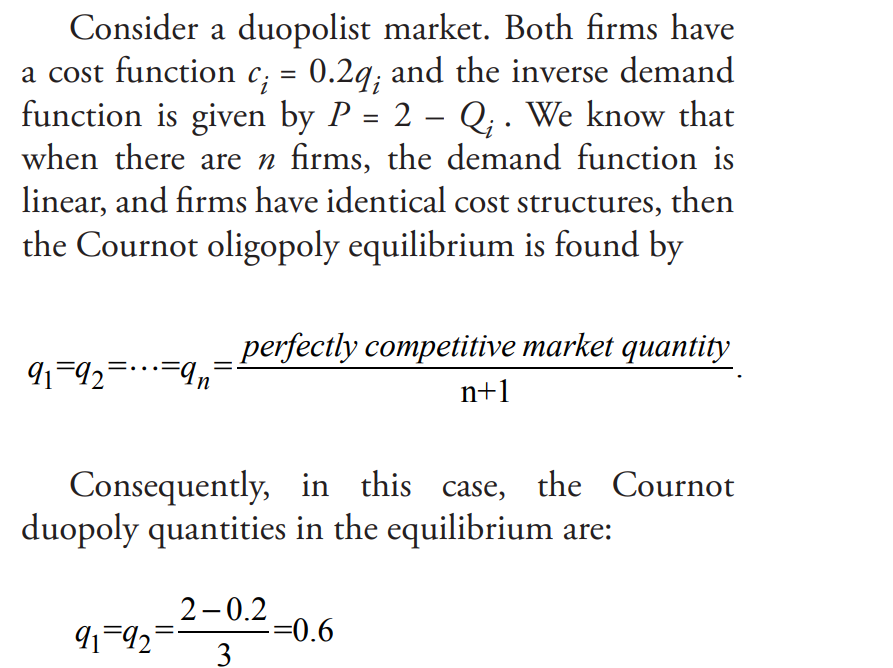
Consider a duopolist market. Both firms have a cost function ci= 0.2qi
and the inverse demand function is given by P = 2 - Qi. What are the Cournot
duopoly quantities for both firms in the equilibrium?
and the inverse demand function is given by P = 2 - Qi. What are the Cournot
duopoly quantities for both firms in the equilibrium?
Seçenekler
A
0.5
B
0.6
C
0.8
D
2
E
4
Açıklama:
Soru 3
Consider a duopolist market. Both firms have a cost function ci= 0.2qi
and the inverse demand function is given by P = 2 - Qi. What are the Cournot
duopoly price in the equilibrium?
and the inverse demand function is given by P = 2 - Qi. What are the Cournot
duopoly price in the equilibrium?
Seçenekler
A
0.2
B
0.4
C
0.5
D
0.6
E
0.8
Açıklama:

Soru 4
If Herfindal-Hirschman index takes a value of zero, which of the following market does it imply?
Seçenekler
A
Perfect competition
B
Monopsony
C
Duopoly
D
Monopoly
E
Oligopoly
Açıklama:
The US antitrust convention is multiplying the index by 10000 so that the HHI takes a value between 0 (which implies perfect competition) and 10000 (which implies monopoly).
Soru 5
In a symmetric Cournot game, all the gains from a ______ merger, if this
horizontal merger is not a merger to _______, are captured by non-mergers so that the merger harms the merging firms. Then we should not observe many horizontal mergers, but the paradox is that we do observe such mergers in real life.
Which of the following should come in the place of the blank spaces above?
horizontal merger is not a merger to _______, are captured by non-mergers so that the merger harms the merging firms. Then we should not observe many horizontal mergers, but the paradox is that we do observe such mergers in real life.
Which of the following should come in the place of the blank spaces above?
Seçenekler
A
vertical,monopoly
B
horizontal,oligopoly
C
horizontal, monoply
D
vertical,oligopoly
E
vertical, perfect competition
Açıklama:
Merger paradox: In a symmetric Cournot game,
all the gains from a horizontal merger, if this
horizontal merger is not a merger to monopoly,
are captured by non-mergers so that the merger
harms the merging firms. Then we should not
observe many horizontal mergers, but the paradox
is that we do observe such mergers in real life.
all the gains from a horizontal merger, if this
horizontal merger is not a merger to monopoly,
are captured by non-mergers so that the merger
harms the merging firms. Then we should not
observe many horizontal mergers, but the paradox
is that we do observe such mergers in real life.
Soru 6
Which of the following refers to a retailer that buys from manufacturers and sells products to consumers?
Seçenekler
A
Aggregate firm
B
Horizontal firm
C
Vertical firm
D
Downstream firm
E
Upstream firm
Açıklama:
Downstream firm: A downstream
firm is a retailer that buys from
manufacturers and sells products to
consumers.
firm is a retailer that buys from
manufacturers and sells products to
consumers.
Soru 7
Which of the following refers to a manufacturer that deals primarily with the exploration and initial production stages of the product?
Seçenekler
A
Upstream firm
B
Downstream firm
C
Aggregate firm
D
Vertical firm
E
Horizontal firm
Açıklama:
An upstream firm is a manufacturer that deals primarily
with the exploration and initial
production stages of the product.
with the exploration and initial
production stages of the product.
Soru 8
____________ ____________ refer to restrictions on competition in vertical
agreements between firms operating at different levels of production?
agreements between firms operating at different levels of production?
Seçenekler
A
Horizontal Restraints
B
Aggregate Restraints
C
Vertical Restraints
D
Mixed Restraints
E
Production Restraints
Açıklama:
Vertical restraints refer to restrictions on competition in vertical
agreements between firms operating at different levels of production.
agreements between firms operating at different levels of production.
Soru 9
_________________________ refers to any attempt by an upstream manufacturer or distributor to control the price at which the product is resold, after the original sale contract.
Which of the following should come in the place of the blank space above?
Which of the following should come in the place of the blank space above?
Seçenekler
A
Resale Tax Maintenance
B
Wholesale Tax Maintenance
C
Wholesale Price Tax
D
Wholesale Price Maintenance
E
Resale Price Maintenance
Açıklama:
Resale price maintenance (RPM) constitutes the largest
number of antitrust actions of all vertical
restrictions. “RPM refers to any attempt by an
upstream manufacturer or distributor to control
the price at which the product is resold, after the
original sale contract”.
number of antitrust actions of all vertical
restrictions. “RPM refers to any attempt by an
upstream manufacturer or distributor to control
the price at which the product is resold, after the
original sale contract”.
Soru 10
When motion picture projectors were sold together with movies made by the same company, what type of vertical restraint is it?
Seçenekler
A
Resale price maintenance
B
Tying
C
Territorial restrictions
D
Exclusive dealing
E
Implicit dealing
Açıklama:
Tying occurs when a manufacturer
requests the buyer of one product to purchase all
the requirements of another product from the
same manufacturer. One of the best examples of
this situation was when motion picture projectors
were sold together with movies made by the same
company.
requests the buyer of one product to purchase all
the requirements of another product from the
same manufacturer. One of the best examples of
this situation was when motion picture projectors
were sold together with movies made by the same
company.
Ünite 7
Soru 1
Which of the following is true regarding non-drastic innovations?
Seçenekler
A
It does not alter the market price but increase the quantity
B
It does not alter the market price but decrease the quantity
C
It increases both the market price and the quantity
D
It does not alter the market price and the quantity
E
It decreases the market price but increase the quantity
Açıklama:
Non-drastic innovation does not alter the market price and the
quantity purchased by the consumer. In the non-drastic innovation case, the innovator sells to the entire
market and gains positive profit.
quantity purchased by the consumer. In the non-drastic innovation case, the innovator sells to the entire
market and gains positive profit.
Soru 2
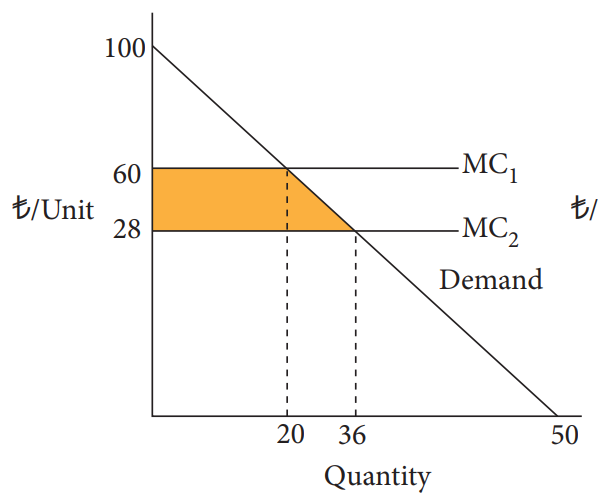 Consider the figure above. Given the demand function, P = 100 - 2Q, and the condition P = MC, which of the following equals the consumer surplus before innovation?
Seçenekler
A
200
B
300
C
400
D
500
E
600
Açıklama:
Given the demand function, P = 100 - 2Q, and the
condition P = MC, the consumer surplus is the area between the demand function and the price line, i.e.,
the area of a triangle with height 100 - P (that is equal to 40) and base 20 (that is the output produced).
So, the consumer surplus before the innovation equals 400TL, CS = (100-60)×20/2
condition P = MC, the consumer surplus is the area between the demand function and the price line, i.e.,
the area of a triangle with height 100 - P (that is equal to 40) and base 20 (that is the output produced).
So, the consumer surplus before the innovation equals 400TL, CS = (100-60)×20/2
Soru 3
Consider the figure above. Given the demand function, P = 100 - 2Q, and the condition P = MC, which of the following equals the consumer surplus after the innovation?Seçenekler
A
1050
B
1194
C
1296
D
1412
E
1561
Açıklama:
After the innovation, the firms will equate the price to the new lower marginal cost of 28TL. Then the consumer surplus will be
equal to 1296TL (that is calculated as the area of a triangle with height 72 (100 − 28) and base 36 (output produced to be attained by 100 −2Q=28).
equal to 1296TL (that is calculated as the area of a triangle with height 72 (100 − 28) and base 36 (output produced to be attained by 100 −2Q=28).
Soru 4
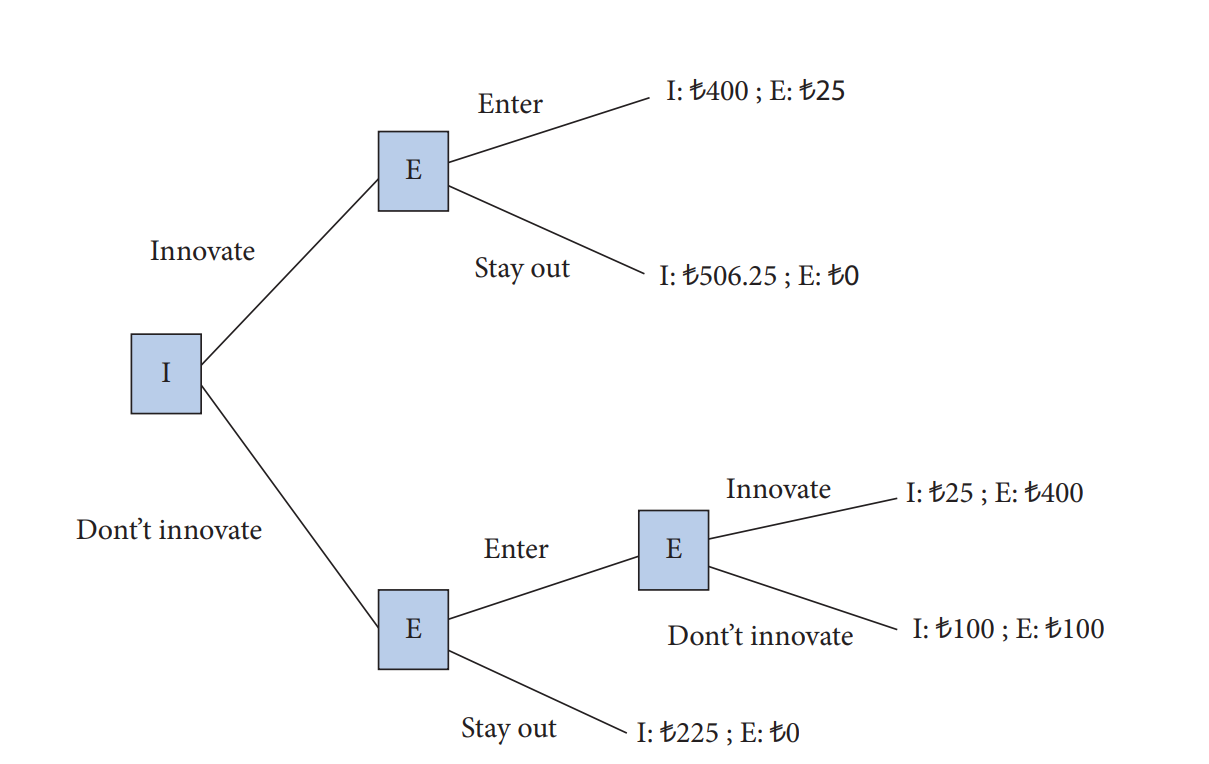 Consider the entry game given above. Furthermor, assume that Assume that P = 60 - Q represents the demand function, and the marginal cost of production at the current technology is 30TL. Using standard Cournot equations, which of the following represents the best response of the incumbent firm (q1)?
Seçenekler
A
(60-15-q2)/2
B
(60-30-q2)/2
C
(60-15-q2)
D
(60-15-q2)/3
E
(30-15-q2)/2
Açıklama:
Let the incumbent conduct R&D. Then the marginal cost for the entrant firm will be 30T (as the cost of the incumbent is now 15T.L) Using the standard Cournot equations, the incumbent firm’s (q1) best response function is (60-15-q2/2) =q1.
Soru 5
Consider the entry game given above. Furthermore, assume that P = 60 - Q represents the demand function, and the marginal cost of production at the current technology is 30TL. Which of the following is the entrant firm’s (q2) best response function using the standard Cournot equations?Seçenekler
A
(60-15-q1)/2
B
(60-30-q1)/2
C
(60-30-q1)
D
(60-15-q1)
E
(60-15-q1)/3
Açıklama:
Using the standard Cournot equations, the incumbent firm’s (q1) best response
function is 60-15-q2 /2 =q1 and the entrant firm’s (q2) best response function is 60-30-q1/2 =q2 .
function is 60-15-q2 /2 =q1 and the entrant firm’s (q2) best response function is 60-30-q1/2 =q2 .
Soru 6
______ _________ is the legal rights assigned to the creators of new ideas,
inventions, new processes, and methods of production.
Which of the following should come in the place of the blank space above?
inventions, new processes, and methods of production.
Which of the following should come in the place of the blank space above?
Seçenekler
A
Static efficiency
B
Intellectual property
C
Dynamic efficiency
D
Invisibility problem
E
Appropriability problem
Açıklama:
Intellectual property (IP) is the
legal rights assigned to the creators of new ideas,
inventions, new processes, and methods of
production. T
legal rights assigned to the creators of new ideas,
inventions, new processes, and methods of
production. T
Soru 7
Which of the following refers to a problem that makes investment in R&D different from investment in tangible assets such as machinery and equipment?
Seçenekler
A
appropriability problem
B
failure problem
C
invisibility problem
D
static efficiency problem
E
dynamic efficiency problem
Açıklama:
The R&D activities encounter the appropriability problem that makes
investment in R&D different from investment in tangible assets such as machinery and equipment.
investment in R&D different from investment in tangible assets such as machinery and equipment.
Soru 8
Which of the following requires the most extended possible protection to maximize
the incentives for creating new knowledge?
the incentives for creating new knowledge?
Seçenekler
A
innovation
B
know-how
C
static efficiency
D
dynamic efficiency
E
R&D activities
Açıklama:
Dynamic efficiency requires the most extended possible protection to maximize
the incentives for creating new knowledge, and static efficiency requires the non-existence of protection to prevent deadweight loss generated through the monopolist’s right to knowledge.
the incentives for creating new knowledge, and static efficiency requires the non-existence of protection to prevent deadweight loss generated through the monopolist’s right to knowledge.
Soru 9
Which of the following requires the non-existence of protection to prevent deadweight loss generated through the monopolist’s right to knowledge?
Seçenekler
A
static efficiency
B
dynamic efficiency
C
know-how
D
R&D activities
E
innovation
Açıklama:
Therefore, dynamic efficiency requires
the most extended possible protection to maximize
the incentives for creating new knowledge, and
static efficiency requires the non-existence of
protection to prevent deadweight loss generated
through the monopolist’s right to knowledge.
the most extended possible protection to maximize
the incentives for creating new knowledge, and
static efficiency requires the non-existence of
protection to prevent deadweight loss generated
through the monopolist’s right to knowledge.
Soru 10
Which of the following is used to characterize the group of users that acquire benefits depending on each other due to the nature of the product they are utilizing?
Seçenekler
A
innovation
B
externalities
C
invisibility
D
sustainability
E
network
Açıklama:
The term “network” is used to characterize the group of users that acquire benefits depending on each other due to the nature of the product they are utilizing
Ünite 8
Soru 1
What was the primary purpose of the Sherman Act adopted in the United States in 1890?
Seçenekler
A
To regulate mergers and acquisitions that could potentially lessen competition in the market.
B
To enforce strict price controls and regulatory incentives, particularly during the period between the two World Wars.
C
To prohibit contracts, combinations, and conspiracies that restrained trade and to prevent monopolization and attempts to monopolize.
D
To allow large companies to form cartels and trusts to stabilize prices and market conditions.
E
To exclusively address concerns related to digital sectors and anticompetitive conducts within them.
Açıklama:
The Sherman Act was a reaction to the cartels and trusts formed among large companies to avoid price wars and market instability in the 1870s and 1880s. Final consumers, farmers, and small industrial firms were hurt by the higher prices of the final goods and inputs supplied by cartelized sectors. In addition, small firms were complaining of the unfair conduct of large competitors, allegedly aiming to drive the small firms out of the market. Section 2 does not prohibit having a monopoly position by itself but prohibits improper conduct from acquiring or maintaining monopoly power.
To prohibit contracts, combinations, and conspiracies that restrained trade and to prevent monopolization and attempts to monopolize.
To prohibit contracts, combinations, and conspiracies that restrained trade and to prevent monopolization and attempts to monopolize.
Soru 2
Which of the following statements accurately reflects the provisions of Turkish competition law after its alignment with EU regulations?
Seçenekler
A
The Turkish competition law only applies to domestic markets and excludes any agreements, conducts, or mergers that affect international trade.
B
The substantive provisions of Turkish competition law are set on two pillars: agreements limiting competition and abuse of market dominance.
C
Turkish competition law does not allow for judicial review of the Competition Board’s decisions.
D
Law No. 4054 in Türkiye is based on three pillars similar to the EU: agreements limiting competition, abuse of dominant position, and mergers or acquisitions.
E
Amendments to the Turkish competition law have removed the requirement for undertakings to defend themselves against allegations before the Competition Board.
Açıklama:
Law No. 4054, and more importantly, the effective enforcement of the competition law and policy constitute important parts of the negotiations carried out for the accession of Türkiye to the EU. Similar to those in the EU, the substantive provisions of Turkish competition law are set on three pillars: (a) “Agreements, Concerted practices and Decisions Limiting Competition” (Article 4), (b) “Abuse of Dominant Position” (Article 6), and (c) “Mergers or Acquisitions” (Article 7).
Law No. 4054 in Türkiye is based on three pillars similar to the EU: agreements limiting competition, abuse of dominant position, and mergers or acquisitions.
Law No. 4054 in Türkiye is based on three pillars similar to the EU: agreements limiting competition, abuse of dominant position, and mergers or acquisitions.
Soru 3
What is the primary purpose of defining the "relevant market" in competition law?
Seçenekler
A
To set a fixed geographical boundary for where a product is sold and bought.
B
To determine the monopolistic practices of a single dominant firm in the market.
C
To outline the set of products and areas which exercise competitive constraint or pressure on each other.
D
To implement the Hypothetical Monopolist Test (HMT) only in merger cases.
E
To simplify the process of identifying barriers to entry and expansion in the market.
Açıklama:
In competition law, the concept of “relevant market” has a different meaning than the place where a certain product is sold and bought. The relevant market comprises the set of products and areas which exercise competitive constraint or pressure on each other. For example, in a merger or competition law case about the suppliers of “apple” affecting a certain geographic area,” the “relevant market” can be defined wider than “apple” and include other types of fresh fruits if it is understood that other fruits exercise competitive pressure against apple in this area and are substitutable enough to apple in the eyes of consumers.
To outline the set of products and areas which exercise competitive constraint or pressure on each other.
To outline the set of products and areas which exercise competitive constraint or pressure on each other.
Soru 4
Why might the assessment of dominance in competition law consider more than just the market share of a firm?
Seçenekler
A
Because market share alone is sufficient to determine the market power of a firm.
B
Because only firms with a market share of less than 40% can be considered dominant.
C
Because other market characteristics and factors such as barriers to entry and buyers' bargaining power also influence a firm's market power.
D
Because the concentration level of competitors is irrelevant in assessing dominance.
E
Because market share thresholds are universally fixed across all jurisdictions.
Açıklama:
Market share is not the sole measure of a dominant position. Other characteristics of the market, such as the likelihood of entry and buyers’ bargaining power, are also taken into account in assessing the market power of a firm. In this respect, competition authorities assess whether there are barriers to entry or expansion in the market. Barriers to entry or expansion may originate from the characteristics of the relevant market or the characteristics or behavior of the undertaking examined. The likelihood of entry into the market by new undertakings or of expansion of undertakings operating in the market can exert competitive pressure on the behavior of the undertaking under investigation. In assessing whether expansion or entry is likely, competition authorities investigate whether it is sufficiently profitable for the relevant undertaking. Possible reactions of the undertaking examined and other competitors in the market can create risks for the success of the entry or expansion.
Because other market characteristics and factors such as barriers to entry and buyers' bargaining power also influence a firm's market power.
Because other market characteristics and factors such as barriers to entry and buyers' bargaining power also influence a firm's market power.
Soru 5
What constitutes a violation of Article 4 of Law No. 4054 in the context of competition law?
Seçenekler
A
Agreements and concerted practices that facilitate or likely facilitate the prevention, distortion, or restriction of competition in a market.
B
Any agreement or practice that promotes competition in a particular market for goods or services.
C
Agreements, concerted practices, and decisions between undertakings that have no impact on market conditions.
D
Exclusive dealings that encourage economic welfare by allowing firms to improve efficiency.
E
Practices that increase supply amounts and encourage competitive bidding in tenders.
Açıklama:
Since in some cases it may not be possible to prove the existence of an explicit agreement in practice, the act also prohibits “concerted practices,” which can be defined as the direct or indirect relations between undertakings that replace their own independent activities and ensure a coordination and practical cooperation provided that they lead to the same result as an agreement. Firms behaving in a concerted manner benefit from some factors facilitating collusion. For example, they can use direct or indirect means for communicating to reach a consensus about the strategies they will adopt. On the other hand, determining what kind of facilitating factor constitutes a sufficient piece of evidence for proving concerted practice is a legal matter, and is not always easy to distinguish whether a certain type of facilitating factor has the object or effect of restricting competition.
Agreements and concerted practices that facilitate or likely facilitate the prevention, distortion, or restriction of competition in a market.
Agreements and concerted practices that facilitate or likely facilitate the prevention, distortion, or restriction of competition in a market.
Soru 6
Which statement accurately describes the regulation of vertical restraints in Turkish competition law?
Seçenekler
A
Vertical agreements are automatically exempt from block exemption if the parties have a market share greater than 30%.
B
Vertical restraints are unregulated in Turkish competition law, allowing for unrestricted manufacturer control over retail pricing.
C
Manufacturers are prohibited from setting maximum resale prices or suggesting resale prices to retailers.
D
Vertical agreements involving restrictions on sales regions or customers of distributors or retailers generally cannot benefit from block exemption.
E
The Turkish Competition Authority encourages vertical agreements that include non-compete obligations indefinitely or for periods extending beyond five years.
Açıklama:
In many markets, the goods and services bought by customers or consumers are distributed or sold by distributors and retailers instead of their producers. The agreements signed between undertakings operating at different levels of the production or distribution chain to purchase, sell, or resale particular goods or services are called “vertical agreements.” The main restraints seen in vertical agreements can be exemplified as follows: Sellers might assign an exclusive area to their distributors and prohibit them from selling outside this area (exclusive territory), sellers might determine the resale price of retailers (RPM), sellers might oblige buyers to purchase a certain minimum amount of goods from them and not to purchase the goods of seller’s competitors (exclusive dealing), sellers might require buyers to pay a fixed franchise fee.
Vertical agreements involving restrictions on sales regions or customers of distributors or retailers generally cannot benefit from block exemption.
Vertical agreements involving restrictions on sales regions or customers of distributors or retailers generally cannot benefit from block exemption.
Soru 7
What does Article 6 of Law No. 4054 in the context of Turkish competition law address?
Seçenekler
A
The encouragement of dominance in a market for goods or services within the country.
B
The prohibition of the abuse of dominant position by one or more undertakings in a market for goods or services.
C
The requirement that all dominant undertakings must engage in price fixing and market allocation.
D
The prohibition of any firm holding a dominant position regardless of its market practices.
E
The obligation for dominant undertakings to exclusively use their market power for consumer welfare.
Açıklama:
Article 6 of Law No. 4054 prohibits “the abuse, by one or more undertakings, of their dominant position in a market for goods or services within the whole or a part of the country on their own or through agreements with others or through concerted practices.” The prohibitions set in Article 6 of Law No. 4054 apply only to undertakings with a dominant position; therefore, the Competition Authority must show whether the undertaking whose conduct is investigated has a dominant position in a specific relevant market.
The prohibition of the abuse of dominant position by one or more undertakings in a market for goods or services.
The prohibition of the abuse of dominant position by one or more undertakings in a market for goods or services.
Soru 8
Which of the following is an example of exclusionary conduct that could be investigated under Article 6 of Law No. 4054 for abuse of dominance?
Seçenekler
A
Competitive pricing that benefits consumers by providing lower prices.
B
Expansion of market share through internal efficiencies by a non-dominant firm.
C
Predatory pricing, intended to deter entry or force the exit of competitors.
D
Agreements between undertakings that promote innovation and technical advancement.
E
Vertical agreements that improve the distribution efficiency of small-scale firms.
Açıklama:
Predatory pricing is an exclusionary pricing strategy through which a dominant undertaking sets a below-cost sales price in the short term to maintain or strengthen its market power and foreclose its actual or potential competitors. With predatory prices dominant firm sacrifices profits in the short run; however, it can apply high prices, sell low-quality products, and decrease consumer choice in the mid- and long-term after excluding its competitors.
Predatory pricing, intended to deter entry or force the exit of competitors.
Predatory pricing, intended to deter entry or force the exit of competitors.
Soru 9
What is the primary consideration of competition authorities when controlling mergers, as stipulated in Article 7 of Law No. 4054 in Türkiye?
Seçenekler
A
Ensuring that all mergers between firms in the same relevant market are defined as horizontal mergers.
B
Assessing whether the proposed merger will create or strengthen a dominant position significantly impeding effective competition.
C
Determining whether the merged firms will exclusively use vertical integration to streamline their distribution channels.
D
Evaluating if conglomerate mergers are between firms that do not have complementary products.
E
Confirming that all non-horizontal mergers will inherently lead to a significant lessening of competition.
Açıklama:
Article 7 of Law No. 4054 “Mergers and Acquisitions” Article 7- “It is illegal and prohibited for one or more undertakings to merge or for an undertaking or a person to acquire - except by inheritance - assets, or all or part of the partnership shares, or instruments conferring executive rights over another undertaking, where these would result in a significant lessening of effective competition within a market for goods or services in the entirety or a portion of the country, particularly in the form of creating or strengthening a dominant position”.
Assessing whether the proposed merger will create or strengthen a dominant position significantly impeding effective competition.
Assessing whether the proposed merger will create or strengthen a dominant position significantly impeding effective competition.
Soru 10
What is a common challenge new entrants might face when trying to establish themselves in digital markets?
Seçenekler
A
The prevalence of single-sided market structures.
B
Low significance of network effects on market value.
C
The abundance and ease of access to large user data sets.
D
Overcoming established intellectual property rights on key technologies.
E
Decreasing utility of platforms with the increase in user base.
Açıklama:
The fact that digital markets have some special features that are more or less different from those of traditional markets has been the starting point for assessing whether a change in the competition policy frameworks is needed. Intellectual property rights on the use of a particular technology can be a barrier to entry.
Overcoming established intellectual property rights on key technologies.
Overcoming established intellectual property rights on key technologies.