Accountıng I (ENG) - Tüm Sorular
Ünite 1
Soru 1
Why you need to know accounting?
Seçenekler
A
forcing the state
B
to give tax
C
to earn money
D
to make effective and efficient decisions
E
to prepare a financial statement
Açıklama:
Introduction LO:1
to make effective and efficient decisions
to make effective and efficient decisions
Soru 2
…. is an information system which provides financial information about the entity for decision makers
Seçenekler
A
Bookkeeping
B
Accounting
C
Identifying
D
Information users
E
Honestly
Açıklama:
Introduction LO:1
Accounting
Accounting
Soru 3
The first step of the accounting process consists of ….. related with the organization.
Seçenekler
A
identifying financial transactions
B
recorded
C
communicates
D
keeping a chronological diary of events
E
bookkeeping
Açıklama:
Basic activities in accounting process LO:1
identifying financial transactions
identifying financial transactions
Soru 4
Which of the following is the internal user of accounting?
Seçenekler
A
Investors
B
Managers
C
Creditors
D
State
E
Customers
Açıklama:
Internal Users LO:1
Manages
Manages
Soru 5
Which of the following is the primary external users of accounting information?
Seçenekler
A
Managerial accountant
B
Marketing Managers
C
Regulatory and supervisory authorities
D
State and trade-unions
E
Investors and creditors
Açıklama:
External Users LO:1
Investors and creditors
Investors and creditors
Soru 6
In general, there are three basic forms of business enterprises. Which of the following is a large company or group of companies authorized to act as a single entity and recognized as such in law?
Seçenekler
A
Sole proprietorship
B
Partnership
C
Customer
D
Corporation
E
Regulatory
Açıklama:
Economic Entity Assumption LO:3
Corporation
Corporation
Soru 7
Which of the following is an acceptable statement of the basic accounting equation?
Seçenekler
A
Assets = Liabilities + Owner’s equity
B
Assets = Liabilities - Owner’s equity
C
Assets - Liabilities = Owner’s equity - Expenses
D
Assets - Owner’s equity = Liabilities - Receivable
E
Assets = Owner’s euity - Revenues + Expenses
Açıklama:
Expanded Version of Basic Accounting Equation LO:4
Assets = Liabilities + Owner’s equity
Assets = Liabilities + Owner’s equity
Soru 8
Measurement refers the valuation of assets and liabilities in accounting process. Accounting Standards generally use one of two main principles in measurement. Those are ….
Seçenekler
A
Net fair value principle or Carrying value principle
B
Historical cost principle or Fair value principle
C
Equivalence value principle or Nominal value principle
D
Saving value principle or Historical cost principle
E
Fair Value principle or Nominal value principle
Açıklama:
Measurement Principles LO:3
Historical cost principle or Fair value principle
Historical cost principle or Fair value principle
Soru 9
The rightness of an action generally depends on the …….. and …… of the accountant.
Seçenekler
A
fair / intention
B
right / honest
C
ethics / honest
D
wrong / fair
E
skills / knowledge
Açıklama:
Ethical Behavior, Measurement Principles, and Basic Assumptions LO:2
skills / knowledge
skills / knowledge
Soru 10
…….are economic resources that are expected to benefit the business in the future.
Seçenekler
A
Liabilities
B
Funds
C
Assets
D
Revenues
E
Owner’s equities
Açıklama:
Assets LO:3
Assets
Assets
Soru 11
Which of the followings are the functions of accounting?
Seçenekler
A
Identification and Recording
B
Recording and Communicating
C
Communicating
D
Identification, Recording and Communicating
E
Identification and Communicating
Açıklama:
Accounting is an information system consisting of identification, recording and communication functions. The functions of accounting are fully expressed in D.
Soru 12
Which of the following is internal users of accounting information?
Seçenekler
A
Managers
B
İnvestors
C
Creditors
D
Government
E
Customers
Açıklama:
Managers, employees and partners are users of internal accounting information. Government, creditors, investors and customers are users of external information.
Soru 13
The accounting equation can be expressed as......
Seçenekler
A
Assets+Liabilities=Owners’ Equity
B
Assets=Liabilities+Owners’ Equity
C
Assets=Liabilities−Owners’ Equity
D
Owners’ Equity x Liabilities=Assets
E
Owners’ Equity+Assets=Liabilities
Açıklama:
The correct answer is B. The basic accounting equation consists of assets = liabilities + owner's equity.
Soru 14
Which of the following is a common feature of the balance sheet and income statement?
Seçenekler
A
Both financial statements belong to a certain date
B
Both statements cover a certain period
C
Net profit item in both tables
D
Both statements show assets and resources
E
Show both revenues and expenses in both statements
Açıklama:
The correct answer is C. Net profit is included in both the balance sheet and income statement. It is the balance sheet showing the entity's assets and resources and the financial statements for a given date. The ability to show revenues and expenses for a certain period belongs to the income statement.
Soru 15
Which financial statement shows the position of an organization at a particular instant in time?
Seçenekler
A
Statement of cash flows
B
Income statement
C
Balance Sheet
D
Owner’s equity statement
E
Both A and B
Açıklama:
The correct answer is C. Balance sheet reports the assets, liabilities, and owner’s equity of the business at a specific date. İncome statement and cash flow statement cover a specific period. The statement of changes in shareholders' equity includes an accounting period.
Soru 16
Which of the following is an example of primary external users because they have a direct financial interest in a business?
Seçenekler
A
Government
B
Taxing authorities
C
Customers
D
Investors
E
Suppliers
Açıklama:
Managers are internal information users. There are several types of external users and they can be individuals or organizations outside a company such as investors, creditors, taxing authorities, government, customers, suppliers etc
Soru 17
................ are a set of principles companies follow when they prepare and publish their financial statements, providing a consistent way of describing the company’s financial performance.
Which of the following is identified above?
Which of the following is identified above?
Seçenekler
A
Ethics
B
Accounting Standards
C
Measurement Principles
D
Faithful representation
E
Basic assumptions
Açıklama:
Accounting Standards are a set of principles companies follow when they prepare and publish their financial statements They provide a systematic, standardized, way of describing the company’s financial performance.
Soru 18
Which of the following is TRUE about owner's equity?
I. It is the total assets of an entity, minus its total liabilities.
II. It represents the capital theoretically available for distribution to shareholders.
III. It refers to existing debts and obligations.
IV. It is defined as economic resources a business owns and assets will provide future services or benefits
I. It is the total assets of an entity, minus its total liabilities.
II. It represents the capital theoretically available for distribution to shareholders.
III. It refers to existing debts and obligations.
IV. It is defined as economic resources a business owns and assets will provide future services or benefits
Seçenekler
A
II, III
B
II, IV
C
I, III
D
I, II
E
I,IV
Açıklama:
Liabilities are defined as a present obligation of the entity arising from past events, the settlement of which is expected to result in an outflow of the entity’s resources. Owner’s equity is the total assets of an entity, minus its total liabilities. This represents the capital theoretically available for distribution to shareholders. Assets, on the other hand, are economic resources a business owns and assets will provide future services or benefits. Both I and II are TRUE about owner’s equity.
Soru 19
.......................... are withdrawals of cash or other assets by the owner for personal use.
Seçenekler
A
Revenues
B
Expenses
C
Contributions by owner(s)
D
Residual equity
E
Distributions to owner(s)
Açıklama:
Contributions by owner are the assets put in the business by the owner. Distributions to owner are withdrawals of cash or other assets by the owner for personal use. Expenses are the cost of assets consumed or services rendered in the process of earning revenue. Revenues are the gross increase in owner’s equity resulting from business activities entered into for the purpose of earning income. The owner’s equity is also called as residual equity.
Soru 20
................... includes analyzing of each transaction in terms of its effect on the items of the accounting equation.
Seçenekler
A
Dual effect
B
External transaction
C
Internal transaction
D
Basic Accounting Equation
E
Identification of transaction
Açıklama:
Identification of transaction includes analyzing of each transaction in terms of its effect on the items of the accounting equation, identifying the specific items affected and determining the amount of the change in each item.
Soru 21
Which of the following is NOT an example of financial statement?
Seçenekler
A
Dual effect
B
Income statement
C
Owner’s equity statement
D
Balance sheet
E
Statement of cash flows
Açıklama:
Dual effect means that at least two items must be affected by a transaction and accounting equation has to remain in balance after making the changes in accounting equation. There are four main financial statements prepared by using summarized accounting data: Income statement, owner’s equity statement, balance sheet and statement of cash flows.
Soru 22
Which of the following are TRUE about balance sheet?
I. It details the change in owner’s equity over an accounting period.
II. It reports the assets, liabilities, and owner’s equity of the business at a specific date.
III. It shows the change in cash position of the company over an accounting period.
IV. It reports the revenues and expenses and resulting net income or loss.
I. It details the change in owner’s equity over an accounting period.
II. It reports the assets, liabilities, and owner’s equity of the business at a specific date.
III. It shows the change in cash position of the company over an accounting period.
IV. It reports the revenues and expenses and resulting net income or loss.
Seçenekler
A
I
B
II
C
III, IV
D
IV
E
I, IV
Açıklama:
Balance sheet reports the assets, liabilities, and owner’s equity of the business at a specific date. II is the only corect choice.
Soru 23
Which of the below is NOT a part of owner's equity statement?
Seçenekler
A
Opening balance
B
Relevance
C
Net income or loss
D
Transactions with owner(s)
E
Closing balance
Açıklama:
Relevance refers the impact capacity of financial information on the decisions of information users. Owner's equity statement includes four main parts: Opening balance (the amount of owner’s equity at the beginning of the accounting period), net income or loss, transactions with owner(s) and closing balance (the amount of owner’s equity at the end of the accounting period).
Soru 24
Which of the below generally depends on the skills and knowledge of the accountant?
Seçenekler
A
Ethics
B
Intention
C
Honesty
D
Rightness
E
Fairness
Açıklama:
The rightness of an action generally depends on the skills and knowledge of the accountant. In other words, the possibility of making a mistake, for instance in classifying or measurement of financial transactions, will be low if the accountant of a company has sufficient skills and knowledge. Therefore, accounting profession is one of the most important professional groups in society, and so accountants are legally subject to a set of procedures in their career.
Soru 25
Which of the below states that assets are recorded at their cost?
Seçenekler
A
Relevance
B
Faithful representation
C
The fair value principle
D
Materiality
E
The historical cost principle
Açıklama:
The relevance of fair value and necessity of faithful representation are the main factors used in determining which measurement principle to apply. Relevance refers the impact capacity of financial information generated by an accounting system on the decisions of information users. Therefore, relevance also contains materiality concept which is the universally accepted accounting principle that all material matters are to be disclosed.
The fair value principle, on the other hand, states that assets and liabilities are reported at their fair value. The historical cost principle states that assets are recorded at their cost.
The fair value principle, on the other hand, states that assets and liabilities are reported at their fair value. The historical cost principle states that assets are recorded at their cost.
Soru 26
I. Decrease assets and decrease liabilities
II. Increase assets and increase liabilities
III. Increase liabilities and decrease stockholders’ equity
IV. Increase assets and increase stockholders’ equity
If the business entity has net income, which of the statements numbered above shows the effect of net income on the accounting equation?
II. Increase assets and increase liabilities
III. Increase liabilities and decrease stockholders’ equity
IV. Increase assets and increase stockholders’ equity
If the business entity has net income, which of the statements numbered above shows the effect of net income on the accounting equation?
Seçenekler
A
I
B
II
C
III
D
IV
E
All of the above
Açıklama:
The correct answer is D. With the increase in the net income of the enterprise, the equity of the enterprise increases and the assets of the accounting equation increase with the increase of the equity.
Soru 27
Which of the following is the principle generally used in the valuation of assets?
Seçenekler
A
What it would cost to replace the asset
B
Selling price
C
Historical cost
D
Fair value
E
Relevance
Açıklama:
The correct answer is C. Assets are recorded at their cost when acquired by the company and this value stays same over the time according to the historical cost principle.
Soru 28
Which of the following best describes assets?
Seçenekler
A
Economic resources that are expected to benefit the business in the future.
B
Something owned by a business that has a ready market value.
C
An economic resource representing cash or the right to receive cash in the future.
D
Something with physical form that’s valued at cost in the accounting records.
E
The owner’s claims to the assets of the business.
Açıklama:
The correct answer to question is option A. Assets are economic resources a business owns and assets will provide future services or benefits.
Soru 29
Which item or items is/are reported on the balance sheet?
Seçenekler
A
İnventory
B
Account Payable
C
Account Receivable
D
Retained Earnings
E
All of the above
Açıklama:
The correct answer is question E. All items presented in the following items are reported to the assets and resources sections of the balance sheet.
Soru 30
Star Inc., has 200.000 TL in revenues, 25.000 in expenses. According to this information, Star Inc. which of the following is the change in stockholders’ equity?
Seçenekler
A
+125.000
B
+150.000
C
+175.000
D
-150.000
E
-125.000
Açıklama:
The change in equity is determined by the difference between revenue and expense. According to the information given in the question, since the revenue is more than the expense, there is an increase of 175.000 TL. Therefore, the correct answer to the question is option C.
Soru 31
I. Identifying
II. Recording
III. Analyzing
IV. Communicating
Which of the activities above are considered to be the basic activities of accounting?
II. Recording
III. Analyzing
IV. Communicating
Which of the activities above are considered to be the basic activities of accounting?
Seçenekler
A
I, II and III
B
I and II
C
I, III and IV
D
II, III and IV
E
I,II and IV
Açıklama:
In a general sense, Accounting is an information system which provides financial information about the entity for decision makers. This system includes three kinds of basic activities which are identifying, recording and communicating of the financial transactions of an entity.
Soru 32
Which of the following definitions is true regarding the three basic activities of accounting?
Seçenekler
A
Identifying includes selecting financial transactions.
B
Recording includes selecting financial transactions.
C
Recording includes preparing financial reports.
D
Communicatinginc ludes recording, classifying, and summarizing.
E
Indentifyinh includes preparing financial reports.
Açıklama:
Identifying includes selecting financial transactions. Recording includes recording, classifying, and summarizing. Communicating includes preparing financial reports.
Soru 33
What is the activity of keeping records of the financial transactions called?
Seçenekler
A
Economic transaction
B
Accounting
C
Bookkeeping
D
Financial statement
E
Classifying
Açıklama:
Bookkeeping is an activity or occupation of keeping records of the financial transactions.The accounting process includes the bookkeeping.
Soru 34
Which of the following is the internal users of accounting?
Seçenekler
A
Managers
B
Investors
C
Governement
D
Customers
E
Suppliers
Açıklama:
External Users There are several types of external users and they can be individuals or organizations outside a company such as investors, creditors, taxing authorities, government, customers, suppliers etc. Managers of a company who plan, organize, and run the business are the most important group of internal users.
Soru 35
Which are considered to be the primary external users?
Seçenekler
A
Government and taxing authorities
B
Investors and creditors
C
Government and investors
D
Customers and suppliers
E
Investors and taxing authorities
Açıklama:
There are several types of external users and they can be individuals or organizations outside a company such as investors, creditors, taxing authorities, government, customers, suppliers etc. The primary external users are investors and creditors, because they have a direct financial interest in a business.
Soru 36
Which of the following is the correct definition of financial accounting?
Seçenekler
A
It provides financial information to meet the information needs of internal information users.
B
It provides financial information to meet the information needs of external information users.
C
It orovides financial information to meet the information needs of government.
D
It provides financial information to meet the information needs of taxing authorities.
E
It rovides financial information to meet theinformation needs of customers.
Açıklama:
Financial accounting provides financial information to meet the information needs of external information users. Managerial accounting provides financial information to meet theinformation needs of managers.
Soru 37
What is faithful representation?
Seçenekler
A
It states that assets are recorded at their cost.
B
It states that assets and liabilities are reported at their fair value.
C
It means the factuality of financial statements.
D
It is the universally accepted accounting principle that all material matters are to be disclosed.
E
It refers the impact capacity of financial information on the decisions of information users.
Açıklama:
The historical cost principle states that assets are recorded at their cost.The fair value principle states that assets and liabilities are reported at their fair value. Relevance refers the impact capacity of financial information on the decisions of information users.Relevance also contains materiality concept which is the universally accepted accounting principle that all material matters are to be disclosed. Faithful representation means that the numbers and disclosures match what really existed or happened.
Soru 38
_____ is a business owned and run by one person. They are often small type businesses (e.g. auto repair shops, used-books stores etc.). Usually a small amount of capital is needed and the owner is entitled to all profits.
Which option completes the sentence above best?
Which option completes the sentence above best?
Seçenekler
A
Company
B
Sole proprietorship
C
Corporation
D
Partnership
E
Business enterprise
Açıklama:
A sole proprietorship is a business owned and run by one person. They are often small type businesses (e.g. auto repair shops, used-books stores etc.). Usually a small amount of capital is needed and the owner is entitled to all profits. The owner is also personally responsible for all debts and liabilities of business. In short, there is no distinction between the business and its owner, but the accounting records of the business activities are kept separate from the personal records of its owner.
Soru 39
Which option shows the basic accounting equation?
Seçenekler
A
Assets = Liabilities + Owner's Equity
B
Liabilities = Assets + Owner's Equity
C
Owner's Equity = Liabilities + Assets
D
Assets = Owner's Equity x Liabilities
E
Liabilities = Assets x Owner's Equity
Açıklama:
In the basic accounting equation, assets must always equal the sum of liabilities and owner’s equity. The order and position of the assets, liabilities, and owner’s equity in the equation does not reflect a random situation. Assets are always showed on the left side of the equation while liabilities and owner’s equity are always showed on the right side of the equation.
Soru 40
What are economic resources that are expected to benefit the business in the future?
Seçenekler
A
Investments
B
Liabilities
C
Revenues
D
Assets
E
Owner's Equity
Açıklama:
Assets are economic resources controlled by the entity as a result of past events and from which future economic benefits are expected to flow to the entity. In short, assets are economic resources a business owns and assets will provide future services or benefits.
Soru 41
I. Identifying
II. Recording
III. Correcting
Which of the above is/are take(s) part in the basic activities of the financial transactions of an entity
II. Recording
III. Correcting
Which of the above is/are take(s) part in the basic activities of the financial transactions of an entity
Seçenekler
A
Only I
B
Only III
C
I and II
D
II and III
E
I, II and III
Açıklama:
Accounting is an information system which provides financial information about the entity for decision makers. This system includes three kinds of basic activities which are identifying, recording and communicating of the financial transactions of an entity.
Soru 42
Which of the following is the first step of the accounting process?
Seçenekler
A
Identifying financial transactions
B
Recording financial transactions
C
Connecting financial transactions
D
Communicating financial transactions
E
Summarizing financial transactions
Açıklama:
The first step of the accounting process consists of identifying the financial transactions related with the organization.
Soru 43
Which of the following is/are the final outcomes of the accounting process?
Seçenekler
A
Receipts
B
Financial statements
C
Payroll statements
D
Waybills
E
Invoices
Açıklama:
At the last step, the company communicates the summarized information obtained from the records to decision makers (information users) by using standardized reports which are called financial statements.
Soru 44
Which basic activity of the accounting includes preparing financial reports?
Seçenekler
A
Identifying
B
Recording
C
Communicating
D
Bookkeeping
E
Transaction
Açıklama:
- Identifying includes selecting financial transactions.
- Recording includes recording, classifying, and summarizing.
- Communicating includes preparing financial reports.
- Bookkeeping is an activity or occupation of keeping records of the financial transactions
Soru 45
I. Internal users
II. External users
III. General users
Which of the above is/are the main group(s) of accounting information users?
II. External users
III. General users
Which of the above is/are the main group(s) of accounting information users?
Seçenekler
A
Only II
B
Only III
C
I and II
D
I and III
E
I, II and III
Açıklama:
Two main groups of information users are internal users and external users.
Soru 46
Which of the following is internal information users?
Seçenekler
A
Managers
B
Government
C
Investors
D
Creditors
E
Competitors
Açıklama:
Managers are internal information users and the others are external users.
Soru 47
I. Inversors
II. Creditors
III. Partners
Which of the above is/are the primary external users of accounting information?
II. Creditors
III. Partners
Which of the above is/are the primary external users of accounting information?
Seçenekler
A
Only I
B
Only III
C
I and II
D
I and III
E
I, II and III
Açıklama:
The primary external users are investors and creditors.
Soru 48
Which of the following is described as "the humanly devised rules, procedures and norms to judge one’s action as right or wrong, honest or dishonest and fair or not fair."?
Seçenekler
A
Rules
B
Rightness
C
Honesty
D
Intention
E
Ethics
Açıklama:
Ethics are the humanly devised rules, procedures, and norms to judge one’s action as right or wrong, honest or dishonest, and fair or not fair.
Soru 49
Which of the following described as "Economic resources that are expected to benefit the business in the future"?
Seçenekler
A
Assets
B
Liabilities
C
Equity
D
Income
E
Cost
Açıklama:
Assets are economic resources controlled by the entity as a result of past events and from which future economic benefits are expected to flow to the entity.
Soru 50
Which of the following is described as "the gross increase in owner’s equity resulting from business activities entered into for the purpose of earning income"?
Seçenekler
A
Assets
B
Liabilities
C
Costs
D
Expenses
E
Revenues
Açıklama:
Revenues are the gross increase in owner’s equity resulting from business activities entered into for the purpose of earning income.
Soru 51
Which of the following is not one of the basic activities in accounting?
Seçenekler
A
Identifying the financial transactions
B
Recording the financial transactions
C
Communicating to decision makers about transactions
D
Preparing financial statements
E
Communicating with banks for funding
Açıklama:
The first step of the accounting process consists of identifying the financial transactions related with the organization. The sale of a table by a furniture shop, the payment of wages or the provisions for services are the examples of financial transactions. Once these kinds of financial transactions are realized and identified in Turkish Liras or in another currency, these events are recorded to provide the history of financial activities of the organization. Recording is a systematic way of keeping chronological diary of events measured in monetary unit. At the last step, company communicates the summarized information obtained from the records to decision makers (information users) by using standardized reports which are called financial statements. E is the right answer
Soru 52
Which of the following is not one of the parties that the accounting numbers are prepared for?
Seçenekler
A
Owners
B
Managers
C
Employees
D
Creditors
E
Suppliers
Açıklama:
Who uses accounting numbers? To answer that question, the accountant must be clear for whom the information is being prepared and for what purpose the information will be used. There are likely to be various information users such as owners, managers, creditors, suppliers etc. You should understand the needs of users because information users focus on different financial information according to their relevant decision making issues. The best way of explaining the needs on financial information is to make a classification of potential users. Two main groups of information users are internal users and external users. We can also classify accounting as Managerial Accounting and Financial Accounting according to this classification of information users. C is the right answer.
Soru 53
"Accounting standards are .........."
Which of the following appropriately completes the definition above?
Which of the following appropriately completes the definition above?
Seçenekler
A
not-for-profit, public interest organizations established to develop a single set of high-quality, understandable, enforceable and globally accepted accounting standards
B
the humanly devised rules, procedures and norms to judge one’s action as right or wrong, honest or dishonest and fair or not fair
C
the possibility of making a mistake in classifying or measurement of financial transactions
D
a set of principles and rules that companies follow when they prepare and publish their financial statements
E
a common set of standards used by accountants in United States.
Açıklama:
Accounting standards are a set of principles and rules that companies follow when they prepare and publish their financial statements, providing a standardized way of describing the company’s financial performance.
.
.
Soru 54
Whihc of the following is a true statement for "historical cost principle"?
Seçenekler
A
Historical cost principle refers the price that would be received to sell an asset or paid to transfer a liability in an orderly transaction
B
Historical cost principles are the main factors used in determining which measurement principle to apply.
C
Historical cost principle states that assets and liabilities are reported at their fair value.
D
Historical cost principle refers to the valuation of assets and liabilities in accounting process.
E
Assets are recorded at their cost when acquired by the company and this value stays same over the time
Açıklama:
Assets are recorded at their cost when acquired by the company and this value stays same over the time according to the historical cost principle. On the other hand, the fair value principle dictates that assets and liabilities should be reported at their fair values. Simply, fair value refers the price that would be received to sell an asset or paid to transfer a liability in an orderly transaction between market participants at the measurement date. Therefore, contrary to historical cost principle, the recorded monetary amount of the asset should be revalued at reporting date according to the fair value principle. E is the right answer.
Soru 55
"The monetary unit assumption requires .........."
Which of the following appropriately completes the statement above?
Which of the following appropriately completes the statement above?
Seçenekler
A
that the financial transactions of the entity should be recorded separately from the economic activities of its owner and all other economic entities
B
that financial transactions can only be recorded if the transaction data can be expressed in money terms
C
that business transactions of the entity are separated from the owner’s personal transactions.
D
that the existence of monetary unit assumption does not enable accounting to measure financial transactions a
E
that accounting numbers represent the monetary amounts of financial transactions.
Açıklama:
The monetary unit assumption requires that financial transactions can only be recorded if the transaction data can be expressed in money terms. B is the right answer.
Soru 56
Which of the following is the definition of "sole proprietorship"?
Seçenekler
A
A sole proprietorship is that owners of corporation are not personally liable for the debts of the entity
B
A sole proprietorship is a large company or group of companies authorized to act as a single entity and recognized as such in law.
C
A sole proprietorship is a form of business where two or more people share ownership.
D
A sole proprietorship is a business owned and run by one person
E
A sole proprietorship is a system in which each partner still has unlimited responsibility for all business’s debt
Açıklama:
A sole proprietorship is a business owned and run by one person. They are often small type businesses (e.g. auto repair shops, used-books stores etc.). Usually a small amount of capital is needed and the owner is entitled to all profits. The owner is also personally responsible for all debts and liabilities of business. In short, there is no distinction between the business and its owner, but the accounting records of the business activities are kept separate from the personal records of its owner. D is the right answer.
Soru 57
Which of the following is not true for "basic accounting equation"?
Seçenekler
A
Assets must always equal the sum of liabilities and owner’s equity
B
The order and position of the assets, liabilities, and owner’s equity in the equation does not reflect a random situation
C
The logic of equation is not related to the background of using debits and credits in recording process
D
Assets are always showed on the left side of the equation
E
Liabilities and owner’s equity are always showed on the right side of the equation
Açıklama:
In the basic accounting equation, assets must always equal the sum of liabilities and owner’s equity. The order and position of the assets, liabilities, and owner’s equity in the equation does not reflect a random situation. Assets are always showed on the left side of the equation while liabilities and owner’s equity are always showed on the right side of the equation. The logic of this positioning creates the background of using debits and credits in recording process. C is the right answer.
Soru 58
Which of the following is the definition of "assets"?
Seçenekler
A
Assets are debts that are owed to creditors
B
Assets are economic resources that are expected to benefit the business in the future
C
Assets are the claims of creditors against to assets of the company
D
Assets the owner’s claims to the assets of the business
E
Assests are the total assets of an entity, minus its total liabilities
.
.
Açıklama:
Assets are economic resources controlled by the entity as a result of past events and from which future economic benefits are expected to flow to the entity. In short, assets are economic resources a business owns and assets will provide future services or benefits. B is the right answer.
Soru 59
Which of the following is not one of the factors which increase or decrease the level of owner’s equity?
Seçenekler
A
Contributions by owner(s)
B
Distributions to owner(s)
C
Expenses.
D
Creditor(s)
E
Revenues
Açıklama:
There are four main factors which increase or decrease the level of owner’s equity: Contributions by owner(s), distributions to owner(s), revenues and expenses. D is the right answer.
Soru 60
Which of the following is the definition of "revenue", which is one of the factors increasing or decreasing the level of owner’s equity?
Seçenekler
A
Revenues are the gross increase in owner’s equity resulting from business activities entered into for the purpose of earning income.
B
Revenues are the cost of assets consumed or services rendered in the process of earning revenue
C
Revenues are the gross income in owner’s equity resulting from trade business activities
D
Revenues are the financial transactions of the business recorded by accountants
E
Revenues are the expenses which decrease owner’s equit
Açıklama:
Revenue is the gross inflow of economic benefits during the period arising from the course of the ordinary activities of an entity when those inflows result in increases in equity, other than increases relating to contributions from equity participants. In other words, revenues are earnings that result from delivering goods or services to customers. In this sense, revenues are the gross increase in owner’s equity resulting from business activities entered into for the purpose of earning income. For examples, selling goods (sales), performing services (fees), lending money (interest), leasing machine (rent) all create revenues for a given period. A is the right answer.
Soru 61
Accounting system includes three kinds of basic activities which are ........., ............ and communicating of the financial transactions of an entity.
Seçenekler
A
Identifying, recording
B
Recording, translating
C
Interpreting, analyzing
D
Analyzing, calculating
E
Calculating, interpreting
Açıklama:
This system includes three kinds of basic activities which are identifying, recording and communicating of the financial transactions of an entity.
Soru 62
- Identify business activities
- Record the business transactions and
- Recording includes recording, classifying, and summarizing
- Communicates the results to decision makers
Seçenekler
A
I and II
B
II and III
C
I, II and III
D
I, II and IV
E
I, II, III and IV
Açıklama:
- Identify business activities
- Record the business transactions and
- Recording includes recording, classifying, and summarizing
- Communicates the results to decision makers
Soru 63
Which of the following is the first step of accounting process?
Seçenekler
A
Identifying the financial transactions
B
Recording the business transactions
C
Bookkeeping
D
Classifying transactions
E
Preparing financial reports
Açıklama:
The first step of the accounting process consists of identifying the financial transactions related with the organisation. The sale of a table by a furniture shop, the payment of wages or the provisions for services are the examples of financial transactions.
Soru 64
............. is an activity or occupation of keeping records of the financial transactions.
Seçenekler
A
Bookkeeping
B
Summarizing
C
Communicating
D
Identifying
E
Interpreting
Açıklama:
Bookkeeping is an accounting action that usually refers only keeping of the chronological diary of financial transactions while the concept of recording includes classifying and measuring as well.
Soru 65
Which of the following is an internal user of accounting information?
Seçenekler
A
Investors
B
Creditors
C
Managers
D
Customers
E
Suppliers
Açıklama:
Managers of a company who plan, organize, and run the business are the most important group of internal users. Managers have different roles and these roles determine the main needs for using financial information. There are several types of external users and they can be individuals or organizations outside a company such as investors, creditors, taxing authorities, government, customers, suppliers etc.
Soru 66
Which of the following is true for managerial accounting?
Seçenekler
A
It is the main tool to answer the questions asked by external users.
B
Creditors use it to evaluate the risks of lending money.
C
Investors buy or sell stocks based on information derived from managerial accounting.
D
It is used to produce internal reports to help internal users in their decision making process.
E
It is used to analyze the company’s ability to fulfill its obligations.
Açıklama:
Internal users can also need some detailed information which is not ready to use in basic and standardized financial statements. In these cases, managerial accounting procedures are applied to produce internal reports to help internal users in their decision making process.
Soru 67
Which of the following is used for providing a standardized way of describing the company’s financial performance?
Seçenekler
A
Auditing standards
B
Accounting Standards
C
Measurement principles
D
Basic assumptions
E
Basic accounting equation
Açıklama:
Accounting standards are a set of principles and rules that companies follow when they prepare and publish their financial statements, providing a standardized way of describing the company’s financial performance.
Soru 68
A company purchases a land for 200,000 TL. In initial accounting, the company records the land at 200,000 TL. The value of the land increases to 250,000 TL. If the company chooses to apply fair value principle, which of the following will be the reporting value of the land?
Seçenekler
A
200.000
B
220.000
C
225.000
D
240.000
E
250.000
Açıklama:
The fair value principle states that assets and liabilities are reported at their fair value. If the company chooses to apply fair value principle, the reported value of the land will be 250,000 TL.
Soru 69
Accountants assume that the business will remain in operation long enough to use existing assets for their intended purpose. Which of the following assumption is the reason for this?
Seçenekler
A
Going concern
B
Economic entity
C
Monetary unit
D
Faithful representation
E
Relevance
Açıklama:
The going concern assumption assumes that the business entity will remain in operation forever. Under the going-concern concept, unless there is evidence to the contrary, accountants assume that the business will remain in operation long enough to use existing assets for their intended purpose.
Soru 70
Think about a company has total assets of 300 million TL. The company has used owner’s equity to finance 30% of its total assets. Which of the following is the amount of this company's liabilities?
Seçenekler
A
90 million
B
150 million
C
180 million
D
210 million
E
270 million
Açıklama:
300 x %30= 90 million TL Owners Equity
According to the basic accounting assumption;
Assets = Liabilities + Owner’s Equity
300 = Liabilities + 90
Liabilities= 210 million
According to the basic accounting assumption;
Assets = Liabilities + Owner’s Equity
300 = Liabilities + 90
Liabilities= 210 million
Soru 71
Which of the following is the first step in an accounting information system?
Seçenekler
A
Recording business transactions
B
Identifying financial transactions
C
Communicating results
D
Preparing financial reports
E
Keeping chronological diary of events
Açıklama:
Accounting is an information system that: • Identify business activities, • Record the business transactions and, • Communicates the results to decision makers
Soru 72
.......... is a systematic way of keeping chronological diary of events measured in monetary unit.
Seçenekler
A
Identifying
B
Recording
C
Communicating
D
Reporting
E
Auditing
Açıklama:
Recording is a systematic way of keeping chronological diary of events measured in monetary unit.
Soru 73
- Bookkeeping
- Classifying
- Measuring
- Communicating
Seçenekler
A
I and II
B
II, III and IV
C
I, II and III
D
I, III and IV
E
I, II, III and IV
Açıklama:
Recording plays a connective role between identification and communication activities and so refers a set of actions includes bookkeeping, classifying and measuring
Soru 74
Which of the following is an internal information user?
Seçenekler
A
Employees
B
Investors
C
Creditors
D
Government
E
Customers
Açıklama:
Employees and managers are internal information users.
Soru 75
Which of the following is defined as "the humanly devised rules, procedures and norms to judge one’s action as right or wrong, honest or dishonest and fair or not fair" ?
Seçenekler
A
Ethics
B
Fairness
C
Honesty
D
Rightness
E
Transparency
Açıklama:
Ethics are the humanly devised rules, procedures and norms to judge one’s action as right or wrong, honest or dishonest and fair or not fair.
Soru 76
Which of the following is a set of principles and rules that companies follow when they prepare and publish their financial statements, providing a standardized way of describing the company’s financial performance?
Seçenekler
A
International Accounting Standards Board (IASB)
B
The Financial Accounting Standards Board (FASB)
C
International Financial Reporting Standards (IFRS)
D
International Standards on Auditing (ISA)
E
Generally Accepted Auditing Standards (GAAS)
Açıklama:
International Accounting Standards Board (IASB) which is a not-for-profit, public interest organization established to develop a single set of high-quality, understandable, enforceable and globally accepted accounting standards called International Financial Reporting Standards (IFRS). As of the end of 2017, 126 countries now require the use of International Financial Reporting Standards for all or most publicly listed companies, whilst a further 12 countries permit its use. On the other hand, The Financial Accounting Standards Board (FASB) is the primary accounting standard-setting body in the United States and issues Financial Accounting Standards that are called Generally Accepted Accounting Principles (GAAP) which is a common set of standards used by accountants in United States.
Soru 77
Which of the following require that the recorded monetary amount of the asset should be revalued at reporting date?
Seçenekler
A
Historical cost principle
B
Fair value principle
C
Materiality
D
Monetary unit assumption
E
Relevance
Açıklama:
The fair value principle dictates that assets and liabilities should be reported at their fair values. Simply, fair value refers the price that would be received to sell an asset or paid to transfer a liability in an orderly transaction between market participants at the measurement date. Therefore, contrary to historical cost principle, the recorded monetary amount of the asset should be revalued at reporting date according to the fair value principle.
Soru 78
Which of the following is not true about the economic entity assumption?
Seçenekler
A
Business transactions of the entity are separated from the owner’s personal transactions.
B
The entity stands apart as a separate economic unit.
C
Business is a separate entity distinct from its creditors.
D
Business is a separate entity distinct from its customers.
E
In a sole proprietorship the owner is not personally responsible for the debts of business.
Açıklama:
In a sole proprietorship the owner is personally responsible for all the debts and liabilities of business. In short, there is no distinction between the business and its owner, but the accounting records of the business activities are kept separate from the personal records of its owner.
Soru 79
On January 1, 2018, the owner of company invests 10,000 TL into the business to establish the company ABC. The company also has liabilities of 5.000 TL. Which of the following is the amount of assets for this company?
Seçenekler
A
10.000
B
15.000
C
20.000
D
25.000
E
30.000
Açıklama:
Liabilities + Owner’s Equity = Assets
5.000 +10.000 = 15.000
5.000 +10.000 = 15.000
Soru 80
Which of the following is defined as " a financial statement that shows the change in cash position of the company over an accounting period"?
Seçenekler
A
Statement of cash flows
B
Balance sheet
C
Owner’s equity statement
D
Income station
E
Audit report
Açıklama:
Statement of cash flows is a financial statement that shows the change in cash position of the company over an accounting period. In other words, statement of cash flows summarizes information concerning the cash inflows (receipts) and outflows (payments) for a specific period of time.
Soru 81
............... is an information system which provides financial information about the entity for decision makers.
What is the term explained above?
What is the term explained above?
Seçenekler
A
Accounting
B
Assets
C
Bookkeeping
D
Expenses
E
Revenues
Açıklama:
Accounting is an information system which provides financial information about the entity for decision makers.
Soru 82
Accounting system includes three kinds of basic activities which are .............., ............. and .............. of the financial transactions of an entity to interested users. What are these three basic activities?
Seçenekler
A
identifying, reviewing, communicating
B
identifying, recording, communicating
C
assests, recording, communicating
D
identifying, recording, liabilities
E
identifying, bookkeeping, liabilities
Açıklama:
Accounting is an information system which provides financial information about the entity for decision makers. This system includes three kinds of basic activities which are identifying, recording andcommunicating of the financial transactions of an entity to interested users
Soru 83
Which of the following information users belong to internal users group?
Seçenekler
A
Managers
B
Investors
C
Creditors
D
Customers
E
Suppliers
Açıklama:
Managers of a company who plan, organize, and run the business are the most important group of internal users.
Soru 84
What are the humanly devised rules, procedures, and norms to judge one’s action as right or wrong, honest or dishonest, and fair or not fair?
Seçenekler
A
Rightness
B
Honesty
C
Accounting standards
D
Ethics
E
Principles
Açıklama:
Ethics are the humanly devised rules, procedures, and norms to judge one’s action as right or wrong, honest or dishonest, and fair or not fair. In this sense, identifying one’s action as ethical, it must be right, honest and fair.
Soru 85
Which of the following statements about the basic accounting equation is true?
Seçenekler
A
Assets are on the right side of the equality while liabilities and owner’s equity are on the left side of the equality
B
The left side of the equality will never be equal to the right side of the equality
C
It shows the relationship among assets, liabilities, and owner’s equity
D
In normal business life, the efficient way of financing total assets is to use only owner’s equity
E
In the basic accounting equation, assets must never equal the sum of liabilities and owner’s equity.
Açıklama:
The basic accounting equation provides the underlying framework for recording and summarizing the financial transactions of a business entity. It shows the relationship among assets, liabilities, and owner’s equity. Assets are on the left side of the equality while liabilities and owner’s equity are on the right side of the equality. But the left side of the equality will alvays be equal to the right side of the equality.
In the basic accounting equation, assets must always equal the sum of liabilities and owner’s equity.
In the basic accounting equation, assets must always equal the sum of liabilities and owner’s equity.
Soru 86
Cash, Supplies, Merchandise, Inventory, Furniture, Land, Buildings, Equipments are examples of ................ .
Seçenekler
A
liabilities
B
expenses
C
revenues
D
loss
E
assets
Açıklama:
Assets are economic resources controlled by the entity as a result of past events and from which future economic benefits are expected to flow to the entity. In short, assets are economic resources a business owns and assets will provide future services or benefits.5 Examples for assets are Cash, Supplies, MerchandiseInventory, Furniture, Land, Buildings, Equipments etc.
Soru 87
If a company borrows money from a bank to purchase a machine or purchases merchandise, what this borrowing will create for the company?
Seçenekler
A
An asset
B
A liability
C
An owner's equity
D
A revenue
E
A net income
Açıklama:
Liabilities are defined as a present obligation of the entity arising from past events, the settlement of which is expected to result in an outflow of the entity’s resources6. In other words, liabilities are claims against assets as existing debts and obligations. In this sense, for example, if a company borrows money from a bank to purchase a machine or purchases merchandise, this borrowing will create a liability for the company.
Soru 88
There are four basic financial statements prepared by using summarized accounting data. Which is not one of these statements?
Seçenekler
A
Income statement
B
Owner’s equity statement
C
Balance sheet
D
Statement of cash flows
E
Transaction statement
Açıklama:
There are four main financial statements prepared by using summarized accounting data: Income statement, owner’s equity statement, balance sheet and statement of cash flows.
Soru 89
Which shows the true order of preparing financial statements?
Seçenekler
A
Income statement-Owner's equity statement-Statement of cash flows-Balance sheet
B
Income statement-Owner's equity statement-Balance sheet-Statement of cash flows
C
Owner's equity statement-Income statement-Balance sheet-Statement of cash flows
D
Income statement-Balance sheet-Owner's equity statement-Statement of cash flows
E
Statement of cash flows-Income statement-Owner's equity statement-Balance sheet
Açıklama:
Accountants should follow this order to prepare the four financial statements: Income statement-Owner's equity statement-Balance sheet-Statement of cash flows
Because they need to calculate net income or loss to prepare owner’s equity statement, need to calculate closing balance of owner’s equity to prepare balance sheet and need the balance amount of cash item reported in balance sheet to check the accuracy of the closing balance of statement of cash flows.
Because they need to calculate net income or loss to prepare owner’s equity statement, need to calculate closing balance of owner’s equity to prepare balance sheet and need the balance amount of cash item reported in balance sheet to check the accuracy of the closing balance of statement of cash flows.
Soru 90
Which is not one of the four main factors which increase or decrease the level of owner’s equity?
Seçenekler
A
Contributions by owner(s)
B
Distributions to owner(s)
C
Revenues
D
Customer type
E
Expenses
Açıklama:
There are four main factors which increase or decrease the level of owner’s equity: Contributions by owner(s), distributions to owner(s), revenues and expenses.
Soru 91
I. Recording the business transactions
II. Communicating of the financial transactions of an entity to interested users
III. Identifying business activities
IV. Growing sustainably to gain more benefits
Which of the given is among the basic activities of accounting?
II. Communicating of the financial transactions of an entity to interested users
III. Identifying business activities
IV. Growing sustainably to gain more benefits
Which of the given is among the basic activities of accounting?
Seçenekler
A
I & IV
B
I, II & III
C
I, II & IV
D
I, III & IV
E
II, III & IV
Açıklama:
Accounting is an information system which provides financial information about the entity for decision makers. This system includes three kinds of basic activities which are identifying, recording and communicating of the financial transactions of an entity. The correct answer is B.
Soru 92
Which of the given is realized during the communication of the summarized information?
Seçenekler
A
Selecting financial transactions
B
Recording
C
Classifying
D
Summarizing
E
Preparing financial reports
Açıklama:
- Identifying includes selecting financial transactions.
- Recording includes recording, classifying, and summarizing.
- Communicating includes preparing financial reports.
Soru 93
Which of the following can NOT be an example of external users?
Seçenekler
A
Investors
B
Creditors
C
Managers
D
Governments
E
Suppliers
Açıklama:
Managers are internal information users. The correct answer is C.
Soru 94
.......... refers to the valuation (determination of the monetary amount subject to recording) of assets and liabilities in accounting process.
Seçenekler
A
Ethics
B
Faithful representation
C
The rightness
D
Measurement
E
Relevance
Açıklama:
Measurement refers to the valuation (determination of the monetary amount subject to recording) of assets and liabilities in accounting process. The correct answer is D.
Soru 95
Which of the given is TRUE about monetary unit assumption?
Seçenekler
A
It is an organization that stands apart as a separate economic unit.
B
It assumes that the business entity will remain in operation forever.
C
Financial transactions can only be recorded if the transaction data can be expressed in terms of money.
D
The monetary unit assumption causes any decrease in the quality of financial information.
E
It requires that the financial transactions of the entity should be recorded separately from the economic activities of its owner and all other economic entities.
Açıklama:
The monetary unit assumption requires that financial transactions can only be recorded if the transaction data can be expressed in terms of money. In other words, monetary unit is an accounting concept which assumes that business transactions or events can be measured and expressed in terms of monetary units and the monetary units are stable and dependable. the monetary unit assumption does not cause any decrease in the quality of financial information. The correct answer is C.
Soru 96
Cash, buildings, furniture and merchandise inventory are the examples of .......... .
Seçenekler
A
assets
B
liabilities
C
owner's equity
D
distributions to owners
E
revenues
Açıklama:
Assets are economic resources controlled by the entity as a result of past events and from which future economic benefits are expected to flow to the entity. Examples for assets are Cash, Supplies, Merchandise Inventory, Furniture, Land, Buildings, Equipments. The correct answer is A.
Soru 97
Which of the following is TRUE about liabilities?
Seçenekler
A
They are economic resources a business owns.
B
They are claims against assets as existing debts and obligations.
C
They represent the capital theoretically available for distribution to shareholders.
D
They are the ownership claims on total assets.
E
Raw materials and supplies which are needed to start production become liabilities of the company when they are acquired.
Açıklama:
Liabilities are defined as a present obligation of the entity arising from past events, the settlement of which is expected to result in an outflow of the entity’s resources. In other words, liabilities are claims against assets as existing debts and obligations. The correct answer is B.
Soru 98
I. Assets
II. Liabilities
III. Distributions
IV. Owner's equity
Which of the given are among the elements which reflect the financial situation of an organization?
II. Liabilities
III. Distributions
IV. Owner's equity
Which of the given are among the elements which reflect the financial situation of an organization?
Seçenekler
A
I & II
B
II & III
C
I, II & IV
D
I, III & IV
E
II, III & IV
Açıklama:
There are three elements which reflect the financial situation of an organization: Assets, liabilities, and owner’s equity. The correct answer is C.
Soru 99
Which of the following is NOT one of the features of corporations?
Seçenekler
A
A corporation is a large company or group of companies authorized to act as a single entity.
B
Shareholders can sell part or all of their stocks to other investors at any time.
C
The business with corporate structure is fully separate and distinct from its owners.
D
Owners of corporation are not personally liable for the debts of the entity.
E
Usually a small amount of capital is needed and the owner is entitled to all profits.
Açıklama:
A sole proprietorship is a business owned and run by one person. They are often small type businesses. Usually a small amount of capital is needed and the owner is entitled to all profits. The correct answer is E.
Soru 100
I. Standards generally use one of two main principles in measurement: historical cost principle or fair value principle.
II. The fair value principle dictates that assets and liabilities should be reported at their fair values.
III. Assets are recorded at their cost when acquired by the company and this value stays same over the time according to the historical cost principle.
Which of the given is TRUE about measurement principles?
II. The fair value principle dictates that assets and liabilities should be reported at their fair values.
III. Assets are recorded at their cost when acquired by the company and this value stays same over the time according to the historical cost principle.
Which of the given is TRUE about measurement principles?
Seçenekler
A
Only III
B
I & II
C
I & III
D
II & III
E
I, II & III
Açıklama:
All of the given are true about measurement principles. The correct answer is E.
Soru 101
Which of the following terms refers to economic resources controlled by the entity as a result of past events and from which future economic benefits are expected to flow to the entity?
Seçenekler
A
assets
B
liabilities
C
owner's equity
D
cash
E
transaction
Açıklama:
Assets are economic resources controlled by the entity as a result of past events and from which future economic benefits are expected to flow to the entity.
The correct answer is A.
The correct answer is A.
Soru 102
Which of the following terms refers to the present obligation of the entity arising from past events, the settlement of which is expected to result in an outflow of the entity’s resources?
Seçenekler
A
assets
B
liabilities
C
owner's equity
D
cash
E
transaction
Açıklama:
Liabilities are defined as a present obligation of the entity arising from past events, the settlement of which is expected to result in an outflow of the entity’s resources6
Soru 103
Which of the following terms refers to the total assets of an entity, minus its total liabilities?
Seçenekler
A
assets
B
liabilities
C
owner's equity
D
cash
E
transaction
Açıklama:
Owner’s equity is the total assets of an entity, minus its total liabilities.
The correct answer is C.
The correct answer is C.
Soru 104
Net income results ______________.
Which of the following completes the statement above?
Which of the following completes the statement above?
Seçenekler
A
when revenues exceed expenses
B
when expenses exceed revenues
C
when revenue equals to the expense
D
when owner’s equity decreases
E
when owner’s equity remains the same
Açıklama:
Net income results when revenues exceed expenses and loss results when expenses exceed revenues. In this sense, net income increases owner’s equity while loss decreases owner’s equity. Therefore, net income or loss is the financial result of the performance of a business in a given period.
The correct answer is A.
The correct answer is A.
Soru 105
Which of the following reports the revenues and expenses and resulting net income or loss of a company for a specific period of time?
Seçenekler
A
owner’s equity statement
B
income statement
C
balance sheet
D
statement of cash flows
E
financial transactions
Açıklama:
Income statement reports the revenues and expenses and resulting net income or loss of a company for a specific period of time.
The correct answer is B.
The correct answer is B.
Soru 106
Which of the following shows the change in cash position of the company over an accounting period?
Seçenekler
A
income statement
B
owner’s equity statement
C
statement of cash flows
D
balance sheet
E
financial transactions
Açıklama:
Statement of cash flows is a financial statement that shows the change in cash position of the company over an accounting period.
The correct answer is C.
The correct answer is C.
Soru 107
Which of the following reports the assets, liabilities, and owner’s equity of the business at a specific date?
Seçenekler
A
income statement
B
owner’s equity statement
C
statement of cash flows
D
balance sheet
E
financial transaction
Açıklama:
Balance sheet reports the assets, liabilities, and owner’s equity of the business at a specific date.
The correct answer is D.
The correct answer is D.
Soru 108
I. identifying
II. recording
III. communicating financial transactions
Which of the above are among the activities that an accounting system includes?
II. recording
III. communicating financial transactions
Which of the above are among the activities that an accounting system includes?
Seçenekler
A
Only I
B
Only III
C
I and II
D
II and III
E
I, II, and III
Açıklama:
In a general sense, Accounting is an information system which provides financial information about the entity for decision makers. This system includes three kinds of basic activities which are identifying, recording and communicating of the financial transactions of an entity.
The correct answer is E.
The correct answer is E.
Soru 109
Which of the following is not among the external users of information?
Seçenekler
A
investors
B
creditors
C
taxing authorities
D
managers
E
government
Açıklama:
There are several types of external users and they can be individuals or organizations outside a company such as investors, creditors, taxing authorities, government, customers, suppliers etc. The primary external users are investors and creditors, because they have a direct financial interest in a business.
The correct answer is D.
The correct answer is D.
Soru 110
________ is a business owned and run by one person.
Which of the following completes the sentence above?
Which of the following completes the sentence above?
Seçenekler
A
a big company
B
an anonymous company
C
a corporation
D
a sole proprietorship
E
a partnership
Açıklama:
A sole proprietorship is a business owned and run by one person. They are often small type businesses (e.g. auto repair shops, used-books stores etc.). Usually a small amount of capital is needed and the owner is entitled to all profits. The owner is also personally responsible for all debts and liabilities of business. In short, there is no distinction between the business and its owner, but the accounting records of the business activities are kept separate from the personal records of its owner.
The correct answer is D.
The correct answer is D.
Ünite 2
Soru 1
Which one is not the typical liability accounts?
Seçenekler
A
Accounts Payable
B
Notes Payable
C
Accrued Liabilities
D
Unearned Revenue
E
Earned Revenue
Açıklama:
Earned revenue is not one of them.
Soru 2
The journalizing and posting process has five steps.Whic one is not one of them?
Seçenekler
A
Identify the accounts and the account types (asset, liability, or equity)
B
Decide whether each account decreases and then trying to increase via the rules of debits and credits
C
Record the transaction in the journal
D
Determine whether the accounting equation is in balance
E
Post the journal entry to the ledger
Açıklama:
It should be ''Decide whether each account increases or decreases and then apply the rules of debits and credits''.As second step
Soru 3
A ....................... is a list of all ledger accounts with their balances at a point in time. ..................summarizes the accounts by listing all the accounts with their balances assets first, followed by liabilities,and then owner’s equity.
According to text,which of the following should be the dotted line?
According to text,which of the following should be the dotted line?
Seçenekler
A
Trial Balance
B
Supplies balance
C
Debiting balance
D
Double-entry system
E
Credit balance
Açıklama:
ıt sould be trial balance
Soru 4
......................................... is the procedure of transferring journal entries to the ledger accounts.
Which of the following should be used to fill in the blank?
Which of the following should be used to fill in the blank?
Seçenekler
A
Posting
B
Ledger
C
Analyzing
D
Journal
E
Journalizing
Açıklama:
ıt should be posting
Soru 5
Entering transaction data as ebit and credit amounts for each account in the journal is known as .................... .
Which of the following should be used to fill in the blank?
Which of the following should be used to fill in the blank?
Seçenekler
A
Journalizing
B
Journal
C
Transactionizing
D
Ledger
E
Debiting
Açıklama:
It should be Journalizing according to text
Soru 6
What is the name of the left side of the account?
Seçenekler
A
Debit side
B
Credit side
C
Double entry side
D
İncreasing side
E
Decreasing side
Açıklama:
there are two part one side debit side another one is credit side at left side it should be debit side
Soru 7
Which one is not correct according to rules of accounting?
Seçenekler
A
Assets increase on left side by debiting while decrease on right side by crediting and normally show debit balance
B
Liabilities increase on right side by crediting while decrease on left side by debiting and normally show credit balance
C
Contributions by owner increase on right side by crediting while decrease on left side by debiting and normally show credit balance.
D
Distributions to owner increase on left side by debiting while decrease on right side by crediting and normally show debit balance
E
Revenues increase on left side by debiting while decrease on right side by crediting and normally show debit balance
Açıklama:
Revenues increase on right side by crediting while decrease on left side by debiting and normally show credit balance
Soru 8
..............................refers to the act of making an entry on the left side of an account and when debit amount exceeds credits, debit balance occurs.
According to text, which of the following should be the dotted line?
According to text, which of the following should be the dotted line?
Seçenekler
A
Debiting
B
T-balance
C
Crediting
D
Asseting
E
Revenuening
Açıklama:
Debiting refers to the act of making an entry on the left side of an account and when debit amount exceeds credits, debit balance occurs.
Soru 9
......................refers to the act of making an entry on the right side of an account and when credit amount exceeds debits, credit balance occurs.
According to text,which of the following should be dotted line
According to text,which of the following should be dotted line
Seçenekler
A
Debiting
B
Crediting
C
Double entrying
D
Revenuing
E
Asseting
Açıklama:
Crediting refers to the act of making an entry on the right side of an account and when credit amount exceeds debits, credit balance occurs.
Soru 10
............................... is a record of all the accounts that the company uses the changes in those accounts, and their balances. A ....... is often defined as a book of accounts.
According to text, which should be at dotted line?
According to text, which should be at dotted line?
Seçenekler
A
Debit
B
Credit
C
Journal
D
T-account
E
Ledger
Açıklama:
it should be ledger
Soru 11
Which of the following expresses the basic accounting equation?
Seçenekler
A
Assets = Owner’s Equity
B
Assets = Liabilities
C
Assets + Buildings = Liabilities
D
Assets = Liabilities + Owner’s Equity
E
Assets = Liabilities + Owner’s Equity + Profit
Açıklama:
Accounts
Assets = Liabilities + Owner’s Equity
Assets = Liabilities + Owner’s Equity
Soru 12
The left side of an account is referred to as the .....
Seçenekler
A
Ledger side
B
Credit side
C
Debit side
D
Foot side
E
Chart side
Açıklama:
The T-Account
Debit side
Debit side
Soru 13
….. represents the net contribution of the owner in the business.
Seçenekler
A
Accounts Payable account
B
Owner’s Capital account
C
Land account
D
Accounts Receivable account
E
Expense account
Açıklama:
Typical Owner’s Equity Accounts LO: 2
Owner’s Capital account
Owner’s Capital account
Soru 14
Which of the following can not be expresses as an expense ?
Seçenekler
A
Salary
B
Advertising
C
Sales
D
Insurance
E
Income Tax
Açıklama:
Typical Owner’s Equity Accounts LO: 2 )
Sales
Sales
Soru 15
….. is often defined as a book of accounts.
Seçenekler
A
A ledger
B
Trial balance
C
Debit
D
Credit
E
Statement
Açıklama:
Ledger LO: 2
A ledger
A ledger
Soru 16
The income statement is prepared using the …... and ……. accounts from the trial balance.
Seçenekler
A
Revenue / Assets
B
Owner’s Equity / Liabilities
C
Debits / Credits
D
Receivable / Payable
E
Revenue / Expense
Açıklama:
Preparing Financial Statements from Trial Balance: Case of TRApps LO: 4 )
Revenue / Expense
Revenue / Expense
Soru 17
AR Company paid salaries of 3,100 TL. Make the journal entry.
Seçenekler
A
Cash / Owner’s Drawings
B
Equipment / Cash
C
Salaries and Wages Expense / Cash
D
Cash / Service Revenue
E
Advertisement Expense / Accounts Payable
Açıklama:
The Recording Process Illustrated: Case of TRApps LO:4)
Salaries and Wages Expense / Cash
Salaries and Wages Expense / Cash
Soru 18
The main book which includes the original entries of company’s transactions.
Seçenekler
A
Debit
B
Ledger
C
T-Account
D
Journal
E
Recording
Açıklama:
The Journal and Journalizing LO: 3 )
Journal
Journal
Soru 19
….. is an individual accounting tool that shows the increases and decreases in a specific asset, liability, or owner’s equity item during a specified period.
Seçenekler
A
An account
B
An credit
C
An balance
D
An Ledger
E
An Journal
Açıklama:
Accounts LO: 1
An account
An account
Soru 20
10 There are three main steps which occur repeatedly in the recording process:
I. Equal debits and credits have been recorded for all transactions.
II. Transfer the journal information to the appropriate accounts in the ledger.
III. Prove that the company has recorded all transactions correct.
IV. Enter the transaction information in a journal.
V. Analyze each transaction for its effects on the accounts.
Which is the last step?
I. Equal debits and credits have been recorded for all transactions.
II. Transfer the journal information to the appropriate accounts in the ledger.
III. Prove that the company has recorded all transactions correct.
IV. Enter the transaction information in a journal.
V. Analyze each transaction for its effects on the accounts.
Which is the last step?
Seçenekler
A
I
B
II
C
III
D
IV
E
V
Açıklama:
Step in the recording process LO: 3 )
Transfer the journal information to the appropriate accounts in the ledger.
Transfer the journal information to the appropriate accounts in the ledger.
Soru 21
Which of the following is true for accounting equation?
Seçenekler
A
Assets = Liabilities + Owner’s Equity
B
Liabilities = Assets + Owner’s Equity
C
Owner’s Equity = Liabilities + Assets
D
Owner’s Equity = Liabilities - Assets
E
Assets = Liabilities - Owner’s Equity
Açıklama:
Assets = Liabilities + Owner’s Equity
Soru 22
Which of the following is not an asset account?
Seçenekler
A
Land
B
Building
C
Notes receivable
D
Prepaid expenses
E
Unearned revenue
Açıklama:
Unearned revenue is a liability account.
Soru 23
Which of the following is an asset account?
Seçenekler
A
Prepaid expenses
B
Unearned revenue
C
Owner’s Capital
D
Revenues
E
Expenses
Açıklama:
Prepaid expenses are asset accounts.
Soru 24
Which of the following account is used when the company promises to pay a debt in the future and when the transaction arises from a credit purchase?
Seçenekler
A
Accounts Payable
B
Accounts Receivable
C
Unearned revenue
D
Prepaid expenses
E
Notes receivable
Açıklama:
• Accounts Payable. The Accounts Payable account is the opposite of Accounts Receivable. A or The company promises to pay a debt in the future. Arises from a credit purchase.
Soru 25
Which of the following is an owner's equity account?
Seçenekler
A
Capital
B
Unearned Revenue
C
Prepaid expenses
D
Land
E
Cash
Açıklama:
Owner,Capital. Owner’s Capital account represents the net contribution of the owner in the business.
Soru 26
Which of the following is a listing of the accounts and the account numbers which identify their location in the ledger?
Seçenekler
A
Chart of accounts
B
Trial balance
C
Ledger
D
The T-Account
E
Accounting equation
Açıklama:
A chart of accounts is a listing of the accounts and the account numbers which identify their location in the ledger. The numbering system usually starts with the balance sheet accounts and follows with the income statement accounts.
Soru 27
Which of the following is a record of all the accounts that the company uses the changes in those accounts, and their balances?
Seçenekler
A
The Ledger
B
Chart of Accounts
C
Trial Balance
D
Balance Sheet
E
Income Statement
Açıklama:
The Ledger is a record of all the accounts that the company uses the changes in those accounts, and their balances.
Soru 28
Which of the following is true for T-Account?
Seçenekler
A
The shape of the account resembles the letter H.
B
T-accounts have a title and include five sides
C
Debit represents the right side of an account.
D
Credit represents the left side of an account.
E
Each account has a space for recording increases in the amount of the item.
Açıklama:
The basic form of account generally is called as T-account, because the shape of the account resembles the letter T.T-accounts have a title and include two sides: Debit (left) and credit (right). Debit represents the left side of an account. Credit represents the right side of an account. Each account has a space for recording increases in the amount of the item.
Soru 29
Which of the following refers to the act of making an entry on the left side of an account?
Seçenekler
A
Debiting
B
Crediting
C
T-Account
D
Double entry accounting
E
The ledger
Açıklama:
Debiting refers to the act of making an entry on the left side of an account
Soru 30
Which of the following is true for a double entry accounting system?
Seçenekler
A
Assets increase on right side by crediting
B
Liabilities increase on left side.
C
Contributions to Owner’s capital increase on right side
D
Revenues increase on left side
E
Expenses increase on right side by debiting.
Açıklama:
Dr./Cr. Rules for Contributions (Owner’s capital): Contributions increase on right side by crediting while decrease on left side by debiting and normally show credit balance.
Soru 31
..................is an individual accounting tool that shows the increases and decreases in a specific asset, liability, or owner’s equity item during a specified period.
Which of the following should be brought to the space left above?
Which of the following should be brought to the space left above?
Seçenekler
A
Asset
B
Liability
C
Account
D
Ledger
E
Journal
Açıklama:
The correct answer is C. An account is an individual accounting tool that shows the increases and decreases in a specific asset, liability, or owner’s equity item during a specified period. Account receivables, account payables and net income are accounts.
Soru 32
Which one is a record of all the accounts that the company uses the changes in?
Seçenekler
A
T-Account
B
Ledger
C
Chart of Accounts
D
Typical Asset Accounts
E
Single-entry accounting
Açıklama:
Ledger is a record of all the accounts that the company uses the changes in those accounts, and their balances. A ledger is often defined as a book of accounts.
Soru 33
What is the left side of T-account is referred as?
Seçenekler
A
Ledger side
B
Foot side
C
Credit side
D
Debit side
E
Chart side
Açıklama:
The left-hand side is called as debit side, and the righthand side is called as credit side. Having debits on the left and credits on the right is an accounting custom, or rule. This rule applies to all accounts.
Soru 34
Which element is included in Typical Asset Accounts?
Seçenekler
A
Accrued Liabilities
B
Notes Payable
C
Owner, Withdrawals
D
Unearned Revenue
E
Accounts Receivable
Açıklama:
Assets are economic resources that provide a future benefit for a business -something the business owns. Companies might sell their goods and services on account and receives a promise for future collection of cash. The Accounts Receivable account holds a customer’s promise to pay in the future for services or goods sold on account. It arises from a credit sale. The company collects cash from the customer sometime after the sale.
Soru 35
Which of the following occurs in according to Dr./Cr. Rules for Expenses?
Seçenekler
A
Expenses decrease on right side by debiting while decrease on left side by crediting and normally show debit balance.
B
Expenses increase on right side by debiting while increase on left side by crediting and normally show credit balance.
C
Expenses increase on left side by debiting while decrease on right side by crediting and normally show debit balance.
D
Expenses increase on left side by crediting while decrease on right side by crediting and normally show debit balance.
E
Expenses increase on left side by debiting while decrease on right side by debiting and normally show credit balance.
Açıklama:
According to Dr./Cr. Rules for Expenses, expenses increase on left side by debiting while decrease on right side by crediting and normally show debit balance.
Soru 36
Which is NOT TRUE about journal?
Seçenekler
A
It is referred to as the book of original entry.
B
In journal debits are listed second.
C
Transactions are recorded in chronological order.
D
It includes titles and references (codes) of accounts used to record transactions.
E
It contributes to the recording process in terms of disclosing the details of transactions in one place.
Açıklama:
Journal entries include debit and credit effects of each transaction. In a journal entry, debits are ALWAYS entered first, and credits are INDENTED and listed second
Soru 37
Which of the below is the final step in the journalizing and posting process?
Seçenekler
A
Determining whether the accounting equation is in balance
B
Recording the transaction in the journal
C
Identifying the accounts and the account types (asset, liability, or equity)
D
Posting the journal entry to the ledger
E
Deciding whether each account increases or decreases and then apply the rules of debits and credits
Açıklama:
The journalizing and posting process has five steps:
Step 1: Identify the accounts and the account types (asset, liability, or equity).
Step 2: Decide whether each account increases or decreases and then apply the rules of debits and credits.
Step 3: Record the transaction in the journal.
Step 4: Post the journal entry to the ledger.
Step 5: Determine whether the accounting equation is in balance.
Step 1: Identify the accounts and the account types (asset, liability, or equity).
Step 2: Decide whether each account increases or decreases and then apply the rules of debits and credits.
Step 3: Record the transaction in the journal.
Step 4: Post the journal entry to the ledger.
Step 5: Determine whether the accounting equation is in balance.
Soru 38
Which is NOT TRUE about trial balance?
Seçenekler
A
It is a list of all ledger accounts with their balances at a point in time.
B
It proves the mathematical equality of debits and credits after posting.
C
Owner's equity is summarized last.
D
It is seen by company insiders and outsiders.
E
It is generally prepared on the last day of the accounting period.
Açıklama:
A trial balance is an internal document used only by company insiders. Outsiders see only the company’s financial statements, not the trial balance.
Soru 39
........... is the procedure of transferring journal entries to the ledger accounts.
Seçenekler
A
Ledger
B
Debiting
C
Posting
D
Trial balance
E
Liabilities
Açıklama:
Posting is the procedure of transferring journal entries to the ledger accounts.
Soru 40
.................. includes identification of economic events to understand how it affects accounting equation and which accounts should be used in recording.
Seçenekler
A
Ledger
B
Journal
C
Posting
D
Support document
E
Analyzing
Açıklama:
Analyzing includes identification of economic events to understand how it affects accounting equation and which accounts should be used in recording.
Soru 41
Which of the following is NOT included in Typical Liability Accounts?
Seçenekler
A
Accounts Payable
B
Unearned Revenue
C
Cash
D
Notes Payable
E
Accrued Liabilities
Açıklama:
Cash is included in Typical Asset Accounts.
Soru 42
Which of the following is true information about the double-entry system?
Seçenekler
A
equal debits and credits are made in the accounts for each transaction.
B
asset, liabilities and owners’ equity accounts all have normal debit balances.
C
a debit entry is recorded on the righ side of a T-account.
D
a credit entry is recorded on the left side of a T-account.
E
half of all the accounts have a normal credit balance.
Açıklama:
The correct answer to question is option A. A debit entry is recorded on the left side of a T-account. A credit entry is recorded on the right side of a T-account. Assets have a debit balance, while liabilities and shareholders' equity have a credit balance.
Soru 43
Th e list of all accounts with their balances is the....
Seçenekler
A
Balance Sheet
B
İncome Statement
C
Trial Balance
D
Journal
E
Cash Flow Statement
Açıklama:
The correct answer is C. A trial balance summarizes the accounts by listing all the accounts with their balances-assets first, followed by liabilities, and then owner’s equity.
Soru 44
Which account types normally have a debit balance?
Seçenekler
A
Assets
B
Expenses
C
Both A and B
D
Liabilities
E
Revenues
Açıklama:
The correct answer is C. Assets, distributions and expenses normally show debit balance.Liabilities, contributions and revenues normally show credit balance.
Soru 45
A debit entry to an account....
Seçenekler
A
increases owner’s equity.
B
increases liabilities.
C
Both A and B
D
increases assets.
E
Both A and D
Açıklama:
A debit entry to an account increases assets. A credit entry to an account increases liabilities and owner's equity.
Soru 46
I. Accounts Payable
II. Owner, Withdrawals
III. Unearned Revenue
IV. Owner,Capital
V. Prepaid Expenses
Which of the above-numbered expressions is a owner's equity account?
II. Owner, Withdrawals
III. Unearned Revenue
IV. Owner,Capital
V. Prepaid Expenses
Which of the above-numbered expressions is a owner's equity account?
Seçenekler
A
I and II
B
II and IV
C
I and III
D
IV and V
E
II and V
Açıklama:
The correct answer is B. Accounts payable and unearned revenue are liability account. Prepaid expenses is a asset account.
Soru 47
Which of the following describes the steps that occur repeatedly in the accounting recording process in the correct order?
Seçenekler
A
Analyzing, posting and journalizing
B
Analyzing and journalizing
C
Journalizing and posting
D
Analyzing, journalizing and posting
E
Analyzing and posting
Açıklama:
There are three main steps which occur repeatedly in the recording process: Analyzing, journalizing and posting. The correct sequence of these steps is in option D.
Soru 48
Which of the following is incorrect information about journal and journalizing?
Seçenekler
A
The journal is the main book which includes the original entries of company’s transactions.
B
Journal is referred to as a book of original entry.
C
In a journal entry, credits are intended and listed second.
D
In a journal entry, credits are always entered first.
E
Entering transaction data in the journal is known as journalizing.
Açıklama:
The correct answer is D. Because in a journal entry, debits are always entered first, and credits are intended and listed second.
Soru 49
The basic summary device of accounting is the.....
Seçenekler
A
Ledger
B
Trial Balance
C
Journal
D
Balance Sheet
E
Account
Açıklama:
Accounts are the basic storage units for accounting data and are used to accumulate amounts from similar financial transactions. So, an account is a summary device of accounting.
Soru 50
Which accounts appear on which financial statement?
Seçenekler
A
Expenses- Balance Sheet
B
Supplies- Income Statement
C
Payables- Income Statement
D
Revenues- Balance Sheet
E
Payables- Balance Sheet
Açıklama:
The correct answer is question E. Income and expense accounts are shown in the income statement. Payables and suppplies are shown in balance sheet.
Soru 51
ABC Company's Liabilities are 300 million, Assets are 750 million TL. Which of the following is the amount of its Owner's Equity?
Seçenekler
A
300 million
B
450 million
C
1.000 million
D
1.050 million
E
1.500 million
Açıklama:
Assets = Liabilities + Owner’s Equity
750 = 300 + Owner’s Equity
Owner’s Equity =450
750 = 300 + Owner’s Equity
Owner’s Equity =450
Soru 52
Which of the following is an asset account?
Seçenekler
A
Prepaid Expenses
B
Accounts Payable
C
Unearned Revenue
D
Notes Payable
E
Revenues
Açıklama:
Prepaid Expenses. Companies might pay certain expenses in advance, such as insurance and rent. A prepaid expense is considered as an asset because the prepayment provides a future benefit for the business. Prepaid Rent, Prepaid Insurance, and Supplies are examples of prepaid expenses.
Soru 53
Which of the following is a liability account?
Seçenekler
A
Unearned revenue
B
Expenses
C
Owner’s Capital
D
Prepaid expenses
E
Notes receivable
Açıklama:
Unearned Revenue (Advances from customers). The obligation occurs when a company receives cash from a customer in advance but has not provided the product or service. The company gives promise to provide services or deliver goods in the future.
Soru 54
A ............... is a listing of the accounts and the account numbers which identify their location in the ledger.
Seçenekler
A
Chart of accounts
B
The Ledger
C
The T-Account
D
Debits and Credits
E
Journal entries
Açıklama:
A chart of accounts is a listing of the accounts and the account numbers which identify their location in the ledger. The numbering system usually starts with the balance sheet accounts and follows with the income statement accounts.
Soru 55
In the ABC Company, the owner contributed 20,000 TL cash to establish the company as capital, which of the following is one of the accounts involved in this transaction?
Seçenekler
A
Cash
B
Accounts Payable
C
Unearned Revenue
D
Equipment
E
Revenues
Açıklama:
In thsi transaction; two accounts involved are Cash and Owner’s Capital.
Soru 56
Which of the following is true for assets?
Seçenekler
A
Normally show credit balance
B
Increase by crediting
C
Assets increase on right side by debiting
D
Assets= Liabilities + Owner's Equity
E
Distributions and expenses act like liabilities on Dr/Cr Rules.
Açıklama:
Assets= Liabilities + Owner's Equity
Soru 57
Which of the following is true?
Seçenekler
A
Assets increase on right side
B
Liabilities decrease on right side
C
Distributions increase on left side
D
Expenses increase on right side
E
Revenues decrease on right side
Açıklama:
Distributions increase on left side
Soru 58
- Transactions occur
- Transactions are analyzed
- Transactions are journalized and posted
- Source documents are prepared
Seçenekler
A
I, IV, II, III
B
I, II, III, IV
C
IV, I, II, III
D
II, IV, I, III
E
IV, III, II, I
Açıklama:
- Transactions Occur
- Source documents are prepared
- Transactions are Analyzed
- Transactions are Journalized and Posted
Soru 59
BB Company purchases a computer by paying 4,000 TL in cash. Which of the following account is used in this transaction?
Seçenekler
A
Buildings
B
Equipment
C
Banks
D
Suppliers
E
Accounts Payable
Açıklama:
Cash and Equipments accounts are used in this transaction.
Soru 60
On January 15, 2018, AB Cleaning performs 3,000 TL of cleaning service for its client. The client pays 1,500 TL in cash and states that the rest of this amount will be paid in following days of January. Which of the following account is used in this transaction?
Seçenekler
A
Accounts Receivable
B
Unearned Revenue
C
Prepaid Expenses
D
Accounts Payable
E
Banks
Açıklama:
The asset ‘Cash’ increases 1.500 TL and asset ‘Accounts Receivable’ increases 1,500 TL revenue account ‘Service Revenue’ increases 3,000 TL.
Soru 61
"An individual accounting tool that shows the increases and decreases in a specific asset, liability, or owner’s equity item during a specified period." describes which one of the following?
Seçenekler
A
Account
B
Balance
C
Income statement
D
Asset
E
Equity
Açıklama:
An account is an individual accounting tool that shows the increases and decreases in a specific asset, liability, or owner’s equity item during a specified period.
Soru 62
Which one of the following describes a debt owed without note?
Seçenekler
A
Cash
B
Accounts Receivable
C
Notes Receivable
D
Prepaid Expenses
E
Buildings
Açıklama:
Accounts Receivable. Companies might sell their goods and services on account and receives a promise for future collection of cash. The Accounts Receivable account holds a customer’s promise to pay in the future for services or goods sold on account.
Soru 63
Which one of the following describes an early payment of future liability?
Seçenekler
A
Accounts Receivable
B
Accounts Payable
C
Notes Receivable
D
Equipment, Furniture, and Fixtures
E
Prepaid Expenses
Açıklama:
Companies might pay certain expenses in advance, such as insurance and rent. A prepaid expense is considered as an asset because the prepayment provides a future benefit for the business. Prepaid Rent, Prepaid Insurance, and Supplies are examples of prepaid expenses.
Soru 64
Wihch one of the following describes a debt without note?
Seçenekler
A
Unearned Revenue
B
Accounts Receivable
C
Accounts Payable
D
Notes Payable
E
Notes Receivable
Açıklama:
Accounts Payable. The Accounts Payable account is the opposite of Accounts Receivable. A or The company promises to pay a debt in the future. Arises from a credit purchase.
Soru 65
Which one of following describes an advance from a costumer?
Seçenekler
A
Accrued Liabilities
B
Unearned Revenue
C
Prepaid Expenses
D
Notes Receivable
E
Accounts Receivable
Açıklama:
Companies might pay certain expenses in advance, such as insurance and rent. A prepaid expense is considered as an asset because the prepayment provides a future benefit for the business. Prepaid Rent, Prepaid Insurance, and Supplies are examples of prepaid expenses.
Soru 66
Which one of the following describes the net contribution of the owner in the business?
Seçenekler
A
Owner,Capital
B
Expenses
C
Revenues
D
Owner, Withdrawals
E
Accrued Liabilities
Açıklama:
Owner’s Capital account represents the net contribution of the owner in the business.
Soru 67
Which one of the following is the listing of the accounts and account numbers?
Seçenekler
A
Chart of accounts
B
Balance sheet
C
Income statement
D
Trial balance
E
Account balance
Açıklama:
A chart of accounts is a listing of the accounts and the account numbers which identify their location in the ledger.
Soru 68
Which one of the following is often defined as a book of accounts?
Seçenekler
A
The T-Account
B
Ledger
C
Chart of accounts
D
Balance sheet
E
Income statement
Açıklama:
The ledger is a record of all the accounts that the company uses the changes in those accounts, and their balances. A ledger is often defined as a book of accounts.
Soru 69
Which one of the following describes entering an amount on the left side of an account?
Seçenekler
A
Balancing
B
Crediting
C
Debiting
D
Writing
E
Clearing
Açıklama:
Entering an amount on the left side of an account is called debiting.
Soru 70
Which one of the following occurs when the sum of the left side exceeds the sum of the right side of an account
Seçenekler
A
Account balance
B
Balance sheet
C
Credit balance
D
Debit balance
E
Trial balance
Açıklama:
If the sum of the left side exceeds the sum of the right side of an account, a debit balance occurs. In other words, debit balance shows the difference between the total amounts of the left and the right side where the debit amount exceeds the credits.
Soru 71
What is the explain of accounting equation?
Seçenekler
A
Accounting equation best reflects the equity owners' residual claim on total assets after subtracting all liabilities. Assets = Shareholders' Equity + Liabilities.
B
An accounting equity is an individual accounting tool that shows the increases and decreases in a specific asset, item during a specified period.
C
An accounting equity are the basic storage units for accounting data and are used to accumulate amounts from similar financial transactions. so, an account is a summary device of accounting.
D
An Accounting equity is cash-equity. Cash equity means business’s money and any medium of exchange including paper currency, coins, certificates of deposit, and checks.
E
An Accounting equity is that companies might sell their goods and services on account and receives a promise for future collection of cash.
Açıklama:
The accounting equation expresses the basic relationships of accounting and contains three categories: assets, liabilities, and owner’s equity.
Soru 72
What increases and decreases owner’s equity?
Seçenekler
A
As an owner’s equity, accrued liabilities occur in one period, and you pay the expense in the next period. You enter an accrued liability into your books at the end of an accounting period.
B
Revenues causes Owner's Equity to increase, and expenses cause Owner's Equity to decrease. When the company incurs electricity charges, the company's Liabilities increase and Owner's Equity decreases. If the company pays for ads to appear in this week's newspaper, Assets decrease and Owner's Equity decreases.
C
Owner’s Equity Accounts are, an accrued expense is an accounting expense recognized in the books before it is paid for. You owe interest on an outstanding loan and haven't been billed by the end of the accounting period.
D
It can be considered an accrued payroll, taxes on employee wages are due in the next period.
E
In Owner's Equity, that are are commonly accrued include: Interest on loans, for which no lender invoice has yet been received.
Açıklama:
It describes typical owner’s equity accounts. The owner’s claims to the assets of the business is called owners’ equity. A company has separate accounts for each element of owner’s equity as owner withdrawals, Revenues and expenses.
Soru 73
What is revenue?
Seçenekler
A
Revenue use up assets or create liabilities in the course of operating a business.
B
Revenue is the amounts taken out of the business by the owner appear in a separate account titled Withdrawals or Drawling.
C
It is known an account which represents the net contribution of the owner in the business.
D
Revenue is an accrued accounting that is a special form of liability for an expense you have not yet paid.
E
The increase in owner’s equity created by delivering goods or services to customers is called revenue.
Açıklama:
The company will receive assets (for example, cash) in exchange for goods sold and services rendered. Therefore, company’s assets and owner’s equity will increase. The increase in owner’s equity created by delivering goods or services to customers is called revenue. The company uses as many revenue accounts as needed. Examples include Sales Revenue account, Service Revenue account, Interest Revenue account or Rent Revenue account.
Soru 74
What is the difference between a business's revenues and its expenses?
Seçenekler
A
The difference between a company's revenues and expenses is called debts of the company during an accounting period.
B
Net income or loss represents the difference between a company's revenues and expenses during an accounting period.
C
The difference between a company's revenues and expenses is owner capital of the company during an accounting period.
D
The difference between a company's revenues and expenses is profit of the company during an accounting period.
E
The difference between a company's revenues and expenses is Accounts Payable of the company during an accounting period.
Açıklama:
Revenues. The company will receive assets (for example, cash) in exchange for goods sold and services rendered. Therefore, company’s assets and owner’s equity will increase. The increase in owner’s equity created by delivering goods or services to customers is called revenue.
Expenses. Expenses use up assets or create liabilities in the course of operating a business. The cost of operating a business is called expense. Expenses have the opposite effect of revenues; expenses decrease owner’s equity. Businesses will try to minimize expenses and thereby maximize net income.
Expenses. Expenses use up assets or create liabilities in the course of operating a business. The cost of operating a business is called expense. Expenses have the opposite effect of revenues; expenses decrease owner’s equity. Businesses will try to minimize expenses and thereby maximize net income.
Soru 75
Traditionally, the two effects of an accounting entry are known as . Accounting system is based on the principal that for every Debit entry, there will always be an equal Credit entry. This is known as the Duality Principal. According to the Double Entry system, which of the following is true?
Seçenekler
A
- Increase in assets
- Increase in expense
- Increase in liability
- Decrease in equity
- Decrease in income
B
- Increase in assets
- Increase in expense
- Decrease in liability
- Increase in equity
- Decrease in income
C
- Increase in assets
- Increase in expense
- Decrease in liability
- Decrease in equity
- Increase in income
D
- Increase in assets
- Increase in expense
- Decrease in liability
- Decrease in equity
- Decrease in income
E
- Decrease in assets
- Increase in expense
- Decrease in liability
- Decrease in equity
- Decrease in income
Açıklama:
For each transaction, one or more accounts must be debited, or entered on the left side of the account, and one or more accounts must be credited, or entered on the right side of the account, and the total monetary amount of the debits must equal the total dollar amount of the credits. The equality of debits and credits provides the basis for the double-entry system of recording transactions.
Soru 76
T-accounts have a title and include two sides: Debit (left) and credit (right). What the left side of T- account represents?
Seçenekler
A
Debit
B
Credit
C
Notes receivable
D
Expenses
E
Cash
Açıklama:
T-accounts have a title and include two sides: Debit (left) and credit (right). Debit represents the left side of an account. Credit represents the right side of an account.
Soru 77
What is Journal and its importance?
Seçenekler
A
Journal is a book in which the transactions are recorded last of all, as and when they take place
B
The Importance of Keeping a Journal in Accounting. A journal entry is the record of a balance-sheet transaction entered into a journal.
C
Accounting process starts with the identification of financial transactions of a business. These books of accounts are called journal. The journal is an important book under the double-entry system. Journal is the first book of systematic record of the financial transactions of the business.
D
A journal is a detailed account that records the general ledger of the financial transactions of a business, to be used for future reconciling of and transfer to other official accounting records.
E
In accounting and bookkeeping, a journal is a record of financial transactions of assets in order by one year.
Açıklama:
The journal is the main book which includes the original entries of company’s transactions. Transactions are recorded in chronological order (following the order in which they occurred) by applying debit and credit procedure. In other words, journal entries include debit and credit effects of each transaction.
Soru 78
Which of the following is just before the balance sheet?
Seçenekler
A
Recording in the Journals.
B
Adjusted Trial Balance.
C
Unadjusted Trial Balance.
D
Financial Statements
E
Posting to the Ledger.
Açıklama:
A trial balance is a list of all ledger accounts with their balances at a point in time. A trial balance summarizes the accounts by listing all the accounts with their balances-assets first, followed by liabilities, and then owner’s equity. Do not confuse the trial balance with the balance sheet! A trial balance is an internal document used only by company insiders. Outsiders see only the company’s financial statements, not the trial balance.
Soru 79
What is the final stage of the accounting process?
Seçenekler
A
The final stage of the accounting process is posting to the Ledger
B
The final stage of the accounting process is recording in the Journals.
C
Regulation of Financial Accounting and Reporting.
D
In the accounting cycle, the last step is to prepare a post-closing trial balance. It is prepared to test the equality of debits and credits after closing entries are made.
E
The final stage of the accounting processes is the Financial Statements.
Açıklama:
A trial balance is a list of all ledger accounts with their balances at a point in time. A trial balance summarizes the accounts by listing all the accounts with their balances-assets first, followed by liabilities, and then owner’s equity.
Soru 80
Which is the effect of repayment of a debt on accounts?
Seçenekler
A
Increase in both cash and debt.
B
Decrease in both cash and debt.
C
Increase in both cash and capital.
D
Decrease in both cash and equity.
E
Increase in cash and decrease in debts.
Açıklama:
Dept account represents a company's obligation to pay off a short-term debt to its creditors or suppliers. It appears on the balance sheet under the current liabilities.
Soru 81
In which account do the expenses that a company pay in advance, such as insurance and rent appear?
Seçenekler
A
notes receivable
B
buildings account
C
fixture accounts
D
accounts receivable
E
prepaid expenses
Açıklama:
Prepaid Expenses. Companies might pay certain expenses in advance, such as insurance and rent. A prepaid expense is considered as an asset because the prepayment provides a future benefit for the business. Prepaid Rent, Prepaid Insurance, and Supplies are examples of prepaid expenses. The correct answer is E.
Soru 82
Which of the following refers to the main difference between an accounts receivable and a notes receivable?
Seçenekler
A
In Accounts Receivable, the company collects cash later than in Notes Receivable.
B
In Accounts Receivable, customers' promise for future payment is held.
C
Accounts Receivable is more based on future rental payments than Notes Receivable.
D
In Notes Receivable, the company collects cash for services it provided.
E
Notes Receivable is more formal than Accounts Receivable.
Açıklama:
Notes Receivable. A note receivable is similar to an account receivable, but a note receivable is more formal than Accounts Receivable because the customer signed a formal note. Notes receivable usually includes interest. the correct answer is E.
Soru 83
Which of the following is not among liabilities?
Seçenekler
A
Accounts payable
B
Notes payable
C
Accrued liabilities
D
Prepaid expenses
E
Unearned revenue
Açıklama:
The most typical liability accounts:
Accounts Payable. The Accounts Payable account is the opposite of Accounts Receivable. A or The company promises to pay a debt in the future. Arises from a credit purchase.
Notes Payable. A note payable is the opposite of a Note Receivable. The Notes Payable account includes the amounts the company must pay because the company signed a written promise to pay a debt amount in the future. Notes payable, like notes receivable, usually involves interest.
Unearned Revenue (Advances from customers). The obligation occurs when a company receives cash from a customer in advance but has not provided the product or service. The company gives promise to provide services or deliver goods in the future.
Accrued Liabilities. An accrued liability is a liability for an expense you have not yet paid. In another words, an amount owed but not paid yet. Interest Payable, Salary Payable, and Income Tax Payable are typical accrued liability accounts for most companies.
The correct answer is D.
Accounts Payable. The Accounts Payable account is the opposite of Accounts Receivable. A or The company promises to pay a debt in the future. Arises from a credit purchase.
Notes Payable. A note payable is the opposite of a Note Receivable. The Notes Payable account includes the amounts the company must pay because the company signed a written promise to pay a debt amount in the future. Notes payable, like notes receivable, usually involves interest.
Unearned Revenue (Advances from customers). The obligation occurs when a company receives cash from a customer in advance but has not provided the product or service. The company gives promise to provide services or deliver goods in the future.
Accrued Liabilities. An accrued liability is a liability for an expense you have not yet paid. In another words, an amount owed but not paid yet. Interest Payable, Salary Payable, and Income Tax Payable are typical accrued liability accounts for most companies.
The correct answer is D.
Soru 84
________ is the procedure of transferring journal entries to the ledger accounts.
Which of the following completes the statement above?
Which of the following completes the statement above?
Seçenekler
A
The ledger
B
Trial balance
C
Journalising
D
Posting
E
Analyzing
Açıklama:
Posting is the procedure of transferring journal entries to the ledger accounts. The correct answer is D.
Soru 85
I Assets
II Distributions
III Liabilities
IV Contributions
Which of the above increase by debiting (on left side) and normally show debit balance?
II Distributions
III Liabilities
IV Contributions
Which of the above increase by debiting (on left side) and normally show debit balance?
Seçenekler
A
Only I
B
Only II
C
I and II
D
III
E
III and IV
Açıklama:
Assets, distributions, and expenses increase by debiting (on left side) and normally show debit balance. The correct answer is C.
Soru 86
I Liabilities
II Assets
III Contributions
IV Expenses
Which of the above increase by crediting (on right side) and normally show credit balance?
II Assets
III Contributions
IV Expenses
Which of the above increase by crediting (on right side) and normally show credit balance?
Seçenekler
A
Only I
B
I and II
C
I and III
D
II and III
E
II and IV
Açıklama:
Liabilities, contributions, and revenues increase by crediting (on right side) and normally show credit balance. The correct answer is C.
Soru 87
Which of the following is correct?
Seçenekler
A
Assets decrease on left side by debiting while increasing on right side by crediting and normally show debit balance.
B
Liabilities increase on right side by crediting while decrease on left side by debiting and normally show credit balance.
C
Contributions decrease on right side by crediting while increasing on left side by debiting and normally show credit balance.
D
Distributions decrease on left side by debiting while increasing on right side by crediting and normally show debit balance.
E
Revenues decrease on right side by crediting while increasing on left side by debiting and normally show credit balance.
Açıklama:
Dr./Cr. Rules for Assets: Assets increase on left side by debiting while decrease on right side by crediting and normally show debit balance.
Dr./Cr. Rules for Liabilities: Liabilities increase on right side by crediting while decrease on left side by debiting and normally show credit balance.
Dr./Cr. Rules for Contributions (Owner’s capital): Contributions increase on right side by crediting while decrease on left side by debiting and normally show credit balance.
Dr./Cr. Rules for Distributions (Owner’s withdrawals): Distributions increase on left side by debiting while decrease on right side by crediting and normally show debit balance.
Dr./Cr. Rules for Revenues: Revenues increase on right side by crediting while decrease on left side by debiting and normally show credit balance.
Dr./Cr. Rules for Expenses: Expenses increase on left side by debiting while decrease on right side by crediting and normally show debit balance.
The correct answer is B.
Dr./Cr. Rules for Liabilities: Liabilities increase on right side by crediting while decrease on left side by debiting and normally show credit balance.
Dr./Cr. Rules for Contributions (Owner’s capital): Contributions increase on right side by crediting while decrease on left side by debiting and normally show credit balance.
Dr./Cr. Rules for Distributions (Owner’s withdrawals): Distributions increase on left side by debiting while decrease on right side by crediting and normally show debit balance.
Dr./Cr. Rules for Revenues: Revenues increase on right side by crediting while decrease on left side by debiting and normally show credit balance.
Dr./Cr. Rules for Expenses: Expenses increase on left side by debiting while decrease on right side by crediting and normally show debit balance.
The correct answer is B.
Soru 88
Which of the followings is not correct?
Seçenekler
A
Assets decrease on left side by debiting while increase on right side by crediting and normally show debit balance.
B
Expenses increase on left side by debiting while decrease on right side by crediting and normally show debit balance.
C
Liabilities increase on right side by crediting while decrease on left side by debiting and normally show credit balance.
D
Contributions increase on right side by crediting while decrease on left side by debiting and normally show credit balance.
E
Distributions increase on left side by debiting while decrease on right side by crediting and normally show debit balance.
Açıklama:
Dr./Cr. Rules for Assets: Assets increase on left side by debiting while decrease on right side by crediting and normally show debit balance.
Dr./Cr. Rules for Liabilities: Liabilities increase on right side by crediting while decrease on left side by debiting and normally show credit balance.
Dr./Cr. Rules for Contributions (Owner’s capital): Contributions increase on right side by crediting while decrease on left side by debiting and normally show credit balance.
Dr./Cr. Rules for Distributions (Owner’s withdrawals): Distributions increase on left side by debiting while decrease on right side by crediting and normally show debit balance.
Dr./Cr. Rules for Revenues: Revenues increase on right side by crediting while decrease on left side by debiting and normally show credit balance.
Dr./Cr. Rules for Expenses: Expenses increase on left side by debiting while decrease on right side by crediting and normally show debit balance.
The correct answer is A.
Dr./Cr. Rules for Liabilities: Liabilities increase on right side by crediting while decrease on left side by debiting and normally show credit balance.
Dr./Cr. Rules for Contributions (Owner’s capital): Contributions increase on right side by crediting while decrease on left side by debiting and normally show credit balance.
Dr./Cr. Rules for Distributions (Owner’s withdrawals): Distributions increase on left side by debiting while decrease on right side by crediting and normally show debit balance.
Dr./Cr. Rules for Revenues: Revenues increase on right side by crediting while decrease on left side by debiting and normally show credit balance.
Dr./Cr. Rules for Expenses: Expenses increase on left side by debiting while decrease on right side by crediting and normally show debit balance.
The correct answer is A.
Soru 89
Distributions _______ on left side by debiting while _______ on right side by crediting and normally show debit balance.
Which of the following completes the statement above?
Which of the following completes the statement above?
Seçenekler
A
increase/ decrease
B
increase/ increase
C
decrease/ decrease
D
decrease/ increase
E
increase/ stay the same
Açıklama:
Dr./Cr. Rules for Distributions (Owner’s withdrawals): Distributions increase on left side by debiting while decrease on right side by crediting and normally show debit balance. The correct answer is A.
Soru 90
Which of the following is an example for asset accounts?
Seçenekler
A
Accounts receivable
B
Acounts payable
C
Notes payable
D
Unearned revenue
E
Accrued liabilities
Açıklama:
Companies might sell their goods and services on account and receives a promise for future collection of cash. The Accounts Receivable account holds a customer’s promise to pay in the future for services or goods sold on account. Arises from a credit sale. The company collects cash from the customer sometime after the sale. The correct answer is A.
Soru 91
Which of the following is not one of the asset accounts of firms?
Seçenekler
A
Cash
B
Account receivables
C
Notes receivables
D
Unpaid expenses
E
Equipment
Açıklama:
Assets are economic resources that provide a future benefit for a business -something the business owns. Most firms use the following asset accounts:
• Cash
• Accounts Receivable
• Notes Receivable
• Prepaid Expenses.
• Land
• Buildings
• Equipment, Furniture, and Fixtures.
• Cash
• Accounts Receivable
• Notes Receivable
• Prepaid Expenses.
• Land
• Buildings
• Equipment, Furniture, and Fixtures.
Soru 92
Which of the following is not one of the equity accounts of owners?
Seçenekler
A
Investments
B
Owner,Capital
C
Owner's withdrawals
D
Revenues
E
Expenses
Açıklama:
This section describes typical owner’s equity accounts. The owner’s claims to the assets of the business is called owners’ equity. A company has separate accounts for each element of owner’s equity. Remember the extended version of accounting equation!
• Owner,Capital. Owner’s Capital account represents the net contribution of the owner in the business.
• Owner, Withdrawals. The amounts taken out of the business by the owner appear in a separate account titled Withdrawals, or Drawing.
• Revenues. The company will receive assets (for example, cash) in exchange for goods sold and services rendered.
• Expenses. Expenses use up assets or create liabilities in the course of operating a business. The cost of operating a business is called expense
• Owner,Capital. Owner’s Capital account represents the net contribution of the owner in the business.
• Owner, Withdrawals. The amounts taken out of the business by the owner appear in a separate account titled Withdrawals, or Drawing.
• Revenues. The company will receive assets (for example, cash) in exchange for goods sold and services rendered.
• Expenses. Expenses use up assets or create liabilities in the course of operating a business. The cost of operating a business is called expense
Soru 93
Which of the following is not true for "chart of accounts"?
Seçenekler
A
A chart of accounts is a created list of the account names used by an organization to define each class of items.
B
A chart of accounts is used to organize a company’s accounts
C
Chart of accounts is simply a list of account names that a company uses in its general ledger for recording various business transactions
D
It provides guidance to accountants or other relevant persons in using specific account names
E
A chart of accounts does not record transactions within a firm
Açıklama:
A chart of accounts is a created list of the account names used by an organization to define each class of items. A chart of accounts is used to organize a company’s accounts. Chart of accounts is simply a list of account names that a company uses in its general ledger for recording various business transactions. It provides guidance to accountants or other relevant persons in using specific account names while recording transactions.
Soru 94
Which of the following is true for "debitting"?
Seçenekler
A
Debitting is the act of delaying the unpaid sales within the accpunts of a firm.
B
Debitting refers to the act of making an entry on the right side of an account and when credit amount exceeds debits.
C
Debiting refers to the act of making an entry on the left side of an account and when debit amount exceeds credits.
D
Debitting represents the both sides of the account, right and left
E
Debitting is the act of borrowing money from the banks for future investments.
Açıklama:
Any entry made on the left side of the account is a debit (abbreviated Dr.), and any entry made on the right side is a credit (abbreviated Cr.). These terms are used to describe the place of entries in recording process not for “increase” or “decrease”. For example, entering an amount on the left side of an account is called debiting while crediting refers to the act of making an entry on the right side of an account. Also, if the sum of the left side exceeds the sum of the right side of an account, a debit balance occurs. other words, debit balance shows the difference between total amounts of the left and the right side where debit amount exceeds the credits. In reverse situation, when the credit amount exceeds the debits, credit balance occurs. Credit balance shows the difference between total amounts of the right and the left side where credit amount exceeds the debits.
Soru 95
"Under double-entry system, debit and credit procedure is used ........."
Which of the following statements appropriately completes the sentence above?
Which of the following statements appropriately completes the sentence above?
Seçenekler
A
to increase the owner’s equity while owner’s withdrawals and expenses decrease the owner’s equity
B
to decrease liabilities or owner’s equity following the the total of the investment within the firm
C
to use appropriate accounts instead of using only minus procedure at the end of the year
D
to keep the accounting equation in balance by using appropriate accounts instead of using plus and minus procedure.
E
to increase liabilities or owner’s equity because they are on opposite sides of the equality.
Açıklama:
The accounting equation provides the analytical framework that we use throughout this book to understand the effects of transactions and events on the financial statements. This equation requires that a company’s assets exactly balance, or offset, an equal amount of financing provided by creditors and owners of the corporation. Each transaction must affect two or more accounts to keep the basic accounting equation in balance. In other words, for each transaction, one or more accounts must be debited, or entered on the left side of the account, and one or more accounts must be credited, or entered on the right side of the account, and the total monetary amount of the debits must equal the total dollar amount of the credits. The equality of debits and credits provides the basis for the double-entry system of recording transactions. Under double-entry system, debit and credit procedure is used to keep the accounting equation in balance by using appropriate accounts instead of using plus and minus procedure.
Soru 96
Which of the following is not one of the items seen in journal entry?
Seçenekler
A
The date of transaction
B
Explanation of the transaction
C
Debit amount
D
Credit amount
E
Estimated sale figures
Açıklama:
Date column includes the dates of transactions. Note that transactions are recorded in chronological order. The titles of the accounts used in the recording and the explanations of each transaction are shown in the next column. References of each account are mentioned. Debit and credit amounts for each account are entered. This is called journalizing. The followings are the items which could be seen in a journal entry:
1. The date of transaction.
2. The debit account title (it shows an increase in assets in this journal entry). Note that, debit accounts are entered first at the left margin of the column.
3. The credit account title (it shows an increase in owner’s equity in this journal entry). Note that, credit accounts are entered on the next line and right margin of the column.
4. Explanation of the transaction.
5. Numerical identifications of the accounts which are used later in posting.
6. Debit amount.
7. Credit amount.
1. The date of transaction.
2. The debit account title (it shows an increase in assets in this journal entry). Note that, debit accounts are entered first at the left margin of the column.
3. The credit account title (it shows an increase in owner’s equity in this journal entry). Note that, credit accounts are entered on the next line and right margin of the column.
4. Explanation of the transaction.
5. Numerical identifications of the accounts which are used later in posting.
6. Debit amount.
7. Credit amount.
Soru 97
Which of the following is not one of the steps in journalizing and posting process?
Seçenekler
A
Identifying the accounts and the account types
B
Deciding whether each account increases or decreases
C
Recording the transaction in the journal.
D
Ignoring the balance in the accounting equation
E
Posting the journal entry to the ledger
Açıklama:
The journalizing and posting process has five steps:
Step 1: Identify the accounts and the account types (asset, liability, or equity).
Step 2: Decide whether each account increases or decreases and then apply the rules of debits and credits.
Step 3: Record the transaction in the journal.
Step 4: Post the journal entry to the ledger.
Step 5: Determine whether the accounting equation is in balance
Step 1: Identify the accounts and the account types (asset, liability, or equity).
Step 2: Decide whether each account increases or decreases and then apply the rules of debits and credits.
Step 3: Record the transaction in the journal.
Step 4: Post the journal entry to the ledger.
Step 5: Determine whether the accounting equation is in balance
Soru 98
Which of the following statements is true for "trial balance"?
Seçenekler
A
The trial balance does not prove the mathematical equality of debits and credits
B
A trial balance is a list of accounts and their balances at a given time
C
The primary purpose of a trial balance is to prove that the debits are not equal to the credits
D
A trial balance has only one column listing the names and the balances of all the accounts
E
A trial balance is an extermal document used only by company outsiders.
Açıklama:
A trial balance is a list of accounts and their balances at a given time. The trial balance proves the mathematical equality of debits and credits after posting. The primary purpose of a trial balance is to prove (check) that the debits equal the credits after posting.The trial balance does not prove that the company has recorded all transactions correct. There may be errors in classification or measurement even the equality is provided. It indicates only that the debits and the credits are equal.
Soru 99
Which of the following could be said for "trial balance"?
Seçenekler
A
Trial balance proves the equality of debits and credits
B
Trial balance could be used to prepare financial statements
C
The income statement is not prepared using expense accounts from the trial balance
D
Trial balance is not the basis for preparation of financial statements.
E
The trial balance is monthly prepared in every accounting period
Açıklama:
In addition to proving the equality of debits and credits, the trial balance is also used to prepare the financial statements. The trial balance is normally prepared at the end of every accounting period and is the basis for preparation of financial statements. The income statement is prepared using the revenue and expense accounts from the trial balance. The net income relates to the increase (or in the case of a net loss, the decrease) in owner’s equity.
Soru 100
Which of the following cannot be subject to financial transactions in a firm?
Seçenekler
A
Customers
B
Suppliers
C
Firm owners
D
Creditors
E
Employees
Açıklama:
Businesses will have a lot of financial transactions with customers, suppliers, creditors, employees, tax authorities, governmental agencies, and others. Financial transactions are economic events that affect a company’s financial position. Therefore, you need to understand both the recording of transactions and combining of those transaction records to prepare financial statements
Soru 101
Which of the following accounts is one of the typical liability accounts?
Seçenekler
A
Accounts Receivable
B
Unearned Revenue
C
Notes Receivable
D
Prepaid Expenses
E
Buildings
Açıklama:
A liability is a debt of company -that is, something the business owes. A payable is always a liability. The most typical liability accounts:
- Accounts Payable. The Accounts Payable account is the opposite of Accounts Receivable. A or The company promises to pay a debt in the future. Arises from a credit purchase.
- Notes Payable. A note payable is the opposite of a Note Receivable. The Notes Payable account includes the amounts the company must pay because the company signed a written promise to pay a debt amount in the future. Notes payable, like notes receivable, usually involves interest.
- Unearned Revenue (Advances from customers). The obligation occurs when a company receives cash from a customer in advance but has not provided the product or service. The company gives promise to provide services or deliver goods in the future.
- Accrued Liabilities. An accrued liability is a liability for an expense you have not yet paid. In another words, an amount owed but not paid yet. Interest Payable, Salary Payable, and Income Tax Payable are typical accrued liability accounts for most companies.
Soru 102
Which one of the following accounts is one of the typical asset accounts?
Seçenekler
A
Accounts Payable
B
Notes Payable
C
Unearned Revenue
D
Prepaid Expenses
E
Accrued Liabilities
Açıklama:
Assets are economic resources that provide a future benefit for a business -something the business owns. Most firms use the following asset accounts:
- Cash. Cash means business’s money and any medium of exchange including paper currency, coins, certificates of deposit, and checks.
- Accounts Receivable. Companies might sell their goods and services on account and receives a promise for future collection of cash. The Accounts Receivable account holds a customer’s promise to pay in the future for services or goods sold on account. Arises from a credit sale. The company collects cash from the customer sometime after the sale.
- Notes Receivable. A note receivable is similar to an account receivable, but a note receivable is more formal than Accounts Receivable because the customer signed a formal note. Notes receivable usually includes interest.
- Prepaid Expenses. Companies might pay certain expenses in advance, such as insurance and rent. A prepaid expense is considered as an asset because the prepayment provides a future benefit for the business. Prepaid Rent, Prepaid Insurance, and Supplies are examples of prepaid expenses.
- Land. The Land account shows the cost of the land a business uses in its operations.
- Buildings. The costs of an office building, factory building, a warehouse, and other buildings appear in the Buildings account.
- Equipment, Furniture, and Fixtures. The cost of equipment, furniture and fixtures. A business has a separate asset account for each type of equipment, for example, Manufacturing Equipment and Office Equipment. The Furniture and Fixtures account shows the cost of these assets such as desks, tables, chairs, counters, etc.
Soru 103
Why the basic form of account generally is called as T-account?
Seçenekler
A
Because the shape of the account resembles the letter T
B
Because the last letter of account is T
C
Because the T-account is a good place to begin the study of the double-entry system
D
Because the Title of Account is at the top
E
Because the shape of T letter has a basic form
Açıklama:
The basic form of account generally is called as T-account, because the shape of the account resembles the letter T.
Soru 104
................ refers to the act of making an entry on the left side of an account and when debit amount exceeds credits,............. occurs.
Seçenekler
A
Credits-debit balance
B
Debiting-credit balance
C
Debiting-debit balance
D
Credits-credit balance
E
Debiting-credits
Açıklama:
Debiting refers to the act of making an entry on the left side of an account and when debit amount exceeds credits, debit balance occurs.
Soru 105
Which of the following statements is wrong?
Seçenekler
A
Crediting refers to the act of making an entry on the right side of an account
B
Debit and credit effects vary due to the types of accounts
C
In a double-entry system, equal debits and credits are made in the accounts for each transaction
D
Assets, distributions, and expenses increase by crediting (on right side) and normally show credit balance
E
There are three main steps which occur repeatedly in the recording process: Analyzing, journalizing and posting
Açıklama:
Assets, distributions, and expenses increase by debiting (on left side) and normally show debit balance.
Soru 106
In a journal entry, ............. are ALWAYS entered first, and ............. are INDENTED and listed second.
Seçenekler
A
Debits-Credits
B
Credits-Debits
C
Credits-Crediting
D
Debits-Crediting
E
Debits-Debiting
Açıklama:
In a journal entry, Debits are ALWAYS entered first, and Credits are INDENTED and listed second.
Soru 107
Which is not a step of the journalizing and posting process?
Seçenekler
A
Identify the accounts and the account types (asset, liability, or equity)
B
Record the transaction in the journal
C
Determine whether the accounting equation is in balance
D
Decide numerical identifications of the accounts which are used later in posting
E
Post the journal entry to the ledger
Açıklama:
The journalizing and posting process has five steps:
Step 1: Identify the accounts and the account types (asset, liability, or equity).
Step 2: Decide whether each account increases or decreases and then apply the rules of debits and credits.Step 3: Record the transaction in the journal.
Step 4: Post the journal entry to the ledger.
Step 5: Determine whether the accounting equation is in balance.
Step 1: Identify the accounts and the account types (asset, liability, or equity).
Step 2: Decide whether each account increases or decreases and then apply the rules of debits and credits.Step 3: Record the transaction in the journal.
Step 4: Post the journal entry to the ledger.
Step 5: Determine whether the accounting equation is in balance.
Soru 108
What is the list of accounts and their balances at a given time that proves the mathematical equality of debits and credits after posting?
Seçenekler
A
Credits
B
Debits
C
Trial balance
D
Balance sheet
E
Journalizing
Açıklama:
A trial balance is a list of accounts and their balances at a given time. The trial balance proves the mathematical equality of debits and credits after posting.
Soru 109
Which account includes the amounts the company must pay because the company signed a written promise to pay a debt amount in the future?
Seçenekler
A
Notes Receivable
B
Prepaid Expenses
C
Accounts Payable
D
Accrued Liabilities
E
Notes Payable
Açıklama:
A note payable is the opposite of a Note Receivable. The Notes Payable account includes the amounts the company must pay because the company signed a written promise to pay a debt amount in the future. Notes payable, like notes receivable, usually involves interest.
Soru 110
The company will receive assets (for example, cash) in exchange for goods sold and services rendered. Therefore, company’s assets and owner’s equity will increase. What is the increase in owner’s equity created by delivering goods or services to customers is called?
Seçenekler
A
Revenue
B
Assets
C
Expenses
D
Capital
E
Withdrawal
Açıklama:
The company will receive assets (for example, cash) in exchange for goods sold and services rendered. Therefore, company’s assets and owner’s equity will increase. The increase in owner’s equity created by delivering goods or services to customers is called revenue. The company uses as many revenue accounts as needed. Examples include Sales Revenue account, Service Revenue account, Interest Revenue account, or Rent Revenue account.
Ünite 3
Soru 1
In which of the following requires that companies record revenues when they receive the cash and they record expenses when the cash is paid?
Seçenekler
A
Cash basis accounting
B
Accrual basis accounting
C
Time period concept
D
The revenue recognition principle
E
Adjusting process
Açıklama:
In cash basis accounting, companies record revenues when they receive the cash and they record expenses when the cash is paid.
Soru 2
Which of the following assumes that unlimited economic life of a company will be divided into regular intervals and that financial statements will be prepared for specific periods such as a month, quarter, or year?
Seçenekler
A
Time period concept
B
Lİquidity
C
Accrual basis accounting
D
Cash basis accounting
E
The revenue recognition principle
Açıklama:
The time-period concept assumes that unlimited economic life of a company will be divided into regular intervals and that financial statements will be prepared for specific periods such as a month, quarter, or year.
Soru 3
Which of the following means that you will record the expenses at the same time with the revenues related with these expenses are recorded?
Seçenekler
A
Matching principle
B
Revenue recognition principle
C
Liquidity
D
Adjusting process
E
Accrual basis accounting
Açıklama:
Matching Principle (Expense recognition principle) means that you will record the expenses at the same time with the revenues related with these expenses are recorded.
Soru 4
If the cash payment occurs before an expense is incurred, which of the following is not true?
Seçenekler
A
It is called as deferred expense.
B
It is called as accrued expense.
C
It is an advance payment of future expenses.
D
It is a prepayment
E
It is called as prepaid expense.
Açıklama:
In deferral adjustments the cash payment occurs before an expense is incurred. Deferred expenses are advance payments of future expenses. Deferred expenses are also called as prepaid expenses. As mentioned before, deferred expenses are the ones that are firstly paid and reported as an asset but will not be recorded as an expense until a future accounting period. In other words, cash is paid before the expense is recognized.
Soru 5
- Rent
- Interest
- Insurance
Seçenekler
A
Only I
B
Only II
C
I and II
D
II and III
E
I, II and III
Açıklama:
Rent, interest, insurance, etc. are the examples of prepaid expenses.
Soru 6
Which of the following is the cost of an asset, or other amount substituted for cost, less its residual value?
Seçenekler
A
Depreciable amount
B
Depreciation
C
Amortisation
D
Depreciation expense
E
Useful life
Açıklama:
Depreciable amount is the cost of an asset, or other amount substituted for cost, less than its residual value.
Soru 7
Which of the following has an indefinite useful life?
Seçenekler
A
Plant
B
Office equipments
C
Cars
D
Land
E
Factories
Açıklama:
Residual value as land has an indefinite useful life, it is not subject to depreciation.
Soru 8
XX Company purchased an Office Building on January 1, 2019. The cost of the office building is 800,000 TL, and the residual value is 80,000 TL. The business believes that the office building will be used for 40 years. If they use straight-line depreciation method, which of the following is the depreciation expense amount for each year?
Seçenekler
A
10,000
B
20,000
C
18,000
D
22,000
E
25,000
Açıklama:
800,000 - 80,000=720,000/40= 18,000
Soru 9
XX Company purchased an Office Building on January 1, 2018, and the cost of the office building is 300,000 TL, and the residual value is 20,000 TL.The business believes that the office building will remain useful for 40 years, and at the end of 40 years, it will be worthless. If we they use straight-line depreciation method, which of the following is the depreciation for each period?
Seçenekler
A
5,000
B
6,000
C
7,000
D
8,000
E
10,000
Açıklama:
300,000-20,000= 280,000 / 40 = 7,000
Soru 10
B Company purchased an Office Building on January 1, 2016, and the cost of the office building is 500,000 TL, and the residual value is 60,000 TL. The business believes that the office building will remain useful for 40 years. If they use straight-line depreciation method, which of the following is the accumulated depreciation of Office Building on December 31, 2019 ?
Seçenekler
A
10,000
B
11,000
C
33,000
D
44,000
E
50,000
Açıklama:
500,000 - 60,000 = 440,000 / 40 = 11,000 depreciation of each year
As of December 31, 2019 = 4 x11,000 =44,000
As of December 31, 2019 = 4 x11,000 =44,000
Soru 11
I. Cash basis
II. Accrual basis
III. Record basis
Which of the above is/are the basis of accounting?
II. Accrual basis
III. Record basis
Which of the above is/are the basis of accounting?
Seçenekler
A
Only I
B
Only II
C
I and II
D
II and III
E
I, II and III
Açıklama:
Accounting is based on either the cash basis or the accrual basis.
Soru 12
Which of the following assumes "unlimited economic life of a company will be divided into regular intervals and that financial statements will be prepared for specific periods"?
Seçenekler
A
Time Period Concept
B
The Revenue Recognition Principle
C
Matching Principle
D
Expense Recognition Principle
E
Cash basis accounting
Açıklama:
The time-period concept assumes that unlimited economic life of a company will be divided into regular intervals and that financial statements will be prepared for specific periods such as a month, quarter, or year.
Soru 13
"The cost of assets consumed or services used during the revenue earning process."
Which of the following is the definition given in the sentence above?
Which of the following is the definition given in the sentence above?
Seçenekler
A
Expense
B
Revenue
C
Cost
D
Income
E
Cash
Açıklama:
Expense is the cost of assets consumed or services used during the revenue earning process.
Soru 14
Which of the following requires that revenue is recognized when it is earned not the cash is received?
Seçenekler
A
The time-period concept
B
Revenue recognition principle
C
Matching principle
D
Expense recognition principle
E
Cash basis acoounting
Açıklama:
Revenue recognition principle dictates that revenue is recognized when it is earned not the cash is received.
Soru 15
Which of the following dictates that revenue is recognized after the cash is received.
Seçenekler
A
Accured revenue
B
Deffered revenue
C
Accured expense
D
Deffered expense
E
Matching principle
Açıklama:
In deferred revenue, revenue is recognized after the cash is received.
Soru 16
Which of the following dictates that expense is recognized before the cash is paid?
Seçenekler
A
Deferred revenue
B
Accrued revenue
C
Deferred expense
D
Accrued expense
E
Time period concept
Açıklama:
In accrued expense, expense is recognized before the cash is paid.
Soru 17
Which of the following is the process of analysing and updating of accounts at the end of the period before the financial statements are prepared?
Seçenekler
A
Connecting process
B
Identifying process
C
Summarizing process
D
Adjusting process
E
Recording process
Açıklama:
The process of analysing and updating of accounts at the end of the period before the financial statements are prepared is called the adjusting process.
Soru 18
Which of the following calculated by the cost of an asset, or other amount substituted for cost, less than its residual value.
Seçenekler
A
Depreciable amount
B
Useful life
C
Residual value
D
Present value
E
Book amount
Açıklama:
Depreciable amount is the cost of an asset, or other amount substituted for cost, less than its residual value.
Soru 19
Which depreciation method allocates an equal amount of depreciation for each period?
Seçenekler
A
Straight-Line Depreciation Method
B
Double Declining Balance Depreciation Method
C
Units of Production Depreciation Method
D
Sum-of-the-Years-Digits Depreciation Method
E
Single Declining Balance Depreciation Method
Açıklama:
The straight-line method allocates an equal amount of depreciation for each period.
Soru 20
Which of the following is a list of all the accounts with their adjusted balances?
Seçenekler
A
Balance sheet
B
Adjusted trial balance
C
Income statement
D
Cash flow statement
E
General ledger
Açıklama:
An adjusted trial balance is a list of all the accounts with their adjusted balances. The purpose is to ensure that total debit balances are equal to total credit balances in the ledger after all adjustments.
Soru 21
The account unearned revenue is a(n)..........
Seçenekler
A
Revenue
B
Asset
C
Liability
D
Expense
E
Owner's Equity
Açıklama:
You receive the cash in advance for the work you will do in the future. The company owes a product or a service to the customer, or it owes the customer his or her money back. Only after completing the work or service or delivering the product does the business earn the revenue. Because of this delay, unearned revenue is a liability. The correct answer is C.
Soru 22
Which of the following information about adjusting entries is correct?
Seçenekler
A
Adjusting entries do not debit or credit cash.
B
Adjusting entries update the accounts.
C
Adjusting entries are necessary every time financial statements are prepared.
D
Adjusting entries are needed to measure the period’s net income or net loss.
E
All of the above
Açıklama:
The process of analysing and updating of accounts at the end of the period before the financial statements are prepared is called the adjusting process. All of the statements given in this case are true.
Soru 23
Which of the following accounts is not closed?
Seçenekler
A
Interest Revenue
B
Accumulated Depreciation
C
Depreciation Expense
D
Dividends
E
Prepaid expense
Açıklama:
The correct answer is B. Accumulated Depreciation is a contra asset account and it will accumulate the depreciation expense during the useful life of depreciable asset.
Soru 24
On a adjusted trial balance, which of the following would indicate that an error has been made?
Seçenekler
A
Service Revenue has a debit balance.
B
Account payable has a credit balance.
C
Salary Expense has a debit balance.
D
Supplies has has a debit balance.
E
Account Receivables has debit a balance.
Açıklama:
The correct answer to question is option A. Because service revenue has a credit balance.
Soru 25
Which is incorrect information about accrual-basis accounting?
Seçenekler
A
Companies record revenues when they perform services.
B
Matching principle is one of the principles of accrual basis accounting.
C
Companies record expenses when they perform services.
D
Time period concept is one of the principles of accrual basis accounting.
E
Companies record revenues when they receive the cash.
Açıklama:
The correct answer is question E. In cash basis accounting, companies record revenues when they receive the cash and they record the expenses when the cash is paid.
Soru 26
...................... assumes that unlimited economic life of a company.
Which of the following should be brought to the space left above?
Which of the following should be brought to the space left above?
Seçenekler
A
The Revenue Recognition Principle
B
Matching Principle
C
Expense recognition principle
D
Time Period Concept
E
Monetary Unit Assumption
Açıklama:
The time-period concept assumes that unlimited economic life of a company will be divided into regular intervals and that financial statements will be prepared for specific periods. The correct answer is D.
Soru 27
......................... a list of all the accounts with their adjusted balances.
What is the financial statement described above?
What is the financial statement described above?
Seçenekler
A
Trial balance
B
Balance sheet
C
İncome statement
D
Cash flow statement
E
Adjusted trial balance
Açıklama:
The correct answer is an adjusted trial balance. Adjusted trial balance is the last step to prepare financial statements.
Soru 28
Which financial statement is prepared on the basis of balance sheet, income statement and owner’s equity statement?
Seçenekler
A
Cash Flow Statement
B
Trial Balance
C
Adjusted Trial Balance
D
Cost of goods sold table
E
Adjustments
Açıklama:
Financial statements are prepared from the adjusted trial balance. Balance sheet, income statement, and owner’s equity statement are prepared with the data found in adjusted trial balance.
Soru 29
I. Depreciation expense
II. Accrued revenues
III. Deferred (Prepaid) expenses
IV. Owner withdrawal
Which of the above or which ones is not an types of adjustments?
II. Accrued revenues
III. Deferred (Prepaid) expenses
IV. Owner withdrawal
Which of the above or which ones is not an types of adjustments?
Seçenekler
A
I and II
B
II and IV
C
III and IV
D
II and III
E
I and IV
Açıklama:
The two basic categories of adjustments can be divided into four different types as follows:
1. Deferred (Prepaid) Expenses
2. Deferred (Unearned) Revenues
3. Accrued Expenses
4. Accrued Revenues
Statement I and IV are among the adjustment categories.
1. Deferred (Prepaid) Expenses
2. Deferred (Unearned) Revenues
3. Accrued Expenses
4. Accrued Revenues
Statement I and IV are among the adjustment categories.
Soru 30
Dolphin Inc. purchased supplies for 2.500 during 2017. At year end, Dolphin had 500 of supplies left. The adjusting entry should....
Seçenekler
A
credit supplies 2.000
B
credit supplies 500
C
debit supplies 2.000
D
debit supplies expense 2.000
E
credit supplies expense 2.000
Açıklama:
Dolphin Inc. purchased supplies for 2.500 during 2017. At year end, Dolphin had 500 of supplies left. The adjusting entry should debit supplies expense 2.000.
Soru 31
I. Cash basis
II. Valuation basis
III. Accrual basis
Which of the above is/are takes place in the main basis of accounting?
II. Valuation basis
III. Accrual basis
Which of the above is/are takes place in the main basis of accounting?
Seçenekler
A
Only I
B
Only II
C
I and III
D
II and III
E
I, II and III
Açıklama:
Accounting is based on either the cash basis or the accrual basis.
Soru 32
Which of the following assumes that unlimited economic life of a company will be divided into regular intervals and that financial statements will be prepared for specific periods such as a month, quarter, or year?
Seçenekler
A
Time period concept
B
Revenue recognition principle
C
Matching principle
D
Social responsibility concept
E
Identification principle
Açıklama:
The time-period concept assumes that unlimited economic life of a company will be divided into regular intervals and that financial statements will be prepared for specific periods such as a month, quarter, or year.
Soru 33
Which of the following can not be an accounting period?
Seçenekler
A
Weekly
B
Monthly
C
Quarterly
D
Semiannually
E
Yearly
Açıklama:
Accounting periods may be monthly, quarterly, semiannually or yearly
Soru 34
Which of the following is the gross increase in owner’s equity from delivering goods or services to customers and clients?
Seçenekler
A
Benefit
B
Income
C
Expense
D
Revenue
E
Loss
Açıklama:
Revenue is the gross increase in owner’s equity from delivering goods or services to customers and clients.
Soru 35
Which of the following is the cost of assets consumed or services used during the revenue earning process?
Seçenekler
A
Revenue
B
Expense
C
Loss
D
Benefit
E
Income
Açıklama:
Expense is the cost of assets consumed or services used during the revenue earning process.
Soru 36
Which of the following dictates that revenue is recognized when it is earned not the cash is received?
Seçenekler
A
Revenue recognition principle
B
Time period concept
C
Matching principle
D
Social responsibility principle
E
Prudence principle
Açıklama:
Revenue recognition principle dictates that revenue is recognized when it is earned not the cash is received.
Soru 37
Which of the following is not one of the basic categories of adjustments?
Seçenekler
A
Prepaid Expenses
B
Unearned Revenues
C
Accrued Expenses
D
Accrued Revenues
E
Unearned Expenses
Açıklama:
The two basic categories of adjustments can be divided into four different types as follows:
1. Deferred (Prepaid) Expenses
2. Deferred (Unearned) Revenues
3. Accrued Expenses
4. Accrued Revenues
1. Deferred (Prepaid) Expenses
2. Deferred (Unearned) Revenues
3. Accrued Expenses
4. Accrued Revenues
Soru 38
Which of the following is the systematic allocation of the depreciable amount of an asset over its useful life?
Seçenekler
A
Depreciation
B
Valuation
C
Registration
D
Measurement
E
Elimination
Açıklama:
Depreciation is the systematic allocation of the depreciable amount of an asset over its useful life
Soru 39
Which of the following is can be calculated as depreciable asset’s cost minus the asset’s accumulated depreciation?
Seçenekler
A
Cash value
B
Current value
C
Book value
D
Nominal value
E
Market value
Açıklama:
Book Value of an asset is the depreciable asset’s cost minus the asset’s accumulated depreciation.
Soru 40
Which of the following is the basis for the preparation of financial statements?
Seçenekler
A
Profit Distribution Table
B
Journal
C
Income statement
D
Balance sheet
E
Adjusted Trial Balance
Açıklama:
Adjusted trial balance is the last step to prepare financial statements. So, we can say that adjusted trial balance is the basis for the preparation of financial statements.
Soru 41
________ dictates that revenue is recognized when it is earned not the cash is received.
Which of the following completes the statement above?
Which of the following completes the statement above?
Seçenekler
A
The time-period concept
B
Revenue recognition principle
C
Deferred revenue concept
D
Matching principle
E
Deferred expense concept
Açıklama:
Revenue recognition principle dictates that revenue is recognized when it is earned not the cash is received. The correct answer is B.
Soru 42
Which of the following means that you will record the expenses at the same time with the revenues related with these expenses are recorded?
Seçenekler
A
The time-period concept
B
Matching Principle
C
Revenue recognition principle
D
Deferred revenue concept
E
Deferred expense concept
Açıklama:
Matching Principle (Expense recognition principle) means that you will record the expenses at the same time with the revenues related with these expenses are recorded. The correct answer is B.
Soru 43
Which of the following assumes that expense is recognized before the cash is paid?
Seçenekler
A
Matching Principle
B
Accrued revenue concept
C
Accrued expense concept
D
Deferred expense concept
E
Deferred revenue concept
Açıklama:
In accrued expense, expense is recognized before the cash is paid. The correct answer is C.
Soru 44
Which of the following dictates that revenue is recognized after the cash is received?
Seçenekler
A
The time-period concept
B
Revenue recognition principle
C
Deferred revenue concept
D
Matching Principle
E
Deferred expense concept
Açıklama:
In deferred revenue, revenue is recognized after the cash is received. The correct answer is C.
Soru 45
Which of the following refers to the cost of an asset, or other amount substituted for cost, less than its residual value?
Seçenekler
A
Deferred expenses
B
Deferred revenues
C
Accrued expenses
D
Accrued revenues
E
Depreciable amount
Açıklama:
Depreciable amount is the cost of an asset, or other amount substituted for cost, less than its residual value. The correct answer is E.
Soru 46
Which of the following refers to the advance payments of future expenses?
Seçenekler
A
Accrued revenues
B
Accrued expenses
C
Deferred revenues
D
Depreciation
E
Deferred expenses
Açıklama:
Deferred expenses (prepaid expenses) are advance payments of future expenses. The correct answer is E.
Soru 47
Which of the following refers to the expected value of the plant asset at the end of its useful life?
Seçenekler
A
Depreciable amount
B
Depreciation expense
C
Depreciation
D
Residual value
E
Useful life
Açıklama:
Residual value is the expected value of the plant asset at the end of its useful life. The correct answer is D.
Soru 48
According to the accrual basis accounting, earned revenues are recorded when they are earned. How should the company make the adjusting entry for accrued revenues?
Seçenekler
A
The company debits an asset account and credits a liability account.
B
The company debits a liability account and credits a revenue account.
C
The company debits a liability account and credits an asset account.
D
The company debits an asset account and credits a revenue account.
E
The company debits an expense account and credits a liability account.
Açıklama:
Revenues earned by performing a service or delivering goods but not yet recorded at the end of the period are accrued revenues. According to the accrual basis accounting, earned revenues are recorded when they are earned. Any revenues earned but not recorded during an accounting period require an adjusting entry that debits an asset account and credits a revenue account. The correct answer is D.
Soru 49
Expenses incurred but not yet paid or recorded at the end of the accounting period are accrued expenses. How should the company make the adjusting entry for accrued expenses?
Seçenekler
A
Expense account will be debited and a liability account will be credited.
B
Liability account will be debited and an expense account will be credited.
C
An asset account will be debited and a revenue account will be credited.
D
A liability account will be debited and an asset account will be credited.
E
Expense account will be debited and a revenue account will be credited.
Açıklama:
Some types of services, such as insurance, are normally paid for before they are used. As you learned before, these prepayments are deferrals. Rent, interest, salaries, wages, utilities, etc. are the other examples of accrued expenses over time. Expenses incurred but not yet paid or recorded at the end of the accounting period are accrued expenses. Accrued expenses are the ones that are firstly incurred and not recorded as an expense until a future accounting period. Because of the unnecessity, such kinds of expenses are not required for daily recordings. For that reason, companies do not recognize them until the preparation of financial reports.
The amount of such an accrued but unpaid item at the end of the accounting period is both an expense and a liability. At each statement date, companies make the necessary adjustment entries related with accrued expenses. Before the adjustments, liabilities and expenses are understated. So in adjusting entry, expense account will be debited and a liability account will be credited.
The correct answer is A.
The amount of such an accrued but unpaid item at the end of the accounting period is both an expense and a liability. At each statement date, companies make the necessary adjustment entries related with accrued expenses. Before the adjustments, liabilities and expenses are understated. So in adjusting entry, expense account will be debited and a liability account will be credited.
The correct answer is A.
Soru 50
Which of the following refers to the depreciable asset’s cost minus the asset’s accumulated depreciation?
Seçenekler
A
Book value
B
Residual value
C
Useful life
D
Depreciation expense
E
Depreciable amount
Açıklama:
Book Value of an asset is the depreciable asset’s cost minus the asset’s accumulated depreciation. The correct answer is A.
Soru 51
Which of the followings is correct about accrual basis accounting?
Seçenekler
A
Revenues are recorded when the cash is received.
B
Expenses are recorded when they are paid.
C
Expenses are recorded when cash is received.
D
Revenues are recored when services are performed.
E
Revenues are recorded when expenses are incurred.
Açıklama:
In accrual basis accounting, companies record revenues when they perform services (rather than when they receive cash) and record expenses when they are incurred (rather than when paid). The correct answer is D.
Soru 52
Which of the followings is correct about cash basis accounting?
Seçenekler
A
Revenues are recorded when services are performed.
B
Revenues are recorded when expenses are incurred.
C
Expenses are recorded before the cash is paid.
D
Revenues are recorded when cash is received.
E
Expenses are recorded when they are incurred.
Açıklama:
In cash basis accounting, companies record revenues when they receive the cash and they record expenses when the cash is paid.
Soru 53
Which of the followings refers to the situation when revenue is recognized before the cash is received?
Seçenekler
A
Revenue recognition principle
B
Expense
C
Periodicity concept
D
Deferred revenue
E
Accrued revenue
Açıklama:
In accrued revenue, revenue is recognized before the cash is received. The correct answer is E.
Soru 54
Which of the followings is correct about deferred expenses?
Seçenekler
A
Expenses is recorded at the same time with the revenues.
B
Expense is recognized when cash is received.
C
Expense is recognized when it is incurred.
D
Expense is recognized after the cash is received.
E
Expense is recognized after the cash is paid.
Açıklama:
In accrued expense, expense is recognized before the cash is paid. The correct answer is E.
Soru 55
Which of the followings is not among the four different types of adjustments?
Seçenekler
A
Deferred (Prepaid) Expenses
B
Deferred (Unearned) Revenues
C
Accrued Assets
D
Accrued Expenses
E
Accrued Revenues
Açıklama:
The two basic categories of adjustments can be divided into four different types as follows:
1. Deferred (Prepaid) Expenses
2. Deferred (Unearned) Revenues
3. Accrued Expenses
4. Accrued Revenues
The correct answer is C.
1. Deferred (Prepaid) Expenses
2. Deferred (Unearned) Revenues
3. Accrued Expenses
4. Accrued Revenues
The correct answer is C.
Soru 56
Which of the followings refers to the decline in usefulness of a plant asset?
Seçenekler
A
Useful life
B
Residual Value
C
Depreciation Expense
D
Accrued Expense
E
Deferred Expense
Açıklama:
Value and usefulness of plant assets will decline when the business uses them in its operations. The decline in usefulness of a plant asset is an expense which is called as a depreciation expense. The correct answer is c.
Soru 57
Which of the followings refers to the expected value of the plant asset at the end of its useful life?
Seçenekler
A
Usefulness
B
Residual Value
C
Asset Value
D
Depreciation
E
Depreciation Amount
Açıklama:
Residual value is the expected value of the plant asset at the end of its useful life. The correct answer is B.
Soru 58
Which of the followings is not correct abut adjusted trial balance?
Seçenekler
A
It is a list of all the accounts with their adjusted balances.
B
They are prepared after the financial statements.
C
Its purpose is to ensure that total debit balances are equal to total credit balances.
D
It is the last step to prepare financial statements.
E
It is the basis for the preparation of financial statements.
Açıklama:
The company has journalized and posted all adjusting entries. Next, it prepares another trial balance from the ledger accounts. This is called an adjusted trial balance. An adjusted trial balance is a list of all the accounts with their adjusted balances. The purpose is to ensure that total debit balances are equal to total credit balances in the ledger after all adjustments. Adjusted trial balance is the last step to prepare financial statements. So, we can say that adjusted trial balance is the basis for the preparation of financial statements. Financial statements are prepared from the adjusted trial balance. The correct answer is B.
Soru 59
Which of the followings refers to the cost invested in the asset that the business has not yet expensed or unexpired?
Seçenekler
A
Book Value
B
Usefulness
C
Accumulated Depreciation
D
Residual Value
E
Depreciation Amount
Açıklama:
The book value represents the cost invested in the asset that the business has not yet expensed or unexpired, in other words, reminder usefulness of plant asset. The correct answer is A.
Soru 60
Which of the followings refers to the method that allocates an equal amount of depreciation for each period?
Seçenekler
A
Straight-line depreciation method.
B
Matching Principle
C
Revenue recognition principle
D
The time-period concept
E
The accumulated depreciation account
Açıklama:
Straight-line depreciation method allocates an equal amount of depreciation for each period. The correct answer is A.
Soru 61
Which one of the following is the basis that companies record revenues when they receive the cash and they record expenses when the cash is paid.
Seçenekler
A
Cash basis accounting
B
Accrual basis accounting
C
Cost basis accounting
D
Profit basis accounting
E
Loss basis accounting
Açıklama:
In cash basis accounting, companies record revenues when they receive the cash and they record expenses when the cash is paid. Cash basis accounting records only cash transactions-cash receipts and cash payments.
Soru 62
Which one of the following is the basis that companies record revenues when they are earned and record expenses when they are incurred?
Seçenekler
A
Cash basis accounting
B
Accrual basis accounting
C
Balance basis accounting
D
Cost basis accounting
E
Advance basis accounting
Açıklama:
Accrual basis accounting records the impact of a business transaction as it occurs. When the business performs a service, makes a sale, or incurs an expense, the transaction will be recorded even if the business did not receive or did not pay any cash. In accrual basis accounting, companies record revenues when they are earned and record expenses when they are incurred.
Soru 63
Which one of the following describes the gross increase in owner’s equity from delivering goods or services to customers and clients?
Seçenekler
A
Expense
B
Loss
C
Cost
D
Revenue
E
Asset
Açıklama:
Revenue is the gross increase in owner’s equity from delivering goods or services to customers and clients.
Soru 64
Which one of the following describes the cost of assets consumed or services used during the revenue earning process.
Seçenekler
A
Revenue
B
Profit
C
Loss
D
Liability
E
Expense
Açıklama:
Expense is the cost of assets consumed or services used during the revenue earning process.
Soru 65
According to which principle of the following the revenue is recognized after the cash is received.
Seçenekler
A
Deferred revenue
B
Accured revenue
C
Matching principle
D
Recognition principle
E
Time period concept
Açıklama:
If cash is received in advance, a liability account will be used as a correspondence to cash account, a liability account called deferred revenue is used as a correspondence to cash account.
Soru 66
According to which principle of the following the revenue is recognized before the cash is received?
Seçenekler
A
Deferred revenue
B
Accured revenue
C
Matching principle
D
Recognition principle
E
Cash basis accounting
Açıklama:
In accrued revenue, revenue is recognized before the cash is received.
Soru 67
According to which principle of the following, the expense is recognized after the cash is paid?
Seçenekler
A
Accrued revenue
B
Deferred revenue
C
Deferred expense
D
Accrued expense
E
Time-period concept
Açıklama:
In deferred expense (prepaid expense), expense is recognized after the cash is paid.
Soru 68
According to which principle of the following, the expense is recognized before the cash is paid?
Seçenekler
A
Accrued expense
B
Deferred expense
C
Accrued revenue
D
Deferred revenue
E
Time-period concept
Açıklama:
In accrued expense, expense is recognized before the cash is paid.
Soru 69
Which of the following is not included in categories of adjusting entires?
Seçenekler
A
Accrued expenses
B
Deferred expenses
C
Accrued revenues
D
Deferred revenues
E
Matched expenses
Açıklama:
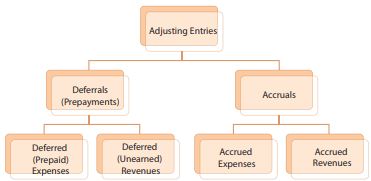
Soru 70
Which one of the following describes the depreciable asset’s cost minus the asset’s accumulated depreciation?
Seçenekler
A
Straight-line depreciation
B
Non-current asset
C
Current asset
D
Book value
E
Fair value
Açıklama:
Book Value of an asset is the depreciable asset’s cost minus the asset’s accumulated depreciation.
Soru 71
What is the cash accounting?
Seçenekler
A
Companies record revenues when they receive the cash and they record expenses when the cash is paid
B
Companies record revenues when they perform services (rather than when they receive cash) and record expenses when they are incurred (rather than when paid).
C
Revenue is recorded when earned and expenses are recorded when consumed.
D
A company should record an expense for estimated bad debts that have not yet been incurred.
E
The account basis of accounting is the concept of recording revenues when earned and expenses as incurred.
Açıklama:
In cash basis accounting, companies record revenues when they receive the cash and they record expenses when the cash is paid. Cash basis accounting records only cash transactions-cash receipts and cash payments. Basically, it is a simple method. But it prevents businesses from being cautious. Companies adopting cash basis accounting focus only transactions involving cash. Those with no monetary input are not taken into consideration. It is possible to say that cash basis accounting is mostly used by small businesses.
Soru 72
What is time period assumption?
Seçenekler
A
Accounting periods should be more than 5 years.
B
The time-period concept assumes that unlimited economic life of a company will be divided into regular intervals and that financial statements will be prepared for specific periods such as a month, quarter, or year.
C
Accounting periods may be approximately weekly for preparing.
D
The time period principle is the concept that a business should report the financial results of its activities over a standard time period which is usually about 2 or 3 years.
E
The time period concept is one of the fundamental accounting principles and rules, applicable to only cash accounting.
Açıklama:
The time-period concept (or alternatively periodicity concept) assumes that unlimited economic life of a company will be divided into artificial time periods and that financial statements can be prepared for specific periods such as a month, quarter, or year.
Soru 73
What is the core revenue recognition principle?
Seçenekler
A
Revenue recognition principle dictates that revenue is recognized when it is earned not the cash is received.
B
Revenue recognition principle is the gross decrease in owner’s equity that results from operations.
C
Revenue recognition principle, revenue is recognized after the cash is received.
D
Revenue recognition principle, in accrued revenue, revenue is recognized before the cash is received.
E
Revenue recognition principle, is the cost of assets consumed or services used during the revenue earning process.
Açıklama:
In revenue recognition principle, revenue is recorded when it is earned, not when the cash is received just the same as the accrual basis accounting.
Soru 74
What is deferred revenue?
Seçenekler
A
Deferred revenue, also known a sort of revenue, refers to payments a company already received for products or services in the past.
B
Delivery of the good or service to the customer, but the deferred revenue is not reclassified as an asset.
C
In deferred revenue, revenue is recognized before the cash is received.
D
Deferred revenue, also known as unearned revenue, refers to advance payments a company receives for products or services that are to be delivered or performed in the future.
E
The deferred revenue is an expense and decrease in owner’s equity that results from operations.
Açıklama:
If cash is received in advance (before revenue is earned), a liability account (called as deferred revenue) will be used as a correspondence to cash account, a liability account called deferred revenue is used as a correspondence to cash account.
Soru 75
What is the matching rule?
Seçenekler
A
Matching is expense that is recognized after cash is paid.
B
Matching is expense that is recognized before cash will be paid.
C
An accounting rule that says revenues must be assigned to the accounting period in which the goods were sold or the services performed.
D
An accounting rule that says revenues must be assigned to the accounting period in which the goods will be sold or the services will be performed in the future.
E
As a matching principle, revenues recognition means that you will record the revenues.
Açıklama:
Matching Principle, also referred as Expense Recognition Principle is used to explain the relationship between expense and revenues. It means that you record the expenses at the same time with the revenues related with these expenses which are recorded regardless of the time cash is paid.
Soru 76
What are the main purpose of adjusting entries in accounting?
Seçenekler
A
The main purpose of adjusting entries is to update the accounts to conform with the accrual concept. At the end of the accounting period, some income and expenses may have not been recorded, taken up or updated; hence, there is a need to update the accounts.
B
Adjusting Entries are not necessary every time financial statements are prepared.
C
Basic categories of adjusting entries are result of physical events.
D
The main purpose of adjusting entries is deferred expenses (prepaid expenses) on income statement.
E
The main purpose of adjusting entries is deferred expenses (prepaid expenses) on balance sheet.
Açıklama:
At the end of each accounting period, companies present their financial statements in order to communicate with information users. To present the company’s true and fair situation all accounts must be updated because recording some revenue and expense transactions are omitted during the period. That means some accounts must be adjusted, and some adjusting entries must be made.
Soru 77
What are the types of adjusting entries.
Seçenekler
A
Basic categories of adjusting entries are deferred (Prepaid) Expenses deferred (Unearned) Revenues, deffered liabilities and deffered revenues.
B
Generally, there are 4 types of adjusting entries. Adjusting entries are prepared for the following: Accrued Income - income earned annd received. Accrued Expense - expenses incurred and already paid.
C
- Deferred (Prepaid) Expenses
- Deferred (Unearned) Revenues
- Accrued Expenses
- Accrued Revenues
D
Generally, there are 4 types of adjusting entriesare depreciable amount which are the cost , asset, other amount substituted for cost, and residual value.
E
Accrued Expenses (Expense Payable) - interest and loan.
Açıklama:
The two basic categories of adjustments can be divided into four different types as follows:
- Deferred (Prepaid) Expenses
- Deferred (Unearned) Revenues
- Accrued Expenses
- Accrued Revenues
Soru 78
How do you record deferred expenses?
Seçenekler
A
Under the expense recognition principles of accrual accounting, expenses are recorded in the period in which they were incurred and has been paid.
B
Deferred expenses ( paid expenses) has done payments of past expenses.
C
A deferred expense is as an asset has already recorded as an expense fort he past accounting period.
D
The term "deferred expense" is used to describe a payment that has been made, and has been reported as an expense in the past accounting period.
E
A deferred expense is a cost that has already been incurred, but which has not yet been consumed. The cost is recorded as an asset until such time as the underlying goods or services are consumed; at that point, the cost is charged to expense.
Açıklama:
Deferred expenses are the ones that are firstly paid and reported as an asset but will not be recorded as an expense until a future accounting period.
Soru 79
What is the meaning of depreciation in accounting?
Seçenekler
A
Value and usefulness of some assets will increase their value when the business uses them in its operations.
B
Depreciation is an accounting method of allocating the cost of a tangible asset over its useful life and is used to account for declines in value. Businesses depreciate long-term assets for both tax and accounting purposes.
C
Businesses depreciate short-term assets for both tax and accounting purposes.
D
Businesses depreciate short-term liabilities for both tax and accounting purposes.
E
Depreciation is the systematic allocation of the expected amount of an asset and liabilities over its residual life.
Açıklama:
Value and usefulness of plant assets will decline when the business uses them in its operations. The decline in usefulness of a plant asset is an expense which is called as a expense. Here the concept of depreciation emerges. Depreciable amount is the cost of an asset minus its residual value, and depreciation is the systematic allocation of the depreciable amount of an asset over its useful life. In other words, depreciation is a cost allocation process over the plant asset’s useful life.
Soru 80
What is the entry for accrued expenses?
Seçenekler
A
Every adjusting entry for accrued expenses debits an expense account, increasing expenses on the income statement and reducing net income, and credits a payable account, decreasing liabilities on the balance sheet.
B
Because of adjustingentry for accrued expenses debits an expense account, decreasing expenses on the income statement.
C
So, in adjusting entry, asset will be created as a debit and revenue as a credit. companies not increase both assets and revenues by making adjusting entries.
D
The amount of such an accrued but unpaid item at the end of the accounting period is both an expense and a liability.
E
The term 'accrued' means to increase or accumulate. When a company accrues expenses, this means that its portion of paid bills is increasing.
Açıklama:
Some types of services, such as insurance, are normally paid for before they are used. As you learned before, these prepayments are deferrals. Rent, interest, salaries, wages, utilities, etc. are the other examples of accrued expenses over time. Expenses incurred but not yet paid or recorded at the end of the accounting period are accrued expenses. Accrued expenses are the ones that are firstly incurred and not recorded as an expense until a future accounting period. Because of the unnecessity, such kinds of expenses are not required for daily recordings. For that reason, companies do not recognize them until the preparation of financial reports. The amount of such an accrued but unpaid item at the end of the accounting period is both an expense and a liability.
Soru 81
Which of the following statement is true for "cash basis accounting"?
Seçenekler
A
companies record revenues when they receive the cash and they record expenses when the cash is paid
B
companies record revenues when they receive the cash and they do not record expenses.
C
companies avoid recording revenues in case they may receive the payment in cash cash
D
companies receive the cash but do not record expenses in the accounting book.
E
companies record all types of payment only if they are made in cash
Açıklama:
In cash basis accounting, companies record revenues when they receive the cash and they record expenses when the cash is paid. Cash basis accounting records only cash transactions-cash receipts and cash payments. Basically, it is a simple method. But it prevents businesses from being cautious. Companies adopting cash basis accounting focus only transactions involving cash. Those with no monetary input are not taken into consideration. It is possible to say that cash basis accounting is mostly used by small businesses.
Soru 82
"The time-period concept assumes that........."
Which of the following statement appropriately completes the sentence above?
Which of the following statement appropriately completes the sentence above?
Seçenekler
A
Revenue is the gross decrease in owner’s equity from delivering goods or services.
B
financial statements will not be prepared for specific periods such as a month, quarter.
C
unlimited economic life of a company will be divided into regular intervals.
D
The basic accounting period is not assumed to be one year.
E
virtually all businesses are supposed to have an already prepared montly financial statements.
Açıklama:
The time-period concept assumes that unlimited economic life of a company will be divided into regular intervals and that financial statements will be prepared for specific periods such as a month, quarter, or year. Each company is set up with the expectation that it will have an unlimited lifetime (remember the going concern assumption). But companies’ related parties (such as government, creditors, investors, management, customers, etc.) wish to have information about the activities and financial position of the company over certain periods. In order to meet these demands and give feedback, the unlimited economic lifetimes are divided into artificial time periods by accountants. The time-period concept (or alternatively periodicity concept) assumes that unlimited economic life of a company will be divided into artificial time periods and that financial statements can be prepared for specific periods such as a month, quarter, or year.
Soru 83
Which of the following is the definition of "revenue"?
Seçenekler
A
Revenue is recognition of the sales before the payment is done.
B
Revenue is the dictation that revenue is recognized when it is in cash.
C
Revenue is the gross decrease in owner’s equity that results from operations.
D
Revenue is the cost of assets consumed or services used during the revenue earning process.
E
Revenue is the gross increase in owner’s equity from delivering goods or services to customers and clients.
Açıklama:
It is important to know when companies should recognize revenue, in other words, when the companies earned the revenue. Revenue recognition principle will guide us. But first of all we will start with the definition of revenue and expense terms. Revenue is the gross inflow of economic benefits during the period arising from the course of the ordinary activities of an entity when those inflows result in increases in equity, other than increases relating to contributions from equity participants. Expense is outflows or other using up of assets or incurrences of liabilities during a period from delivering or producing goods, rendering services, or carrying out other activities that constitute the entity’s ongoing major or central operations.
Soru 84
Which of the following is not one of the reasons why trial balance is unadjusted?
Seçenekler
A
Some costs are not recorded during the current accounting period because these costs expire in time as a result of recurring daily transactions.
B
Some financial events are recorded on a day-to-day basis because it is wise to do so
C
Some types of expenses may be recorded as an electricity bill may be received until next accounting period.
D
Some types of income are not recorded as production cost could be higher than expected.
E
The accounts are almost ready to prepare the financial statements of the companies
Açıklama:
Information users need to know how well the company is performing. Actually, companies will identify and record the company’s financial events on daily basis. To summarize and give information about the company’s ending position at the end of the period, they must prepare their financial statements by using the accounts balances. This process will begin with the trial balance. This trial balance is unadjusted because the accounts are not yet ready to prepare the financial statements. The reasons as follows:
1. Some financial events are not recorded on a day-to-day basis because it is unwise to do so such as consumption of supplies or the earnings of salaries by employees.
2. Some costs are not recorded during the current accounting period because these costs expire with the passage of time rather than as a result of recurring daily transactions such as rent expense or insurance expense.
3. Some types of expenses may be unrecorded. For example, an electricity bill may not be received until the next accounting period.
1. Some financial events are not recorded on a day-to-day basis because it is unwise to do so such as consumption of supplies or the earnings of salaries by employees.
2. Some costs are not recorded during the current accounting period because these costs expire with the passage of time rather than as a result of recurring daily transactions such as rent expense or insurance expense.
3. Some types of expenses may be unrecorded. For example, an electricity bill may not be received until the next accounting period.
Soru 85
Which of the following is not one of the types of adjustment?
Seçenekler
A
Prepaid expenses
B
Unearned revenues
C
Accrued expenses
D
Accrued revenues
E
Earned revenues
Açıklama:
Adjusting entries are important in order to prepare correct and up-to-date financial reports. There are two basic categories of adjusting entries. These are deferrals and accruals. In a deferral adjustment, cash will be paid before an expense is incurred or the cash will be received before the revenue is earned. Accruals adjustments are the opposite of deferrals. An accrual records an expense before the cash is paid, or it records the revenue before the cash is received. The two basic categories of adjustments can be divided into four different types as follows:
1. Deferred (Prepaid) Expenses
2. Deferred (Unearned) Revenues
3. Accrued Expenses
4. Accrued Revenues
1. Deferred (Prepaid) Expenses
2. Deferred (Unearned) Revenues
3. Accrued Expenses
4. Accrued Revenues
Soru 86
"Deferred expenses are........."
Which of the following appropriately completes the sentence above?
Which of the following appropriately completes the sentence above?
Seçenekler
A
varieties of productive facilities such as machinery, equipment.
B
the systematic allocations of the depreciable amount of an asset.
C
the costs of assets
D
are the advance payments of future expenses.
E
plant assets that are long lived and tangible.
Açıklama:
Deferred expenses (prepaid expenses) are advance payments of future expenses. Deferred expenses are the ones that are firstly paid and reported as an asset but will not be recorded as an expense until a future accounting period. In other words, cash is paid before the expense is recognized. Rent, interest, insurance, etc. are the examples of prepaid expenses. The amounts of office supplies used up may also be considered as prepaid expenses. As it is not necessary, such kinds of expenses are not required in daily recordings. For that reason, companies do not recognize them until the preparation of their financial reports.
Soru 87
"Depreciable amount is ................"
Which of the following appropriately completes the sentence above?
Which of the following appropriately completes the sentence above?
Seçenekler
A
the cost of an asset, or other amount substituted for cost, less than its residual value
B
the systematic allocation of the depreciable amount of an asset over its useful life.
C
the estimated lifespan of a plant asset.
D
indefinite useful life of the production.
E
a contra asset account during the useful life of depreciable asset.
Açıklama:
Depreciable amount is the cost of an asset, or other amount substituted for cost, less than its residual value. Depreciation is the systematic allocation of the depreciable amount of an asset over its useful life. Useful life is the estimated lifespan of a plant asset. Accumulated Depreciation is a contra asset account and it will accumulate the depreciation expense during the useful life of depreciable asset.
Soru 88
"Accrued expenses are............"
Seçenekler
A
the depreciable asset’s unrecorded costs
B
the revenues recognized after the cash is received
C
the expenses not yet paid but recorded at the end of the accounting period
D
the expenses collected but not yet recorded at the end of the accounting period
E
the expenses incurred but not yet paid or recorded at the end of the accounting period
Açıklama:
Some types of services, such as insurance, are normally paid for before they are used. As you learned before, these prepayments are deferrals. Rent, interest, salaries, wages, utilities, etc. are the other examples of accrued expenses over time. Expenses incurred but not yet paid or recorded at the end of the accounting period are accrued expenses. Accrued expenses are the ones that are firstly incurred and not recorded as an expense until a future accounting period.
Soru 89
Which of the following is not the data needed for adjusting entries?
Seçenekler
A
Office supplies on hand
B
Companies' equipments
C
Payment deposits
D
Accrued salary expense
E
Accrued service revenue
Açıklama:
At the end of the period, we have to get the adjustment data. Data needed for adjusting entries include the following:
a. Office supplies on hand
b. Companies' equipment
c. Accrued salary expense
d. Accrued service revenue
a. Office supplies on hand
b. Companies' equipment
c. Accrued salary expense
d. Accrued service revenue
Soru 90
Which of the following is not one of the items that adjustment properly measurures?
Seçenekler
A
Net income on the income statement
B
Net loss on the income statement
C
Assets on the balance sheet
D
Credits on the balance sheet
E
Liabilities on the balance sheet
Açıklama:
At the end of the accounting period, an adjusting entry is completed, and it records revenues to the period in which they are earned and expenses to the period in which they occur. Adjusting entries also update the asset and liability accounts. Adjustments are necessary to properly measureseveral items such as:
1. Net income (loss) on the income statement
2. Assets and liabilities on the balance sheet
1. Net income (loss) on the income statement
2. Assets and liabilities on the balance sheet
Soru 91
Which of the following is not among the common accounting periods?
Seçenekler
A
weekly
B
monthly
C
quarterly
D
semiannually
E
yearly
Açıklama:
Accounting periods may be monthly, quarterly, semiannually or yearly. The correct answer is A.
Soru 92
Which of the following is not true about cash basis accounting?
Seçenekler
A
Companies record revenues when they provide a service.
B
Companies record expenses when the cash is paid.
C
Cash basis accounting records only cash transactions.
D
It prevents businesses from being cautious.
E
Companies focus only transactions which involve cash.
Açıklama:
In cash basis accounting, companies record revenues when they receive the cash and they record expenses when the cash is paid. Cash basis accounting records only cash transactions-cash receipts and cash payments. Basically, it is a simple method. But it prevents businesses from being cautious. Companies adopting cash basis accounting focus only transactions involving cash. Those with no monetary input are not taken into consideration. It is possible to say that cash basis accounting is mostly used by small businesses. The correct answer is A.
Soru 93
Which of the following is not true about accrual basis accounting?
Seçenekler
A
Companies record the impact of a business transaction as it occurs.
B
The moment companies perform a service, the transaction is recorded.
C
Companies record only when they receive a cash.
D
Companies record revenues when they are earned.
E
Companies record expenses when they are incurred.
Açıklama:
Accrual basis accounting records the impact of a business transaction as it occurs. When the business performs a service, makes a sale, or incurs an expense, the transaction will be recorded even if the business did not receive or did not pay any cash. In accrual basis accounting, companies record revenues when they are earned and record expenses when they are incurred. Recording regardless of monetary inflows and outflows forms the basis of accrual basis accounting. So, the profitability of the company applying accrual basis accounting can be measured much better when compared with applying the cash basis accounting.
The correct answer is C.
The correct answer is C.
Soru 94
If the accounting period consists of one year and the starting and ending dates are January 1 and December 31, fiscal year will be equal to ________.
Which of the following completes the statement above?
Which of the following completes the statement above?
Seçenekler
A
interim period
B
monthly period
C
calender year
D
quarter period
E
semiannual period
Açıklama:
If the accounting period consists of one year and the starting and ending dates are January 1 and December 31, fiscal year will be equal to the calendar year. But that does not mean that it is absolutely necessary.
The correct answer is C.
The correct answer is C.
Soru 95
Which of the following refers to any 12-month accounting period?
Seçenekler
A
interim period
B
quaterly period
C
semiannual period
D
fiscal year
E
monthly period
Açıklama:
The 12-month accounting period used for the annual financial statements is called as fiscal year.
The correct answer is D.
The correct answer is D.
Soru 96
In ______________, revenue is recognized after the cash is received.
Which of the following completes the statement above?
Which of the following completes the statement above?
Seçenekler
A
revenue recognition principle
B
accrued revenue
C
accrued expense
D
deferred revenue
E
matching principle
Açıklama:
In deferred revenue, revenue is recognized after the cash is received.
The correct answer is D.
The correct answer is D.
Soru 97
In accrued revenue, revenue is recognized ______________.
Which of the following completes the statement above?
Which of the following completes the statement above?
Seçenekler
A
when it is earned
B
after the cash is received
C
after the cash is paid
D
before the cash is paid
E
before the cash is received
Açıklama:
In accrued revenue, revenue is recognized before the cash is received.
The correct answer is E.
The correct answer is E.
Soru 98
A company pays the rent in cash on the 15th of each month but records it at the beginning of the same month.
Which of the following explains the situation for this company?
Which of the following explains the situation for this company?
Seçenekler
A
matching principle
B
deferred expense
C
prepaid expense
D
deferred revenue
E
accrued expense
Açıklama:
In accrued expense, expense is recognized before the cash is paid.
The correct answer is E.
The correct answer is E.
Soru 99
Which of the following is not subject to depreciation?
Seçenekler
A
buildings
B
land
C
furtniture
D
trucks
E
machinery
Açıklama:
Residual value as land has an indefinite useful life, it is not subject to depreciation.
The correct answer is B.
The correct answer is B.
Soru 100
Which of the following term refers to the expected value of the plant asset at the end of its expected lifespan?
Seçenekler
A
useful life
B
residual value
C
depreciation
D
depreciation expense
E
depreciable amount
Açıklama:
Residual value is the expected value of the plant asset at the end of its useful life.
The correct answer is B.
The correct answer is B.
Soru 101
Which of the following statements is correct?
Seçenekler
A
Accounting is based on either the cash basis or the accrual basis
B
In accrual basis accounting, companies record revenues when they receive the cash and they record expenses when the cash is paid
C
In cash basis accounting, companies record revenues when they perform services and record expenses when they are incurred
D
The time-period concept assumes that limited economic life of a company will be divided into irregular intervals
E
Accounting periods may only be monthly or yearly
Açıklama:
Accounting is based on either the cash basis or the accrual basis. In cash basis accounting, companies record revenues when they receive the cash and they record expenses when the cash is paid. In accrual basis accounting, companies record revenues when they perform services (rather than when they receive cash) and record expenses when they are incurred (rather than when paid). The time-period concept assumes that unlimited economic life of a company will be divided into regular intervals and that financial statements will be prepared for specific periods such as a month, quarter, or year. Accounting periods may be monthly, quarterly, semiannually or yearly.
Soru 102
What does accounting time period that is one year in length is called?
Seçenekler
A
Yearly calendar
B
Fiscal year
C
Calendar year
D
Time period
E
Accounting year
Açıklama:
Fiscal Year = Accounting time period that is one year in length.
Soru 103
............... is the cost of assets consumed or services used during the revenue earning process. Fill the gap with the suitable word.
Seçenekler
A
Revenue
B
Deferred revenue
C
Interim period
D
Expense
E
Cash
Açıklama:
Expense is the cost of assets consumed or services used during the revenue earning process.
Soru 104
Which of the following statements is wrong?
Seçenekler
A
Adjusting Entries are necessary every time financial statements are prepared
B
Basic categories of adjusting entries are deferrals and accruals
C
Accrued expenses are advance payments of future expenses
D
Depreciable amount is the cost of an asset, or other amount substituted for cost, less than its residual value
E
Depreciation is the systematic allocation of the depreciable amount of an asset over its useful life
Açıklama:
Deferred expenses (prepaid expenses) are advance payments of future expenses.
Soru 105
................. of an asset is the depreciable asset’s cost minus the asset’s accumulated depreciation. What should the gap is filled with?
Seçenekler
A
Accumulated Depreciation
B
Book Value
C
Straight-line depreciation method
D
Residual value
E
Useful life
Açıklama:
Book Value of an asset is the depreciable asset’s cost minus the asset’s accumulated depreciation.
Soru 106
Accounting periods may be ................ .
Which of the following options should not fill the gap?
Which of the following options should not fill the gap?
Seçenekler
A
monthly
B
yearly
C
quarterly
D
semiannually
E
daily
Açıklama:
Accounting periods may be monthly, quarterly, semiannually or yearly.
Soru 107
Revenue recognition principle dictates that .............
Seçenekler
A
revenue is recognized after the cash is received
B
revenue is recognized before the cash is received
C
you record the expenses at the same time with the revenues related with these expenses
D
revenue is recognized when it is earned not the cash is received
E
revenue is recognized when the cash is paid
Açıklama:
Revenue recognition principle dictates that revenue is recognized when it is earned not the cash is received.
Soru 108
In ...................., revenue is recognized before the cash is received.
Seçenekler
A
accrued revenue
B
deferred revenue
C
matching principle
D
accrued expense
E
deferred expense
Açıklama:
In accrued revenue, revenue is recognized before the cash is received.
Soru 109
............... are necessary every time financial statements are prepared.
Seçenekler
A
Deferrals
B
Adjusting Entries
C
Accruals
D
Deferred (Unearned) Revenues
E
Accrued Expenses
Açıklama:
Adjusting Entries are necessary every time financial statements are prepared.
Soru 110
........................ is the cost of an asset, or other amount substituted for cost, less than its residual value.
Seçenekler
A
Depreciable amount
B
Depreciation
C
Depreciation expense
D
Residual value
E
Useful life
Açıklama:
Depreciable amount is the cost of an asset, or other amount substituted for cost, less than its residual value.
Ünite 4
Soru 1
Which of the following is defined as one form of trial balance that holds in-term transactions’ totals and balances as well as the end of the period transactions’ totals and balances for final checking of the accounts and preparation of financial statements?
Seçenekler
A
Adjusted trial balance
B
Balance sheet
C
Income statement
D
Statement of owner’s equity
E
Income Summary Account
Açıklama:
Adjusted trial balance is one form of trial balance that holds in-term transactions’ totals and balances as well as the end of the period transactions’ totals and balances for final checking of the accounts and preparation of financial statements.
Soru 2
In which of the following financial statement, company reports revenues, expenses and their differences?
Seçenekler
A
Income statement
B
Balance sheet
C
Statement of owner’s equity
D
Adjusted trial balance
E
Post-Closing Trial Balance
Açıklama:
In the income statement company reports revenues, expenses and their differences.
Soru 3
Which of the following statement reports the changes in the capital throughout the period caused by the owner’s capital investments or withdrawals, net profit or loss?
Seçenekler
A
Statement of owner’s equity
B
Income statement
C
Balance sheet
D
Adjusted Trial Balance
E
Post-Closing Trial Balance
Açıklama:
Statement of owner’s equity reports the changes in the capital throughout the period caused by the owner’s capital investments or withdrawals, net profit or loss.
Soru 4
Revenues and expenses are reported in the ...............; assets, liabilities and owner’s equity are reported in the .................
Seçenekler
A
Income statement, balance sheet
B
Statement of owners equity, balance sheet
C
Balance sheet, income statement
D
Income statement, Statement of owners equity
E
Balance sheet, Statement of owners equity
Açıklama:
Revenues and expenses are reported in the income statement; assets, liabilities and owner’s equity are reported in the balance sheet.
Soru 5
Which of the following is the measure of how quickly and easily an account can be converted into cash?
Seçenekler
A
Liquidity
B
Currency
C
Periodicity
D
Equity
E
Preparedness
Açıklama:
Liquidity is the measure of how quickly and easily an account can be converted into cash
Soru 6
Which of the following is not a section in a classified balance sheet?
Seçenekler
A
Current assets
B
Non-current assets
C
Current liabilities
D
Owner's Equity
E
Trade Receivables
Açıklama:
Assets are divided into two sections: current assets and non-current assets. Liabilities are also divided into two sections: current liabilities and non-current (long-term) liabilities. There is one more section in the classified balance sheet and, that is for the owner’s equity.
Soru 7
Which of the following is an example of non current assets?
Seçenekler
A
Cash
B
Account Receivables
C
Equipment
D
Salary Payable
E
Capital
Açıklama:
Equipment is an example of non current assets.
Soru 8
Which of the following is defined as tansferring the balances of the revenue and expense accounts to Income summary account, and transferring Income Summary account’s balance to Capital account?
Seçenekler
A
Closing Entries
B
Adjusted Trial Balance
C
Post Closing Trial Balance
D
Income Summary
E
Income statement
Açıklama:
Transferring the balances of the revenue and expense accounts to Income summary account, and transferring Income Summary account’s balance to Capital account are called the Closing Entries.
Soru 9
- The company must calculate the results of its operations.
- The company must ascertain the term’s profit or loss.
- The revenue accounts and expense accounts have to be closed.
Seçenekler
A
Only I
B
I and II
C
II and III
D
I and III
E
I, II and III
Açıklama:
At the end of the period, the company must calculate the results of its operations. In other words, the company must ascertain the term’s profit or loss. For this aim, the balances of revenue accounts and expense accounts have to be posted to Income Summary account. By accounting meaning, the revenue accounts and expense accounts have to be closed and their balances have to be posted to Income Summary account. Because the company has so many different revenue and expense accounts separately, they have to be accumulated under one account in order to figure out the exact result. This account is the Income Summary account. After the accumulation of revenues and expenses under Income Summary account, the final result is clear.
Transferring the balances of the revenue and expense accounts to Income summary account, and transferring Income Summary account’s balance to Capital account are called the “Closing Entries”. The accounts which are closed at the end of the term are called “temporary accounts” because they hold only one period’s transactions and they have to be zeroed for the next period.
Transferring the balances of the revenue and expense accounts to Income summary account, and transferring Income Summary account’s balance to Capital account are called the “Closing Entries”. The accounts which are closed at the end of the term are called “temporary accounts” because they hold only one period’s transactions and they have to be zeroed for the next period.
Soru 10
Which of the following stages in accounting cycle includes "opening the accounts for the new fiscal year"?
Seçenekler
A
Beginning of the period activities
B
During the period activities
C
End of the period activities
D
Completing period activities
E
Post closing period activities
Açıklama:
Beginning of the period activities deal with the opening transactions of the company. After the closing entries done for the previous term, the accounts have to be opened for the new fiscal year. The opening of the accounts is based on the opening balance sheet.
Soru 11
I. The assets
II. Liabilities
III. The changes in the capital throughout a period
IV. The owner's equity in a specific date
Which of the things above does the balance sheet report?
II. Liabilities
III. The changes in the capital throughout a period
IV. The owner's equity in a specific date
Which of the things above does the balance sheet report?
Seçenekler
A
I,II and III
B
I, II and IV
C
I, III and IV
D
II,III and IV
E
I, II, III and IV
Açıklama:
Balance sheet reports the assets, liabilities and the owner’s equity in a specific date.Statement of owner’s equity reports the changes in the capital throughout the period caused by the owner’s capital investments or withdrawals, net profit or loss.
Soru 12
In which statement are revenues and expenses reported?
Seçenekler
A
Balance sheet
B
Statement of owner’s equity
C
Income statement
D
Net statement
E
Profit statement
Açıklama:
Revenues and expenses are reported in the income statement; assets, liabilities and owner’s equity are reported in the balance sheet.
Soru 13
What is the measure of how quickly and easily an account can be converted into cash?
Seçenekler
A
Liquidity
B
Maturity
C
Equity
D
Asset
E
Liability
Açıklama:
Liquidity is the measure of how quickly and easily an account can be converted into cash.
Soru 14
Which of the following step is followed after the opening entries recorded by using the opening balance sheet?
Seçenekler
A
Posting opening entries to ledger accounts
B
Analyzing and journalizing daily transactions
C
Posting daily transactions to accounts
D
Preparing monthly trial balances
E
Preparing unadjusted trial balance at the end of the period
Açıklama:
The steps in accounting cycles briefly: • Opening entries based on opening balance sheet • Posting opening entries to ledger accounts • Analyzing and journalizing daily transactions • Posting daily transactions to accounts • Preparing monthly trial balances • Preparing unadjusted trial balance at the end of the period • Adjusting entries • Preparing adjusted trial balance • Preparing financial statements • Closing entries • Preparing post-closing trial balance.
Soru 15
Which of the following is the final step of the accounting cycle?
Seçenekler
A
Adjusting entries
B
Preparing adjusted trial balance
C
Preparing financial statements
D
Closing entries
E
Preparing post-closing trial balance
Açıklama:
As the end of the period comes, adjusting entries are made to ensure the assets, liabilities and owner’s equity. After the adjustment transactions, adjusted trial balance is prepared, and financial statements are prepared afterwards. After the preparation of financial statements, the company journalizes and posts the closing entries. The final step of the accounting cycle is preparing the post-closing trial balance.
Soru 16
Which of the following is the correct definition of the accounting cycle?
Seçenekler
A
The process by which companies produce their financial statements for a specific period of time
B
The process by which companies produce their financial statements for the beginning of the period activities
C
The process by which companies produce their financial statements for during the period activities
D
The process by which companies produce their financial statements for the end of the period activities
E
The process by which companies produce their financial statements after closing of revenue accounts
Açıklama:
Accounting cycle can be defined as the process by which companies produce their financial statements for a specific period of time8 . As briefly mentioned, accounting cycle includes three main stages of activities; • beginning of the period activities • during the period activities • end of the period activities.
Soru 17
After closing of revenue accounts,expense accounts and Income Summary account, whihc of the following is to be prepared?
Seçenekler
A
Financial statements
B
Accounting entries
C
Posting daily transactions to accounts
D
Post-closing trial balance
E
Closing entries
Açıklama:
After closing of revenue accounts,expense accounts and Income Summary account, it is timeto prepare post-closing trial balance as the ending step in the accounting cycle. Post-closing trial balance shows the accounts with only balances. As the revenue accounts, expense accounts and Income Summary accounts were closed, it means that they have no balances. So, in the post-closing trial balance those type of accounts will not take place. Assets, liabilities and Capital accounts are the only accounts that have balances left at the end of the period.
Soru 18
What shows the owners’ investments, profit and loss of the period?
Seçenekler
A
Current assets
B
Non-current assets
C
Current liabilities
D
Non-current liabilities
E
Owner's equity
Açıklama:
Owner’s equity shows the owners’ investments, profit and loss of the period.
Soru 19
In the picture above, a sample entry is given for which of the following?
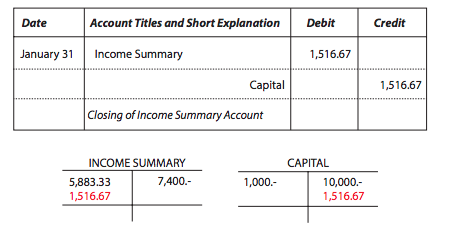
Seçenekler
A
Financial Statement
B
Income Statement
C
Balance Sheet
D
Post-Closing Trial Balance
E
Revenue Statement
Açıklama:
In TRApps Co. example, Income Summary account has the credit balance of 1,516.67 TL (7,400- 5,883.33). In other words, transferred revenue totals are higher than transferred expense totals. TRApps Co has the profit! Now, as the company calculated its profit, it is time to close Income Summary account. In this case, because the company has profit, the Income Summary account must be debited for closing. The balance will be transferred to Capital account. If there were loss for the company, then there would be a debit balance. In this case Income Summary account would be credited for closing. Here is the journal entry for TRApps Co. for closing Income Summary account.
Soru 20
Beginning of the period activities deal with the opening transactions of the company. After the closing entries done for the previous term, the accounts have to be opened for the new fiscal year. The opening of the accounts is based on the ______________ which is also the closing balance sheet of the ended period.
Which of the following completes the sentence above?
Which of the following completes the sentence above?
Seçenekler
A
journal entry
B
daily transaction
C
opening balance sheet
D
adjusting entry
E
owner's equity
Açıklama:
Beginning of the period activities deal with the opening transactions of the company. After the closing entries done for the previous term, the accounts have to be opened for the new fiscal year. The opening of the accounts is based on the opening balance sheet which is also the closing balance sheet of the ended period. Journal entry is recorded according to the opening balance sheet and accounts are posted to the ledger. Hereby, the accounts are now ready for daily transactions, in other words, the accounts are ready for during the period transactions.
Soru 21
..................... reports each asset, liability and owner’s equity in five specific sections.
Seçenekler
A
Adjusted trial balance
B
Liquidity
C
Balance sheet
D
Income statement
E
Classified Balance Sheet
Açıklama:
Classified balance sheet reports each asset, liability and owner’s equity in specific sections. There are five sections in the classified balance sheet
Soru 22
Which of the following is TRUE about non-current liabilities?
Seçenekler
A
Financing current assets with non-current liabilities is more advantegous.
B
Non-current liabilities are the liabilities that their maturity dates are within one year.
C
Companies use their non-current liabilities for financing only non-current assets.
D
Non-current liabilities explain the measure of how quickly and easily an account can be converted into cash.
E
Non-current liabilities report the changes in the capital throughout the period caused by the owner’s net profit or loss.
Açıklama:
Liabilities are the existing debts of the company. Non-current liabilities are the liabilities that their maturity dates are over one year or the operating cycle. Companies use their non-current liabilities for financing non-current assets as well as current assets. Financing current assets with non-current liabilities creates an advantage for the company rather than using current liabilities. Company can use the assets financed by non-current liabilities and earn more profit till the maturity date rather than using current liability
Soru 23
A company has raw materials which will be consumed within 10 months. In which section of the balance sheet should the company report this?
Seçenekler
A
Owner’s equity
B
Current assets
C
Non-current assets
D
Non-current liabilities
E
Current liabilities
Açıklama:
Current assets include the assets that will be converted into cash, sold, consumed or received Statement of owner’s equity reports the changes in the capital throughout the period caused by the owner’s capital investments or withdrawals, net profit or loss. Balance sheet reports the assets, liabilities and the owner’s equity in a specific date. Revenues and expenses are reported in the income statement; assets, liabilities and owner’s equity are reported in the balance sheet. This company has raw material to be consumed within 10 months.
Soru 24
The company has 15,000 liras of revenues and 3,000 liras of expenses.
Which of the following statement is TRUE about this company's closing process?
Which of the following statement is TRUE about this company's closing process?
Seçenekler
A
12,000 liras of revenue will be posted to Income Summary account.
B
3,000 liras of expense will be posted to credit side of Income Summary account.
C
15,000 liras of revenue will be posted to debit side of Income Summary account.
D
The company has a loss of 3000 liras.
E
12,000 liras of profit is transferred to Capital account.
Açıklama:
If the revenue exceeds expenses , then profit occurs. In this example, the revenue exceeds the expense by 10.000 liras, which means that the company has a profit of 10,000 liras. If expenses exceed revenues, then loss occurs. The balance of the Income Summary account, the 10,000 lira profit- is transferred to Capital account.
Soru 25
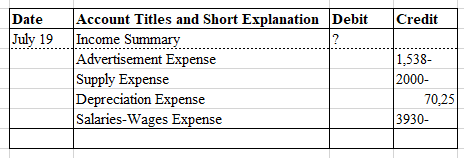 You see the closing entry of Company A. If the service revenue is 9,500,49, which of the following figures should go in the Income Statement Debit Column?
Seçenekler
A
9,500,49
B
1,538
C
2,000
D
7,538,25
E
3,930
Açıklama:
Advertisement Expense, Supply Expense, Depreciation Expense and Salaries-Wages Expense are credited with the same amount of their debit balances, and Income Summary account is debited. The total in this case is: 7,538,25.
Soru 26
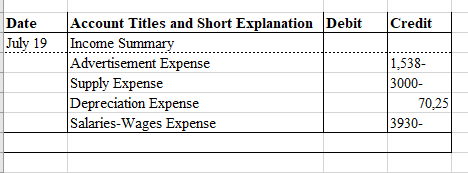 The chart shows the closing entry of Company A. What might the account seen below be?
Seçenekler
A
Service revenue
B
Advertisement Expense
C
Depreciation Expense
D
Income summary
E
Salaries-Wages Expense
Açıklama:
Advertisement Expense, Supply Expense, Depreciation Expense and Salaries-Wages Expense are credited with the same amount of their debit balances, and Income Summary account is debited. After the journal entry, the accounts will show up like:
Soru 27
Which one is the first step in accounting cycle?
Seçenekler
A
Preparing balance sheet
B
Preparing income statement
C
Opening entries based on opening balance sheet
D
Making closing entries
E
Preparing post-closing trial balance
Açıklama:
The steps in accounting cycles briefly are:
• Opening entries based on opening balance sheet
• Posting opening entries to ledger accounts
• Analyzing and journalizing daily transactions
• Posting daily transactions to accounts
• Preparing monthly trial balances
• Preparing unadjusted trial balance at the end of the period
• Adjusting entries
• Preparing adjusted trial balance
• Preparing financial statements
• Closing entries
• Preparing post-closing trial balance
• Opening entries based on opening balance sheet
• Posting opening entries to ledger accounts
• Analyzing and journalizing daily transactions
• Posting daily transactions to accounts
• Preparing monthly trial balances
• Preparing unadjusted trial balance at the end of the period
• Adjusting entries
• Preparing adjusted trial balance
• Preparing financial statements
• Closing entries
• Preparing post-closing trial balance
Soru 28
In accounting cycles, which of the following is done after preparing adjusted trial balance?
Seçenekler
A
Posting daily transactions to accounts
B
Preparing financial statements
C
Closing entries
D
Analyzing and journalizing daily transactions
E
Posting opening entries to ledger accounts
Açıklama:
The steps in accounting cycles briefly are:
• Opening entries based on opening balance sheet
• Posting opening entries to ledger accounts
• Analyzing and journalizing daily transactions
• Posting daily transactions to accounts
• Preparing monthly trial balances
• Preparing unadjusted trial balance at the end of the period
• Adjusting entries
• Preparing adjusted trial balance
• Preparing financial statements
• Closing entries
• Preparing post-closing trial balance
• Opening entries based on opening balance sheet
• Posting opening entries to ledger accounts
• Analyzing and journalizing daily transactions
• Posting daily transactions to accounts
• Preparing monthly trial balances
• Preparing unadjusted trial balance at the end of the period
• Adjusting entries
• Preparing adjusted trial balance
• Preparing financial statements
• Closing entries
• Preparing post-closing trial balance
Soru 29
The company pays ....................... either with cash of by handling goods or services within one year or in an operating cycle.
Seçenekler
A
Current assets
B
Current Liabilities
C
Non-current assets
D
Owner's equity
E
Revenue
Açıklama:
Current liabilities are the liabilities that the company has to pay either with cash of by handling goods or services within one year or in an operating cycle.
Soru 30
Which of the accounts below are the only ones that have balances left at the end of the period?
I.Revenue accounts
II.Assets
III. Expense accounts
IV. Capital accounts
V.Liabilities
I.Revenue accounts
II.Assets
III. Expense accounts
IV. Capital accounts
V.Liabilities
Seçenekler
A
I, II, III
B
III, IV, V
C
II, IV, V
D
I, III, V
E
II, III, V
Açıklama:
As the revenue accounts, expense accounts and Income Summary accounts were closed, it means that they have no balances. So, in the post-closing trial balance those type of accounts will not take place. Assets, liabilities and Capital accounts are the only accounts that have balances left at the end of the period.
Soru 31
I. Income statement
II. Statement of owner’s equity
III. Balance sheet
Which of the above is/are (a) financial statement(s)?
II. Statement of owner’s equity
III. Balance sheet
Which of the above is/are (a) financial statement(s)?
Seçenekler
A
I and II
B
I and III
C
Only II
D
Onlay III
E
I, II and III
Açıklama:
Financial statements are prepared in order;
• Income statement
• Statement of owner’s equity
• Balance sheet
• Income statement
• Statement of owner’s equity
• Balance sheet
Soru 32
Which of the following is the financial statement that reports operation results of a business for a specific period of time?
Seçenekler
A
Balance sheet
B
Income statement
C
Statement of owner’s equity
D
Cash flow statement
E
Adjusted trial balance
Açıklama:
Income statement is the financial statement that reports operation results of a business for a specific period of time (month, quarter quarter, or year year).
Soru 33
Which of the following is the financial statement that reports the changes in the capital throughout the period caused by the owner’s capital investments or withdrawals, net profit or loss.
Seçenekler
A
Balance sheet
B
Income statement
C
Statement of owner’s equity
D
Cash flow statement
E
Adjusted trial balance
Açıklama:
Statement of owner’s equity reports the changes in the capital throughout the period caused by the owner’s capital investments or withdrawals, net profit or loss.
Soru 34
Which of the following is the financial statement that reports the assets, liabilities and the owner’s equity in a specific date.
Seçenekler
A
Balance sheet
B
Income statement
C
Statement of owner’s equity
D
Cash flow statement
E
Adjusted trial balance
Açıklama:
Balance sheet reports the assets, liabilities and the owner’s equity in a specific date.
Soru 35
Which of the following is the measure of how quickly and easily an account can be converted into cash
Seçenekler
A
Certainity
B
Rigidity
C
Liquidity
D
Accuracy
E
Accessibility
Açıklama:
Liquidity is the measure of how quickly and easily an account can be converted into cash
Soru 36
Which of the following includes the assets that will be converted into cash, sold, consumed or received within 12 months?
Seçenekler
A
Current assets
B
Non-current assets
C
Current liabilities
D
Non-current liabilities
E
Owner's equity
Açıklama:
Current assets include the assets that will be converted into cash, sold, consumed or received within 12 months or within the business’s operating cycle, and the cash and cash equivalents.
Soru 37
Which of the following includes the assets acquired to be used in business ‘s operations for more than 12 months and receivables of which due dates are more than 12 months.
Seçenekler
A
Current assets
B
Non-current assets
C
Current liabilities
D
Non-current liabilities
E
Owner's equity
Açıklama:
Non-current assets include the assets acquired to be used in business ‘s operations for more than 12 months and receivables of which due dates are more than 12 months
Soru 38
Which of the following includes the liabilities that the company has to pay either with cash of by handling goods or services within one year or in an operating cycle?
Seçenekler
A
Current assets
B
Non-current assets
C
Current liabilities
D
Non-current liabilities
E
Owner's equity
Açıklama:
Current liabilities are the liabilities that the company has to pay either with cash of by handling goods or services within one year or in an operating cycle.
Soru 39
Which of the following shows the profit and loss of the period in balance sheet?
Seçenekler
A
Current assets
B
Non-current assets
C
Current liabilities
D
Non-current liabilities
E
Owner's equity
Açıklama:
Owner’s equity shows the owners’ investments, profit and loss of the period.
Soru 40
Which of the following is the first step of accounting cycle?
Seçenekler
A
Posting daily transactions to accounts
B
Preparing adjusted trial balance
C
Analyzing and journalizing daily transactions
D
Adjusting entries
E
Opening entries based on opening balance sheet
Açıklama:
The steps in accounting cycles briefly:
• Opening entries based on opening balance sheet
• Posting opening entries to ledger accounts
• Analyzing and journalizing daily transactions
• Posting daily transactions to accounts
• Preparing monthly trial balances
• Preparing unadjusted trial balance at the end of the period
• Adjusting entries
• Preparing adjusted trial balance
• Preparing financial statements
• Closing entries
• Preparing post-closing trial balance
• Opening entries based on opening balance sheet
• Posting opening entries to ledger accounts
• Analyzing and journalizing daily transactions
• Posting daily transactions to accounts
• Preparing monthly trial balances
• Preparing unadjusted trial balance at the end of the period
• Adjusting entries
• Preparing adjusted trial balance
• Preparing financial statements
• Closing entries
• Preparing post-closing trial balance
Soru 41
Which one of the following is the starting point for the preparation of the financial statement?
Seçenekler
A
Income statement
B
Balance sheet
C
Adjusted trial balance
D
Statement of owner's equity
E
Non-current assets
Açıklama:
For the preparation of financial statements, the starting point is the adjusted trial balance.
Soru 42
Which of the following is not one of the characteristics of information given in financial statements?
Seçenekler
A
Relevant
B
Faithfully representable
C
Comparable
D
Timely
E
Creative
Açıklama:
Therefore, information given in the financial statements must be relevant, faithfully representable, comparable, verifiable, timely and understandable.
Soru 43
Which of the following will be the starting point for the preparation of financial statements?
Seçenekler
A
Adjusted Trial Balance
B
Income Statement
C
General Ledger
D
Assets Amount
E
Closing entries
Açıklama:
For the preparation of financial statements, the starting point is the adjusted trial balance. Adjusted trial balance is one form of trial balance that holds in-term transactions’ totals and balances as well as the end of the period transactions’ totals and balances for final checking of the accounts and preparation of financial statements.
Soru 44
................is the financial statement that reports operation results of a business for a specific period of time.
Seçenekler
A
Balance sheet
B
Adjusted trial balance
C
Income statement
D
Statement of owner’s equity
E
General Ledger
Açıklama:
Income statement is the financial statement that reports operation results of a business for a specific period of time (month, quarter quarter, or year year).
Soru 45
Which of the following is true for balance sheet?
Seçenekler
A
It reports the changes in the capital throughout the period caused by the owner’s capital investments.
B
Revenues and expenses are reported in it.
C
It reports operation results of a business for a specific period of time.
D
It provides information about the financial position of the company.
E
It reports assets and liabilities for a specific time period.
Açıklama:
Balance sheet reports the assets, liabilities and the owner’s equity in a specific date. In other words, balance sheet provides information about the financial position of the company. In the trial balance you can easily find out asset, liability and owner’s equity accounts which will form the balance sheet.
Soru 46
............ is the measure of how quickly and easily an account can be converted into cash.
Seçenekler
A
Liquidity
B
Current assets
C
Current liabilities
D
Convertibles
E
Receivables
Açıklama:
Liquidity is the measure of how quickly and easily an account can be converted into cash.
Soru 47
Which of the following is an example for current liabilities?
Seçenekler
A
Salary payable
B
Accounts receivable
C
Supplies
D
Capital
E
Equipment
Açıklama:
Salary payable is an example of current liabilities.
Soru 48
Which of the following is not true for closing entries?
Seçenekler
A
Includes transferring the balances of the revenue and expense accounts to Income summary account.
B
Includes transferring Income Summary account’s balance to Capital account.
C
If revenues exceeds expenses then profit occurs.
D
Profit and loss are transferred to the capital account.
E
In order to close revenue accounts, the revenue account must be credited.
Açıklama:
In order to close revenue accounts, the revenue account must be debited.
Soru 49
BB Company has a Service Revenue account which has a credit balance of 7,400 TL. Which of the following accounts is used for closing this account?
Seçenekler
A
Income summary
B
Accounts receivable
C
Cash
D
Supplies
E
Profit/Loss
Açıklama:
Service Revenue account is debited with the same amount of its credit balance and Income Summary account is credited. By doing so, BB Company closes its revenue account and transfers the balance to Income Summary account.
Soru 50
............... reports each asset, liability and owner’s equity in specific sections.
Seçenekler
A
Classified balance sheet
B
Income statement
C
The statement of owner's equity
D
Adjusted trial balance
E
Closing entries
Açıklama:
Classified balance sheet reports each asset, liability and owner’s equity in specific sections.
Soru 51
Which one of the following is the financial statement that reports operation results of a business for a specific period of time (month, quarter quarter, or year year)?
Seçenekler
A
Income statement
B
Statement of owner's equity
C
Balance sheet
D
Owner's equity
E
Current liabilities
Açıklama:
Income statement is the financial statement that reports operation results of a business for a specific period of time (month, quarter quarter, or year year).
Soru 52
In which of the following , the accounts are arranged from the most to least liquid?
Seçenekler
A
Owner's equity, current liabilities, non current liabilities
B
Non current liabilities, current liabilities, owner's equity
C
Current liabilities, non current liabilities, owner's equity
D
Current liabilities, owner's equity, non current liabilities
E
Owner's equity, non current liabilities, current liabilities
Açıklama:
Current liabilities, non current liabilities, owner's equity
Soru 53
If the enterprise's revenues are 1.000.000 tl and profit is 450.000 tl, then which one states be the expenses?
Seçenekler
A
1.450.000 tl
B
550.000 tl
C
450.000 tl
D
1.000.000 tl
E
600.000 tl
Açıklama:
Profit/loss = revenues + expenses. This means 1.000.000 - 450.000 = 550.000
Soru 54
Which one of the following should be prepared at the ending step in the accounting cycle?
Seçenekler
A
Income statement
B
Classified balance sheet
C
Balance sheet
D
Income summary account
E
Post-closing trial balance
Açıklama:
After closing of revenue accounts,expense accounts and Income Summary account, it is timeto prepare post-closing trial balance as the ending step in the accounting cycle.
Soru 55
Which one of the following is "the definition of the process by which companies produce their financial statements for a specific period of time"?
Seçenekler
A
Income statement
B
Balance sheet
C
Closing entries
D
Accounting cycle
E
Adjusting entries
Açıklama:
Accounting cycle can be defined as the process by which companies produce their financial statements for a specific period of time.
Soru 56
Which one of the following is the first step of the accounting cycle?
Seçenekler
A
Posting opening entries to ledger accounts
B
Opening entries based on opening balance sheet
C
Analyzing and journalizing daily transactions
D
Adjusting entries
E
Posting daily transactions to accounts
Açıklama:
Opening entries based on opening balance sheet is the first step of the accounting circle.
Soru 57
Which one of the following is the last step of the accounting cycle?
Seçenekler
A
Closing entries
B
Preparing financial statements
C
Preparing post-closing trial balance
D
Preparing adjusted trial balance
E
Adjusting entries
Açıklama:
Preparing post-closing trial balance is the last step of the accounting cycle.
Soru 58
At the end of the each month which one is prepared by the company?
Seçenekler
A
Monthly trial balance
B
Adjusted trial balance
C
Closing entries
D
Post-closing trial balance
E
Preparing unadjusted trial balance at the end of the period
Açıklama:
At the end of each month, monthly trial balance is prepared in order to ensure that the totals and the balances of the accounts are equal.
Soru 59
Which one is not among the current assets?
Seçenekler
A
Cash
B
Merchandise inventory
C
Supplies
D
Trade names
E
Marketable securities
Açıklama:
Current assets include the assets that will be converted into cash, sold, consumed or received within 12 months or within the business’s operating cycle, and the cash and cash equivalents. Here are some examples for current assets: cash and cash equivalents, accounts receivables, merchandise inventory, prepaid expenses, supplies, marketable securities, etc.
Soru 60
Which of the following should be prepared after adjusting entries?
Seçenekler
A
Posting opening entries to ledger accounts
B
Preparing monthly trial balances
C
Preparing post-closing trial balance
D
Closing entries
E
Preparing adjusted trial balance
Açıklama:
Preparing adjusted trial balance follows adjusting entries
Soru 61
What is the order of preparation for financial statements?
Seçenekler
A
Income statement, presents the revenues, expenses, and profits/losses generated during the reporting period.
- Statement of cash flows.
- Statement of retained earnings.
B
Financial statements are prepared in order;
- Income statement
- Statement of owner’s equity
- Balance sheet
C
Business's financial statements are the income statement and the statement of retained earnings.
D
Begining preparing your financial report by balancing your company's financial holdings and create a statement of the company's income.
E
Begininig the report with an accounting of the amount of cash the company has brought in or spent.
Açıklama:
For the preparation of financial statements, the starting point is the adjusted trial balance. As you can remember from the previous chapters, adjusted trial balance is one form of trial balance that holds in-term transactions’ totals and balances as well as the end of the period transactions’ totals and balances for final checking of the accounts and preparation of financial statements. After the preparation of adjusted trial balance and financial statements, closing entries will be recorded in order to get accounts ready for the next year. We will focus on closing process further in this chapter. Now, let’s have a look at the financial statements. Financial statements are prepared in order;
- Income statement
- Statement of owner’s equity
- Balance sheet
Soru 62
What items appear on the income statement?
Seçenekler
A
The income statementshows us sales revenue, cost of goods sold,total or specific general expenses , depreciation expense, ınterest expense, tax expense.
B
The income statement shows us only sales of company.
C
The income statement shows us only taxes expense of company.
D
The income statement reports each asset, liability and owner’s equity in specific sections.
E
The income statement is the measure of how quickly and easily an account can be converted into cash.
Açıklama:
Income Statement shows the profit or loss of the company. So, how does profit or loss occur?
The positive difference between revenues and expenses give profit whereas the negative difference gives the loss. So, in the income statement company reports revenues, expenses and their differences.
The positive difference between revenues and expenses give profit whereas the negative difference gives the loss. So, in the income statement company reports revenues, expenses and their differences.
Soru 63
What time period does an income statement cover?
Seçenekler
A
Income Statement is a financial document prapered only quarter.
B
It can cover any period of time for which you want information, from a particular week to a span of multiple mounts.
C
Income Statement is a financial document prapered only quarter.
D
Income Statement is a financial document that can cover any period of time for which you want information, from a particular week to a span of multiple years.
E
Income Statement is a financial document generated only monthly.
Açıklama:
Balance sheet reports the assets, liabilities and the owner’s equity in a specific date. In other words, balance sheet provides information about the financial position of the company.
Soru 64
What are the sources of financing a business?
Seçenekler
A
Companies have two finance sources for their assets. They are liabilities and owner’s equity.
B
The sources of financing a business is owner’s equity.
C
The sources of financing a business is non-current liabilities.
D
The sources of financing a business is non-current assets.
E
The sources of financing a business isthe cash, and cash equivalents.
Açıklama:
Companies have two finance sources for their assets. They are liabilities and owner’s equity. Sources are classified according to their maturity dates on the balance sheet: from short-term maturity dates to owner’s equity which has an indefinite maturity date. Liabilities are the existing debts of the company. They are classified as current liabilities and non-current liabilities.
Soru 65
Current liabilities are the short-term liabilities. What are examples of current liabilities?
Seçenekler
A
Accrued expenses.
B
Customer deposits.
C
Accounts payable, Sales taxes payable, Payroll taxes payable, Income taxes payable. Interest payable, Bank account overdrafts.
D
The Debt Account and Revenues and Expenses of company.
E
Profit / Loss of a company.
Açıklama:
Current liabilities are the short-term liabilities. It means that the company has to pay the liability either with cash of by handling goods or services within one year or in an operating cycle.
Soru 66
What are examples of non-current assets?
Seçenekler
A
Examples of non-current assets include short-term deposits.
B
Examples of non-current assets include investments in other companies, intellectual property (e.g. patents), and property, plant and equipment.
C
Best examples of non-current assets include accounts receivable.
D
Examples of non-current assets include raw materials.
E
Examples of non-current assets include finished goods / inventory.
Açıklama:
Non-current assets include the assets acquired to be used in business ‘s operations for more than 12 months and receivables of which due dates are more than 12 months and examples of non-current assets include investments in other companies, intellectual property (e.g. patents), and property, plant and equipment.
Soru 67
What is the purpose of the closing process in accounting?
Seçenekler
A
In the balance sheet, which is in the closing stage, owner’s equity shows the owners’ investments, profit and loss of the period.
B
The purpose of the closing entry is to bring to the companies their benefit from current liabilities for financing its current assets.
C
The purpose of the closing entry, assets are reported according to their liquidity in the balance sheet.
D
The purpose of the closing entry is to bring the temporary account balances to zero on the general ledger, including revenue, expense and dividend accounts. All income statement balances are eventually transferred to retained earnings.
E
The purpose of the closing entryis toprepare statement of owner’s equity reports the changes in the capital throughout the period caused by the owner’s capital investments or withdrawals, net profit or loss.
Açıklama:
Transferring the balances of the revenue and expense accounts to Income summary account, and transferring Income Summary account’s balance to Capital account are called the “Closing Entries”. The accounts which are closed at the end of the term are called “temporary accounts” because they hold only one period’s transactions and they have to be zeroed for the next period.
Soru 68
How do you close a revenue account?
Seçenekler
A
Accounts, Closing Entries for Expense.
B
Closing the Income Summary Account.
C
Close revenue accounts. close expense accounts, close income summary account, close dividends (or withdrawals) account.
D
Revenue accounts have credit balances or have no balances at the end of the term.
E
As the end of the period comes, adjusting entries are made to ensure the assets, liabilities and owner’s equity.
Açıklama:
Closing Entries for Revenue Accounts, Closing Entries for Expense Accounts, Closing the Income Summary Account.
Soru 69
What is the full cycle of accounting?
Seçenekler
A
The steps in accounting cycles briefly:
- Opening entries based on opening balance sheet
- Posting opening entries to ledger accounts
- Analyzing and journalizing daily transactions
- Posting daily transactions to accounts
- Preparing monthly trial balances
- Preparing unadjusted trial balance at the end of the period
- Adjusting entries
- Preparing adjusted trial balance
- Preparing financial statements
- Closing entries
- Preparing post-closing trial balance
B
The accounting cycle is often described as a process that includes the following-steps: identifying, collecting and analyzing documents and transactions.
C
The accounting cycle is often described as a process that includes the following-steps: posting the journalized amounts to accounts in the general and subsidiary ledgers
D
The accounting cycle is often described as a process that includes the following-steps, preparing an unadjusted trial balance.
E
An accounting cycle includes three main stages of activities;
- beginning of the period activities
- during the period activities
- end of the period activities
Açıklama:
As the end of the period comes, adjusting entries are made to ensure the assets, liabilities and owner’s equity. After the adjustment transactions, adjusted trial balance is prepared, and financial statements are prepared afterwards. After the preparation of financial statements, the company journalizes and posts the closing entries. The final step of the accounting cycle is preparing the post-closing trial balance. Now, let’s summarize the steps in accounting cycles briefly:
- Opening entries based on opening balance sheet
- Posting opening entries to ledger accounts
- Analyzing and journalizing daily transactions
- Posting daily transactions to accounts
- Preparing monthly trial balances
- Preparing unadjusted trial balance at the end of the period
- Adjusting entries
- Preparing adjusted trial balance
- Preparing financial statements
- Closing entries
- Preparing post-closing trial balance
Soru 70
Which accounts go on the Post Closing Trial Balance?
Seçenekler
A
The post-closing trial balance contains only revenue accounts.
B
The post-closing trial balance contains only expense accounts.
C
The post-closing trial balance contains no revenue, expense, gain, loss, or summary account balances, since these temporary accounts have already been closed and their balances moved into the retained earnings account as part of the closing process.
D
The post-closing trial balance contains only income summary.
E
The post-closing trial balance contains only liabilities and Capital accounts and assets.
Açıklama:
After closing of revenue accounts, expense accounts and Income Summary account, it is time to prepare post-closing trial balance as the ending step in the accounting cycle. Post-closing trial balance shows the accounts with only balances. As the revenue accounts, expense accounts and Income Summary accounts were closed, it means that they have no balances.
Soru 71
_____ is the financial statement that reports operation results of a business for a specific period of time (month, quarter quarter, or year year).
Which of the following fills the blank above?
Which of the following fills the blank above?
Seçenekler
A
Income statement
B
Statement of owner’s equity
C
Balance sheet
D
Adjusted trial balance
E
Owner's balance
Açıklama:
Income statement is the financial statement that reports operation results of a business for a specific period of time (month, quarter quarter, or year year).
Soru 72
In which of the following revenues and expenses are reported?
Seçenekler
A
Statement of owner’s equity
B
Balance sheet
C
income statement
D
Adjusted trial balance
E
Depreciation Expense
Açıklama:
Revenues and expenses are reported in the income statement; assets, liabilities and owner’s equity are reported in the balance sheet.
Soru 73
Which of the following best describes "Liquidity"?
Seçenekler
A
The assets acquired to be used in business ‘s operations for more than 12 months and receivables of which due dates are more than 12 months
B
The measure of how quickly and easily an account can be converted into cash
C
The assets that will be converted into cash, sold, consumed or received within 12 months or within the business’s operating cycle, and the cash and cash equivalents.
D
The report that shows the assets, liabilities and the owner’s equity in a specific date.
E
The changes in the capital throughout the period caused by the owner’s capital investments or withdrawals, net profit or loss.
Açıklama:
Liquidity is the measure of how quickly and easily an account can be converted into cash.
Soru 74
From the perspective of liquidity, non-current assets’ convertibility into cash must be over how many months?
Seçenekler
A
1
B
3
C
6
D
12
E
24
Açıklama:
Non-current assets include the assets acquired to be used in business ‘s operations for more than 12 months and receivables of which due dates are more than 12 months. From the perspective of liquidity, non-current assets’ convertibility into cash must be over 12 months.
Soru 75
If the company has a profit at the end of the period, To which of the following, the credit balance of the Income Summary account is transferred?
Seçenekler
A
To the revenue account
B
To the statement of owner’s equity
C
To income summary account
D
To expense accounts
E
To the credit side of Capital account
Açıklama:
If the company has a profit at the end of the period, the credit balance of the Income Summary account is transferred to the credit side of Capital account, because profit increases the Capital. If there is a loss, the debit balance of the Income Summary account is transferred to the debit side of Capital account, because loss decreases the Capital.
Soru 76
When the revenue accounts and expense accounts are closed and Which of the following their balances were transferred to first?
Seçenekler
A
Capital account
B
Income Summary account
C
Revenue account
D
Expense account
E
Credit account
Açıklama:
Now that the revenue accounts and expense accounts are closed and their balances were transferred to Income Summary account, the company may easily calculate its profit or loss.
Soru 77
Which of the following is the ending step in the accounting cycle?
Seçenekler
A
The post-closing trial balance
B
Monthly trial balances
C
Closing entries
D
Adjusted trial balance
E
Financial statements
Açıklama:
After closing of revenue accounts,expense accounts and Income Summary account, it is timeto prepare post-closing trial balance as the ending step in the accounting cycle. Post-closing trial balance shows the accounts with only balances.
Soru 78
Which of the following is NOT one of the steps in the during the period activities of the accounting cycle?
Seçenekler
A
Posting daily transactions to accounts
B
Preparing monthly trial balances
C
Analyzing and journalizing daily transactions
D
Preparing unadjusted trial balance at the end of the period
E
Opening entries based on opening balance sheet
Açıklama:
During the period, the company makes tens of thousands of financial transactions. Each transaction has to be recorded into journals and posted to the ledger. At the end of each month, monthly trial balance is prepared in order to ensure that the totals and the balances of the accounts are equal. If the transaction is recorded recorded into a wrong account, the trial balance cannot figure it out. The trial balance is prepared as a cumulative table. This means that monthly totals are added onto previous months’ totals. With the same manner, the trial balance prepared at the end of June includes six months’ total amounts. Preparing unadjusted trial balance at the end of the period is to be done before ending of the period activities.
Soru 79
For the preparation of financial statements, which of the following is the starting point?
Seçenekler
A
Closing entries
B
post-closing trial balance
C
Opening entries based on opening balance sheet
D
the adjusted trial balance
E
Posting daily transactions to accounts
Açıklama:
For the preparation of financial statements, the starting point is the adjusted trial balance. After the preparation of adjusted trial balance and financial statements, closing entries will be recorded in order to get accounts ready for the next year
Soru 80
Which of the following shows the investments done by the owner/owners and the result of the operations of the company which is either profit or loss?
Seçenekler
A
Owner’s equity
B
Capital account
C
Revenue account
D
Expense account
E
Daily transactions
Açıklama:
Owner’s equity shows the investments done by the owner/owners and the result of the operations of the company which is either profit or loss.
Ünite 5
Soru 1
Which company type divided into two subtypes, retailer and whole seller?
Seçenekler
A
Service companies
B
Manufacturing companies
C
Merchandising companies
D
Stock companies
E
Limited companies
Açıklama:
Merchandising companies purchase the goods that are ready to be sold and sell them to generate revenue. Considering the type of their customers, merchandising companies are called either as retailer or whole seller.
Soru 2
Which of the following buys merchandise inventory either from a producer or a wholesaler and then sells those goods to consumers?
Seçenekler
A
Service company
B
Manufacturing company
C
Financial institution
D
Retailer
E
Whole seller
Açıklama:
A retailer buys merchandise inventory either from a producer or a wholesaler and then sells those goods to consumers.
Soru 3
Which of the following is the first step of operating cycle for a merchandising company?
Seçenekler
A
Purchase of inventories
B
Selling inventories to customers
C
Hosting inventories
D
Collecting cash from costumers
E
Receiving inventories
Açıklama:
The operating cycle of a merchandising company starts with the purchase of inventories from a producer or an individual, called a vendor. Then these inventories are sold to customers, either in cash or on account. When the cash is collected from customers, the operating cycle ends the first round.
Soru 4
Which of the following is the last step of the first round of operating cycle for a merchandising company?
Seçenekler
A
Selling inventories to costumers
B
Purchasing inventories
C
Hosting inventories
D
Collecting cash from costumers
E
Receiving inventories
Açıklama:
The operating cycle of a merchandising company starts with the purchase of inventories from a producer or an individual, called a vendor. Then these inventories are sold to customers, either in cash or on account. When the cash is collected from customers, the operating cycle ends the first round.
Soru 5
Which of the following shows the expense of inventories that sold to the costumers?
Seçenekler
A
Ending inventory
B
Begining inventory
C
Cost of goods sold
D
Service cost
E
Sales revenue
Açıklama:
If the merchandise inventory is sold, its cost is taken from inventory account in balance sheet and recognized as an expense (cost of goods sold) in the income statement.
Soru 6
Which of the following is the formula of gross profit?
Seçenekler
A
Sales revenue - Cost of goods sold
B
Operating expenses + Administrative expenses
C
Operating income - Interest revenues
D
Net income + Operating income
E
Sales revenue - Net income
Açıklama:
When COGS is deducted from sales revenue, gross profit is calculated. Gross profit evaluates the company’s profitability in terms of selling activities.
Soru 7
In which inventory system there is no record for Cost of Goods Sold (COGS) until the end of accounting period?
Seçenekler
A
Periodic inventory system
B
Perpetual inventory system
C
Real inventory system
D
Random inventory system
E
Gross inventory system
Açıklama:
In periodic inventory system, companies use “Purchase” account to record their purchases of inventories and there is no record for Cost of Goods Sold (COGS) until the end of accounting period
Soru 8
Which of the following is the formula of cost of goods sold?
Seçenekler
A
Beginning Inventory - Purchases - Ending Inventory
B
Beginning Inventory + Purchases + Ending Inventory
C
Beginning Inventory - Purchases + Ending Inventory
D
Beginning Inventory + Purchases - Ending Inventory
E
Ending Inventory - Purchases - Beginning Inventory
Açıklama:
The formula that is used to calculate COGS is:
COGS = Beginning Inventory + Purchases - Ending Inventory
COGS = Beginning Inventory + Purchases - Ending Inventory
Soru 9
 Which transaction belongs to the record in the figure?
Seçenekler
A
Purchased merchandise inventory in cash
B
Purchased merchandise inventory on account
C
Selling merchandise inventory in cash
D
Selling merchandise inventory on account
E
Adjusting the inventory account
Açıklama:
The Merchandise Inventory account increases when a purchase is made, so we used the debit side of Merchandise Inventory account. The Cash account decreases when a purchase is made, so we used the credit side of Cash account.
Soru 10
Which of the following is a contra-sales revenue account?
Seçenekler
A
Gross profit
B
Sales discounts
C
Operating income
D
Net income
E
Interest revenues
Açıklama:
“Sales Discounts” account is a contra-sales revenue account, and it is deducted from the gross sales revenue to reach net sales revenue in the income statement.
Soru 11
.....................begins with the purchase of merchandise inventory and ends when the cash from sales is collected from customers.
Which of the following should be brought to the space left above?
Which of the following should be brought to the space left above?
Seçenekler
A
Merchandising Companies
B
Operating cycle
C
Inventory Systems
D
Merchandise Inventory
E
Freight-in
Açıklama:
The correct answer to the problem is the operating cycle
Soru 12
How sales discounts should appear in the financial statements?
Seçenekler
A
as an addition to sales
B
as an addition to inventory
C
as a deduction from sales
D
as an operating expense
E
as an operating revenue
Açıklama:
Sales Discounts account is a contra-sales revenue account and it is deducted from the gross sales revenue to reach net sales revenue in the income statement. The correct answer is C.
Soru 13
In which financial statement are sales returns, sales discount and sales allowances shown?
Seçenekler
A
Balance Sheet
B
İncome Statement
C
Owner's Equity
D
Cash Flow Statement
E
Cost of the good sold table
Açıklama:
In income statement are sales returns, sales discount and sales allowances shown. The correct answer is option B.
Soru 14
Which of the following statements is true?
Seçenekler
A
The Sales account is used to record only sales on account.
B
A service company purchases products from suppliers and then sells them.
C
Gross profit = Net sales revenue+Cost of goods sold
D
Net sales revenue = Sales Revenue - (Sales Returns and Allowances + Sales Discounts)
E
The invoice is the purchaser’s request for collection from the customer.
Açıklama:
The correct answer is D. The invoice is the document given by the seller to the customer in return for collection. The service business does not buy products. Trading businesses buy products from suppliers and sell them to customers. Gross profit is the excess of sales revenue over cost of goods sold.
Soru 15
How is inventory classified in the financial statements?
Seçenekler
A
Asset
B
Liability
C
Revenue
D
Expense
E
Contra account
Açıklama:
Inventories are included in assets in the balance sheet.
Soru 16
Blue Company sold 100 units of piano to a customer for cash On May 20. Sales price of a piano is 8.00 TL. Which of the following is true about the accounting record to be made according to this information?
Seçenekler
A
Sales Revenue 800 TL debit
B
Account Receivable 800 TL debit
C
Cash 800 TL credit
D
Sales Revenue 800 TL credit
E
Account Payable 800 TL credit
Açıklama:
According to the information given in the question, cash account is debit 800 TL. Sales income account is credited as 800 TL.
Soru 17
The ending inventory of Sky is 45.000. If beginning inventory was 75.000 and goods available totaled 130.000, the cost of goods sold is....
Seçenekler
A
65
B
70
C
75
D
80
E
85
Açıklama:
The cost of goods sold is (130.000-45.000)=85.000 TL
Soru 18
Which of the following is incorrect information about the perpetual inventory system?
Seçenekler
A
Perpetual inventory system inventory accounts do not provide information on inventory whenever needed.
B
The first transaction in the sales transaction in the perpetual inventory system is record the amount of revenue and increase either in cash or in receivables.
C
Transportation costs are recorded as “delivery expense” if the shipment is FOB destination.
D
In FOB shipment point, the seller has no responsibility related to transportation.
E
The second transaction in the sales transaction in the perpetual inventory system is record the amount of COGS and decrease in inventory.
Açıklama:
The correct answer to question is option A. The expression given in this case belongs to the periodic inventory system.
Soru 19
If the sales agreement includes cash discount, the amount of discount is deducted from the “.........................” account.
Which of the following should be brought to the space left above?
Which of the following should be brought to the space left above?
Seçenekler
A
Cost Of The Gold Sold
B
Sales Revenue
C
Merchandise Inventory
D
Accounts Payable
E
Account Payable
Açıklama:
The correct answer is C. Merchandise inventory account decreases as a result of sales discount.
Soru 20
In which case is the transportation cost covered by the purchase cost?
Seçenekler
A
Delivery expense
B
FOB shipping point
C
FOB destination point
D
Sales Revenue
E
Merhandise inventory
Açıklama:
The correct answer is B. If the FOB shipping point type of shipment is preferred, the transportation cost belongs to the buyer. Therefore, transportation cost is added to the cost of merchandise, because it is a part of purchase cost.
Soru 21
Which of the followings is type of businesses in which raw materials are converted to finished goods and then sold to customers?
Seçenekler
A
Service companies
B
Manufacturing companies
C
Merchandising companies
D
Retailer
E
Whole seller
Açıklama:
INTRODUCTION
Manufacturing companies is type of businesses in which raw materials are converted to finished goods and then sold to customers.
Manufacturing companies is type of businesses in which raw materials are converted to finished goods and then sold to customers.
Soru 22
Which of the followings provide services to demanding parties without incurring any manufacturing or trading activities?
Seçenekler
A
Service companies
B
Manufacturing companies
C
Merchandising companies
D
Retailer
E
Whole seller
Açıklama:
INTRODUCTION
Service companies, such as hospitals, hotels, law firms etc., provide services to demanding parties without incurring any manufacturing or trading activities.
Service companies, such as hospitals, hotels, law firms etc., provide services to demanding parties without incurring any manufacturing or trading activities.
Soru 23
Which of the followings purchase the goods that are ready to be sold and sell them to generate revenue?
Seçenekler
A
Service companies
B
Manufacturing companies
C
Merchandising companies
D
Retailer
E
Whole seller
Açıklama:
INTRODUCTION
These companies purchase the goods that are ready to be sold and sell them to generate revenue.
These companies purchase the goods that are ready to be sold and sell them to generate revenue.
Soru 24
When does the operation cycle begin?
Seçenekler
A
Purchasing of inventories from a producer or an individual
B
Selling inventories to customers
C
Collecting cash from customers
D
Recording a receivable
E
Scheduling the payment
Açıklama:
MERCHANDISING OPERATIONS
Operating cycle begins with the purchase of merchandise inventory and ends when the cash from sales is collected from customers.
Operating cycle begins with the purchase of merchandise inventory and ends when the cash from sales is collected from customers.
Soru 25
What happens if the merchandise inventory is sold?
Seçenekler
A
Gross profit is calculated. Gross profit evaluates the company’s profitability in terms of selling activities.
B
Multiple-step income statement is preferred.
C
Cost is taken from inventory account in balance sheet and recognized as an expense (cost of goods sold) in the income statement.
D
Companies use “Purchase” account to record their purchases of inventories.
E
Freight cost is not included in the cost of goods.
Açıklama:
MERCHANDISING OPERATIONS
If the merchandise inventory is sold, its cost is taken from inventory account in balance sheet and recognized as an expense (cost of goods sold) in the income statement.
If the merchandise inventory is sold, its cost is taken from inventory account in balance sheet and recognized as an expense (cost of goods sold) in the income statement.
Soru 26
What happens when Cost of Goods Sold (COGS) is deducted from sales revenue?
Seçenekler
A
Gross profit is calculated. Gross profit evaluates the company’s profitability in terms of selling activities.
B
Multiple-step income statement is preferred.
C
Cost is taken from inventory account in balance sheet and recognized as an expense (cost of goods sold) in the income statement.
D
Companies use “Purchase” account to record their purchases of inventories.
E
Freight cost is not included in the cost of goods.
Açıklama:
MERCHANDISING OPERATIONS
When COGS is deducted from sales revenue, gross profit is calculated. Gross profit evaluates the company’s profitability in terms of selling activities.
When COGS is deducted from sales revenue, gross profit is calculated. Gross profit evaluates the company’s profitability in terms of selling activities.
Soru 27
Which of the followings is not among the expenses of “Single-Step Income Statement”?
Seçenekler
A
Salaries Expense
B
Advertising Expense
C
Research and Development Expenses
D
Delivery Expense
E
Depreciation Expense
Açıklama:
MERCHANDISING OPERATIONS
Research and Development Expenses are among the MULTIPLE-STEP INCOME STATEMENT
Research and Development Expenses are among the MULTIPLE-STEP INCOME STATEMENT
Soru 28
Which of the following statements is not true regarding “Periodic Inventory System”?
Seçenekler
A
Periodic inventory system is used by the companies with inexpensive inventories.
B
Periodic inventory system is used by the companies with manual accounting systems.
C
This system is preferred less day-by-day.
D
In periodic inventory system, companies use “Purchase” account to record their purchases of inventories.
E
In this system, companies continuously update the inventory account whenever a transaction occurs.
Açıklama:
INVENTORY SYSTEMS
Companies continuously update the inventory account whenever a transaction occurs in Perpetual inventory system
Companies continuously update the inventory account whenever a transaction occurs in Perpetual inventory system
Soru 29
Which of the following statements is not true regarding “Perpetual Inventory System”?
Seçenekler
A
Perpetual inventory system has a widespread use, because it provides high level of control over inventories.
B
In this system, companies continuously update the inventory account whenever a transaction occurs.
C
The purchases of inventories are directly debited to inventory account, while the cost of inventories are credited when they are sold.
D
In perpetual inventory system, companies use “Purchase” account to record their purchases of inventories.
E
Perpetual inventory system provides the companies opportunity to compare the amounts of inventories in accounting records stolen or wasted goods are not detected, because and in warehouses.
Açıklama:
INVENTORY SYSTEMS
In periodic inventory system, companies use “Purchase” account to record their purchases of inventories.
In periodic inventory system, companies use “Purchase” account to record their purchases of inventories.
Soru 30
Why do the companies prefer “Perpetual Inventory System”?
Seçenekler
A
To record their purchases of inventories and there is no record for Cost of Goods Sold (COGS) until the end of accounting period.
B
To have continuous control over inventories.
C
To evaluate the company’s profitability in terms of selling activities.
D
To provide written evidence of the transaction.
E
To make the inventory ready for sale.
Açıklama:
INVENTORY SYSTEMS
Companies prefer “Perpetual Inventory System” to have continuous control over inventories.
Companies prefer “Perpetual Inventory System” to have continuous control over inventories.
Soru 31
Which of the following is incorrect information about the operating cycle?
Seçenekler
A
Account receivables may result from the sale of inventories.
B
Cash is collected by collecting account receivables from customers.
C
Businesses buy inventory in cash.
D
İnventories are sold to customers, either in cash or on account.
E
The operating cycle starts with the sell of inventories from a producer.
Açıklama:
The correct answer is B. The operating cycle of a merchandising company starts with the purchase of inventories from a producer or an individual, called a vendor.
Soru 32
Which account does a merchandiser use that a service company does not use?
Seçenekler
A
Cost of the gold sold
B
Merhandise Inventory
C
Sales Revenue
D
Service Revenue
E
All of the above
Açıklama:
The correct answer is C. Merchandising company use sales revenue account. Service company use the service revenue account.
Soru 33
The two main inventory accounting systems are the ..................
Which of the following is the right place to be left blank?
Which of the following is the right place to be left blank?
Seçenekler
A
cash and accrual
B
returns and allowances
C
First in first out and last in firs out
D
purchase and sale
E
perpetual and periodic
Açıklama:
The correct answer is question E. First in first out and last in last out stock valuation method.
Soru 34
Which of the following accounts is debit when purchasing stocks on account?
Seçenekler
A
Merchandise İnventory
B
Account Payable
C
Account Receivable
D
Sales Revenue
E
Cash
Açıklama:
When purchasing inventory on account, imerhandise inventory account is debitted. Account payable account is credited.
Soru 35
A company had sales of 300.000 and sales returns of 45.000. Cost of goods sold was 152.000. How much gross profit did a company report?
Seçenekler
A
102.000
B
103.000
C
255.000
D
256.000
E
148.000
Açıklama:
300.000-45.000=255.000 Net Sales
255.000-152.000=103.000 Gross Profit
255.000-152.000=103.000 Gross Profit
Soru 36
A company merchandise inventory account showed a balance of 7.000 before the year end adjustments. The physical count of goods on hand totaled 6.300. To adjust the accounts, which of the following is true about the company registration?
Seçenekler
A
Cost of the gold sold debit 700
B
Merchandise inventory credit 600
C
Account Payable credit 500
D
Merchandise inventory debit 600
E
Cost of the gold sold credit 700
Açıklama:
The correct answer to question is option A. The company debit 600 of the cost of the goods sold, the inventories credit 600.
Soru 37
Anadolu Company purchased 60 units of piano from Melody Company on cash. Price of a piano is 12.000 TL. Which of the following is true about the Anadolu company's entry?
Seçenekler
A
Cash 650.000 debit
B
Merchandise İnventory 720.000 credit
C
Merchandise İnventory 650.000 debit
D
Cash 720.000 credit
E
Account Payable 720.000 credit
Açıklama:
Merchandise inventory account is 720.000 debited. Cash account is 720.000 credited.
Soru 38
Suppose that Victor Company sold 200 units of bottle to a customer for cash. Sales price of a glass is 8.00 TL. According to this information, which account will be credited by Victor Company?
Seçenekler
A
Merchandise İnventory
B
Account Receivables
C
Cash
D
Sales Revenue
E
Service Revenue
Açıklama:
The Victor Company debited the cash account 1.600 TL and the sales revenue account credited 1.600 TL.
Soru 39
- Service companies
- Manufacturing companies
- Merchandising companies
Seçenekler
A
Only I
B
Only II
C
I and II
D
II and III
E
I, II and III
Açıklama:
Based on their operations, companies are classified in three categories as “service companies”, “manufacturing companies”, and “merchandising companies”.
Soru 40
Which of the following is a contra revenue account?
Seçenekler
A
Sales Revenue
B
Service Revenue
C
Sales Allowances
D
Cash
E
Sales Discounts
Açıklama:
The correct answer is C. Sales allowances account is a contra-sales revenue account.
Soru 41
- raw materials inventory
- work-in-process inventory
- finished goods inventor
Seçenekler
A
Only I
B
Only III
C
I and II
D
I and III
E
I, II and III
Açıklama:
In manufacturing companies raw materials are converted to finished goods and then sold to customers. These companies have three types of inventories: (i) raw materials inventory, which includes materials and parts purchased to be used in production, (ii) work-in-process inventory, which are the products that are not completed as of the end of accounting period and (iii) finished goods inventory, which are the completed products available to be sold.
Soru 42
Which of the following is the starting transaction in the operating cycle of a merchandising company starts with
Seçenekler
A
The purchase of inventories from a vendor.
B
Raw materials are converted to finished goods.
C
Raw materials are converted to work-in-process inventory.
D
The cash is collected from customers.
E
Inventories are sold to customers, either in cash or on account.
Açıklama:
The cyle starts with the purchase of inventories from a producer or an individual, called a vendor.
Soru 43
In which of the following, the rest of the inventories account is updated after each transaction?
Seçenekler
A
Perpetual Inventory System
B
First İn First Out Method
C
Accrual Basis
D
Periodic Inventory System
E
Last İn First Out Method
Açıklama:
The correct answer to question is option A. In a perpetual inventory system, balance of inventory accounts is always updated as each transaction occurs.
Soru 44
When this merchandise inventory is sold, the revenue is reported as sales revenue, and its cost is recognized as an expense. Which of the following term defines this expense?
Seçenekler
A
Cost of merchandise sold
B
Merchandise Inventory Asset
C
Ending Inventory
D
Inventory Available for Sale
E
Beginning Inventory
Açıklama:
When this merchandise inventory is sold, the revenue is reported as sales revenue, and its cost is recognized as an expense called the cost of merchandise sold.
Soru 45
- Periodic inventory system is used by the companies with inexpensive inventories
- Perpetual inventory system is used by the companies manual accounting systems.
- Perpetual inventory system provides high level of control over inventories.
Seçenekler
A
Only I
B
I and III
C
I and II
D
II and III
E
I, II and III
Açıklama:
- Periodic inventory system is used by the companies with inexpensive inventories
- Periodic inventory system is used by the companies manual accounting systems.
- Perpetual inventory system provides high level of control over inventories.
Soru 46
ABC Company uses periodic inventory system. The begnning inventory is 10,000 TL, purchases in that period is 5,000TL and the ending inventory costs 1000 TL. Which of the following is the cost of goods sold during the period?
Seçenekler
A
10,000
B
11,000
C
14,000
D
15,000
E
16,000
Açıklama:
COGS = Beginning Inventory + Purchases - Ending Inventory
=10,000+5,000 -1,000 =14,000
=10,000+5,000 -1,000 =14,000
Soru 47
If two parties agree on the shipment as FOB shipping point, which of the following party is responisble for the transportation?
Seçenekler
A
The Buyer
B
The Seller
C
The Bank
D
The Carrier
E
The Warrantor
Açıklama:
If two parties agree on the shipment as FOB shipping point, transportation is the buyer’s responsibility. It is also called “Freight-in”, because freight cost is included in the cost of purchased goods.
Soru 48
If the shipment type is FOB destination,which of the following party is responsible for the transportation?
Seçenekler
A
The Buyer
B
The Seller
C
The Carrier
D
The Bank
E
The Warrantor
Açıklama:
If the shipment type is FOB destination, transportation is under the seller’s responsibility. Freight cost is not included in the cost of goods; therefore, this type of shipment is called “freight out”. The freight cost is recognized as delivery expense, in the accounting records of the seller.
Soru 49
ABC Company bought 5000 glasses in August 10 on account.Price of a glass is 3 TL. When they received the glasses, the quality checks detected 50 glasses with scratches on them. Therefore, on Augut 20, ABC Company returned these 50 glasses and demanded refunding. Which of the following is true for this refunding transaction?
Seçenekler
A
Accounts Payable account is credited 150 TL
B
Cash account is credited 150 TL
C
Merchandise Inventory account is credited 150 TL
D
Accounts Payable account debited 500TL
E
Merchandise Inventory account is debited 500 TL
Açıklama:
Merchandise Inventory account is credited 150 TL.(3 X 50)
Soru 50
The credit terms of Purchase of Inventory on August 5 from ABC Company is 3/10; n/30. XYZ Cmpany bought 500 bags on August 5, price of a bag is 50TL. XYZ Company made payment on August 15. Whic of the following is the amount of discount in this transaction?
Seçenekler
A
450
B
600
C
750
D
900
E
1000
Açıklama:
50 X 500= 25,000TL X %3 =>750 TL discount
Soru 51
Which one of the following is not among the service companies?
Seçenekler
A
Hotels
B
Law firms
C
Retailer companies
D
Banks
E
Hospitals
Açıklama:
Retailer companies are not among the service companies
Soru 52
Which one is called merchandise on hand (not sold)?
Seçenekler
A
Cost of merchandise sold
B
Merchandise inventory asset
C
Operating cycle
D
Ending inventory
E
Cost of goods sold
Açıklama:
Merchandise on hand (not sold) is called merchandise inventory asset.
Soru 53
Which one of the following is recorded on the top of income statement?
Seçenekler
A
Costs of goods sold
B
Sales revenue
C
Expenses
D
Gross profit
E
Income before tax
Açıklama:
During the operating cycle, companies generate revenues which is called the “Sales Revenue” and this item is recorded on the top of income statement to be the basis for net income.
Soru 54
Which one of the following is the last line of the income statement?
Seçenekler
A
Income before tax
B
Gross profit
C
Net sates
D
Expenses
E
Operating income
Açıklama:
Income before tax is the last line of the income statement.
Soru 55
Which one of the following is the equation of "Beginning Inventory + Purchases - Ending Inventory"
Seçenekler
A
Expenses
B
Operating income
C
Gross profit
D
Balance sheet
E
Cost of goods sold
Açıklama:
Cost of Goods Sold = Beginning Inventory + Purchases - Ending Inventory
Soru 56
Which one is the equation of "Purchase cost inventory - Purchase returns and allowances - Purchase discounts + Freight in"
Seçenekler
A
Cost of Goods Sold
B
Merchandise Inventory
C
Purchase Discount
D
Net Cost of Inventory Purchased
E
Sales Revenue
Açıklama:
Net Cost of Inventory Purchased = Purchase cost inventory - Purchase returns and allowances - Purchase discounts + Freight in
Soru 57
Which one of the following is the description of this phrase "If customers are unsatisfied with the goods they purchased, because of defects or for other reasons, seller may reduce the initial price at which the goods were sold to pursue the customers to keep the goods"?
Seçenekler
A
Sales returns
B
Sales discounts
C
Sales allowance
D
Sales revenue
E
Sold merchandise
Açıklama:
If customers are unsatisfied with the goods they purchased, because of defects or for other reasons, seller may reduce the initial price at which the goods were sold to pursue the customers to keep the goods. It is sales allowance.
Soru 58
If sales revenue is 4.000 TL, Sales returns and allowances are 450 TL and sales discounts are 600 TL, which one should be the net sales revenue?
Seçenekler
A
4.450 TL
B
2.950 TL
C
4.600 TL
D
5.050 TL
E
4.000 TL
Açıklama:
Net sales revenue = Sales Revenue - (Sales Returns and Allowances + Sales Discounts)
Soru 59
Which one of the following is the equation of "Net sales revenue - Cost of goods sold"?
Seçenekler
A
Net income
B
Income before tax
C
Gross profit
D
Net sales
E
Cost of goods sold
Açıklama:
Gross profit = Net sales revenue - Cost of goods sold
Soru 60
In the closing process at first all revenues and expenses are closed to a pool account. Which one of the following is the name of this account?
Seçenekler
A
Gross profit
B
Income summary
C
Net income
D
Net sales revenue
E
Income befre tax
Açıklama:
In the closing process at first all revenues and expenses are closed to a pool account, called “income summary”.
Soru 61
Which one of the following is a sevice company?
Seçenekler
A
Hospital
B
Hotel
C
Barber
D
Cargo agency
E
Grocery
Açıklama:
Grocery store is a merchandising company.
Soru 62
Which one of the following is not a service company?
Seçenekler
A
Barber shop
B
Hospital
C
Hotel
D
Cargo company
E
Grocery market
Açıklama:
Barbershop market is a merchandising company.
Soru 63
Which one of the following buys merchandise inventory from producer and sells it to costumers?
Seçenekler
A
Retailer company
B
Whole seller company
C
Manufacturing company
D
Service company
E
Finished goods company
Açıklama:
A retailer buys merchandise inventory either from a producer or a wholesaler and then sells those goods to consumers.
Soru 64
Which one of the following buys merchandise inventory from producer and sells it to retailers?
Seçenekler
A
Retailer company
B
Service company
C
Whole seller company
D
Finished goods company
E
Manufacturing company
Açıklama:
A whole seller buts merchandising inventory from a producer and then sells them to retailers.
Soru 65
I- Sell the inventory
II- Purchase inventory
III- Collect cash from customers
Which of the above are included in the operating cycle of a merchandising company?
II- Purchase inventory
III- Collect cash from customers
Which of the above are included in the operating cycle of a merchandising company?
Seçenekler
A
Only I
B
Only II
C
I and II
D
II and III
E
I, II and III
Açıklama:
The operating cycle of a merchandising company starts with the purchase of inventories from a producer or an individual, called a vendor. Then these inventories are sold to customers, either in cash or on account. When the cash is collected from customers, the operating cycle ends the first round.
Soru 66
Which one of the following is the end of an operating cycles one round?
Seçenekler
A
Purchase inventory
B
Sell the inventory
C
Collect cash from costumers
D
Depreciation entities
E
Post-closing entities
Açıklama:
Operating cycle begins with the purchase of merchandise inventory and ends when the cash from sales is collected from customers.
Soru 67
Which one of the following describes the unsold inventory?
Seçenekler
A
Inventoy purchase
B
Sold inventory
C
Unsold inventory
D
Depreciation
E
Current liability
Açıklama:
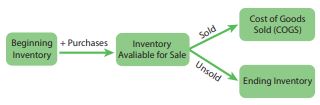
Soru 68
Which one of the following is the amount of deduction of COGS from sales revenue?
Seçenekler
A
Gross profit
B
Net profit
C
Operating profit
D
Operating loss
E
Net loss
Açıklama:
When COGS is deducted from sales revenue, gross profit is calculated. Gross profit evaluates the company’s profitability in terms of selling activities.
Soru 69
beginning inventory + purchases - ending inventory = ?
What is the formula above?
What is the formula above?
Seçenekler
A
Inventory in hand
B
Cost of goods sold
C
Unsold inventory
D
Partial inventory
E
Perpetual inventory
Açıklama:
COGS = Beginning Inventory + Purchases - Ending Inventory
Soru 70
Which one of the following is a manufacturing company?
Seçenekler
A
Audit firm
B
Barbershop
C
Tourism agency
D
Carpenter shop
E
Grocery market
Açıklama:
Grocery market is a merchandising company. Audit firm, barbershop and tourism agency are service companies. Carpenter shop is a manufacturing company.
Soru 71
Which of the following is the beginning activity in an operating cycle for a merchandising company?
Seçenekler
A
The purchase of merchandise inventory
B
Collecting the cash from customers
C
Selling the inventory
D
Making the production
E
Valuation of the inventory
Açıklama:
Operating cycle begins with the purchase of merchandise inventory and ends when the cash from sales is collected from customers.
Soru 72
Which of the following is true for a merchandising company?
Seçenekler
A
Raw materials are converted to finished goods and then sold to customers.
B
They do not make production.
C
Hospitals, hotels and law firms are examples of merchandising companies.
D
These companies have three types of inventories.
E
They have work-in-process inventory.
Açıklama:
These companies purchase the goods that are ready to be sold and sell them to generate revenue. Considering the type of their customers, merchandising companies are called either as retailer or whole seller.
Soru 73
Which of the following is true for company using a periodic inventory system?
Seçenekler
A
They have inexpensive inventories and manuel accounting systems.
B
They continuously update the inventory account.
C
The purchases of inventories are directly debited to inventory account
D
The cost of inventories are credited when they are sold.
E
They have continuous control over inventories.
Açıklama:
Periodic inventory system is used by the companies with inexpensive inventories and manual accounting systems. However, with the increased use of technology in all areas of businesses, this system is preferred less day-by-day. The other information is true for companies using perpetual inventory system.
Soru 74
The beginning inventory of a company using periodic inventory system is 300.000 lira. Total purchases cost 150.000 lira and the company has an ending inventory amount of 100.000. Which of the following is the amount of cost of goods sold for this company?
Seçenekler
A
300.000
B
350.000
C
400.000
D
500.000
E
550.000
Açıklama:
300.000 + 150.000 - 100.000 =350.000
COGS = Beginning Inventory + Purchases - Ending Inventory
COGS = Beginning Inventory + Purchases - Ending Inventory
Soru 75
A company must determine the cost of purchases. So, measuring the cost of purchases is the first step in recording the inventories. Which of the following will not be included in the cost?
Seçenekler
A
Transportation costs
B
Custom duties
C
Value added tax
D
The price paid to the supplier
E
Irrecoverable taxes
Açıklama:
Taxes, such as Value Added Tax (VAT), are deducted from the amount of tax that the company should pay the government at the end of an accounting period. These types of recoverable amounts are not included in the cost of merchandise inventory, as companies benefit from those payments in terms of decreases in tax liability, not as sales revenue.
Soru 76
................. exist when sellers allow purchasers to return merchandise that is defective, damaged, or under-performing.
Seçenekler
A
Purchase returns
B
Purchase allowences
C
Purchase discount
D
Purchase tax
E
Purchase payments
Açıklama:
Purchase returns exist when sellers allow purchasers to return merchandise that is defective, damaged, or under-performing.
Soru 77
Suppose that credit terms of Purchase of Inventory on May 13 from ABC Company is 3/15; n/30. The purchase amount is 3500. Let’s assume that XYZ Company made payment on May 25. Which of the following is the debt amount of XYZ Company?
Seçenekler
A
3395
B
3705
C
3695
D
3605
E
3555
Açıklama:
3500 * 3%= 105 cash discount
3500-105=3395.
3500-105=3395.
Soru 78
Purchase cost inventory of ABC company is 140.000. There is purchase returns amount of 25.000 and there is no allowances and discounts. Which of the following is the amount of net cost of inventory purchased?
Seçenekler
A
115.000
B
125.000
C
140.000
D
155.000
E
165.000
Açıklama:
Net Cost of Inventory Purchased = Purchase cost inventory - Purchase returns and allowances - Purchase discounts + Freight in
=140.000-25.000=115.000
=140.000-25.000=115.000
Soru 79
Suppose that Nehir Company sold 150 units of baby car seats to a customer for cash On May 28. Sales price of a baby car seat is 1.000 TL. Which of the following is true for the recording of this transaction?
Seçenekler
A
Accounts Payable is debited by 1.000 TL
B
Sales revenue account is credited by 1000 TL
C
Cash account is debited by 150.000 TL
D
Cost of Goods sold is debited by 1.000 TL
E
Banks is credited by 150.000 TL
Açıklama:
150 *1.000 TL = 150.000TL (debited Cash and credited Sales Revenue)
Soru 80
Suppose that on April 15, %10 of the 100 units (each unit costs 500 TL) of baby car seats sold on credit on April 20 is returned. Which of the following accounts are used to record this transaction?
Seçenekler
A
Accounts Receivable, Sales Returns and Allowances
B
Cash, Sales Returns and Allowances
C
Banks, Sales Returns and Allowances
D
Cash, Sales Revenue
E
Sales Revenue, Banks
Açıklama:
Sales Returns and Allowances 5.000
Accounts Receivable 5.000
Accounts Receivable 5.000
Soru 81
Which of the following can be classified as a merchandising company?
Seçenekler
A
A cleaning service company
B
A company producing car parts
C
A private primary school
D
A restaurant
E
A coffee import company
Açıklama:
Merchandising companies do not make production. They only purchase goods and resell to either consumers or retailers. Therefore, a coffee import company is a merchandising company.
Soru 82
If the merchandise inventory is sold, its cost is taken from inventory account in balance sheet and recognized as an _____ in the income statement.
Which of the following best completes the statement above?
Which of the following best completes the statement above?
Seçenekler
A
Beginning inventory
B
purchase
C
Expense
D
Revenue
E
Balance
Açıklama:
If the merchandise inventory is sold, its cost is taken from inventory account in balance sheet and recognized as an expense (cost of goods sold) in the income statement.
Soru 83
Which of the following is true according to the “matching principle” ?
Seçenekler
A
Periodic inventory system is used by the companies with inexpensive inventories and manual accounting systems.
B
Companies may prepare either single-step or multiple-step income statement.
C
Gross profit evaluates the company’s profitability in terms of selling activities.
D
Expenses should be recorded in the period in which they generate revenues
E
Accounting for purchases and sales differs between the periodic and perpetual inventory systems.
Açıklama:
Although its name is Cost of Goods Sold, it is an expense item recorded under sales account in income statement. Because according to the “matching principle” expenses should be recorded in the period in which they generate revenues.
Soru 84
Which of the following is calculated when Cost of Goods Sold (COGS) is deducted from sales revenue?
Seçenekler
A
Gross profit
B
Expanses
C
Purchases
D
Revenue
E
Sales
Açıklama:
When COGS is deducted from sales revenue, gross profit is calculated. Gross profit evaluates the company’s profitability in terms of selling activities.
Soru 85
Which of the following describes the formula to calculate the cost of goods (COGS) sold during the period?
Seçenekler
A
COGS = Beginning Inventory + Expenses - Ending Inventory
B
COGS = Beginning Inventory + Purchases - Ending Inventory
C
COGS = Beginning Inventory + Purchases + Ending Inventory
D
COGS = Beginning Inventory + Ending Inventory - Purchases
E
COGS = Beginning Inventory + Ending Inventory - Expenses
Açıklama:
At the end of a period, companies take a physical count of inventories to determine the amount of ending inventories and considering the balances of beginning inventory, total purchases and ending inventory, companies calculate the cost of goods sold during the period. The formula that is used to calculate COGS is: COGS = Beginning Inventory + Purchases - Ending Inventory
Soru 86
If two parties agree on the shipment as FOB shipping point, transportation is the buyer’s responsibility. It is also called _____ .
Which of the following best completes the statement above?
Which of the following best completes the statement above?
Seçenekler
A
Shipping
B
Freight-out
C
FOB destination point
D
FOB shipping point
E
Freight-in
Açıklama:
If two parties agree on the shipment as FOB shipping point, transportation is the buyer’s responsibility. It is also called “Freight-in”, because freight cost is included in the cost of purchased goods.
Soru 87
Where is the Purchased merchandise inventory is recorded at the time of purchase?
Seçenekler
A
in the Merchandise Inventory account
B
in the commercial invoice
C
in the beginning inventory
D
in the ending inventory
E
in the purchases account
Açıklama:
Purchased merchandise inventory is recorded in the Merchandise Inventory account at the time of purchase weather on cash or on account.
Soru 88
_____ exists when sellers allow purchasers to return merchandise that is defective, damaged, or under-performing.
Which of the following best complete the statement above?
Which of the following best complete the statement above?
Seçenekler
A
Accounts payable
B
Purchase allowance
C
Purchase return
D
Purchase discount
E
Payment of liability
Açıklama:
Usually, customers are allowed to return the goods to the sellers in any unsatisfactory situation, such as defective, damaged or under-performing products, etc. Purchase returns exist when sellers allow purchasers to return merchandise that is defective, damaged, or under-performing
Soru 89
Which of the following is the correct formula for "Net sales revenue"?
Seçenekler
A
Net sales revenue = Sales Returns - (Sales Revenue and Allowances + Sales Discounts)
B
Net sales revenue = Sales Revenue - (Cost of goods sold + Sales Discounts)
C
Net sales revenue = Sales Revenue - (Sales Returns and Allowances + Purchases)
D
Net sales revenue = Sales Revenue + (Sales Returns and Allowances + Sales Discounts)
E
Net sales revenue = Sales Revenue - (Sales Returns and Allowances + Sales Discounts)
Açıklama:
Net sales revenue = Sales Revenue - (Sales Returns and Allowances + Sales Discounts)
Soru 90
Most of the differences between the periodic and perpetual inventory systems are recognized by the buyers, but from the seller’s perspective, the only difference is the absence of _____ entry after each sales record.
Which of the following best completes the statement above?
Which of the following best completes the statement above?
Seçenekler
A
COGS
B
Purchases
C
Net purchases
D
Purchase returns
E
Accounts payable
Açıklama:
Most of the differences between the periodic and perpetual inventory systems are recognized by the buyers. Accounting records almost totally differ between two systems for the buyer, but from the seller’s perspective, the only difference is the absence of COGS entry after each sales record
Soru 91
I. Service companies
II. Manufacturing companies
III. Merchandising companies
Based on their operations, companies are classified into three categories, so which of the classification items above is/are among this classification?
II. Manufacturing companies
III. Merchandising companies
Based on their operations, companies are classified into three categories, so which of the classification items above is/are among this classification?
Seçenekler
A
Only I
B
I and II
C
II and III
D
I and III
E
I, II and III
Açıklama:
Based on their operations, companies are classified into three categories as “service companies”, “manufacturing companies”, and “merchandising companies”. The correct choice is E.
Soru 92
I. Hospital
II. Hotel
III. Law firm
Which of the companies above is/are a kind of service company?
II. Hotel
III. Law firm
Which of the companies above is/are a kind of service company?
Seçenekler
A
Only I
B
I and II
C
II and III
D
I and III
E
I, II and III
Açıklama:
Service companies, such as hospitals, hotels, law firms etc., provide services to demanding parties without incurring any manufacturing or trading activities. The correct choice is E.
Soru 93
Which of the followings is a kind of merchandising company?
Seçenekler
A
Hospital
B
Law firm
C
Factory
D
Hotel
E
Greengrocery
Açıklama:
Merchandising companies purchase the goods that are ready to be sold and sell them to generate revenue. Thus, greengrocer is a kind of merchandising company. The correct choice is E
Soru 94
I. Raw materials inventory
II. Work-in-process inventory
III. Finished goods inventory
Which of the inventory types is/are used by manufacturing companies?
II. Work-in-process inventory
III. Finished goods inventory
Which of the inventory types is/are used by manufacturing companies?
Seçenekler
A
Only I
B
I and II
C
II and III
D
I and III
E
I, II and III
Açıklama:
Manufacturing companies, have three types of inventories: (i) raw materials inventory, which includes materials and parts purchased to be used in production, (ii) work-in-process inventory, which are the products that are not completed as of the end of accounting period and (iii) finished goods inventory, which are the completed products available to be sold. The correct choice is E.
Soru 95
Operating cycle begins with the.............. and ends with ........................
Please choose the right answer which fulfills the blanks correctly.
Please choose the right answer which fulfills the blanks correctly.
Seçenekler
A
the purchase of merchandise inventory, the collection of the cash from sales to customers.
B
the collection of the cash from sales to customers, the purchase of merchandise inventory,
C
beginning of the new year, the purchase of merchandise inventory,
D
beginning of the new year, he collection of the cash from sales to customers.
E
beginning of the new year, end of the year
Açıklama:
Operating cycle begins with the purchase of merchandise inventory and ends when the cash from sales is collected from customers. The correct choice is A.
Soru 96
Which of the following statements is not correct?
Seçenekler
A
A merchandising company first purchases merchandise inventory to sell to its customers.
B
Merchandise on hand (not sold) is called merchandise inventory asset.
C
When merchandise inventory asset is sold, the revenue is reported as sales revenue.
D
The cost of merchandise sold is subtracted from sales to arrive at net profit.
E
When the companies purchase merchandise inventory to resell, it is an expenditure.
Açıklama:
The cost of merchandise sold is subtracted from sales to arrive at gross profit. The correct choice is D.
Soru 97
I. When the companies purchase merchandise inventory to resell, it is an expenditure.
II. All expenditures that the companies incur until the goods become ready to be sold are included in the cost of merchandise inventory.
III. When the goods are sold, the cost in balance sheet is transferred to income statement as an expense.
Which of the statements above about cost flow for merchandising companies is/are correct?
II. All expenditures that the companies incur until the goods become ready to be sold are included in the cost of merchandise inventory.
III. When the goods are sold, the cost in balance sheet is transferred to income statement as an expense.
Which of the statements above about cost flow for merchandising companies is/are correct?
Seçenekler
A
Only I
B
I and II
C
II and III
D
I and III
E
I, II and III
Açıklama:
When the companies purchase merchandise inventory to resell, it is an expenditure. All expenditures that the companies incur until the goods become ready to be sold are included in the cost of merchandise inventory. That cost is kept in the balance sheet until the goods are sold. When they are sold, the cost in balance sheet is transferred to income statement as an expense (COGS). The correct choice is E.
Soru 98
I. Sales
II. Cost of goods sold
III. Operating expenses
Which of the items is/are recorded in the income statement?
II. Cost of goods sold
III. Operating expenses
Which of the items is/are recorded in the income statement?
Seçenekler
A
Only I
B
I and II
C
II and III
D
I and III
E
I, II and III
Açıklama:
In income statement there are items such as sales, cost of goods sold and operating expenses. The correct choice is E
Soru 99
I. Periodic inventory system
II. Perpetual inventory system.
III. Systematic inventory system.
Which of the statements above is/are among the inventory systems of merchandising companies?
II. Perpetual inventory system.
III. Systematic inventory system.
Which of the statements above is/are among the inventory systems of merchandising companies?
Seçenekler
A
Only I
B
I and II
C
II and III
D
I and III
E
I, II and III
Açıklama:
Information on inventories is very important for merchandising companies, as most of their activities base on inventories. In accounting for inventories, these companies have two options:
a. Periodic inventory system and
b. Perpetual inventory system. The correct answer is B.
a. Periodic inventory system and
b. Perpetual inventory system. The correct answer is B.
Soru 100
Which of the followings is not in inventory cost flow?
Seçenekler
A
Beginning Inventory
B
Ending Inventory
C
Value-Added Tax
D
Purchases
E
Cost of Goods Sold
Açıklama:
Value-Added Tax is not in inventory cost flow.
Ünite 6
Soru 1
Which of the followings states that businesses should use the same accounting methods and procedures from period to period?
Seçenekler
A
Disclosure Principle
B
Consistency Principle
C
Materiality Concept
D
Conservatism
E
Perpetual Inventory System
Açıklama:
INVENTORY-RELATED ACCOUNTING PRINCIPLES
The consistency principle holds that companies should use the same accounting methods and procedures in each accounting period, so that the information provided will help investors and creditors to compare a company’s financial statements from one period to the next.
The consistency principle holds that companies should use the same accounting methods and procedures in each accounting period, so that the information provided will help investors and creditors to compare a company’s financial statements from one period to the next.
Soru 2
Which of the followings holds that a company should report enough information for financial statement users to understand methods and procedures used for each component of the financial statements to make wise decisions about the company by providing additional information?
Seçenekler
A
Disclosure Principle
B
Consistency Principle
C
Materiality Concept
D
Conservatism
E
Perpetual Inventory System
Açıklama:
INVENTORY-RELATED ACCOUNTING PRINCIPLES
A business’s financial statements must report enough information for outsiders to make knowledgeable decisions about the company because of the disclosure principle rules.
A business’s financial statements must report enough information for outsiders to make knowledgeable decisions about the company because of the disclosure principle rules.
Soru 3
Which of the followings states that a company must perform strictly proper accounting only for significant items?
Seçenekler
A
Disclosure Principle
B
Consistency Principle
C
Materiality Concept
D
Conservatism
E
Perpetual Inventory System
Açıklama:
INVENTORY-RELATED ACCOUNTING PRINCIPLES
A company must perform strictly proper accounting only for items that are significant to the business’s financial situation according to the materiality concept requirements.
A company must perform strictly proper accounting only for items that are significant to the business’s financial situation according to the materiality concept requirements.
Soru 4
Which of the followings means being careful in reporting items in the financial statements?
Seçenekler
A
Disclosure Principle
B
Consistency Principle
C
Materiality Concept
D
Conservatism
E
Perpetual Inventory System
Açıklama:
INVENTORY-RELATED ACCOUNTING PRINCIPLES
A business should report the least favorable figures in the financial statements when two or more possible options are presented according to the conservatism concept requirements.
A business should report the least favorable figures in the financial statements when two or more possible options are presented according to the conservatism concept requirements.
Soru 5
Which of the following statements is not true related to “conservatism concept”?
Seçenekler
A
Anticipate gains, and provide for all probable income.
B
If in doubt, record an asset the lowest reasonable amount and reliability at the highest reasonable amount.
C
When there is a question, record an expense rather than an asset.
D
When you are faced with a decision between two possible options, you must choose the option that undervalues, rather than overvalues, your business.
E
The purpose of conservatism is to report realistic figures and never exaggerate assets or net income.
Açıklama:
INVENTORY-RELATED ACCOUNTING PRINCIPLES
Conservatism follows the idea anticipating no gains, but providing for all probable losses.
Conservatism follows the idea anticipating no gains, but providing for all probable losses.
Soru 6
Which of the followings is an inventory way of tracking and recording inventory and cost of goods sold on a continual basis?
Seçenekler
A
Perpetual Inventory System
B
Specific Identification Method
C
Average Cost Method
D
First-In, First-Out (FIFO) Method
E
Last-In, First-Out (LIFO) Method
Açıklama:
INVENTORY COSTING METHODS
Perpetual Inventory System is a system of tracking and recording inventory and costs of goods sold on a continual basis, so current inventory balance can be calculated on real time basis, and the accounting system can display the current inventory balance at any point in time.
Perpetual Inventory System is a system of tracking and recording inventory and costs of goods sold on a continual basis, so current inventory balance can be calculated on real time basis, and the accounting system can display the current inventory balance at any point in time.
Soru 7
Which of the followings is an inventory costing method based on the specific cost of particular units of inventory?
Seçenekler
A
Perpetual Inventory System
B
Specific Identification Method
C
Average Cost Method
D
First-In, First-Out (FIFO) Method
E
Last-In, First-Out (LIFO) Method
Açıklama:
Inventory Cost Flow Methods
The specific identification method uses the specific cost of each inventory unit to determine ending inventory and cost of goods sold. Specific identification requires that companies keep records of the original cost of each individual inventory item.
The specific identification method uses the specific cost of each inventory unit to determine ending inventory and cost of goods sold. Specific identification requires that companies keep records of the original cost of each individual inventory item.
Soru 8
Which of the followings allocates the cost of goods available for sale on the basis of the weighted average unit cost incurred?
Seçenekler
A
Lower of Cost or Market Value Method (LCM)Specific Identification Method
B
Average Cost Method
C
First-In, First-Out (FIFO) Method
D
Last-In, First-Out (LIFO) Method
E
Specific Identification Method
Açıklama:
Inventory Cost Flow Methods
Average Cost Method is an inventory costing method based on the weighted average cost per unit of inventory that is calculated after each purchase. Weighted average cost per unit is determined by dividing the cost of goods available for sale by the number of units available.
Average Cost Method is an inventory costing method based on the weighted average cost per unit of inventory that is calculated after each purchase. Weighted average cost per unit is determined by dividing the cost of goods available for sale by the number of units available.
Soru 9
Which of the followings assumes that the earliest goods purchased are the first to be sold?
Seçenekler
A
Lower of Cost or Market Value Method (LCM)
B
Specific Identification Method
C
Average Cost Method
D
First-In, First-Out (FIFO) Method
E
Last-In, First-Out (LIFO) Method
Açıklama:
Inventory Cost Flow Methods
First-In, First-Out (FIFO) is an inventory costing method in which the first costs into inventory are the first costs out to cost of goods sold. Ending inventory is based on the costs of the most recent purchases.
First-In, First-Out (FIFO) is an inventory costing method in which the first costs into inventory are the first costs out to cost of goods sold. Ending inventory is based on the costs of the most recent purchases.
Soru 10
Which of the followings is a valuation method which requires inventory to be reported in financial statements at whichever is lower - its historical cost or its market value.
Seçenekler
A
Lower of Cost Method(LCM)
B
Specific Identification Method
C
Average Cost Method
D
First-In, First-Out (FIFO) Method
E
Last-In, First-Out (LIFO) Method
Açıklama:
VALUATION OF INVENTORIES
Lower of Cost or Market Value Method (LCM) is a valuation method which requires inventory to be reported in financial statements at whichever is lower - its historical cost or its market value.
Lower of Cost or Market Value Method (LCM) is a valuation method which requires inventory to be reported in financial statements at whichever is lower - its historical cost or its market value.
Soru 11
Which of the followings happens when the cost of replacing items in inventory is below the recorded cost and the inventory is not salable at normal sales prices?
Seçenekler
A
Inventory is valued at market value other than cost.
B
Inventories which are most recently purchased are sold first.
C
Inventories which are purchased first are sold first.
D
Weighted average cost per unit is determined by dividing the cost of goods available for sale by the number of units available.
E
The business maintains detailed records of inventory sales and purchases as well as carefully identifying the inventory sold.
Açıklama:
VALUATION OF INVENTORIES
The value of inventory for companies selling high-technology or fashion goods might drop very quickly due to changes in technology or fashions. In such cases, inventory is valued at market value other than cost. Two such cases arise when (1) the cost of replacing items in inventory is below the recorded cost and (2) the inventory is not salable at normal sales prices.5
The value of inventory for companies selling high-technology or fashion goods might drop very quickly due to changes in technology or fashions. In such cases, inventory is valued at market value other than cost. Two such cases arise when (1) the cost of replacing items in inventory is below the recorded cost and (2) the inventory is not salable at normal sales prices.5
Soru 12
Why do the companies have to use the same accounting system (periodic or perpetual inventory system) and the same inventory cost flow system (specific identification, weighted average cost, FIFO or LIFO) within the accounting periods?
Seçenekler
A
To unsold units left on hand as “Merchandise Inventory” in its financial statements.
B
To provide comparability of their financial statements.
C
To make knowledgeable decisions about the company.
D
To determine how frequently merchandise inventory is sold.
E
To measure inventory in a timely and accurate manner is critical for having uninterrupted business operations.
Açıklama:
Consistency Principle states that businesses should use the same accounting methods and procedures from period to period. From the inventories point of view, companies have to use the same accounting system (periodic or perpetual inventory system) and the same inventory cost flow system (specific identification, weighted average cost, FIFO or LIFO) within the accounting periods to provide comparability of their financial statements.
Soru 13
Manufacturers normally have three inventory accounts in their financial statements. Which of the following is one of them?
Seçenekler
A
Raw Materials Inventory
B
Continuous good inventory
C
Semi-finished good inventory
D
Storage inventory
E
Components inventory
Açıklama:
Manufacturers normally have three inventory accounts in their financial statements: raw materials, work in process, and finished goods
Soru 14
.........................................holds that companies should use the same accounting methods and procedures in each accounting period so that the information provided will help investors and creditors to compare a company’s financial statements from one period to the next.
Which should come to the dotted place according to the continuation of the sentence?
Which should come to the dotted place according to the continuation of the sentence?
Seçenekler
A
Disclosure Principle
B
Consistency Principle
C
Materiality Concept
D
Conservatism Principle
E
Perpetual Inventory Principle
Açıklama:
According to text dotted place should be ' Disclosure Principle'
Soru 15
A business’s financial statements must report enough information for outsiders to make knowledgeable decisions about the company because of the......................................................rules.
Which should come to the dotted place according to the continuation of the sentence?
Which should come to the dotted place according to the continuation of the sentence?
Seçenekler
A
Consistency Principle
B
Disclosure Principle
C
Materiality Concept Principle
D
Conservatism concept Principle
E
Perpetual Inventory Principle
Açıklama:
According to text dotted place should be Disclosure Principle
Soru 16
A company must perform strictly proper accounting only for items that are significant to the business’s financial situation according to......................................... requirements.
Which of the following should come to space according to the sentence?
Which of the following should come to space according to the sentence?
Seçenekler
A
Periodic Inventory concept
B
Disclosure principle
C
Materiality concept
D
consistency principle
E
Perpetual Inventory concept
Açıklama:
A company must perform strictly proper accounting only for items that are significant to the business’s financial situation according to the materiality concept requirements.
Soru 17
A business should report the least favorable figures in the financial statements when two or more possible options are presented according to ....................................... requirements.
Which of the following should come to the space according to the sentence?
Which of the following should come to the space according to the sentence?
Seçenekler
A
Periodic Inventory concept
B
Consistency concept
C
Disclosure concept
D
Materiality concept
E
Conservatism concept
Açıklama:
A business should report the least favorable figures in the financial statements when two or more possible options are presented according to the conservatism concept requirements.
Soru 18
According to Conservatism which of the following idea is not correct?
Seçenekler
A
Anticipate no gains, but provide for all probable losses.
B
If in doubt, record an asset the lowest reasonable amount and reliability at the highest reasonable amount.
C
When there is a question, record an expense rather than an asset
D
When you are faced with a decision between two possible options, you must choose the option that undervalues, rather than overvalues, your business
E
When there is a question,ıt should be not recorded.
Açıklama:
E is wrong because,when there is a question, record an expense rather than an asset
Soru 19
........................ is an inventory system of tracking and recording inventory and cost of goods sold on a continual basis.
Which of the following should come to the space according to the sentence?
Which of the following should come to the space according to the sentence?
Seçenekler
A
Perpetual Inventory System
B
Conservatism concept system
C
Periodic Inventory System
D
Specific Identification System
E
Average Cost system
Açıklama:
Perpetual Inventory System is an inventory system of tracking and recording inventory and cost of goods sold on a continual basis
Soru 20
................................. is a system of determining the quantity of inventory on hand only periodically.
Which of the following should come to the space according to the sentence?
Which of the following should come to the space according to the sentence?
Seçenekler
A
Materiality Concept system
B
Conservatism concept system
C
Perpetual Inventory System
D
Specific Identification system
E
Periodic Inventory System
Açıklama:
Periodic Inventory System is a system of determining the quantity of inventory on hand only periodically.
Soru 21
....................................method is a method of approximating the flow of inventory costs in a business that is used to determine the amount of cost of goods sold and ending merchandise inventory.
Which of the following should come to space according to the sentence?
Which of the following should come to space according to the sentence?
Seçenekler
A
Inventory Cost Flow
B
Periodic Inventory flow
C
Specific Identification flow
D
Average Cost
E
First-In, First-Out (FIFO)
Açıklama:
Inventory Cost Flow Method is a method of approximating the flow of inventory costs in a business that is used to determine the amount of cost of goods sold and ending merchandise inventory.
Soru 22
..............................is an inventory costing method based on the specific cost of particular units of inventory.
Which of the following should come to the space according to the sentence?
Which of the following should come to the space according to the sentence?
Seçenekler
A
Periodic Inventory
B
Specific Identification Method
C
First-In, First-Out (FIFO) Method
D
Average Cost Method
E
Inventory Cost Flow method
Açıklama:
Specific Identification Method is an inventory costing method based on the specific cost of particular units of inventory.
Soru 23
What is the name of asset items that a company holds for sale in the ordinary course of business, or items that will be used or consumed in the production of goods to be sold?
Seçenekler
A
Inventories
B
Current Assets
C
Retail
D
Raw Materials
E
Finished Goods
Açıklama:
Inventories can can simply be defined as asset items that a company holds for sale in the ordinary course of business, or items that will be used or consumed in the production of goods to be sold.
Soru 24
What reports the cost of goods and materials on hand which will be used in production?
Seçenekler
A
Work in Process Inventory
B
Raw Materials Inventory
C
Finished Goods Inventory
D
A Service Company
E
Accounting Principles
Açıklama:
Raw Materials Inventory reports the cost of goods and materials on hand which will be used in production.
Soru 25
What reports the cost of goods, materials and other components of manufacturing process used for the inventory which are still in production process?
Seçenekler
A
Raw Materials Inventory
B
Finished Goods Inventory
C
Work in Process Inventory
D
Accounting Principles
E
Inventory Accounting Systems
Açıklama:
Work in Process Inventory reports the cost of goods, materials and other components of manufacturing process used for the inventory which are still in production process, in other words unfinished at the time financial statements are prepared.
Soru 26
What reports the cost of goods, materials and other components of manufacturing process used for the inventory produced and available for sale?
Seçenekler
A
Accounting Principles
B
Inventory Accounting Systems
C
Raw Materials Inventory
D
Finished Goods Inventory
E
Work in Process Inventory
Açıklama:
Finished Goods Inventory reports the cost of goods, materials and other components of manufacturing process used for the inventory produced and available for sale.
Soru 27
Which principle holds that companies should use the same accounting methods and procedures in each accounting period, so that the information provided will help investors and creditors to compare a company’s financial statements from one period to the next?
Seçenekler
A
Perpetual Inventory System
B
Conservatism
C
Materiality Concept
D
Disclosure Principle
E
Consistency Principle
Açıklama:
The consistency principle holds that companies should use the same accounting methods and procedures in each accounting period, so that the information provided will help investors and creditors to compare a company’s financial statements from one period to the next.
Soru 28
Which principle holds that a company should report enough information for financial statement users to understand methods and procedures used for each component of the financial statements to make wise decisions about the company by providing additional information?
Seçenekler
A
Perpetual Inventory System
B
Conservatism
C
Materiality Concept
D
Disclosure Principle
E
Consistency Principle
Açıklama:
The disclosure principle holds that a company should report enough information for financial statement users to understand methods and procedures used for each component of the financial statements to make wise decisions about the company by providing additional information.
Soru 29
Which principle states that a company must perform strictly proper accounting only for significant items?
Seçenekler
A
Perpetual Inventory System
B
Conservatism
C
Materiality Concept
D
Disclosure Principle
E
Consistency Principle
Açıklama:
The materiality concept states that a company must perform strictly proper accounting only for significant items.
Soru 30
Which principle means being careful in reporting items in the financial statements?
Seçenekler
A
Perpetual Inventory System
B
Conservatism
C
Materiality Concept
D
Disclosure Principle
E
Consistency Principle
Açıklama:
Conservatism in accounting means being careful in reporting items in the financial statements.
Soru 31
What is the name of the system of tracking and recording inventory and costs of goods sold on a continual basis?
Seçenekler
A
Perpetual Inventory System
B
Average Cost Method
C
Inventory Cost Flow
D
Specific Identification Method
E
Periodic Inventory System
Açıklama:
Perpetual Inventory System is a system of tracking and recording inventory and costs of goods sold on a continual basis, so current inventory balance can be calculated on real time basis, and the accounting system can display the current inventory balance at any point in time.
Soru 32
What is the name of the system which relies upon physical count of the inventory to determine the ending inventory balance and cost of goods sold?
Seçenekler
A
Perpetual Inventory System
B
Inventory Cost Flow
C
Specific Identification Method
D
Average Cost Method
E
Periodic Inventory System
Açıklama:
Periodic Inventory System is an inventory system which relies upon physical count of the inventory to determine the ending inventory balance and cost of goods sold.
Soru 33
Which of the following reports the cost of goods and materials on hand which will be used in production.
Seçenekler
A
Raw materials inventory
B
Work in process inventory
C
Finished goods inventory
D
Service inventory
E
Operational inventory
Açıklama:
Raw Materials Inventory reports the cost of goods and materials on hand which will be used in production.
Soru 34
Which of the following reports the cost of goods, materials and other components of manufacturing process used for the inventory which are still in production process, in other words unfinished at the time financial statements are prepared.
Seçenekler
A
Raw materials inventory
B
Work in process inventory
C
Finished goods inventory
D
Service inventory
E
Operational inventoy
Açıklama:
Work in Process Inventory reports the cost of goods, materials and other components of manufacturing process used for the inventory which are still in production process, in other words unfinished at the time financial statements are prepared.
Soru 35
Which of the following reports the cost of goods, materials and other components of manufacturing process used for the inventory produced and available for sale.
Seçenekler
A
Raw materials inventory
B
Work in process inventory
C
Finished goods inventory
D
Service inventory
E
Operational inventory
Açıklama:
Finished Goods Inventory reports the cost of goods, materials and other components of manufacturing process used for the inventory produced and available for sale.
Soru 36
Which of the following states that businesses should use the same accounting methods and procedures from period to period.
Seçenekler
A
Consistency Principle
B
Disclosure Principle
C
Conservatism Concept
D
Materiality Concept
E
Current Value Principle
Açıklama:
The consistency principle holds that companies should use the same accounting methods and procedures in each accounting period, so that the information provided will help investors and creditors to compare a company’s financial statements from one period to the next.
Soru 37
Which of the following holds that a company should report enough information for financial statement users to understand methods and procedures used for each component of the financial statements to make wise decisions about the company by providing additional information.
Seçenekler
A
Consistency Principle
B
Disclosure Principle
C
Materiality Concept
D
Conservatism Concept
E
Current Value Principle
Açıklama:
A business’s financial statements must report enough information for outsiders to make knowledgeable decisions about the company because of the disclosure principle rules.
Soru 38
Which of the following states that a company must perform strictly proper accounting only for significant items.
Seçenekler
A
Disclosure Principle
B
Consistency Principle
C
Materiality Concept
D
Conservatism Concept
E
Current Value Principle
Açıklama:
A company must perform strictly proper accounting only for items that are significant to the business’s financial situation according to the materiality concept requirements.
Soru 39
I. Perpetual Inventory System
II. Pre-Sale Inventory System
III. Periodic Inventory System
Which of the above is/are takes place in inventory accounting systems?
II. Pre-Sale Inventory System
III. Periodic Inventory System
Which of the above is/are takes place in inventory accounting systems?
Seçenekler
A
Yalnız I
B
Yalnız II
C
I ve III
D
II ve III
E
I, II ve III
Açıklama:
There are two basic inventory accounting systems: “Perpetual Inventory System” and “Periodic Inventory System”.
Soru 40
Which of the following based on the specific cost of particular units of inventory.
Seçenekler
A
Specific Identification Method
B
Average Cost Method
C
First-In, First-Out (FIFO) Method
D
Last-In, First-Out (LIFO) Method
E
Total Cost Method
Açıklama:
The specific identification method uses the specific cost of each inventory unit to determine ending inventory and cost of goods sold.
Soru 41
In which inventory cost flow method, ending inventory is based on the costs of the most recent purchases.
Seçenekler
A
Specific Identification Method
B
Average Cost Method
C
First-In, First-Out (FIFO) Method
D
Last-In, First-Out (LIFO) Method
E
Total Cost Method
Açıklama:
First-In, First-Out (FIFO) Method is an inventory costing method in which the first costs into inventory are the first costs out to cost of goods sold. Ending inventory is based on the costs of the most recent purchases.
Soru 42
Which of the following measures the number of times a company sells average level of merchandise inventory during a period.
Seçenekler
A
Days’ Sales in Inventory
B
Inventory Turnover Ratio
C
Current Ratio
D
Liquid Ratio
E
Cash Ratio
Açıklama:
Inventory Turnover Ratio measures number of times a company sells average level of merchandise inventory during a period.
Soru 43
Which of the following is the definition of "consistency principle", which is an inventory-related accounting principle?
Seçenekler
A
It iholds that companies should use the same accounting methods and procedures in each accounting period.
B
It is about that financial statements by themselves are just composed of numbers without any additional information.
C
It states that a company must perform strictly proper accounting only for significant items.
D
It is about being careful in reporting items in the financial statements.
E
It is about reporting some information in your financial statements.
Açıklama:
The consistency principle holds that companies should use the same accounting methods and procedures in each accounting period, so that the information provided will help investors and creditors to compare a company’s financial statements from one period to the next. For example, assume that you are analyzing a company’s net income over a two-year period in which there was a decrease in net income from the first year to the second. Analysis of the income statement shows that Sales Revenue was almost the same for both years, but Cost of Goods Sold increased significantly, which resulted in decreases in gross profit and operating income. A is the right answer
Soru 44
Which of the following cannot be suggested to be an idea followed by "Conservatism"?
Seçenekler
A
"Anticipate no gains, but provide for all probable losses"
B
"If in doubt, record an asset the lowest reasonable amount and reliability at the highest reasonable amount"
C
"When there is a question, record an expense rather than an asset"
D
"When you are faced with a decision between two possible options, you must choose the option that undervalues"
E
"Inventory management is not a significant aspect of any successful business"
Açıklama:
Conservatism in accounting means being careful in reporting items in the financial statements. Conservatism follows these ideas:
• Anticipate no gains, but provide for all probable losses.
• If in doubt, record an asset the lowest reasonable amount and reliability at the highest reasonable amount.
• When there is a question, record an expense rather than an asset.
• When you are faced with a decision between two possible options, you must choose the option that undervalues, rather than overvalues, your business
E is the right answer.
• Anticipate no gains, but provide for all probable losses.
• If in doubt, record an asset the lowest reasonable amount and reliability at the highest reasonable amount.
• When there is a question, record an expense rather than an asset.
• When you are faced with a decision between two possible options, you must choose the option that undervalues, rather than overvalues, your business
E is the right answer.
Soru 45
Which one is the definition of "Periodic Inventory System"?
Seçenekler
A
It is a system of tracking and recording inventory and costs of goods sold on a continual basis.
B
It is a system of determining the quantity of inventory on hand only periodically.
C
It is the task of displaying the current inventory balance at any point in time.
D
It is the system of keeping a running computerized record of merchandise inventory.
E
It is about achieving better control over the inventory by recording monthly accounts.
Açıklama:
Periodic Inventory System is an inventory system which relies upon physical count of the inventory to determine the ending inventory balance and cost of goods sold. In other words, no effort is made to keep up-todate records of either the inventory or cost of goods sold, physical count of inventory is made at specific intervals. B is the right answer.
Soru 46
Which of the following is the right formula for the calculation of each unit of inventory?
Seçenekler
A
Cost per unit = Purchase returns + Purchase price - Purchase discounts - Purchase returns - Freight in
B
Cost per unit = Purchase discounts- Purchase price - Purchase returns + Freight in
C
Cost per unit = Purchase price - Purchase discounts - Purchase returns + Freight in
D
Cost per unit = Purchase price - Purchase discounts + Purchase returns + Freight in
E
Cost per unit = Purchase price - Purchase discounts - Purchase returns - Freight in
Açıklama:
Companies determine the number of units from perpetual inventory records backed up by a physical count. The cost of each unit of inventory is as follows:
Cost per unit = Purchase price - Purchase discounts - Purchase returns + Freight in
C is the right answer.
Cost per unit = Purchase price - Purchase discounts - Purchase returns + Freight in
C is the right answer.
Soru 47
"In order to find out the reporting value for inventories on hand, we have to compare cost with .........."
Which of the following is the right word for the blank in the statement above?
Which of the following is the right word for the blank in the statement above?
Seçenekler
A
product cost
B
replacement cost
C
realizable valur
D
input cost
E
market value
Açıklama:
In order to find out the reporting value for inventories on hand, we have to compare cost with market value. E is the right answer.
Soru 48
Which of the following best completes the blank in the following statement? "Measure inventory in a timely and accurate manner is critical for ............. since inventory is often one of the largest current assets on a company’s balance sheet"
Seçenekler
A
calculating the maximum cost
B
having uninterrupted business operations
C
reporting value for inventories on hand
D
ending merchandise inventory
E
estimating sales values
Açıklama:
Having the ability to measure inventory in a timely and accurate manner is critical for having uninterrupted business operations since inventory is often one of the largest current assets on a company’s balance sheet. An error in ending merchandise inventory creates a whole string of errors in other related accounts. So, businesses have to perform a physical count of their merchandise inventory at the end of each accounting period to report their inventories with correct values. B is the right answer.
Soru 49
"It reports the cost of goods and materials on hand which will be used in production"
Which of the following is defined in the statement above?
Which of the following is defined in the statement above?
Seçenekler
A
Raw Materials Inventory
B
Work in Process Inventory
C
Finished Goods Inventory
D
Merchandise inventory
E
Retail inventory
Açıklama:
A manufacturing company produces goods and usually sells them to merchandising firms. Although the products they produce may differ, manufacturers normally have three inventory accounts in their financial statements: raw materials, work in process, and finished goods.
Raw Materials Inventory reports the cost of goods and materials on hand which will be used in production.
Work in Process Inventory reports the cost of goods, materials and other components of manufacturing process used for the inventory which are still in production process, in other words unfinished at the time financial statements are prepared.
Finished Goods Inventory reports the cost of goods, materials and other components of manufacturing process used for the inventory produced and available for sale. A is the right answer
Raw Materials Inventory reports the cost of goods and materials on hand which will be used in production.
Work in Process Inventory reports the cost of goods, materials and other components of manufacturing process used for the inventory which are still in production process, in other words unfinished at the time financial statements are prepared.
Finished Goods Inventory reports the cost of goods, materials and other components of manufacturing process used for the inventory produced and available for sale. A is the right answer
Soru 50
"Companies should use the same accounting methods and procedures in each accounting period ......." Which of the following appropriately completes the statement above?
Seçenekler
A
as businesses prefer to use the same accounting methods and procedures from period to period
B
so that companies are able to purchase their inventories at a higher cost in the second year
C
because companies making investment analyze the invested companies’ net income over a two-year period
D
so that the information provided will help investors and creditors to compare a company’s financial statements from one period to the next
E
as any increase in income results in huge decrease in the gross profit and operating income.
Açıklama:
The consistency principle holds that companies should use the same accounting methods and procedures in each accounting period, so that the information provided will help investors and creditors to compare a company’s financial statements from one period to the next. For example, assume that you are analyzing a company’s net income over a two-year period in which there was a decrease in net income from the first year to the second. Analysis of the income statement shows that Sales Revenue was almost the same for both years, but Cost of Goods Sold increased significantly, which resulted in decreases in gross profit and operating income. D is the right answer.
Soru 51
Which of the following is not the information which is recorded by "Perpetual Inventory System"?
Seçenekler
A
Units purchased and cost amounts
B
Units purchased and cost amounts
C
The quantity of predicted merchandise inventory
D
Cost per unit
E
Predicted sales figures
Açıklama:
The perpetual inventory system keeps a running computerized record of merchandise inventory, that is, the number of inventory units and the money amounts associated with the inventory are perpetually (continuously) updated.
This system achieves better control over the inventory by recording the following information:
• Units purchased and cost amounts
• Units sold and sales and cost amounts
• The quantity of merchandise inventory on hand and its cost.
B is the right answer.
This system achieves better control over the inventory by recording the following information:
• Units purchased and cost amounts
• Units sold and sales and cost amounts
• The quantity of merchandise inventory on hand and its cost.
B is the right answer.
Soru 52
"The specific identification method uses the specific cost of each inventory unit..........."
Which of the following appropriately completes the statement above?
Which of the following appropriately completes the statement above?
Seçenekler
A
to understand accounting and reporting inventories.
B
to enable investors and creditors make wise decisions about the company.
C
to determine the value of merchandise inventory on hand.
D
to use a specific identification costing method.
E
to determine ending inventory and cost of goods sold.
Açıklama:
The specific identification method uses the specific cost of each inventory unit to determine ending inventory and cost of goods sold. Specific identification requires that companies keep records of the original cost of each individual inventory item. In the specific identification method, the company knows exactly which item was sold and exactly what the item cost.4 The specific identification method is impractical unless each unit can be identified accurately. This costing method is best for businesses that sell unique, easily identified inventory items, such as jeweler (a specific diamond earring), an automobile dealer (each automobile has a unique serial number) and real estate (identified by address). This method requires the business maintains detailed records of inventory sales and purchases as well as carefully identifying the inventory sold.E is the right answer.
Soru 53
Which inventory-related accounting principle states that businesses should use the same accounting methods and procedures from period to period?
Seçenekler
A
Disclosure principle
B
Materiality concept
C
Consistency principle
D
Conservatism
E
First in- first out method
Açıklama:
The consistency principle holds that companies should use the same accounting methods and procedures in each accounting period, so that the information provided will help investors and creditors to compare a company’s financial statements from one period to the next. For example, assume that you are analyzing a company’s net income over a two-year period in which there was a decrease in net income from the first year to the second. The correct answer is C.
Soru 54
Which inventory-related accounting principle states that a company should report enough information for financial statement users to understand methods and procedures used for each component of the financial statements to make wise decisions about the company by providing additional information?
Seçenekler
A
Consistency principle
B
Conservatism
C
Disclosure principle
D
Materiality concept
E
First in- first out method
Açıklama:
The disclosure principle holds that a company should report enough information for financial statement users to understand methods and procedures used for each component of the financial statements to make wise decisions about the company by providing additional information. The correct answer is C.
Soru 55
Which of the followings is not true about the periodic inventory system?
Seçenekler
A
It records the inventory and costs of goods sold on a continual basis.
B
It relies upon physical count of the inventory.
C
It aims to determine the ending inventory balance and cost of goods sold.
D
Counting is done is at specific intervals.
E
It is normally used for relatively inexpensive goods.
Açıklama:
Periodic Inventory System is an inventory system which relies upon physical count of the inventory to determine the ending inventory balance and cost of goods sold. In other words, no effort is made to keep up-todate records of either the inventory or cost of goods sold, physical count of inventory is made at specific intervals. The periodic inventory system requires businesses to obtain a physical count of inventory to determine quantities on hand. The system is normally used for relatively inexpensive goods, such as in a small, local store without optical-scanning cash registers that does not keep a running record of every loaf of bread and every key chain that it sells. The correct answer is A.
Soru 56
Which inventory cost flow method allocates the cost of goods available for sale on the basis of the weighted average unit cost incurred?
Seçenekler
A
Average Cost Method
B
Specific Identification Method
C
Periodic Inventory Method
D
First-In, First-Out (FIFO) Method
E
Last-In, First-Out (LIFO) Method
Açıklama:
The average cost method allocates the cost of goods available for sale on the basis of the weighted average unit cost incurred. The average cost method assumes that goods are similar in nature. When the average cost method is used in a perpetual inventory system, the business computes a new weighted average cost per unit after each purchase. This unit cost is then used to determine the cost of each sale until another purchase is made and a new average is computed. Ending inventory and cost of goods sold are then based on the same average cost per unit. The correct answer is A.
Soru 57
According to which inventory cost flow method, is the cost of goods sold is based on the most recent purchases?
Seçenekler
A
Specific Identification Method
B
Average Cost Method
C
First-In, First-Out (FIFO) Method
D
Disclosure Principle
E
Last-In, First-Out (LIFO) Method
Açıklama:
Last-in, First-out (LIFO) is just the opposite of FIFO. Under the last-in, first-out (LIFO) method, ending inventory comes from the oldest costs (beginning inventory and earliest purchases) of the period. The cost of goods sold is based on the most recent purchases (new costs) -that is, the last units in are assumed to be the first units out of the warehouse (sold). This method is forbidden for being misleading especially in hyperinflationary economies. The correct answer is E.
Soru 58
Which inventory cost flow method assumes that goods are similar in nature?
Seçenekler
A
Disclosure Principle
B
First-In, First-Out (FIFO) Method
C
Last-In, First-Out (LIFO) Method
D
Specific Identification Method
E
Average Cost Method
Açıklama:
The average cost method allocates the cost of goods available for sale on the basis of the weighted average unit cost incurred. The average cost method assumes that goods are similar in nature. When the average cost method is used in a perpetual inventory system, the business computes a new weighted average cost per unit after each purchase. This unit cost is then used to determine the cost of each sale until another purchase is made and a new average is computed. Ending inventory and cost of goods sold are then based on the same average cost per unit. The correct answer is E.
Soru 59
Which inventory cost flow method is generally forbidden in hyper-inflationary economies?
Seçenekler
A
First-In, First-Out (FIFO) Method
B
Last-In, First-Out (LIFO) Method
C
Average Cost Method
D
Specific Identification Method
E
Consistency Principle
Açıklama:
Last-in, First-out (LIFO) is just the opposite of FIFO. Under the last-in, first-out (LIFO) method, ending inventory comes from the oldest costs (beginning inventory and earliest purchases) of the period. The cost of goods sold is based on the most recent purchases (new costs) -that is, the last units in are assumed to be the first units out of the warehouse (sold). This method is forbidden for being misleading especially in hyper-inflationary economies. The correct answer is B.
Soru 60
Which inventory-related accounting principle states that a company must perform strictly proper accounting only for significant items?
Seçenekler
A
Consistency principle
B
Disclosure principle
C
Conservatism
D
Materiality principle
E
Specific identification method
Açıklama:
The materiality concept states that a company must perform strictly proper accounting only for significant items.2 Information is significant (material in accounting terms) when it would cause someone to change a decision. The most important point about this concept is to understand what is significant or material. The correct answer is D.
Soru 61
Which of the followings is not among the ideas that conservatism (one of the inventory-related accounting principles) follows?
Seçenekler
A
Anticipate no gains, but provide for all probable losses.
B
If in doubt, record an asset the lowest reasonable amount and reliability at the highest reasonable amount.
C
• When there is a question, record an expense rather than an asset.
D
Perform strictly proper accounting only for significant items.
E
Choose the option that undervalues, rather than overvalues, your business
Açıklama:
Conservatism in accounting means being careful in reporting items in the financial statements. Conservatism follows these ideas:
• Anticipate no gains, but provide for all probable losses.
• If in doubt, record an asset the lowest reasonable amount and reliability at the highest reasonable amount.
• When there is a question, record an expense rather than an asset.
• When you are faced with a decision between two possible options, you must choose the option that undervalues, rather than overvalues, your business. The correct answer is D.
• Anticipate no gains, but provide for all probable losses.
• If in doubt, record an asset the lowest reasonable amount and reliability at the highest reasonable amount.
• When there is a question, record an expense rather than an asset.
• When you are faced with a decision between two possible options, you must choose the option that undervalues, rather than overvalues, your business. The correct answer is D.
Soru 62
I The requirements of regulatory bodies
II The purpose of the company
III Paying less tax
Which of the facstor(s) above can affect a company's choices about which cost flow method to use?
II The purpose of the company
III Paying less tax
Which of the facstor(s) above can affect a company's choices about which cost flow method to use?
Seçenekler
A
Only I
B
Only II
C
II-II
D
I-III
E
I-II-III
Açıklama:
Depending on the cost flow method used the cost of ending inventory and the cost of goods sold reported are directly affected. It is in fact critical for companies to decide which cost flow method to adopt, and there are several factors that affect their decision. The first factor that limits the choice of companies is the requirements of regulatory bodies. LIFO is forbidden by most of the regulators especially by the ones in hyper-inflationary economies. The other factor which affects the decision made is the purpose of the company. In other words, if the company is planning to sell its shares in the market, then it wants to be evaluated as a profitable company and would prefer to choose the method which will show its financials in a more profitable way. On the other hand, if a company wants to pay less tax, then it would prefer to choose the method which will show the company less profitable.
Soru 63
Which of the followings is true for "Inventories"?
Seçenekler
A
Inventories are asset items that a company holds for sale in the ordinary course of business.
B
Inventories are items that are not used or consumed in the production of goods to be sold
C
Inventories do not come out as different categories in companies depending on their activities.
D
Inventories are purchased by merchandising companies in a form ready for sale
E
Inventories are not accounted companies' financial statements.
Açıklama:
Inventories can can simply be defined as asset items that a company holds for sale in the ordinary course of business, or items that will be used or consumed in the production of goods to be sold (IAS 2- Inventories). From this definition, we understand that inventories can come out as different categories in companies depending on their activities. A merchandising company usually purchases its merchandise in a form ready for sale and reports only the cost assigned to unsold units left on hand as “Merchandise Inventory” in its financial statements. A manufacturing company produces goods and usually sells them to merchandising firms. Although the products they produce may differ, manufacturers normally have three inventory accounts in their financial statements.
Soru 64
"Raw material inventory_____"
Which of the following appropriately completes the sentence above?
Which of the following appropriately completes the sentence above?
Seçenekler
A
reports the cost of goods, materials and other components of manufacturing process used for the inventory which are still in production process
B
reports the cost of goods and materials on hand to be used in production.
C
reports the cost of goods, materials and other components of manufacturing process used for the inventory produced and available for sale.
D
reports the cost of goods, materials and other components of manufacturing process which have already finished
E
reports goods which are not used in the services of companies providing facilities as inventories or stocks
Açıklama:
Although the products they produce may differ, manufacturers normally have three inventory accounts in their financial statements: raw materials, work in process, and finished goods.
Raw Materials Inventory reports the cost of goods and materials on hand which will be used in production.
Work in Process Inventory reports the cost of goods, materials and other components of manufacturing process used for the inventory which are still in production process, in other words unfinished at the time financial statements are prepared.
Finished Goods Inventory reports the cost of goods, materials and other components of manufacturing process used for the inventory produced and available for sale.
In other words, inventories for manufacturing companies are raw materials, work-in-process products and finished goods that are considered to be portions of a business’s assets that are ready or will be ready for sale
Raw Materials Inventory reports the cost of goods and materials on hand which will be used in production.
Work in Process Inventory reports the cost of goods, materials and other components of manufacturing process used for the inventory which are still in production process, in other words unfinished at the time financial statements are prepared.
Finished Goods Inventory reports the cost of goods, materials and other components of manufacturing process used for the inventory produced and available for sale.
In other words, inventories for manufacturing companies are raw materials, work-in-process products and finished goods that are considered to be portions of a business’s assets that are ready or will be ready for sale
Soru 65
Which of the following is true for the "consistency principle" of accounting?
Seçenekler
A
It is that businesses should report the least favorable figures in the financial statements when two or more possible options are presented
B
It requires strictly proper accounting only for items that are significant to the business’s financial situation according to the materiality concept requirements.
C
It is that enough information for outsiders to make knowledgeable decisions about the company is not compulsory
D
It rests on a conceptual framework that identifies the objectives, characteristics, elements, and implementation of financial statements
E
It holds that companies should use the same accounting methods and procedures in each accounting period
Açıklama:
The consistency principle holds that companies should use the same accounting methods and procedures in each accounting period, so that the information provided will help investors and creditors to compare a company’s financial statements from one period to the next. For example, assume that you are analyzing a company’s net income over a two-year period in which there was a decrease in net income from the first year to the second. Analysis of the income statement shows that Sales Revenue was almost the same for both years, but Cost of Goods Sold increased significantly, which resulted in decreases in gross profit and operating income.
Soru 66
Which of the following is not one of the ideas which is considered in reporting items in financial statements?
Seçenekler
A
When there is a question, do not record an expense but record an asset.
B
If in doubt, avoid record an asset the lowest reasonable amount and reliability at the highest reasonable amount.
C
Anticipate no gains, but provide for all probable losses.
D
When you are faced with a decision between two possible options, you must choose the option that does not undervalue
E
Do not report realistic figures but exaggerate assets or net income
Açıklama:
Conservatism in accounting means being careful in reporting items in the financial statements. Conservatism follows these ideas:
• Anticipate no gains, but provide for all probable losses.
• If in doubt, record an asset the lowest reasonable amount and reliability at the highest reasonable amount.
• When there is a question, record an expense rather than an asset.
• When you are faced with a decision between two possible options, you must choose the option that undervalues, rather than overvalues, your business
The purpose of conservatism is to report realistic figures and never exaggerate assets or net income
• Anticipate no gains, but provide for all probable losses.
• If in doubt, record an asset the lowest reasonable amount and reliability at the highest reasonable amount.
• When there is a question, record an expense rather than an asset.
• When you are faced with a decision between two possible options, you must choose the option that undervalues, rather than overvalues, your business
The purpose of conservatism is to report realistic figures and never exaggerate assets or net income
Soru 67
Which of the following is the definition of "perpetual inventory system"?
Seçenekler
A
It is a method of approximating the flow of inventory costs in a business that is used to determine the amount of cost of goods sold
B
It is a method of calculating the Cost of Ending Inventory and Cost of Goods Sold once at the end of an accounting period
C
It is an inventory system of tracking and recording inventory and cost of goods sold on a continual basis
D
It is an alternative way of calculating real time balances of Inventory Account and the Cost of Goods Sold Account.
E
It is a system of determining the quantity of inventory on hand only periodically.
Açıklama:
Perpetual Inventory System is a system of tracking and recording inventory and costs of goods sold on a continual basis, so current inventory balance can be calculated on real time basis, and the accounting system can display the current inventory balance at any point in time. The perpetual inventory system keeps a running computerized record of merchandise inventory, that is, the number of inventory units and the money amounts associated with the inventory are perpetually (continuously) updated.
Soru 68
"Specific identification method ______" Which of the following appropriately completes the statement above?
Seçenekler
A
allocates the cost of goods available for sale on the basis of the weighted average unit cost incurred.
B
assumes that the company uses perpetual inventory system as an accounting system
C
is determined by dividing the cost of goods available for sale by the number of units available.
D
is an inventory costing method based on the specific cost of particular units of inventory.
E
is an inventory costing method based on the weighted average cost per unit of inventory that is calculated after each purchase
Açıklama:
The specific identification method uses the specific cost of each inventory unit to determine ending inventory and cost of goods sold. Specific identification requires that companies keep records of the original cost of each individual inventory item. In the specific identification method, the company knows exactly which item was sold and exactly what the item cost. The specific identification method is impractical unless each unit can be identified accurately. This costing method is best for businesses that sell unique, easily identified inventory items, such as jeweler (a specific diamond earring), an automobile dealer (each automobile has a unique serial number) and real estate (identified by address). This method requires the business maintains detailed records of inventory sales and purchases as well as carefully identifying the inventory sold.
Soru 69
Whihc of the following is true for "First-In, First-Out (FIFO)"?
Seçenekler
A
It is an inventory costing method in which the first costs into inventory are the first costs out to cost of goods sold. Ending inventory is based on the costs of the most recent purchases.
B
It is an inventory costing method in which the last costs into inventory are the first costs out to cost of goods sold.
C
It is an inventory costing method which leaves the newest costs and purchases in ending inventory.
D
It is a method which assumes that inventories which are most recently purchased are sold first
E
It is a method in which cost of goods sold is based on the most recent purchases (new costs)
Açıklama:
The First-In, First-Out (FIFO) method assumes that the earliest goods purchased arethe first to besold. Under the first-in, first-out (FIFO) method, the cost of goods sold is based on the oldest purchases - that is, the first units to come in are assumed to be the first units to go out of the warehouse (sold). FIFO costing is consistent with the physical movement of inventory (for most companies). That is, under the FIFO inventory costing method, companies sell their oldest inventory first.
Soru 70
What is "Lower of Cost or Market Value Method (LCM)"?
Seçenekler
A
It is used for the calculation of the market value of work-inprocess inventory in manufacturing companies.
B
It is the estimated sales value minus estimated cost of completion and minus estimated cost of sale.
C
It is a valuation method which requires inventory to be reported in financial statements at whichever is lower.
D
It is a inventory cost method which measures number of times a company sells average level of merchandise inventory during a period.
E
It is a method in Inventory ratio which measures the number days that inventory is held by a company
Açıklama:
Lower of Cost or Market Value Method (LCM) is a valuation method which requires inventory to be reported in financial statements at whichever is lower - its historical cost or its market value. Net Realizable Value is the estimated sales value minus estimated cost of completion and minus estimated cost of sale.
Soru 71
Which if the following is true for "Inventory Turnover Ratio"?
Seçenekler
A
It is the other key ratio used by the management of a company to measure average number of days that merchandise inventory is held by the company
B
It measures the number of times a company sells average level of merchandise inventory during a period.
C
It measures the number days that inventory is held by a company.
D
It is a method used in the calculation of the market value of work-inprocess inventory in manufacturing companies.
E
It is a method used in the calculation of the amount of work force required for production
Açıklama:
Inventory Turnover Ratio measures number of times a company sells average level of merchandise inventory during a period. Companies always try to manage their inventory levels in a way to meet their customer demand on a timely basis without making large investments. Inventory turnover ratio is used to determine how frequently merchandise inventory is sold
Soru 72
"Organizations pay more and more attention to their inventory management systems every day _____"
Which of the following completes the statement above most appropriately?
Which of the following completes the statement above most appropriately?
Seçenekler
A
because effective inventory management is accepted as a fundamental measure of the overall health and success of a business
B
because the loss is recognized before an actual transaction takes place.
C
because most accounting is done using computerized methods
D
when the replacement cost of inventory falls below its historical cost
E
when the business computes a new weighted average cost per unit after each purchase
Açıklama:
Organizations pay more and more attention to their inventory management systems every single day because effective inventory management is accepted as a fundamental measure of the overall health and success of a business. There are two financial ratios which are used by managers to monitor their inventory levels: Inventory Turnover Ratio and Days’ Sales in Inventory.
Soru 73
Which one states that a company must perform strictly proper accounting only for significant items?
Seçenekler
A
Disclosure principle
B
Materiality Concept
C
Consistency Principle
D
Conservatism
E
Raw Materials Inventory
Açıklama:
A company must perform strictly proper accounting only for items that are significant to the business’s financial situation according to the materiality concept requirements.
Soru 74
I. Anticipate gains, and provide for all probable losses.
II. When there is a question, record an expense rather than an asset.
III.When you are faced with a decision, you must choose the option that undervalues, rather than overvalues, your business.
Which one/ones above is/are correct about the ideas that conservatism follows?
II. When there is a question, record an expense rather than an asset.
III.When you are faced with a decision, you must choose the option that undervalues, rather than overvalues, your business.
Which one/ones above is/are correct about the ideas that conservatism follows?
Seçenekler
A
Only I
B
I-II
C
I-III
D
II-III
E
I-II-III
Açıklama:
Anticipate no gains, but provide for all probable losses.If in doubt, record an asset the lowest reasonable amount and reliability at the highest reasonable amount.
• When there is a question, record an expense rather than an asset.
• When you are faced with a decision between two possible options, you must choose the option that undervalues, rather than overvalues, your business
The purpose of conservatism is to report realistic figures and never exaggerate assets or net income.
• When there is a question, record an expense rather than an asset.
• When you are faced with a decision between two possible options, you must choose the option that undervalues, rather than overvalues, your business
The purpose of conservatism is to report realistic figures and never exaggerate assets or net income.
Soru 75
"This is a method of approximating the flow of inventory costs in a business that is used to determine the amount of cost of goods sold and ending merchandise inventory."? Which option is described above?
Seçenekler
A
Inventory Cost Flow
B
Periodic Inventory System
C
Materiality Concept
D
Perpetual Inventory System
E
Conservatism
Açıklama:
Inventory Cost Flow Method is a method of approximating the flow of inventory costs in a business that is used to determine the amount of cost of goods sold and ending merchandise inventory.
Soru 76
In which method does the company know exactly which item was sold and exactly what the item cost?
Seçenekler
A
Average Cost Method
B
First-In, First-Out (FIFO) Method
C
Specific Identification Method
D
Last-In, First-Out (LIFO) Method
E
Weighted average cost
Açıklama:
The specific identification method uses the specific cost of each inventory unit to determine ending inventory and cost of goods sold. Specific identification requires that companies keep records of the original cost of each individual inventory item. In the specific identification method, the company knows exactly which item was sold and exactly what the item cost.
Soru 77
"A company had inventories on hand and the cost is TL 10,000. Estimated selling price for those inventories was TL 15,000 and estimated cost of sales was TL 1,500." With which value inventories should be reported?
Seçenekler
A
11.500
B
16.500
C
14.500
D
10.000
E
15.000
Açıklama:
In order to find out the reporting value for inventories on hand, we have to compare cost with market value. In this question, we know the cost was TL 10,000, but we have to calculate market value or net realizable value. When we deduct estimated cost of sales from estimated sales value, we find it as TL 13,500. Since the cost is lower, we keep on reporting inventories with TL 10,000.
Soru 78
How can you find Inventory Turnover Ratio?
Seçenekler
A
By adding Cost of Goods Sold and Average Merchandise Inventory
B
By multiplying Cost of Goods Sold and Average Merchandise Inventory
C
By dividing Cost of Goods Sold by Average Merchandise Inventory
D
By adding Beginning Merchandise Inventory and Ending Merchandise Inventory, and dividing them by two
E
By adding Beginning Merchandise Inventory and Ending Merchandise Inventory
Açıklama:
Inventory Turnover Ratio = Cost of Goods Sold /
Average Merchandise Inventory
Average Merchandise Inventory
Soru 79
"It measures the number days that inventory is held by a company." Which option is described above?
Seçenekler
A
Inventory Turnover Ratio
B
Average Merchandise Inventory
C
Days’ Sales in Inventory
D
Net Realizable Value
E
Lower of Cost or Market Value Method
Açıklama:
Days’ Sales in Inventory ratio measures the number days that inventory is held by a company.
Soru 80
"This is the estimated sales value minus estimated cost of completion and minus estimated cost of sale." Which option is described above?
Seçenekler
A
Lower of Cost or Market Value Method
B
Net Realizable Value
C
Inventory Turnover Ratio
D
Days’ Sales in Inventory
E
Last-In, First-Out (LIFO) Method
Açıklama:
Net Realizable Value is the estimated sales value minus estimated cost of completion and minus estimated cost of sale.
Soru 81
I.Last-in, First-out (LIFO) is just the opposite of FIFO
II.The cost of goods sold is based on the most recent purchases
III.This method is also used in hyperinflationary economies
Which one/ones is/are correct about Last-In, First-Out (LIFO) Method?
II.The cost of goods sold is based on the most recent purchases
III.This method is also used in hyperinflationary economies
Which one/ones is/are correct about Last-In, First-Out (LIFO) Method?
Seçenekler
A
Only I
B
I-II
C
I-III
D
II-III
E
I-II-III
Açıklama:
The cost of goods sold is based on the most recent purchases (new costs) -that is, the last units in are assumed to be the first units out of the warehouse (sold). This method is forbidden for being misleading especially in hyperinflationary economies.
Soru 82
Which one is determined by dividing the cost of goods available for sale by the number of units available?
Seçenekler
A
Average Cost Method
B
Inventory Cost Flow
C
Specific Identification Method
D
Weighted average cost per unit
E
Conservatism
Açıklama:
Average Cost Method is an inventory costing method based on the weighted average cost per unit of inventory that is calculated after each purchase. Weighted average cost per unit is determined by dividing the cost of goods available for sale by the number of units available.
Soru 83
Which principle holds the idea that companies should use the same accounting methods and procedures in each accounting period?
Seçenekler
A
disclosure principle
B
consistency principle
C
materiality concept
D
conservatisim
E
faithfulness
Açıklama:
The materiality concept states that a company must perform strictly proper accounting only for significant items.2 Information is significant (material in accounting terms) when it would cause someone to change a decision. The most important point about this concept is to understand what is significant or material.
The correct answer is B.
The correct answer is B.
Soru 84
Which of the following measures number of times a company sells average level of merchandise inventory during a period?
Seçenekler
A
Days’ Sales in Inventory
B
Inventory Turnover Ratio
C
Financial Ratio
D
Annual Ratio
E
Quarterly Ratio
Açıklama:
Inventory Turnover Ratio measures number of times a company sells average level of merchandise inventory during a period.
The correct answer is B.
The correct answer is B.
Soru 85
Which of the following shows the calculation for inventory turnover ratio?
Seçenekler
A
Cost of Goods Sold divided by Average Merchandise Inventory
B
Cost of Goods Bought divided by Average Merchandise Inventory
C
Cost of Goods Sold divided by Days' Sales Inventory
D
Cost of Goods Sold multiplied by Average Merchandise Inventory
E
Cost of Goods Sold added to Average Merchandise Inventory
Açıklama:
Turnover Ratio = Cost of Goods Sold divided by Average Merchandise Inventory
The correct answer is A.
The correct answer is A.
Soru 86
Which of the following shows the calculation for Days' Sales Inventory?
Seçenekler
A
365 days divided by inventory turnover
B
7 days divided by inventory turnover
C
365 days divided by average merchandise inventory
D
7 days multiplied by inventory turnover
E
365 days multiplied by inventory turnover
Açıklama:
Days’ Sales in Inventory = 365 days divided by inventory turnover
The correct answer is A.
The correct answer is A.
Soru 87
According to which method, does ending inventory come from the oldest costs (beginning inventory and earliest purchases) of the period?
Seçenekler
A
Inventory Cost Flow Method
B
Specific Identification Method
C
Average Cost Method
D
FIFO
E
LIFO
Açıklama:
Last-In, First-Out (LIFO) Method Last-in, First-out (LIFO) is just the opposite of FIFO. Under the last-in, first-out (LIFO) method, ending inventory comes from the oldest costs (beginning inventory and earliest purchases) of the period.
The correct answer is E.
The correct answer is E.
Soru 88
In which method, is the cost of goods sold based on the oldest purchases?
Seçenekler
A
Perpetual Inventory System
B
Inventory Cost Flow
C
Specific Identification Method
D
FIFO
E
LIFO
Açıklama:
First-In, First-Out (FIFO) Method The First-In, First-Out (FIFO) method assumes that the earliest goods purchased arethe first to besold. Under the first-in, first-out (FIFO) method, the cost of goods sold is based on the oldest purchases - that is, the first units to come in are assumed to be the first units to go out of the warehouse (sold). FIFO costing is consistent with the physical movement of inventory (for most companies). That is, under the FIFO inventory costing method, companies sell their oldest inventory first.
The correct answer is D.
The correct answer is D.
Soru 89
Which method is based on the specific cost of particular units of inventory?
Seçenekler
A
LIFO
B
FIFO
C
Specific Identification Method
D
Inventory Cost Flow
E
Average Cost Method
Açıklama:
Specific Identification Method is an inventory costing method based on the specific cost of particular units of inventory.
The correct answer is C.
The correct answer is C.
Soru 90
Which of the following is the calculation of ending inventory?
Seçenekler
A
Ending inventory = Unit cost / Number of units on hand
B
Ending inventory = Unit cost - Number of units on hand
C
Ending inventory = Unit cost x Number of units on hand
D
Ending inventory = Unit cost + Number of units on hand
E
Ending inventory = Number of units on hand - Unit cost
Açıklama:
Ending inventory = Unit cost x Number of units on hand
The correct answer is C.
The correct answer is C.
Soru 91
According to conservatism, which of the following is not true?
Seçenekler
A
Anticipate no gains, but provide for all probable losses.
B
If in doubt, record an asset the lowest reasonable amount.
C
When in doubt, record reliability at the lowest reasonable amount.
D
When there is a question, record an expense rather than an asset.
E
When you are faced with a decision between two possible options, you must choose the option that undervalues.
Açıklama:
Conservatism in accounting means being careful in reporting items in the financial statements. Conservatism follows these ideas:
Anticipate no gains, but provide for all probable losses.
If in doubt, record an asset the lowest reasonable amount and reliability at the highest reasonable amount.
When there is a question, record an expense rather than an asset.
When you are faced with a decision between two possible options, you must choose the option that undervalues, rather than overvalues, your business The purpose of conservatism is to report realistic figures and never exaggerate assets or net income.
The correct answer is C.
Anticipate no gains, but provide for all probable losses.
If in doubt, record an asset the lowest reasonable amount and reliability at the highest reasonable amount.
When there is a question, record an expense rather than an asset.
When you are faced with a decision between two possible options, you must choose the option that undervalues, rather than overvalues, your business The purpose of conservatism is to report realistic figures and never exaggerate assets or net income.
The correct answer is C.
Soru 92
Perpetual inventory system tracks and records inventory and costs of goods sold on a/an _________ basis.
Which of the following completes the sentence above?
Which of the following completes the sentence above?
Seçenekler
A
periodical
B
continual
C
interval
D
annaul
E
quarterly
Açıklama:
Perpetual Inventory System is a system of tracking and recording inventory and costs of goods sold on a continual basis, so current inventory balance can be calculated on real time basis, and the accounting system can display the current inventory balance at any point in time.
The correct answer is B.
The correct answer is B.
Soru 93
Inventories are assets;
I. Held for sale in the ordinary course of business;
II. Use in the process of production for such sale
III. In the form of materials or supplies to be consumed in the production process or in the rendering of the services.
Which of the following statements are correct?
I. Held for sale in the ordinary course of business;
II. Use in the process of production for such sale
III. In the form of materials or supplies to be consumed in the production process or in the rendering of the services.
Which of the following statements are correct?
Seçenekler
A
Only I
B
I and III
C
II and III
D
I and III
E
I, II and III
Açıklama:
Inventories are assets;
I. Held for sale in the ordinary course of business;
II. Use in the process of production for such sale
III. In the form of materials or supplies to be consumed in the production process or in the rendering of the services. The correct choice is E.
I. Held for sale in the ordinary course of business;
II. Use in the process of production for such sale
III. In the form of materials or supplies to be consumed in the production process or in the rendering of the services. The correct choice is E.
Soru 94
I. Raw Materials Inventory
II. Work in Process Inventory
III. Finished Goods Inventory
Which of the inventory types is/are among the inventory accounts in financial statements of manufacturing companies?
II. Work in Process Inventory
III. Finished Goods Inventory
Which of the inventory types is/are among the inventory accounts in financial statements of manufacturing companies?
Seçenekler
A
Only I
B
I and II
C
II and III
D
I and III
E
I, II and III
Açıklama:
A manufacturing company produces goods and usually sells them to merchandising firms. Although the products they produce may differ, manufacturers normally have three inventory accounts in their financial statements: raw materials, work in process, and finished goods. Raw Materials Inventory reports the cost of goods and materials on hand which will be used in production. Work in Process Inventory reports the cost of goods, materials and other components of manufacturing process used for the inventory which are still in production process, in other words unfinished at the time financial statements are prepared. Finished Goods Inventory reports the cost of goods, materials and other components of manufacturing process used for the inventory produced and available for sale.The correct choice is E.
Soru 95
In accordance with the.................. principle holds that companies should use the same accounting methods and procedures in each accounting period, so that the information provided will help investors and creditors to compare a company’s financial statements from one period to the next.
Which of the following terms should fill the blank?
Which of the following terms should fill the blank?
Seçenekler
A
Consistency
B
Disclosure
C
Materiality
D
Conservatism
E
Economic Entity
Açıklama:
In accordance with the consistency principle holds that companies should use the same accounting methods and procedures in each accounting period, so that the information provided will help investors and creditors to compare a company’s financial statements from one period to the next. The correct choice is A.
Soru 96
The ..................... principle holds that a company should report enough information for financial statement users to understand methods and procedures used for each component of the financial statements to make wise decisions about the company by providing additional information.
Which of the following terms fills the blank correctly?
Which of the following terms fills the blank correctly?
Seçenekler
A
Consistency
B
Disclosure
C
Materiality
D
Conservatism
E
Economic Entity
Açıklama:
The disclosure principle holds that a company should report enough information for financial statement users to understand methods and procedures used for each component of the financial statements to make wise decisions about the company by providing additional information.
Soru 97
A company must perform strictly proper accounting only for items that are significant to the business’s financial situation according to the ............... concept requirements.
which of the following terms fills the blank correctly?
which of the following terms fills the blank correctly?
Seçenekler
A
Consistency
B
Disclosure
C
Materiality
D
Conservatism
E
Economic Entity
Açıklama:
A company must perform strictly proper accounting only for items that are significant to the business’s financial situation according to the materiality concept requirements. The correct choice is C.
Soru 98
A business should report the least favorable figures in the financial statements when two or more possible options are presented according to the ..................... concept requirements.
Which of the following statements fills the blank correctly?
Which of the following statements fills the blank correctly?
Seçenekler
A
Consistency
B
Disclosure
C
Materiality
D
Conservatism
E
Economic Entity
Açıklama:
A business should report the least favorable figures in the financial statements when two or more possible options are presented according to the conservatism concept requirements. The correct choice is D.
Soru 99
I. Units purchased and cost amounts
II. Units sold and sales and cost amounts
III. The quantity of merchandise inventory on hand and its cost.
Perpetual Inventory System achieves better control over the inventory by recording which of the information above?
II. Units sold and sales and cost amounts
III. The quantity of merchandise inventory on hand and its cost.
Perpetual Inventory System achieves better control over the inventory by recording which of the information above?
Seçenekler
A
Only I
B
I and II
C
II and III
D
I and III
E
I, II and III
Açıklama:
Perpetual Inventory System achieves better control over the inventory by recording the following information:
• Units purchased and cost amounts
• Units sold and sales and cost amounts
• The quantity of merchandise inventory on hand and its cost. The correct choice is E.
• Units purchased and cost amounts
• Units sold and sales and cost amounts
• The quantity of merchandise inventory on hand and its cost. The correct choice is E.
Soru 100
In the .......................... method, the company knows exactly which item was sold and exactly what the item cost.
Which of the following items fills the blank correctly?
Which of the following items fills the blank correctly?
Seçenekler
A
Specific Identification
B
Average Cost
C
First-In, First-Out
D
Last-In, First-Out
E
Maximum cost
Açıklama:
In the specific identification method, the company knows exactly which item was sold and exactly what the item cost. So, specific Identification Method is an inventory costing method based on the specific cost of particular units of inventory. The correct choice is A.
Soru 101
............................ is an inventory costing method based on the weighted average cost per unit of inventory that is calculated after each purchase.
Which of the following choices fills the blank correctly?
Which of the following choices fills the blank correctly?
Seçenekler
A
Specific Identification Method
B
Average Cost Method
C
First-In, First-Out (FIFO) Method
D
Last-In, First-Out (LIFO) Method
E
Minimum cost method
Açıklama:
Average Cost Method is an inventory costing method based on the weighted average cost per unit of inventory that is calculated after each purchase. Weighted average cost per unit is determined by dividing the cost of goods available for sale by the number of units available. The correct choice is B.
Soru 102
................................ method an inventory costing method in which the first costs into inventory are the first costs out to cost of goods sold. Ending inventory is based on the costs of the most recent purchases.
Which of the following choices fills the blank correctly?
Which of the following choices fills the blank correctly?
Seçenekler
A
First-In, First-Out (FIFO) Method
B
Last-In, First-Out (LIFO) Method
C
Average Cost Method
D
Specific Identification Method
E
Maximum cost method
Açıklama:
First-In, First-Out (FIFO) Method an inventory costing method in which the first costs into inventory are the first costs out to cost of goods sold. Ending inventory is based on the costs of the most recent purchases. The correct choice is A.
Ünite 7
Soru 1
Which of the following is not among the objectives of internal control?
Seçenekler
A
Safeguard assets
B
Employees comply with laws
C
Separation of duties
D
Provide reasonable assurance
E
Business information is accurate
Açıklama:
The correct answer is C. The objective of internal control is to provide reasonable assurance that (1) assets are safeguarded and used for business purposes, (2) business information is accurate, and (3) employees comply with laws and regulations.
Soru 2
When an organization has strong internal control, management can expect various benefits.
The benefit least likely to occur is.....
The benefit least likely to occur is.....
Seçenekler
A
Elimination of employee fraud.
B
Reduced cost of an external audit.
C
Some assurance of compliance with governmental regulations.
D
Improvement in the reliability and integrity of information for decision-making purposes.
E
Reasonable assurance regarding the achievement of objectives relating to operations.
Açıklama:
The correct answer to question is option A. Effective internal control to be established in enterprises aims to prevent errors and frauds that may occur by all employees in order to achieve their goals and targets. The option of reducing the fees of the independent audit may be considered false. Because the company's effective internal control may not eliminate the need for external audit. Assurances that are in compliance with government regulations are not actions of internal control in the enterprise, but an action that may be provided to ensure internal control. Option D may be considered false because the reliability and integrity of management decision-making information can help senior management make effective decisions. Internal control is accurate because it provides reasonable assurance that the objectives of operations, reporting and compliance are achieved.
Soru 3
Which of the following best describe the interrelated components of internal control?
Seçenekler
A
Control environment, risk assessment, control activities, information and communication systems, and monitoring
B
Risk assessment, backup facilities, responsibility accounting, and natural laws
C
Legal environment of the firm, management philosophy, and organizational structure
D
Control environment, risk assessment and control activities
E
Organizational structure, management philosophy, and planning
Açıklama:
The correct answer to question is option A. According to the COSO Report, an internal control system must include five interrelated components at the same time to be effective. These five components are the control environment, risk identification, control activities, IT and communication and monitoring. In order to establish internal control in the enterprise, information and communication systems should be monitored and risk assessments should be made. Organizational structure, management philosophy and planning components need to be considered by senior management to establish internal control, but do not fully express the components of internal control. Likewise, the components expressed in other embodiments do not fully express the internal control components.
Soru 4
Monitoring is an important component of internal control. Which of the following items would not be an example of monitoring?
Seçenekler
A
Management regularly compares divisional performance with budgets for the division.
B
Hiring competent, reliable, and ethical personnel.
C
Data processing management regularly generates exception reports for unusual transactions or volumes of transactions and follows up with investigation as to causes.
D
Management has asked internal auditing to perform regular audits of the controls over cash processing.
E
Data processing management regularly reconciles batch control totals for items processed with batch controls for items submitted.
Açıklama:
The correct answer is question E. A, B and D are a control activities. Option C can be considered as the identification of risks from the internal control components.
Soru 5
The primary responsibility for establishing and maintaining internal control rests with
Seçenekler
A
The external auditor
B
The controller
C
Salesman
D
The treasurer
E
Management
Açıklama:
Management is responsible for setting up and maintaining internal control in the enterprise. The external auditor may examine internal control but is not responsible for the establishment and maintenance of the entity. The internal auditor is responsible for auditing the activities related to internal control in the enterprise. It can be said that the accountant is responsible for performing the records related to financial transactions in the enterprise. The salesman is responsible for marketing activities in the organization.
Soru 6
If internal control is well designed, two tasks that should be performed by different persons are
Seçenekler
A
Approval of bad debt write-offs, and reconciliation of the accounts payable subsidiary ledger and controlling account.
B
Posting of amounts from both the cash receipts journal and cash payments journal to the general ledger.
C
Access to the safe-deposit box requires two officers.
D
Recording of cash receipts and preparation of bank reconciliations.
E
Distribution of payroll checks and approval of sales returns for credit.
Açıklama:
The correct answer is B. The principle of separation of duties may be ensured by the fact that the personnel who record cash receipts in the enterprise and perform bank reconciliations are different persons. Internal control is thus well designed. If these two tasks are performed by the same personnel, there is a possibility of embezzlement. The fact that staff records the amount of cash inflows and cash payments in the large ledger does not constitute an internal control violation since there is no cash access. The same personnel performing the tasks specified in A and E may not be a problem in terms of internal control in the enterprise since the tasks are independent.
Soru 7
Which of the following are the components of the fraud triangle exactly?
Seçenekler
A
Pressure, opportunity, rationalization and separation of duties
B
Pressure, opportunity, and rationalization
C
Opportunity and rationalization
D
Pressure and rationalization
E
Pressure and opportunity
Açıklama:
The correct answer is B. The fraud triangle is pressure, opportunity, and rationalization.
Soru 8
Which of the following is incorrect information about cash and cash equivalents?
Seçenekler
A
Cash which is the most liquid asset of a business.
B
The first current asset is Cash.
C
Cash equivalents which is a highly liquid investment that can be converted into cash in a short term.
D
Cash Ratio = (Cash + Cash Equivalents) / Total Current Assets
E
All of the assets of a business are listed on the left side of the balance sheet.
Açıklama:
The correct answer is D. Cash ratio is (Cash + Cash Equivalents) / Total Current Liabilities. Current Assets and the first current asset is “Cash” which is the most liquid asset of a business. For different proposes of financial statement presentation process, it can be written as Cash equivalents which is a highly liquid investment that can be converted into cash in a short term.
Soru 9
A system of internal control includes physical controls over access to and use of assets and records. A departure from the purpose of such procedures is that....
Seçenekler
A
Access to the safe-deposit box requires two officers.
B
Only storeroom personnel and line supervisors have access to the raw materials storeroom.
C
Only salespersons and sales supervisors use sales department vehicles.
D
The mailroom compiles a list of the checks received in the incoming mail.
E
Order and sales department is connected to single personnel.
Açıklama:
The correct answer is C. In accordance with the principle of separation of duties, access to assets should be provided by authorized persons in ensuring internal control.
Soru 10
An adequate system of internal controls is most likely to detect a fraud perpetrated by a ............
Seçenekler
A
Single manager
B
Two employee
C
Group of managers in collusion
D
Single employee
E
Group of employees in collusion
Açıklama:
It can be said that the internal control system is sufficient if the fraud done by a single personnel can be detected. It may be easier to identify actions by several people. Therefore, B, C and C options may be considered incorrect. Errors and tricks that can be made in the enterprise can be performed not only by management personnel but also by all personnel. Therefore, option A is considered false.
Soru 11
Which of the following statements is wrong about COSO Framework?
Seçenekler
A
Facilitates risk assessment and deals with fraud.
B
Can be applied to only one specific type of business.
C
Can provide flexibility to the internal control process.
D
States how components and related principles are present and functioning.
E
Can help eliminate ineffective, redundant, or inefficient controls.
Açıklama:
The framework that suggested by COSO is useful for board of directors, management, all personnel, and all other related parties. However, this internal control framework has a particular importance and benefit for board of directors and management. Below are explained some important points which are beneficial for board of directors and management. COSO framework:
• can be applied to all types of business.
• has a principle-based approach and this approach can provide flexibility to the internal control process.
• states how components and related principles are present and functioning and how components operate together. So, they can understand the requirements for effective controls.
• facilitates risk assessment prepares an appropriate response within acceptable level and deals with fraud.
• can be applied not only in financial reporting but also all other types of reporting, operating and compliance objectives.
• can help to eliminate ineffective, redundant, or inefficient controls.
The correct answer is B.
• can be applied to all types of business.
• has a principle-based approach and this approach can provide flexibility to the internal control process.
• states how components and related principles are present and functioning and how components operate together. So, they can understand the requirements for effective controls.
• facilitates risk assessment prepares an appropriate response within acceptable level and deals with fraud.
• can be applied not only in financial reporting but also all other types of reporting, operating and compliance objectives.
• can help to eliminate ineffective, redundant, or inefficient controls.
The correct answer is B.
Soru 12
Which of the following is not one of the five components of internal control of COSO Framework?
Seçenekler
A
Control environment
B
Fraud activities
C
Risk assessment
D
Control activities
E
Monitoring activities
Açıklama:
Internal control has five components: control environment, risk assessment, control activities, information and communication, and monitoring activities. The correct answer is B.
Soru 13
Which component of internal control is applied to identify and assess risks to the achievement of objectives?
Seçenekler
A
Control activities
B
Control environment
C
Information and communication
D
Risk assessment
E
Monitoring activities
Açıklama:
Risk Assessment: It is a process to identify and assess risks to the achievement of objectives. Accordingly, this process forms a basis to determine the way of risk management. Because of the numbers and diversity of the risk that the businesses are subject to, risk assessment must be a dynamic and iterative process in this changing environment. The correct answer is D.
Soru 14
Which component of internal control is intended to ensure that the actions taken for the achievement of the objectives are performed effectively?
Seçenekler
A
Control environment
B
Risk assessment
C
Information and communication
D
Control activities
E
Monitoring activities
Açıklama:
Control activities are some policies and procedures which ensure that the actions taken for the achievement of the objectives are performed effectively. The correct answer is D.
Soru 15
In terms of control activities, which of the following procedure requires dividing responsibilities between different people to prevent fraud and errors?
Seçenekler
A
Hiring competent, reliable, and ethical personnel
B
Separation of duties
C
Monitoring and audits
D
Documentation
E
Information Technology
Açıklama:
Separation of duties means dividing responsibilities between different people to prevent fraud and errors. Generally, smart management separates custody of assets, record keeping and authorization of transactions. In this context, the accounting department should be separated from all other operating departments. For example, a sales person who may have some premium from total sales shouldn’t approve or journalize the sales transactions. Likewise, in some cases, if a person is responsible for protecting some assets, he/she shouldn’t have any responsibility about the accounting process The correct answer is B.
Soru 16
In terms of control activities, which of the following procedure requires that different people should be determined for each different duty?
Seçenekler
A
Hiring competent, reliable, and ethical personnel
B
Information Technology
C
Assignment of responsibilities
D
Monitoring and audits
E
Documentation
Açıklama:
Assignment of responsibilities requires that different people should be determined for each different duty. Their responsibilities should be assigned and explained clearly The correct answer is C.
Soru 17
In terms of control activities, which of the following procedure is related to the accounting process, and provides the details about financial transactions in a business?
Seçenekler
A
Information Technology
B
Hiring competent, reliable, and ethical personnel
C
Assignment of responsibilities
D
Separation of duties
E
Documentation
Açıklama:
Documentation, which is related to the accounting process, provides the details about financial transactions in a business. These include sales invoice, purchase orders, shipping records, reports, etc. For each transaction, separate and adequate documents should be prepared as hard copy or in an electronic format. Documents should be pre-numbered to assure the completeness of the transaction and to prevent control deficiencies. The correct answer is E.
Soru 18
Which of the following shows the calculation of cash ratio?
Seçenekler
A
Cash Ratio = (Cash + Cash Equivalents) / Total Current Liabilities
B
Cash Ratio = (Cash - Cash Equivalents) / Total Current Liabilities
C
Cash Ratio = (Cash + Cash Equivalents) x Total Current Liabilities
D
Cash Ratio = (Cash + Cash Equivalents) + Total Current Liabilities
E
Cash Ratio = (Cash x Cash Equivalents) / Total Current Liabilities
Açıklama:
It can be calculated with an equation as follows:
Cash Ratio = (Cash + Cash Equivalents) / Total Current Liabilities
The correct answer is A.
Cash Ratio = (Cash + Cash Equivalents) / Total Current Liabilities
The correct answer is A.
Soru 19
Which of the following refers to the measure of a company’s ability to pay current liabilities from cash and cash equivalents?
Seçenekler
A
Statement of cash flows
B
Petty cash ticket
C
Bank reconciliation
D
Bank statement
E
Cash ratio
Açıklama:
Cash ratio is a measure of a company’s ability to pay current liabilities from cash and cash equivalents. The correct answer is E.
Soru 20
Which of the following refers to a formal document which authorizes a cash payment?
Seçenekler
A
Voucher
B
Cash ratio
C
Petty cash fund
D
Bank statement
E
Bank reconciliation
Açıklama:
A voucher is a formal document which authorizes a cash payment. The correct answer is A.
Soru 21
Based on COSO framework, which of the following is not a compenent of internal control?
Seçenekler
A
Control environment
B
Risk Assessment
C
Control Activities
D
Monitoring Activities
E
Accountability Activities
Açıklama:
Accountability is not a component in COSO internal control framework
Soru 22
- It can be applied to all types of business
- The framework has a principle-based approach
- It facilitates risk assessment
Seçenekler
A
Only I
B
Only III
C
I and III
D
I and II
E
I, II and III
Açıklama:
COSO framework: • can be applied to all types of business. • has a principle-based approach and this approach can provide flexibility to the internal control process. • states how components and related principles are present and functioning and how components operate together. So, they can understand the requirements for effective controls. • facilitates risk assessment prepares an appropriate response within acceptable level and deals with fraud. • can be applied not only in financial reporting but also all other types of reporting, operating and compliance objectives. • can help to eliminate ineffective, redundant, or inefficient controls.
Soru 23
- The objectives can be categorized into four groups.
- Reporting objectives are about the reliability of reports.
- Operation objective state the efficiency and effectiveness of the business’ activities.
Seçenekler
A
Only II
B
II and III
C
I and II
D
I and III
E
I, II and III
Açıklama:
The objectives can be categoized in 3 groups;
Operations objectives: These objective state the efficiency and effectiveness of the business’ activities. Reporting objectives: These objectives are about the reliability of financial, non-financial and all other types of reports.
Compliance objectives: These objectives related to complying with laws and regulations that the business is subject to according to the its characteristics.
Operations objectives: These objective state the efficiency and effectiveness of the business’ activities. Reporting objectives: These objectives are about the reliability of financial, non-financial and all other types of reports.
Compliance objectives: These objectives related to complying with laws and regulations that the business is subject to according to the its characteristics.
Soru 24
Which of the following internal control environment defines a set of standards, processes, and structures that provide a basis to carry control consciousness across the businesses?
Seçenekler
A
Control environment
B
Risk assessment
C
Control activities
D
Information and communication
E
Monitoring activities
Açıklama:
Control Environment: It defines a set of standards, processes, and structures that provide a basis to carry control consciousness across the businesses. So, it serves as a basis or an umbrella for all other components of internal control.
Soru 25
The Revised Internal Control-Integrated Framework states 17 principles that explain the basic concepts related to each component in an effective internal control.Which of the following is a principle about control activities?
Seçenekler
A
The organization demonstrates a commitment to integrity and ethical values.
B
The organization demonstrates a commitment to attract, develop, and retain competent individuals in alignment with objectives.
C
The organization considers the potential for fraud in assessing risks to the achievement of objectives.
D
The organization selects and develops control activities that contribute to the mitigation of risks to the achievement of objectives to acceptable levels.
E
The organization obtains or generates and uses relevant, quality information to support the functioning of internal control.
Açıklama:
The principles regarding control activities are as follows: • The organization selects and develops control activities that contribute to the mitigation of risks to the achievement of objectives to acceptable levels. • The organization selects and develops general control activities over technology to support the achievement of objectives. • The organization deploys control activities through policies that establish what is expected and procedures that put policies into action.
Soru 26
Which of the following is the basic difference between fraud and error?
Seçenekler
A
Creating misstatement
B
Intention
C
Causing injury or damage
D
Accounting process
E
The parties involved
Açıklama:
An error is an unintentional misrepresentation of some items. But, a fraud is an intentional misrepresentation of something. It can be defined as “an intentional misrepresentation of facts which is, made for purpose of persuading another party to act in a way that causes injury or damage to that party.” Therefore, the difference between the terms error and fraud is based on intention.
Soru 27
- Fraud can be classified into two common types according to their impacts on financial statements.
- In misappropriation of assets usually employee tries to cover the fraud up with an inaccurate entry or tries to steal the asset before recording process.
- Fraud can results from the conflict of different parties’ interests.
Seçenekler
A
Only I
B
Only II
C
I and II
D
II and III
E
I, II and III
Açıklama:
- Fraud can be classified into two common types according to their impacts on financial statements.
- In misappropriation of assets usually employee tries to cover the fraud up with an inaccurate entry or tries to steal the asset before recording process.
- Fraud can results from the conflict of different parties’ interests.
- All of the statements above are true for fraud.
Soru 28
- Pressure
- Opportunity
- Collusion
- Rationalization
Seçenekler
A
I, III and IV
B
I and II
C
I, II and IV
D
II, III and IV
E
I, II, III and IV
Açıklama:
Fraud Triangle has three components: pressure, opportunity, and rationalization. These components refer to some factors that allow committing both types of fraud.
Soru 29
- It should be verified.
- It should be approved.
- It should be recorded.
Seçenekler
A
Only I
B
Only II
C
I and II
D
II and III
E
I, II and III
Açıklama:
To achieve effective controls on cash payment, it should be verified, approved and recorded. In this process, companies usually use a “voucher system.”
Soru 30
- Businesses can keep their important amount of cash in a bank instead of keeping on hand.
- It is a way of protecting cash from possible thefts.
- It requires approval from both the business and the bank
Seçenekler
A
Only II
B
I and II
C
II and III
D
I and III
E
I, II and III
Açıklama:
- Businesses can keep their important amount of cash in a bank instead of keeping on hand.
- It is a way of protecting cash from possible thefts.
- It requires approval from both the business and the bank.
- All of the statements above are true for bank accounts and their use as a control device
Soru 31
Which of the following is a process, affected by an entity’s board of directors, management, and other personnel, designed to provide reasonable assurance regarding the achievement of objectives relating to operations, reporting, and compliance?
Seçenekler
A
Internal control
B
Fraud
C
Committee of Sponsoring Organization of the Treadway Commission (COSO)
D
Cash flow
E
Bank Reconciliation
Açıklama:
Internal control is a process, affected by an entity’s board of directors, management, and other personnel, designed to provide reasonable assurance regarding the achievement of objectives relating to operations, reporting, and compliance. The correct answer is A.
Soru 32
Which of the following is not one of the components of internal control?
Seçenekler
A
control environment
B
rationalization
C
risk assessment
D
monitoring activities
E
information and communication
Açıklama:
Fraud Triangle has three components: pressure, opportunity, and rationalization
Internal control has five components: control environment, risk assessment, control activities, information and communication, and monitoring activities. Rationalization is one of the components of fraud triangle. The correct answer is B.
Internal control has five components: control environment, risk assessment, control activities, information and communication, and monitoring activities. Rationalization is one of the components of fraud triangle. The correct answer is B.
Soru 33
Which of the following is a process to identify and determine risks to the achievement of objectives?
Seçenekler
A
Control Activities
B
Monitoring Activities
C
Risk Assessment
D
Information and Communication
E
Control Environment
Açıklama:
Risk Assessment: It is a process to identify and assess risks to the achievement of objectives. Accordingly, this process forms a basis to determine the way of risk management. The correct answer is C.
Soru 34
Which of the following is an intentional misrepresentation of facts which is made made for purpose of persuading another party to act in a way that causes injury or damage to that party?
Seçenekler
A
Separation of Dutie
B
Assignment of Responsibilities
C
Documentation
D
Fraud
E
Internal Control
Açıklama:
Fraud is an intentional misrepresentation of facts which is made made for purpose of persuading another party to act in a way that causes injury or damage to that party. The correct answer is D.
Soru 35
How many types of frauds are there?
Seçenekler
A
6
B
5
C
4
D
3
E
2
Açıklama:
There are two types of frauds: misappropriation of assets and fraudulent financial reporting. The correct answer is E.
Soru 36
Which of the following is one of the components which is based on the effects of the stress factor on the management and other employees?
Seçenekler
A
Pressure
B
Opportunity
C
Rationalization
D
Information Technology
E
Documentation
Açıklama:
Pressure is one of the components which is based on the effects of the stress factor on the management and other employees. The correct answer is A.
Soru 37
Which of the following is a document that shows the expected amount of cash receipt and payments for a period in the future?
Seçenekler
A
Cash flow
B
Cash budget
C
Fraud
D
Bank Reconciliation
E
Bank statement
Açıklama:
A cash budget is a document that shows the expected amount of cash receipt and payments for a period in the future. The correct answer is B.
Soru 38
Which of the foolowing is one of three parties while drawing a check that all these formal procedures represent the reliability of checks?
Seçenekler
A
Cybersecurity
B
Voucher
C
Maker
D
Cash flow
E
Petty cash fund
Açıklama:
There are three parties while drawing a check: A maker, a payee, and a bank. The correct answer is C.
Soru 39
Which of the following contains small cash amounts to use for small expenditures?
Seçenekler
A
Payee
B
Voucher
C
Cash budget
D
Petty cash fund
E
Cash flow
Açıklama:
A petty cash fund is a fund that contains small cash amounts to use for small expenditures. The correct answer is D.
Soru 40
Which of the following is a document which is prepared by a bank to show the transactions that occurred in the account of a business within a month?
Seçenekler
A
Petty cash fund
B
Cash Ratio
C
Reporting Cash
D
Bank Reconciliation
E
Bank statement
Açıklama:
A bank statement is a document which is prepared by a bank to show the transactions that occurred in the account of a business within a month. The correct answer is E.
Soru 41
Which one of the following is not among the cash types?
Seçenekler
A
Money order
B
Check
C
Coin
D
Currency
E
Bank account
Açıklama:
Cash includes coins, currency (paper money), checks, money orders, and deposits in checking and savings accounts.
Soru 42
Which one of the following defines "managerial task and responsibility to ensure that all of the activities of a company are under the management control".
Seçenekler
A
Cash
B
Factoring
C
Internal control
D
Income statement
E
Bank account
Açıklama:
Internal control is a managerial task and responsibility to ensure that all of the activities of a company are under the management control.
Soru 43
Which one of the following is not among the components of internal control?
Seçenekler
A
Control activities
B
Leading organization
C
Monitoring activities
D
Control environment
E
Information and communication
Açıklama:
Internal control has five components: control environment, risk assessment, control activities, information and communication, and monitoring activities.
Soru 44
Which one of the following is a definiton of "requires that different people should be determined for each different duty"?
Seçenekler
A
Assignment of responsibilities
B
Seperation of duties
C
Monitoring and audits
D
Information technology
E
Documentation
Açıklama:
Assignment of responsibilities requires that different people should be determined for each different duty.
Soru 45
Which one of the following is "an intentional misrepresentation of facts which is, made for purpose of persuading another party to act in a way that causes injury or damage to that party"?
Seçenekler
A
Error
B
Documentation
C
Fraud
D
Rationalization
E
Pressure
Açıklama:
Fraud is an intentional misrepresentation of facts which is, made for purpose of persuading another party to act in a way that causes injury or damage to that party.
Soru 46
On which year ACFE developed a "Fraud Tree"?
Seçenekler
A
1996
B
1998
C
2000
D
2002
E
2004
Açıklama:
ACFE developed a “Fraud Tree” with a broad perspective in 1996.
Soru 47
Which one is a formal document which authorizes a cash payment?
Seçenekler
A
Maker
B
Payee
C
Cash
D
Cash budget
E
Voucher
Açıklama:
A voucher is a formal document which authorizes a cash payment.
Soru 48
Which one of the following is not among the advantages of online banking?
Seçenekler
A
Mobile banking
B
View your transactions
C
Cheaper system
D
Transfer money between accounts
E
Syncing with your money applications
Açıklama:
Cheaper system is not among the advantages of online banking.
Soru 49
Which of the following describes a plan and a system of control procedures designed and implemented by the management and the board of directors?
Seçenekler
A
Internal control
B
External control
C
Internal audit
D
External audit
E
Independent audit
Açıklama:
Internal control can be defined as a plan and a system of control procedures designed and implemented by the management and the board of directors.
Soru 50
Which one is a statement that explains the differences between the balance shown on the bank statement and the one shown on the business’s accounting records?
Seçenekler
A
Bank reconciliation
B
Bank statement
C
Income statement
D
Bank account
E
Cash ratio
Açıklama:
A bank reconciliation which is a statement that explains the differences between the balance shown on the bank statement and the one shown on the business’s accounting records.
Soru 51
Which of the following published Internal Control-Integrated Framework?
Seçenekler
A
IASB
B
IFAC
C
COSO
D
IIA
E
KGK
Açıklama:
Committee of Sponsoring Organization of the Treadway Commission (COSO) is a joint initiative of some private sector organizations. COSO published Internal Control-Integrated Framework in 1992.
Soru 52
I- Operations objectives
II- Reporting objectives
III- Compliance objectives
Which of the above are among internal control objects?
II- Reporting objectives
III- Compliance objectives
Which of the above are among internal control objects?
Seçenekler
A
Only I
B
Only II
C
I and II
D
II and III
E
I, II and III
Açıklama:
An internal control should design and implement to achieve some objectives. According to the definition of internal control, another fundamental concept is about related objectives. These related objectives can be categorized into three groups: Operations objectives, reporting objectives, and compliance objectives.
Soru 53
Which one of the following express "at least two or more people work together to commit a fraud"?
Seçenekler
A
Theft
B
Fraud triangle
C
Rationalization
D
Collusion
E
Opportunity
Açıklama:
In a collusion, at least two or more people work together to commit a fraud.
Soru 54
Which of the following is not included in the internal control components?
Seçenekler
A
Control environment
B
Risk assessment
C
Control activities
D
Relating activities
E
Monitoring activities
Açıklama:
Internal control has five components: control environment, risk assessment, control activities, information and communication, and monitoring activities.
Soru 55
Which internal control component of the following describes a set of standards, processes, and structures that provide a basis to carry control consciousness across the businesses?
Seçenekler
A
Control environment
B
Risk assessment
C
Control activities
D
Information and communication
E
Monitoring activities
Açıklama:
Control Environment: It defines a set of standards, processes, and structures that provide a basis to carry control consciousness across the businesses. So, it serves as a basis or an umbrella for all other components of internal control.
Soru 56
Which internal control component of the following is based on some policies and procedures which ensure that the actions taken for the achievement of the objectives are performed effectively?
Seçenekler
A
Risk Assessment
B
Control Environment
C
Control Activities
D
Information and Communication
E
Monitoring Activities
Açıklama:
Control activities are some actions based on policies and procedures. The policies and procedures for the actions named control activities, are established to ensure that management directives are carried out.
Soru 57
Which of the following describes s an intentional misrepresentation of facts which is made for purpose of persuading another party to act in a way that causes injury or damage to that party.
Seçenekler
A
Error
B
Mistake
C
Misunderstanding
D
Fraud
E
Misleading
Açıklama:
Fraud is an intentional misrepresentation of facts which is made for purpose of persuading another party to act in a way that causes injury or damage to that party.
Soru 58
I- Misappropriation of assets
II- Fraudulent financial reporting
III- Stealing from company
Which of the above are among types of fraud?
II- Fraudulent financial reporting
III- Stealing from company
Which of the above are among types of fraud?
Seçenekler
A
Only I
B
Only II
C
I and II
D
II and III
E
I, II and III
Açıklama:
There are two types of frauds: misappropriation of assets and fraudulent financial reporting.
Soru 59
I- Pressure
II- Opportunity
III- Rationalization
Which of the above are among the fraud triangle?
II- Opportunity
III- Rationalization
Which of the above are among the fraud triangle?
Seçenekler
A
Only I
B
Only II
C
I and II
D
II and III
E
I, II and III
Açıklama:
Fraud Triangle has three components: pressure, opportunity, and rationalization. These components refer to some factors that allow committing both types of fraud.
Soru 60
Which of the following describes the document that shows the expected amount of cash receipt and payments for a period in the future?
Seçenekler
A
Cash flow statement
B
Cash budget
C
Cash invoice
D
Liquidity document
E
Current asset
Açıklama:
A cash budget is a document that shows the expected amount of cash receipt and payments for a period in the future.
Soru 61
On which of the following issues internal control does not provide reasonable assurance?
Seçenekler
A
Assets are safeguarded
B
Assets are used for business purposes
C
Business information is accurate
D
Employees comply with laws and regulations
E
External auditors comply with regulations.
Açıklama:
The objective of internal control is to provide reasonable assurance that (1) assets are safeguarded and used for business purposes, (2) business information is accurate, and (3) employees comply with laws and regulations.
Soru 62
Internal control is a .........., affected by an entity’s board of directors, management, and other personnel, designed to provide reasonable assurance regarding the achievement of objectives related to operations, reporting and ...........
Seçenekler
A
Process, auditing
B
Department, auditing
C
Process, compliance
D
Unit, governance
E
Department, governance
Açıklama:
“Internal control is a process, affected by an entity’s board of directors, management, and other personnel, designed to provide reasonable assurance regarding the achievement of objectives related to operations, reporting and compliance.
Soru 63
- can be applied to all types of business.
- provide flexibility to the internal control process.
- can help to eliminate ineffective, redundant controls.
Seçenekler
A
I
B
I and II
C
II and III
D
I and III
E
I, II and III
Açıklama:
COSO framework: • can be applied to all types of business. • has a principle-based approach and this approach can provide flexibility to the internal control process. • states how components and related principles are present and functioning and how components operate together. So, they can understand the requirements for effective controls. • facilitates risk assessment prepares an appropriate response within acceptable level and deals with fraud. • can be applied not only in financial reporting but also all other types of reporting, operating and compliance objectives. • can help to eliminate ineffective, redundant, or inefficient controls.
Soru 64
Which of the following internal control component defines a set of standards, processes, and structures that provide a basis to carry control consciousness across the businesses?
Seçenekler
A
Control environment
B
Risk assessment
C
Control activities
D
Information and communication
E
Monitoring activities
Açıklama:
Control Environment: It defines a set of standards, processes, and structures that provide a basis to carry control consciousness across the businesses.
Soru 65
A sales person who may have some premium from total sales should not approve or journalize the sales transactions. Which of the following term express this situation?
Seçenekler
A
Seperation of duties
B
Hiring competent, reliable, and ethical personnel
C
Monitoring and audits
D
Assignment of responsibilities
E
Documentation
Açıklama:
Separation of duties means dividing responsibilities between different people to prevent fraud and errors. Generally, smart management separates custody of assets, record keeping and authorization of transactions. In this context, the accounting department should be separated from all other operating departments. For example, a sales person who may have some premium from total sales shouldn’t approve or journalize the sales transactions. Likewise, in some cases, if a person is responsible for protecting some assets, he/she shouldn’t have any responsibility about the accounting process.
Soru 66
After gathering information, an effective communication will be needed to utilize this information in the business. Which of the internal control component deals with this issue?
Seçenekler
A
Information and Communication
B
Monitoring Activities
C
Control Activities
D
Risk Assessment
E
Control Environment
Açıklama:
To achieve the internal control objectives, relevant and timely information is required. After gathering information, an effective communication will be needed to utilize this information in the business. Hence, the information and communication system should be designed to carry out an internal control structure.
Soru 67
Which of the following is not true for a fraud?
Seçenekler
A
It is an unintentional misrepresentation of some items.
B
Employees trying to steal money is a type of fraud.
C
Managers can make false and misleading entries in the books.
D
Frauds may deceiving investors and creditors.
E
Fraud Triangle has three components: pressure, opportunity, and rationalization.
Açıklama:
Fraud is an intentional misrepresentation of some items.
Soru 68
- Pressure
- Opportunity
- Rationalization
- Collusion
Seçenekler
A
I and II
B
I, II and IV
C
I, II and III
D
II, III and IV
E
I, III and IV
Açıklama:
Pressure, opportunity, and rationalization.
Soru 69
- Companies using voucher system.
- Cash payments should be verified, approved and recorded.
- Companies can use cash budget.
Seçenekler
A
I
B
I and II
C
II and III
D
I and III
E
I, II and III
Açıklama:
- Companies using voucher system.
- Cash payments should be verified, approved and recorded.
- Companies can use cash budget as an internal control activity
Soru 70
................ is a statement that explains any differences between the balance shown on the bank statement and the balance shown on the business’s accounting records.
Seçenekler
A
Bank statement
B
Bank reconciliation
C
Cash receipt
D
Seperation of duties
E
Audit report
Açıklama:
A bank reconciliation is a statement that explains any differences between the balance shown on the bank statement and the balance shown on the business’s accounting records.
Soru 71
In which year is Internal Control-Integrated Framework revised and republished?
Seçenekler
A
2010
B
2011
C
2012
D
2013
E
2014
Açıklama:
Internal Control-Integrated Framework is revised and republished in 2013.
Soru 72
"This is a process, affected by an entity’s board of directors, management, and other personnel, designed to provide reasonable assurance regarding the achievement of objectives related to operations, reporting and compliance." Which option is defined above?
Seçenekler
A
Internal Control
B
Cash
C
Reasonable assurance
D
Operations objectives
E
Reporting objectives
Açıklama:
Internal control is a process, affected by an entity’s board of directors,management, and other personnel,designed to provide reasonable assurance regarding the achievement of objectives relating to operations, reporting, and compliance.
Soru 73
I.It can not be applied to all types of business
II.It can help to eliminate ineffective, redundant, or inefficient controls.
III.It has a principle-based approach and this approach can provide flexibility to the internal control process.
Which one/ones is/are correct about COSO framework?
II.It can help to eliminate ineffective, redundant, or inefficient controls.
III.It has a principle-based approach and this approach can provide flexibility to the internal control process.
Which one/ones is/are correct about COSO framework?
Seçenekler
A
Only I
B
I-II
C
I-III
D
II-III
E
I-II-III
Açıklama:
Below are explained some important points which are beneficial for board of directors and management.
COSO framework:can be applied to all types of business.
COSO framework:can be applied to all types of business.
Soru 74
"The organization considers the potential for fraud in assessing risks to the achievement of objectives" Which option is the given principle about?
Seçenekler
A
Risk assessment
B
Control activities
C
Control environment
D
Information and Communication
E
Monitoring activities
Açıklama:
Risk Assessment:It is a process to identify and assess risks to the achievement of objectives. Accordingly, this process forms a basis to determine the way of risk management. Because of the numbers and diversity of the risk that the businesses are subject to, risk assessment must be a dynamic and iterative process in this changing environment.
Soru 75
In which option the three components of "Fraud Triangle" are given correctly?
Seçenekler
A
pressure,flexibility,risks
B
flexibility, risks, opportunity
C
pressure, risks, rationalization
D
flexibility, risks, rationalization
E
pressure, opportunity,rationalization
Açıklama:
The components of fraud triangle are pressure, opportunity, and rationalization.
Soru 76
" Some sorts of programs can control, find solutions to protect businesses’ cash and other assets against fraud." Which notion's explanation is given above?
Seçenekler
A
Cash
B
Cash Budget
C
Receipts
D
Artificial Intelligence
E
Internal Control
Açıklama:
Regarding with artificial intelligence, “machine learning” and “deep learning” can provide effective techniques to find some solutions to protect businesses’ cash and other assets against fraud.
Soru 77
Which information can not be seen on a check with a QR code?
Seçenekler
A
the trade name of the drawee bank
B
the name, surname or trade name of the owner of the check
C
the total number of the banks in which the owner of the check has check account
D
the number and amount of checks paid within the last ten years
E
the date of presentation for the last check paid
Açıklama:
The number and amount of checks paid within the last five years, so the given information is wrong in terms of the amount of years.
Soru 78
Which option can not be a type of protection against cybersecurity?
Seçenekler
A
Secure logins
B
Periodic software updates
C
Anti-virus programs
D
QR codes
E
Limited access
Açıklama:
Despite many advantages, online banking may pose new types of risks about cybersecurity. To protect the business against these risks, the management should establish new control procedures such as anti-virus programs, firewalls, filtering systems, periodic software updates, passwords, secure logins, limited access, etc.
Soru 79
"This is a document which is prepared by a bank to show the transactions that occurred in the account of a business within a month."Which option is described above?
Seçenekler
A
Cheque
B
Bank Statement
C
Receipt
D
Cash
E
Bill
Açıklama:
A bank statement is a document which is prepared by a bank to show the transactions that occurred in the account of a business within a month.
Soru 80
"This is a measure of a company’s ability to pay current liabilities from cash and cash equivalents" What is described above?
Seçenekler
A
Cash
B
Budget
C
Cash Ratio
D
Receipt
E
Internal Control
Açıklama:
Cash ratio is a measure of a company’s ability to pay current liabilities from cash and cash equivalents.
Cash Ratio = (Cash + Cash Equivalents) / Total Current Liabilities
Cash Ratio = (Cash + Cash Equivalents) / Total Current Liabilities
Soru 81
It is well known that there are five components of internal control, based on Committee of Sponsoring Organization(COSO). Which option below is not one of them?
Seçenekler
A
Monitoring activities
B
Risk assessments
C
Internal Control-Integrated Framework
D
Information and communication
E
Control activities
Açıklama:
Control Environment, risk assessment, control activities, monitor activities and information and communication are the components of internal control.
Soru 82
__________ has the responsibility to constitute and maintain effective controls in a business entity.
Which of the following statements fills the blank correctly?
Which of the following statements fills the blank correctly?
Seçenekler
A
Internal control
B
External control
C
Management
D
Control
E
Coso Framework
Açıklama:
Management has the responsibility to constitute and maintain effective controls in a business entity.
Soru 83
Which of the following is not one of the objectives of internal control?
Seçenekler
A
Ensuring that business information is accurate
B
Making sure that employees comply with laws
C
Knowing that assets are safeguarded and used for business purposes
D
Showing that facts are misrepresented
E
Being able to know that regulations are complied with
Açıklama:
Showing that facts are misrepresented is irrelevant.
Soru 84
___________ can be defined as a plan and a system of control procedures designed and implemented by the management and the board of directors.
Seçenekler
A
Management
B
Internal control
C
Operations objectives
D
External Control
E
Cash ratio
Açıklama:
In this context, internal control can be defined as a plan and a system of control procedures designed and implemented by the management and the board of directors
Soru 85
An ______ is an unintentional misrepresentation of some items. But, a _______ is an intentional misrepresentation of something.
Seçenekler
A
Trick-fraud
B
Error-trick
C
Error- fraud
D
Fraud-Fallacy
E
Fraud-error
Açıklama:
An error is an unintentional misrepresentation of some items. But, a fraud is an intentional misrepresentation of something.
Soru 86
Pressure, opportunity and rationalization are the components of _________.
Seçenekler
A
fraud triangle
B
Error triangle
C
Fallacy triangle
D
Trick triangle
E
Delusion triangle
Açıklama:
The components of fraud triangle are pressure, opportunity, and rationalization.
Soru 87
- A fund that contains small cash amounts to use for small expenditures is called as _________
Seçenekler
A
A petty cash fund
B
Cash ratio fund
C
management fund
D
Accountant fund
E
Cash fund
Açıklama:
A petty cash fund is a fund that contains small cash amounts to use for small expenditures.
Soru 88
There are plenty of advantages of _________; however, online banking may pose new types of risks about it.
Seçenekler
A
Cybersecurity
B
Cash fund
C
Legalization
D
Petty cash fund
E
Petty cash account
Açıklama:
Despite many advantages, online banking may pose new types of risks about cybersecurity
Soru 89
How is the measure of a company's competence to pay current liabilities from cash and equivalents called?
Seçenekler
A
Cash Ratio
B
cybersecurity
C
transaction
D
online banking
E
a petty cash fund
Açıklama:
-“Cash ratio is a measure of a company’s ability to pay current liabilities from cash and cash equivalents".
Soru 90
What should be created so as to empower the environment of the business against the cybersecurity attacks and fraud?
Seçenekler
A
Culture
B
Society
C
Courts
D
Education
E
Government
Açıklama:
Creating a culture against to the cybersecurity attacks and fraud is very important to strengthen the control environment of the business.
Ünite 8
Soru 1
Which of the followings is the intention of “Cash discounts”?
Seçenekler
A
To reduce the amount of accounts receivables.
B
To show the credit sales price.
C
To encourage the customer to make their payment earlier.
D
To show the losses incurred due to uncollectible receivables.
E
To record the written-off uncollectible account receivables.
Açıklama:
Cash Discounts
Cash discounts are intended to encourage the customer to make their payment earlier.
Cash discounts are intended to encourage the customer to make their payment earlier.
Soru 2
Which of the followings reduces the amount of accounts receivables since the customer delivers back the goods or the company waives a portion of its claim due to product defects?
Seçenekler
A
Sales Returns and Allowances
B
Cash (net) realizable value
C
Accounts receivable
D
Trade Discounts
E
Cash Discounts
Açıklama:
Sales returns and allowances reduce the amount of accounts receivables since the customer delivers back the goods or the company waives a portion of its claim due to product defects.
Soru 3
Which of the followings is the amount owed to a company by customers as a result of delivering goods or services?
Seçenekler
A
Accounts receivable
B
Cash (net) realizable value
C
Bad debt expense
D
Percent-of-Sales
E
Payee
Açıklama:
Accounts receivable is the amount owed to a company by customers as a result of delivering goods or services. It occurs when a business makes sales on credit.
Soru 4
Which of the followings is an income statement account that shows the losses incurred due to uncollectible receivables?
Seçenekler
A
Accounts receivable
B
Cash (net) realizable value
C
Bad debt expense
D
Percent-of-Sales
E
Payee
Açıklama:
UNCOLLECTIBLE ACCOUNTS RECEIVABLE (BAD DEBTS)
Bad debt expense is an income statement account that shows the losses incurred due to uncollectible receivables.
Bad debt expense is an income statement account that shows the losses incurred due to uncollectible receivables.
Soru 5
Which of the followings is the business of purchasing receivables from companies upon a fee for the services performed to manage and collect receivables?
Seçenekler
A
Factor
B
Factoring
C
Maker
D
Payee
E
Trading
Açıklama:
Selling Receivables
Factoring is the business of purchasing receivables from companies upon a fee for the services performed to manage and collect receivables.
Factoring is the business of purchasing receivables from companies upon a fee for the services performed to manage and collect receivables.
Soru 6
Which of the followings measures the liquidity of accounts receivable and is calculated as net credit sales divided by net accounts receivable?
Seçenekler
A
Cash (Net) Realizable Value
B
Percentage of sales basis
C
Percentage of receivable basis
D
Aging of accounts receivable
E
Accounts Receivable Turnover Ratio
Açıklama:
ANALYZING THE ACCOUNTS RECEIVABLE
Accounts Receivable Turnover Ratio measures the liquidity of accounts receivable and is calculated as net credit sales divided by net accounts receivable.
Accounts Receivable Turnover Ratio measures the liquidity of accounts receivable and is calculated as net credit sales divided by net accounts receivable.
Soru 7
Which of the followings is the analysis of customer balances with respect to the length of time they have not been paid?
Seçenekler
A
Cash (Net) Realizable Value
B
Percentage of sales basis
C
Percentage of receivable basis
D
Aging of accounts receivable
E
Accounts Receivable Turnover Ratio
Açıklama:
Aging Approach
Aging of accounts receivable is the analysis of customer balances with respect to the length of time they have not been paid.
Aging of accounts receivable is the analysis of customer balances with respect to the length of time they have not been paid.
Soru 8
Which of the followings is the main purpose of “Aging of accounts receivable” ?
Seçenekler
A
To analyze customer balances with respect to the length of time they have not been paid.
B
To show the credit sales price.
C
To encourage the customer to make their payment earlier.
D
To show the losses incurred due to uncollectible receivables.
E
To record the written-off uncollectible account receivables.
Açıklama:
Aging Approach
Aging of accounts receivable is the analysis of customer balances with respect to the length of time they have not been paid.
Aging of accounts receivable is the analysis of customer balances with respect to the length of time they have not been paid.
Soru 9
Which of the followings is a written agreement or a commitment to pay a particular amount of promised money at a particular period of time?
Seçenekler
A
Payee
B
Maker
C
Promissory note
D
Dishonored Note
E
Factor
Açıklama:
NOTES RECEIVABLE
Promissory note is a written agreement or a commitment to pay a particular amount of promised money at a particular period of time
Promissory note is a written agreement or a commitment to pay a particular amount of promised money at a particular period of time
Soru 10
Which of the followings is the writer of a note, promises to pay?
Seçenekler
A
Payee
B
Maker
C
Promissory note
D
Dishonored Note
E
Factor
Açıklama:
NOTES RECEIVABLE
Maker is the writer of a note, promises to pay.
Maker is the writer of a note, promises to pay.
Soru 11
...................can be classified with respect to the nature of the transaction or with respect to their maturity structures.
what should come to the dotted place according to the sentence?
what should come to the dotted place according to the sentence?
Seçenekler
A
Receivable
B
Account
C
Cash realizable value
D
Cash discount
E
Bad dept expense
Açıklama:
according to the definition, the dotted place should be like (A)
Soru 12
Generally, receivables are classified into three main categories.
Which of these is one of them?
Which of these is one of them?
Seçenekler
A
Accounts receivables
B
Arise receivable
C
Long term receivable
D
Short term receivable
E
Balance receivable
Açıklama:
Accounts receivables is one of them
Soru 13
There are three main accounting issues with respect to the accounting of receivables.
Which of these is one of them?
Which of these is one of them?
Seçenekler
A
Long term accounts receivable
B
Valuation of accounts receivable
C
Short term accounts receivable
D
Non disposition of accounts receivable
E
Non recognition of accpunts receivable
Açıklama:
Valuation of accounts receivable is one of them
Soru 14
......................................shows the credit sales price adjusted for returns, discounts, and allowances expected to be collected from customers.
Which of the following should come to the dotted place according to the sentence?
Which of the following should come to the dotted place according to the sentence?
Seçenekler
A
Recognition of Accounts Receivable
B
Cash (net) realizable value
C
Valuation of accounts receivable
D
Disposition of accounts receivable
E
Sales receivable
Açıklama:
dotted line should be like (B)
Soru 15
...............................reduce the amount of accounts receivables since the customer delivers back the goods or the company waives a portion of its claim due to product defects.
Which of the following should be the dotted line?
Which of the following should be the dotted line?
Seçenekler
A
Cash (net) realizable value
B
Recognition of Accounts Receivable
C
Sales returns and allowances
D
Valuation of accounts receivable
E
Disposition of accounts receivable
Açıklama:
Dotted line should be (Sales returns and allowances)
Soru 16
.........................is an income statement account that shows the losses incurred due to uncollectible receivables.
Which of the following should be the dotted line?
Which of the following should be the dotted line?
Seçenekler
A
Bad debt expense
B
Cash discounts
C
Sales returns and allowances
D
Cash (net) realizable value
E
Valuation of Accounts Receivables
Açıklama:
Dotted line should be bad debt expense
Soru 17
..........................is the percentage relationship between the amount of credit sales and estimated losses from uncollectible accounts.
Which of the following should be the dotted line?
Which of the following should be the dotted line?
Seçenekler
A
Percentage of sales basis
B
Bad debt expense percantage
C
Cash discounts percantage
D
Sales returns percantage
E
Sales allowances percantage
Açıklama:
The dotted line should be percentage of sales basis
Soru 18
.........................is a percentage relationship between amount of account receivables and estimated losses from uncollectible accounts.
Which of the following should be the dotted line?
Which of the following should be the dotted line?
Seçenekler
A
Percentage of sales basis
B
Percentage of receivable basis
C
Aging of accounts receivable percantage
D
Accounts Receivable Turnover Ratio percantage
E
Bad debt expense percantage
Açıklama:
Dotted line should be like (B)
Soru 19
...................is the business of purchasing receivables from companies upon a fee for the services performed to manage and collect receivables.
Which of the following should be the dotted line?
Which of the following should be the dotted line?
Seçenekler
A
Factoring
B
Arising
C
Marketing
D
Collecting
E
Factor
Açıklama:
Dotted line should be like (A)
Soru 20
..........................measures the liquidity of accounts receivable and is calculated as net credit sales divided by net accounts receivable.
Which of the following should be the dotted line?
Which of the following should be the dotted line?
Seçenekler
A
Factoring
B
Sales basis ratio
C
Accounts Receivable Turnover Ratio
D
Aging of accounts receivable ratio
E
Percentage of receivable basis
Açıklama:
dotted line should be like (A)
Soru 21
What is the amount owed to a company by customers as a result of delivering goods or services?
Seçenekler
A
Bad debt expense
B
Accounts receivable
C
Trade discounts
D
Cash discounts
E
Cash (net) realizable value
Açıklama:
Accounts receivable is the amount owed to a company by customers as a result of delivering goods or services. It occurs when a business makes sales on credit. This means that the business agrees to get cash from its customers later for goods or services delivered today. The correct answer is B.
Soru 22
Which of the following indicates to an income statement account that shows the losses incurred due to uncollectible receivables?
Seçenekler
A
Trade discounts
B
Bad debt expense
C
Cash discounts
D
Accounts receivable
E
Cash (net) realizable value
Açıklama:
Bad debt expense is an income statement account that shows the losses incurred due to uncollectible receivables. The correct answer is B.
Soru 23
Which of the following indicates to the credit sales price adjusted for returns, discounts, and allowances expected to be collected from customers?
Seçenekler
A
Accounts receivable
B
Cash discounts
C
Trade discounts
D
Bad debts expense
E
Cash (net) realizable value
Açıklama:
Cash (net) realizable value shows the credit sales price adjusted for returns, discounts, and allowances expected to be collected from customers. The correct answer is E.
Soru 24
When a company sells its goods or services on cash basis, how does the company record this transaction?
Seçenekler
A
Account receivables account is debited; sales revenue account is credited.
B
Account receivables account is credited; sales revenue account is debited.
C
Cash account is credited; the sales revenue account is debited.
D
Cash account is debited; the sales revenue account is credited.
E
Account receivables account is debited; the sales revenue account is credited.
Açıklama:
When the company sells its goods or services on cash basis, there would be no need to consider for accounts receivables. In such a case, cash account is debited; the sales revenue account is credited. As we have mentioned before, if the company sells its goods and services on credit, then it has to debit accounts receivables. The correct answer is D.
Soru 25
When a company sells goods or services to its customer on credit, how does the company record this transaction?
Seçenekler
A
Cash account is debited; sales revenue is credited.
B
Cash account is credited; sales revenue is debited.
C
Cash account is debited; sales revenue account is credited.
D
Account receivables account is debited; sales revenue account is credited.
E
Account receivables account is credited; sales revenue account is debited.
Açıklama:
As can be seen, account receivables account is debited when a company sells goods or services on credit; sales revenue account is credited. The correct answer is D.
Soru 26
Accounts receivable is recognized when a company ______.
Seçenekler
A
delivers good or services on cash
B
reduces the catalogue price
C
delivers good or services on credit
D
receives goods returned by the customers
E
has losses incurred due to uncollectible receivables
Açıklama:
Accounts receivable is recognized when a company delivers good or services on credit. The correct answer is C.
Soru 27
When are "sales returns and allowances" recorded?
Seçenekler
A
When a company offers a cash discount to its customers.
B
When a company delivers goods on credit.
C
When a customer delivers back the goods.
D
When a customer pays on cash.
E
When a company reduces the catalogue price of the goods.
Açıklama:
Return facility is often part of a company’s marketing program that enables it to maintain competitiveness. It is basically a contra sales account that records (1) any goods returned by the customers and (2) any allowance given to a customer because the company delivered defective or improper goods. As a result, this will reduce the company’s account receivable. The correct answer is C.
Soru 28
Which of the following is true about the sales returns and allowances?
Seçenekler
A
They reduce the amount of accounts receivables.
B
They occur when the goods are delivered on credit.
C
They increase the profitability of goods.
D
They result from the reduction in the catalogue price.
E
They are intended to encourage the customer to make their payment earlier.
Açıklama:
Sales returns and allowances reduce the amount of accounts receivables since the customer delivers back the goods or the company waives a portion of its claim due to product defects. The correct answer is A.
Soru 29
Which approach that is used in the accounting for uncollectible receivables includes the analysis of customer balances with respect to the length of time they have not been paid?
Seçenekler
A
Aging of accounts receivable
B
Percentage of sales basis
C
Direct write-off method
D
Dishonor of notes receivable
E
Sale of notes receivable
Açıklama:
Aging of accounts receivable is the analysis of customer balances with respect to the length of time they have not been paid. The correct answer is A.
Soru 30
Which of the following refers to the business of purchasing receivables from companies upon a fee for the services performed to manage and collect receivables?
Seçenekler
A
Sales returns and allowances
B
Allowance method
C
Honor of notes receivable
D
Factoring
E
Promissory note
Açıklama:
Factoring is the business of purchasing receivables from companies upon a fee for the services performed to manage and collect receivables. The correct answer is D.
Soru 31
Which of the following is an accounting term associated with the amounts that are owed to the business by other parties, mainly its customers?
Seçenekler
A
Debit
B
Credit
C
Payable
D
Receivable
E
Equity
Açıklama:
Receivable is an accounting term associated with the amounts that are owed to the business by other parties, mainly its customers.
Soru 32
I. Accounts receivables
II. Notes receivables
III. Other receivables
Which of the above is/are takes place in the main categories of receivables?
II. Notes receivables
III. Other receivables
Which of the above is/are takes place in the main categories of receivables?
Seçenekler
A
Only I
B
Only II
C
I and III
D
II and III
E
I, II and III
Açıklama:
Generally, receivables are classified into three main categories: (1) accounts receivables, (2) notes receivables, and (3) other receivables.
Soru 33
Which of the following occurs when a business makes sales on credit.
Seçenekler
A
Accounts payable
B
Accounts receivable
C
Notes receivable
D
Notes payable
E
Petty cash
Açıklama:
Accounts receivable is the amount owed to a company by customers as a result of delivering goods or services. It occurs when a business makes sales on credit.
Soru 34
I. Recognition of accounts receivable
II. Valuation of accounts receivable
III. Equation of accounts receivable
Which of the above is/are takes place in the main accounting issues with respect to the accounting of receivables.
II. Valuation of accounts receivable
III. Equation of accounts receivable
Which of the above is/are takes place in the main accounting issues with respect to the accounting of receivables.
Seçenekler
A
I and II
B
I and III
C
Only II
D
Only III
E
I, II and III
Açıklama:
There are three main accounting issues with respect to the accounting of receivables. They are:
1. Recognition of accounts receivable
2. Valuation of accounts receivable
3. Disposition of accounts receivable
1. Recognition of accounts receivable
2. Valuation of accounts receivable
3. Disposition of accounts receivable
Soru 35
Which of the following shows the credit sales price adjusted for returns, discounts, and allowances expected to be collected from customers?
Seçenekler
A
Current value
B
Book value
C
Market value
D
Fair value
E
Cash realizable value
Açıklama:
Cash (net) realizable value shows the credit sales price adjusted for returns, discounts, and allowances expected to be collected from customers.
Soru 36
Which of the following reduces the amount of accounts receivables since the customer delivers back the goods or the company waives a portion of its claim due to product defects?
Seçenekler
A
Trade Discounts
B
Sales Returns and Allowances
C
Cash Discounts
D
Sales Revenue
E
Deferred Delay Charges
Açıklama:
Sales returns and allowances reduce the amount of accounts receivables since the customer delivers back the goods or the company waives a portion of its claim due to product defects.
Soru 37
Which of the following is an income statement account that shows the losses incurred due to uncollectible receivables?
Seçenekler
A
Sales Revenue
B
Sales Returns and Allowances
C
Interest Income Deferred Delay Charges
D
Bad Debt Expense
E
Deferred Delay Charges
Açıklama:
Bad debt expense is an income statement account that shows the losses incurred due to uncollectible receivables.
Soru 38
I. Percentage of net credit sales approach
II. Percentage of current assets approach
III. Percentage of accounts receivable approach
Which of the above is/are takes place in the basic ways that are used to forecast uncollectible receivables?
II. Percentage of current assets approach
III. Percentage of accounts receivable approach
Which of the above is/are takes place in the basic ways that are used to forecast uncollectible receivables?
Seçenekler
A
Only I
B
Only II
C
I and III
D
II and III
E
I, II and III
Açıklama:
There are two basic ways that are used to forecast uncollectible receivables:
1. Percentage of net credit sales approach (percent-of-sales approach)
2. Percentage of accounts receivable approach (aging approach)
1. Percentage of net credit sales approach (percent-of-sales approach)
2. Percentage of accounts receivable approach (aging approach)
Soru 39
Which of the following is the business of purchasing receivables from companies upon a fee for the services performed to manage and collect receivables
Seçenekler
A
Leasing
B
Factoring
C
Forfaiting
D
Swap
E
Option
Açıklama:
Factoring is the business of purchasing receivables from companies upon a fee for the services performed to manage and collect receivables.
Soru 40
Which of the following is calculated as net credit sales divided by net accounts receivable?
Seçenekler
A
Accounts Receivable Turnover
B
Days to Collect Accounts Receivable
C
Total Assets Turnover
D
Working Capital Turnover
E
Inventory Turnover
Açıklama:
Accounts Receivable Turnover Ratio measures the liquidity of accounts receivable and is calculated as net credit sales divided by net accounts receivable.
Soru 41
Which of the following shows the credit sales price adjusted for returns, discounts, and allowances expected to be collected from customers?
Seçenekler
A
Bad debt expense
B
Trade receivables
C
Accounts receivable
D
Sales returns and allowances
E
Cash (net) realizable value
Açıklama:
Cash (net) realizable value shows the credit sales price adjusted for returns, discounts, and allowances expected to be collected from customers. The correct answer is E.
Soru 42
Which of the following is an income statement account that shows the losses incurred due to uncollectible receivables?
Seçenekler
A
Sales returns and allowances
B
Cash (net) realizable value
C
Cash discounts
D
Bad debt expense
E
Aging of accounts receivable
Açıklama:
Bad debt expense is an income statement account that shows the losses incurred due to uncollectible receivables. The correct answer is E.
Soru 43
Which of the following is intended to encourage the customer to make their payment earlier?
Seçenekler
A
Bad debt expense
B
Cash discounts
C
Sales returns and allowances
D
Cash (net) realizable value
E
Trade receivables
Açıklama:
Cash discounts are intended to encourage the customer to make their payment earlier. The correct answer is B.
Soru 44
Which of the following refers to the analysis of customer balances with respect to the length of time they have not been paid?
Seçenekler
A
Cash (net) realizable value
B
Bad debt expense
C
Aging of accounts receivable
D
Percentage of receivable basis
E
Percentage of sales basis
Açıklama:
Aging of accounts receivable is the analysis of customer balances with respect to the length of time they have not been paid. The correct answer is C.
Soru 45
Which of the following is used to measure the liquidity of accounts receivable?
Seçenekler
A
Aging of accounts receivable
B
Percentage of receivable basis
C
Accounts receivable turnover ratio
D
Percentage of sales basis
E
Direct write-off method
Açıklama:
Accounts Receivable Turnover Ratio measures the liquidity of accounts receivable and is calculated as net credit sales divided by net accounts receivable. The correct answer is C.
Soru 46
Which of the following shows the calculation of accounts receivable turnover ratio?
Seçenekler
A
Net credit sales is multiplied by net accounts receivable.
B
Net credit sales is divided by net accounts receivable.
C
Net credit sales minus net accounts receivable.
D
Net credit sales is added to net accounts receivable.
E
Net credit sales is divided by 365 days.
Açıklama:
Accounts Receivable Turnover Ratio measures the liquidity of accounts receivable and is calculated as net credit sales divided by net accounts receivable. The correct answer is B.
Soru 47
Which of the following shows the calculation for average collection period?
Seçenekler
A
365 days divided by receivable turnover ratio
B
365 days multiplied by receivable turnover ratio
C
Net credit sales divided by net accounts receivable
D
Net credit sales multiplied by 365 days
E
Receivable turnover ratio divided by net accounts receivable
Açıklama:
Average collection period is the average amount of time that a receivable payment is outstanding and is calculated as 365 days divided by receivable turnover ratio. The correct answer is A.
Soru 48
If a company sells its goods and services on credit, how should this company record this transaction?
Seçenekler
A
Accounts receivables is debited.
B
Accounts receivables is credited.
C
Cash account is debited.
D
Cash account is credited.
E
Sales revenue account is debited.
Açıklama:
When the company sells its goods or services on cash basis, there would be no need to consider for accounts receivables. In such a case, cash account is debited; the sales revenue account is credited. As we have mentioned before, if the company sells its goods and services on credit, then it has to debit accounts receivables. The correct answer is A.
Soru 49
Which of the following reduces the amount of accounts receivables?
Seçenekler
A
Promissory note
B
Trade receivables
C
Factoring
D
Sales returns and allowances
E
Cash (net) realizable value
Açıklama:
Sales returns and allowances reduce the amount of accounts receivables since the customer delivers back the goods or the company waives a portion of its claim due to product defects. The correct answer is D.
Soru 50
Which of the following refers to the business of purchasing receivables from companies upon a fee for the services performed to manage and collect receivables?
Seçenekler
A
Discounting of notes receivable
B
Payee
C
Trade receivables
D
Factoring
E
Promissory note
Açıklama:
Factoring is the business of purchasing receivables from companies upon a fee for the services performed to manage and collect receivables. The correct answer is D.
Soru 51
"Receivable is an accounting term ........" Which of the following appropriately completes the defition above?
Seçenekler
A
associated with the amounts that are owed to the business by other parties, mainly its customers.
B
used in delivering goods or services, while customers may not prefer cash.
C
used to decrase both customer base and sales while it may take time to collect its receivables
D
used to explain valuation and expense methods of uncollectible accounts receivables.
E
used to classify receivables with respect to their cost and sale figures.
Açıklama:
Receivable is an accounting term associated with the amounts that are owed to the business by other parties, mainly its customers. These are basically the claims that are likely to be acquired in future. These claims stem from selling goods or services on credit. Receivables can also arise when someone lends money to another person. Let’s assume that your friend needs 200 TL cash to buy something. He borrows 200 TL on June 1st and promises to pay it back at the end of the month. You give up cash and, instead, agree with a 200 TL receivable from your friend. The receivable is an asset, but it is not as liquid as cash. A is the right answer.
Soru 52
Which of the following is a category of "receivables"?
Seçenekler
A
Cost receivables
B
Accounts receivables
C
Loan receivables
D
Cash receivables
E
Creditted receivables
Açıklama:
Generally, receivables are classified into three main categories: (1) accounts receivables, (2) notes receivables, and (3) other receivables. Receivables can be also classified as current (short-term) and non-current (long-term) receivables with respect to their maturity structures. Receivables that are expected to be collected in less than one or exactly in one year (or operating period) are presented as current asset in the balance sheet. Receivables that are expected to be collected in more than one year (or longer than the operating period) are presented as non-current asset in the balance sheet. B is the right answer.
Soru 53
"Accounts receivable arises ......." Which of the following appropriately completes the statement above?
Seçenekler
A
before the sales revenue account is credited by banks
B
when the company has to debit accounts receivables
C
when another company buys the company's goods or services on cash basis
D
when a company sells goods or services to its customer on credit
E
when thebasic sales transaction has no cash and income increasing effect
Açıklama:
Recognizing accounts receivable is comparatively simple and straight. Accounts receivable arises when a company sells goods or services to its customer on credit in its normal course of business. Normally a 30 to 60-day time period is entitled to the debtors for payment. D is the right answer.
Soru 54
What is the function of "return facility" in a marketing program?
Seçenekler
A
Increasing company's account receivables
B
Keeping the accounts of sold goods
C
Ensuring bank credits
D
Providing maximum profit from sales
E
Enabling the company to maintain competitiveness.
Açıklama:
Return facility is often part of a company’s marketing program that enables it to maintain competitiveness. It is basically a contra sales account that records (1) any goods returned by the customers and (2) any allowance given to a customer because the company delivered defective or improper goods. As a result, this will reduce the company’s account receivable. E is the right answer.
Soru 55
Which of the following is true for "trade discounts"?
Seçenekler
A
Trade discounts usually decrase for a customer when a company either wants to encourage prompt payment
B
Trade discounts offer a cash discount to companies' customers if they agree to pay within a designated period.
C
Only the cost is recorded after a net of the trade discounts.
D
Trade discounts are not recorded and therefore they are not reflected in the books of accounting for both buyer and seller
E
Trade discounts increase the final sales price and are not affected by the date of payment
Açıklama:
Trade discount is the reduction in the catalogue price or listed price of the goods. Trade discounts reduce the final sales price and are not affected by the date of payment. Hence, it is important to note that trade discounts are not recorded and therefore they are not reflected in the books of accounting for both buyer and seller. Only the price is recorded after a net of the trade discounts. D is the right answer.
Soru 56
Which of the following is not one of the features of "allowance method"?
Seçenekler
A
The uncollectible amounts are anticipated
B
The icome for the uncollectible account is matched against sales
C
Forecasted uncollectible receivables are not credited
D
Collectible receivables are debited to Allowance for Doubtful Debts Account
E
Customers are expected to repay their debts
Açıklama:
Under allowence method, the company should make necessary adjustments at the end of its accounting year for the amount of losses it predicts as a result of making sales on credit to its customers. This allowance method has three basic yet important features:
1. The uncollectible amounts are anticipated and the expense for the uncollectible account is matched against sales in the same period in which sales were made.
2. Through an adjusting entry at the last of accounting year, forecasted uncollectible receivables are credited to Allowance for Doubtful Debts Account and debited to Bad Debts Expense account.
3. Recognized uncollectible receivables are debited to Allowance for Doubtful Debts Account and credited to Account Receivable account at the time when specific amount is written. A is the right answer
1. The uncollectible amounts are anticipated and the expense for the uncollectible account is matched against sales in the same period in which sales were made.
2. Through an adjusting entry at the last of accounting year, forecasted uncollectible receivables are credited to Allowance for Doubtful Debts Account and debited to Bad Debts Expense account.
3. Recognized uncollectible receivables are debited to Allowance for Doubtful Debts Account and credited to Account Receivable account at the time when specific amount is written. A is the right answer
Soru 57
When are uncollectible account receivables written-off?
Seçenekler
A
When the company cannot credit Account Receivable and making an offsetting debit to Allowance for Doubtful Debts account.
B
When particular account receivable is categorized as an asset in the records
C
Whenever a company becomes sure that a particular customer will not be able to repay and hence that account receivable would be uncollectible.
D
When the Allowance for Doubtful Debts account is not debited instead of the Uncollectible Accounts Expense account.
E
When the forecasted expense of credit losses is not debited to the uncollectible accounts receivable
Açıklama:
One important issue regarding allowances is how to record the written-off uncollectible account receivables. Whenever a company becomes sure that a particular customer will not be able to repay and hence that account receivable would be uncollectible, then that particular account receivable will no longer be categorized as an asset, so it has to be written off from the books. This write-off means to deduct the receivables balance of that specific customer’s account to nil. The company credit Account Receivable and making an offsetting debit to Allowance for Doubtful Debts account. C is the right answer.
Soru 58
"Percentage of receivable basis is ....... " Which of the following appropriately completes the definition above?
Seçenekler
A
a new method which is used to group losses with respect to payment due dates
B
a method prepared by the company in which it categorizes customer balances with respect to the duration of time since they have not been paid.
C
the analysis of customer balances with respect to the length of time they have not been paid.
D
a percentage relationship between amount of account receivables and estimated losses from uncollectible accounts.
E
the calculation multiplied with the amounts of receivables in each aging group.
Açıklama:
Percentage of receivable basis is a percentage relationship between amount of account receivables and estimated losses from uncollectible accounts. D is the right answer.
Soru 59
Which of the following is true for "Direct write-off method"?
Seçenekler
A
The loss amount is not charged directly to the uncollectible account expense
B
The company does not estimate bad debts losses in this method.
C
The company uses allowance account for the expenses based on estimates in this method
D
Uncollectible receivables cannot be calculated through Direct Write-off Method.
E
It is mainly used by relatively small and private companies
Açıklama:
The other way in which uncollectible receivables can be calculated is through Direct Write-off Method, which is mainly used by relatively small and private companies. Under this method, a company does not estimate bad debts losses and does not use allowance account for the expenses based on estimates. Instead, when a specific receivable is considered to be uncollectible or worthless, the loss amount is charged directly to the uncollectible account expense. E is the right answer.
.
.
Soru 60
Which of the following is the right definition of "factoring"?
Seçenekler
A
Factoring measures the liquidity of accounts receivable and is calculated as net credit sales divided by net accounts receivable.
B
Factoring is the business of purchasing receivables from companies upon a fee for the services performed to manage and collect receivables.
C
Factoring is the average amount of time that a receivable payment is outstanding and is calculated as 365 days divided by receivable turnover ratio.
D
Factoring is a trend line of the proportion of customer sales that are paid at the time of sale, noting the payment type used.
E
Factoring a written agreement or a commitment to pay a particular amount of promised money at a particular period of time.
Açıklama:
The most practiced method to sell receivables is the sale to a factor, also called as factoring. Factoring is the business of purchasing receivables from companies upon a fee for the services performed to manage and collect receivables. A factor is generally a bank or a finance company that purchases receivables from companies for a fee and then it collects payments directly from these customer receivables at their prescribed time. Traditionally, factoring was associated with home furnishing, footwear, textile, and furniture industries. B is the right answer
Soru 61
Which one of the following express account and notes receivables from sales transactions?
Seçenekler
A
Current receivables
B
Non-current receivables
C
Trade receivables
D
Notes receivables
E
Account receivables
Açıklama:
Trade receivables are account and notes receivables from sales transactions.
Soru 62
When a company delivers good or services on credit which one is recognized?
Seçenekler
A
Trade receivable
B
Notes receivable
C
Sale revenue
D
Sales return
E
Accounts receivable
Açıklama:
Accounts receivable is recognized when a company delivers good or services on credit.
Soru 63
Which one of the following shows the credit sales price adjusted for returns, discounts, and allowances expected to be collected from customers?
Seçenekler
A
Cash (net) realizable value
B
Account receivables
C
Non-current receivables
D
Trade receivables
E
Current receivable
Açıklama:
Cash (net) realizable value shows the credit sales price adjusted for returns, discounts, and allowances expected to be collected from customers.
Soru 64
Which one of the following is the reduction in the catalogue price or listed price of the goods?
Seçenekler
A
Cash discounts
B
Sales returns
C
Sales allowances
D
Accounts receivable
E
Trade discounts
Açıklama:
Trade discount is the reduction in the catalogue price or listed price of the goods.
Soru 65
Which one of the following is an income statement account that shows the losses incurred due to uncollectible receivables?
Seçenekler
A
Income statement
B
Cash discounts
C
Bad debt expense
D
Trade discounts
E
Sales allowances
Açıklama:
Bad debt expense is an income statement account that shows the losses incurred due to uncollectible receivables.
Soru 66
Which one of the following is the analysis of customer balances with respect to the length of time they have not been paid?
Seçenekler
A
Aging of accounts receivable
B
Percentage of receivable basis
C
Direct write-off method
D
Percentage of sales approach
E
Percentage of sales basis
Açıklama:
Aging of accounts receivable is the analysis of customer balances with respect to the length of time they have not been paid.
Soru 67
Which one of the following is the business of purchasing receivables from companies upon a fee for the services performed to manage and collect receivables?
Seçenekler
A
Credit cards sales
B
Debit card sales
C
Leasing
D
Factoring
E
Forfaiting
Açıklama:
Factoring is the business of purchasing receivables from companies upon a fee for the services performed to manage and collect receivables.
Soru 68
Which one of the following is the writer of a note, promises to pay?
Seçenekler
A
Payee
B
Maker
C
Factor
D
Promissory note
E
Buyer
Açıklama:
Maker is the writer of a note, promises to pay.
Soru 69
Which one of the following is recognized at their fair value, which comprises of transaction costs associated with the transaction?
Seçenekler
A
Sales allowances
B
Cash discounts
C
Trade discounts
D
Valuation of accounts receivables
E
Deferred Delay Charges
Açıklama:
Accounts receivables are recognized at their fair value, which comprises of transaction costs associated with the transaction.
Soru 70
Which one of the following is a written agreement or a commitment to pay a particular amount of promised money at a particular period of time?
Seçenekler
A
Promissory note
B
Factoring
C
Leasing
D
Avarage collection period
E
Forfaiting
Açıklama:
Promissory note is a written agreement or a commitment to pay a particular amount of promised money at a particular period of time.
Soru 71
Which of the following is true about the term "receivable"?
Seçenekler
A
Receivable is an accounting term associated with the amounts that are owed to the business by other parties.
B
It is not possible to classify receivables with respect to the nature of the transaction or with respect to their maturity structures.
C
The receivable term cannot be used for the cases when someone lends money to another person
D
Receivables arise from main operating activities of companies and they are known as trade receivables differently from notes receivables.
E
Receivables can be classified only as short-term receivables with respect to their maturity structures.
Açıklama:
Receivable is an accounting term associated with the amounts that are owed to the business by other parties, mainly its customers. These are basically the claims that are likely to be acquired in future. These claims stem from selling goods or services on credit. Receivables can also arise when someone lends money to another person. Generally, receivables are classified into three main categories: (1) accounts receivables, (2) notes receivables, and (3) other receivables. Accounts receivables and notes receivables arise from main operating activities of companies and they are known as trade receivables. Receivables can be also classified as current (short-term) and non-current (long-term) receivables with respect to their maturity structures.
Soru 72
Which of the following is one of the main accounting issues with respect to the accounting of receivables?
Seçenekler
A
Recognition of sales on hand
B
Validation of accounts receivable
C
Disposition of accounts receivable
D
Proposing a new receivable
E
Expansion of receivables
Açıklama:
There are three main accounting issues with respect to the accounting of receivables. They are:
1. Recognition of accounts receivable
2. Valuation of accounts receivable
3. Disposition of accounts receivable
1. Recognition of accounts receivable
2. Valuation of accounts receivable
3. Disposition of accounts receivable
Soru 73
"When the company sells its goods or services on cash basis, ............." Which of the following statement appropriately completes the sentence above?
Seçenekler
A
account receivables account is debited
B
the company does not have to debit accounts receivables
C
cash account is not debited
D
there would be no need to consider for accounts receivables
E
the sales revenue account is not credited
Açıklama:
When the company sells its goods or services on cash basis, there would be no need to consider for accounts receivables. In such a case, cash account is debited; the sales revenue account is credited. As we have mentioned before, if the company sells its goods and services on credit, then it has to debit accounts receivables.Cash account is debited and sales revenue is credited. This basic sales transaction has cash and income increasing effect.
Soru 74
Which of the following is true for "sales returns and allowances"?
Seçenekler
A
Sales returns and allowances are the amount owed to a company by customers as a result of delivering goods or services
B
Sales returns and allowances are comparably liquid form of asset, where usually it takes 30 to 90 days to be converted into cash.
C
Sales returns and allowances are recognized when a company delivers good or services on credit
D
Sales returns and allowances show the credit sales price adjusted for returns, discounts, and allowances
E
Sales returns and allowances reduce the amount of accounts receivables.
Açıklama:
Return facility is often part of a company’s marketing program that enables it to maintain competitiveness. It is basically a contra sales account that records (1) any goods returned by the customers and (2) any allowance given to a customer because the company delivered defective or improper goods. As a result, this will reduce the company’s account receivable.Sales returns and allowances reduce the amount of accounts receivables since the customer delivers back the goods or the company waives a portion of its claim due to product defects.
Soru 75
Which of the following is true for "cash discount"?
Seçenekler
A
Cash discounts are not reflected in the books of accounting.
B
Cash discounts are not recorded.
C
Cash discounts are not affected by the date of payment.
D
Cash discounts are intended to encourage the customer to make their payment earlier
E
Cash discounts reduce the final sales price
Açıklama:
Companies often offer a cash discount to its customers if they agree to pay within a designated period. In other words, the opportunity to get a cash discount usually arises for a customer when a company either wants to encourage prompt payment or because of competitive reasons and also to increase the chances of collection. Cash discounts are intended to encourage the customer to make their payment earlier.
Soru 76
Which of the following is true for "bad debt expenses"?
Seçenekler
A
Bad debt expense is treated under the allowance method or the direct write-off method.
B
Bad debt expense is an income statement account that shows the losses incurred due to uncollectible receivables.
C
Bad dept expenses are not overstated on the balance sheet
D
Bad debt expense is not a good indicator of a company’s credit policy.
E
Bad dept expenses are not considered in account management of companies
Açıklama:
Bad debt expense is an income statement account that shows the losses incurred due to uncollectible receivables. It is also important to be aware of that the amount to be reflected as an asset on the balance sheet because some receivables might become bad or will be uncollectible. Hence, in order to ensure that account receivables are not overstated on the balance sheet, they are reported in their cash (net) realizable value. As mentioned before, this value deducts the amounts that the business expects it might not be able to get from its receivables. Therefore, out of receivables, the estimated uncollectible amounts are reduced and then reported on the balance sheet.
Soru 77
Which of the following is not one of the important features of allowance method?
Seçenekler
A
The incomes for the uncollectible account is matched against sales in the same period in which sales were made.
B
At the last of accounting year, forecasted uncollectible receivables are not credited to Allowance for Doubtful Debts Account
C
Recognized uncollectible receivables are debited to Allowance for Doubtful Debts Account
D
Companies do not make necessary adjustments at the end of its accounting year
E
Bad Debts Expenses are not recorded in the company’s income statement as an operating expense
Açıklama:
Under allowance method, the company should make necessary adjustments at the end of its accounting year for the amount of losses it predicts as a result of making sales on credit to its customers. This allowance method has three basic yet important features:
1. The uncollectible amounts are anticipated and the expense for the uncollectible account is matched against sales in the same period in which sales were made.
2. Through an adjusting entry at the last of accounting year, forecasted uncollectible receivables are credited to Allowance for Doubtful Debts Account and debited to Bad Debts Expense account.
3. Recognized uncollectible receivables are debited to Allowance for Doubtful Debts Account and credited to Account Receivable account at the time when specific amount is written.
1. The uncollectible amounts are anticipated and the expense for the uncollectible account is matched against sales in the same period in which sales were made.
2. Through an adjusting entry at the last of accounting year, forecasted uncollectible receivables are credited to Allowance for Doubtful Debts Account and debited to Bad Debts Expense account.
3. Recognized uncollectible receivables are debited to Allowance for Doubtful Debts Account and credited to Account Receivable account at the time when specific amount is written.
Soru 78
Which statement is true for "Percentage of sales basis"?
Seçenekler
A
It is used to estimate an expected amount of uncollectible receivables.
B
It avoids using historical relationships between bad debts and net credit sales to estimate bad debts amount
C
It is a percentage relationship between amount of account receivables and estimated losses from uncollectible accounts.
D
Percentage of sales basis is the percentage relationship between the amount of credit sales and estimated losses from uncollectible accounts.
E
It is the analysis of customer balances with respect to the length of time they have not been paid
Açıklama:
Percentage of sales basis is the percentage relationship between the amount of credit sales and estimated losses from uncollectible accounts. In a situation where a company has been in a business for a long time, it might be able to use historical relationships between bad debts and net credit sales to estimate bad debts amount. This approach is based on historical or past experience and forecasted credit policies. This approach is also called an “income statement approach” because of its focus on the size and amount of expense. Usually a percentage is applied to either total credit sales or credit sales (net) of the current accounting year.
Soru 79
"Under the percentage of Account receivable approach,.................."
Which statement appropriately comletes the sentence above?
Which statement appropriately comletes the sentence above?
Seçenekler
A
companies establish a percentage relationship between the amount of account receivables and forecasted losses from bad debts accounts
B
each receivable amount is grouped with respect to sales due dates.
C
the company allocates the relevant amounts of receivables in association with their payment dates.
D
the company assigns percentages of estimates regarding the probability of collection
E
percentages are multiplied with the amounts of receivables in each group
Açıklama:
Firms often believe that they are able to forecast bad debts if they relate them to the balance in the Account Receivable account at the end of the period instead of the sales of that period. Under the percentage of Account receivable approach, companies establish a percentage relationship between the amount of account receivables and forecasted losses from bad debts accounts. Although this method is using account receivable rather than sales, the objective of both the approaches remain the same, i.e. the company uses past experience with bad debts to determine future amounts.
Soru 80
Which of the following statement is true for "Direct Write-off Method"?
Seçenekler
A
Bad debts expense is not reflected actual losses from the uncollectible receivables
B
The loss amount is not charged to the uncollectible account expense
C
Companies use allowance account for the expenses based on estimates
D
Companies could estimate bad debts losses in this method
E
It is mainly used by relatively small and private companies
Açıklama:
The other way in which uncollectible receivables can be calculated is through Direct Write-off Method, which is mainly used by relatively small and private companies. Under this method, a company does not estimate bad debts losses and does not use allowance account for the expenses based on estimates. Instead, when a specific receivable is considered to be uncollectible or worthless, the loss amount is charged directly to the uncollectible account expense.
.
.
Soru 81
Which of the following reduces the amount of accounts receivables since the customer delivers back the goods or the company waives a portion of its claim due to product defects?
Seçenekler
A
Sales Returns and Allowances
B
Trade Discounts
C
Cash Discounts
D
Valuation of Accounts Receivables
E
Disposition of Accounts Receivable
Açıklama:
Sales returns and allowances reduce the amount of accounts receivables since the customer delivers back the goods or the company waives a portion of its claim due to product defects.
Soru 82
Which of the following is an income statement account that shows the losses incurred due to uncollectible receivables?
Seçenekler
A
Bad debt expense
B
Allowance method
C
The direct write-off method
D
Cash discounts
E
Cash realizable value
Açıklama:
Bad debt expense is an income statement account that shows the losses incurred due to uncollectible receivables.
Soru 83
Which of the following is the percentage relationship between the amount of credit sales and estimated losses from uncollectible accounts?
Seçenekler
A
Trade discounts
B
The direct write-off method
C
Bad debt expense
D
Percentage of sales basis
E
Allowance for uncollectible accounts
Açıklama:
Percentage of sales basis is the percentage relationship between the amount of credit sales and estimated losses from uncollectible accounts.
Soru 84
Which of the following is the business of purchasing receivables from companies upon a fee for the services performed to manage and collect receivables?
Seçenekler
A
Factoring
B
Average collection period
C
Credit
D
Credit card
E
Debit card
Açıklama:
Factoring is the business of purchasing receivables from companies upon a fee for the services performed to manage and collect receivables.
Soru 85
The average collection period for receivables is computed by dividing 365 days by?
Seçenekler
A
Average accounts receivable
B
Ending account receivables
C
Account receivable turnover ratio
D
Beginning account receivables
E
Net credit sales
Açıklama:
To evaluate a company’s ability to analyze its account receivables, accounts receivable turnover ratio is used. This accounting ratio is calculated by simply dividing Net credit sales by Average Accounts Receivable for the duration during which the sales were made by the company. Not only the turnover but also receivable levels are also assessed based on how long it takes to collect the receivable. This can be taken as an alternative to the accounts receivable turnover ratio with more direct interpretation. The ratio called days to collect account receivable is calculated by dividing total or 365 days by accounts receivable turnover.
Soru 86
Which of the following is accounts receivable turnover ratio ?
Seçenekler
A
Credit Sales/ Average Account Receivable
B
365 days / Accounts Receivables Turnover
C
Future Value / Interest Rate
D
Future Value / Average Account Receivable
E
Credit Sales/Interest Rate
Açıklama:
This ratio is calculated by simply dividing Net credit sales by Average Accounts Receivable for the duration during which the sales were made by the company.
Soru 87
Which of the following is not amongst the dispositions of notes receivable?
Seçenekler
A
Honor of Notes Receivable
B
Dishonor of Notes Receivable
C
Sale of Notes Receivable
D
Realizable Value Receviable
E
None of them
Açıklama:
the disposition of notes receivable is divided into three alternatives:
1. Honor of Notes Receivable
2. Dishonor of Notes Receivable
3. Sale of Notes Receivable
1. Honor of Notes Receivable
2. Dishonor of Notes Receivable
3. Sale of Notes Receivable
Soru 88
Which of the following is an accounting term associated with the amounts that are owed to the business by other parties, mainly its customers?
Seçenekler
A
Discounts
B
Receivable
C
Sales
D
Cash
E
Accounts
Açıklama:
Receivable is an accounting term associated with the amounts that are owed to the business by other parties, mainly its customers.
Soru 89
ABC Co. on June 1st, 2018, sells goods on account to XYZ Co. worth 2,000 TL, at terms 2/10, n/30. On June 5th, goods at a value of 200 TL are returned to ABC Co. On June 11th, XYZ Co. pays its due balance.What is the amount of cash received?
Seçenekler
A
2000
B
1,764
C
1,864
D
1,800
E
1,724
Açıklama:
First entry above shows that ABC Co. sells its goods at 2,000 TL on credit. Hence, accounts receivables account is debited and sales revenue account is credited at the same amount of 2,000 TL. In the second entry, however, the accounting impact of customer returns, which is 200 TL worth, is reported. In this case, as it returns the goods, the customer will pay less in the future. For this reason, accounts receivable is credited by 200 TL to account for such a decrease. Sales returns and allowances account is debited to Cash discounts are intended to encourage the customer to make their payment earlier. Date June 1 Accounts Receivable Account Titles and Short Explanation Debit Credit 2,000 Sales Revenue 2,000 To record sales on account Date June 5 Sales Returns and Allowances Account Titles and Short Explanation Debit Credit 200 Accounts Receivable 200 To record goods returned Date June 11 Account Titles and Short Explanation Debit Credit Cash (1,800 TL - 36 TL) Sales Discounts (1,800 TL x 0.02) 1,764 36 Accounts Receivable 1,800 To record collection of accounts receivable in a discount period 225 Accounting I record for customer returns. Third entry presents the records pertaining to the collection of receivables before the maturity predetermined as 30 days. Since the customer makes an early payment, ABC Co. applies a discount of 2% on the remaining receivable balance of 1,800 TL. This 36 TL discount is debited as sales discount. Cash is also debited to stand for the collection of receivables after discount. Ultimately, accounts receivable is credited as a whole in order to close the open balance.
Soru 90
Which of the following about VISA credit card sales is incorrect?
Seçenekler
A
The collection period is short
B
The collection process doesn’t include the retailer
C
The credit investigation of the customer is made by the credit card issuer
D
Two parties are involved
E
The time to collect accounts receivables takes longer than the time to collect proceedings from the customer’s credit card
Açıklama:
Normally, companies collect account receivables in cash and remove it from the books simultaneously. However, in recent years as credit sales and receivables have grown considerably, some companies have started to sell their receivables to other companies in order to accelerate receipt of cash from receivables. The most practiced method to sell receivables is the sale to a factor, also called as factoring. Factoring arrangements vary extensively. However, factors (the buyer of the receivables) charge a fee or commission for their services. In today’s world, many businesses have reduced their investments in receivables by encouraging customers to pay via credit cards such as Visa or Master. The credit card companies pay these businesses and later bill the customers. The working of debit cards is slightly different than the working of credit cards. Using a debit card is similar to paying with cash, except that the customers will not have to carry cash with them. When debit card is swapped by retailer at the point of sale terminal (POS) or cash counter, the bank balance of the customer is automatically reduced and the amount is transferred to retailer’s account.
Soru 91
I.They are account and notes receivables from sales transactions.
II.They are known as claims arising from credit sales or loan transactions.
III.They can be classified with respect to the nature of the transaction or with respect to their maturity structures.
Which one/ones is/are correct about receivables?
II.They are known as claims arising from credit sales or loan transactions.
III.They can be classified with respect to the nature of the transaction or with respect to their maturity structures.
Which one/ones is/are correct about receivables?
Seçenekler
A
Only I
B
I-II
C
I-III
D
II-III
E
I-II-III
Açıklama:
Receivables can be classified with respect to the nature of the transaction or with respect to their maturity structures.Trade receivables are account and notes receivables from sales transactions.Receivables are known as claims arising from credit sales or loan transactions.
Soru 92
"It is is the reduction in the catalogue price or listed price of the goods." Which option is described above?
Seçenekler
A
Cash Discounts
B
Trade Discounts
C
Sales returns and allowances
D
Cash (net) realizable value
E
Bad debt expense
Açıklama:
Trade discount is the reduction in the catalogue price or listed price of the goods. Trade discounts reduce the final sales price and are not affected by the date of payment. Hence, it is important to note that trade discounts are not recorded and therefore they are not reflected in the books of accounting for both buyer and seller. Only the price is recorded after a net of the trade discounts.
Soru 93
"As banks purchase these notes from the companies at a “discount” from their maturity values, this process is also called _______." Which option is correct to use for the blank?
Seçenekler
A
discounting of notes receivable
B
maturity date
C
payment
D
allowance for doubtful debt
E
interest receivable
Açıklama:
A company can sell it to a bank and in return can receive cash before the note’s actual maturity date. As banks purchase these notes from the companies at a “discount” from their maturity values, this process is also called discounting of notes receivable.”
Soru 94
Why is it more profitable to use 360 days while calculating the interest rate?
Seçenekler
A
You can find annual rate of interest easier.
B
You can find more equal interest rate.
C
The note holder can receive more interest.
D
Principal can be followed more accurately.
E
The calculation time can be lessen.
Açıklama:
However, it is more profitable to use 360 days instead of 365 because the note holder receives more interest.
Soru 95
Which one is the writer of a note, promises to pay?
Seçenekler
A
Promissory note
B
Maker
C
Payee
D
Notes payable
E
Notes receivable
Açıklama:
Maker is the writer of a note, promises to pay.Payee is the receiver of a note, to get the payment
Soru 96
If the Accounts Receivable Turnover is 8.81 what is the Days to Collect Accounts Receivable?
Seçenekler
A
365 days
B
31.5 days
C
41.4 days
D
121 days
E
15.6 days
Açıklama:
Th formula to find the solution is : DaystoCollect AccountsReceivable = 365days/
AccountsReceivablesTurnover
AccountsReceivablesTurnover
Soru 97
I.Customers have to pay the price to the credit card company at the time of shopping.
II.The businesses are not getting 100% of the face value of their sale
III.Credit card companies are providing these benefits for free.
Which one/ones is not /are not correct about credit card sales?
II.The businesses are not getting 100% of the face value of their sale
III.Credit card companies are providing these benefits for free.
Which one/ones is not /are not correct about credit card sales?
Seçenekler
A
Only I
B
I-II
C
I-III
D
II-III
E
I-II-III
Açıklama:
Credit card companies provide convenience to customers of buying without having to pay at the moment. To retailers, these credit card companies provide benefit of not checking each customer’s credit rating or credit history. Also, there is no need for the businesses to keep account receivables for longer period of time or to carry out collection from their customers. Credit card companies are not providing these benefits for free. They are charging a commission fee of 1% to 5% normally on a sale. This means the businesses are not getting 100% of the face value of their sale.
.
.
Soru 98
Why are higher percentages assigned to the older receivables?
Seçenekler
A
The lengthier a receivable is past due, the less are the chances for collectivity.
B
The older they are, the more they can pay.
C
The older they are, the more properties they have.
D
The older they are, the less the expenses are.
E
The older they are, the more responsible they are.
Açıklama:
As the example suggests, higher percentages are assigned to the older receivables because the lengthier a receivable is past due, there are more chances that it will be uncollectible.
Soru 99
If the Accounts receivables is 500,000 and Allowance for doubtful debts is 20,000 what is the Cash (Net) Realizable Value of the Accounts Receivable?
Seçenekler
A
520,000
B
480,000
C
2,500
D
80,000
E
5,000
Açıklama:
You can use the formula Accounts receivables - (minus)Allowance for doubtful debts=Cash (Net) Realizable Value of the Accounts Receivable
Soru 100
"This is an income statement account that shows the losses incurred due to uncollectible receivable." Which option is described above?
Seçenekler
A
Allowance method or the direct write-off method
B
Cash discounts
C
Sales returns and allowances
D
Cash (net) realizable value
E
Bad debt expense
Açıklama:
Income statement of a firm is also affected by the uncollectible receivable amounts. The amount of expected uncollectible receivables is reported in the income statement as an expense so that profit should not be overstated. This expense is recorded in bad debts expense account and reported as bad debts expense in the income statement.